

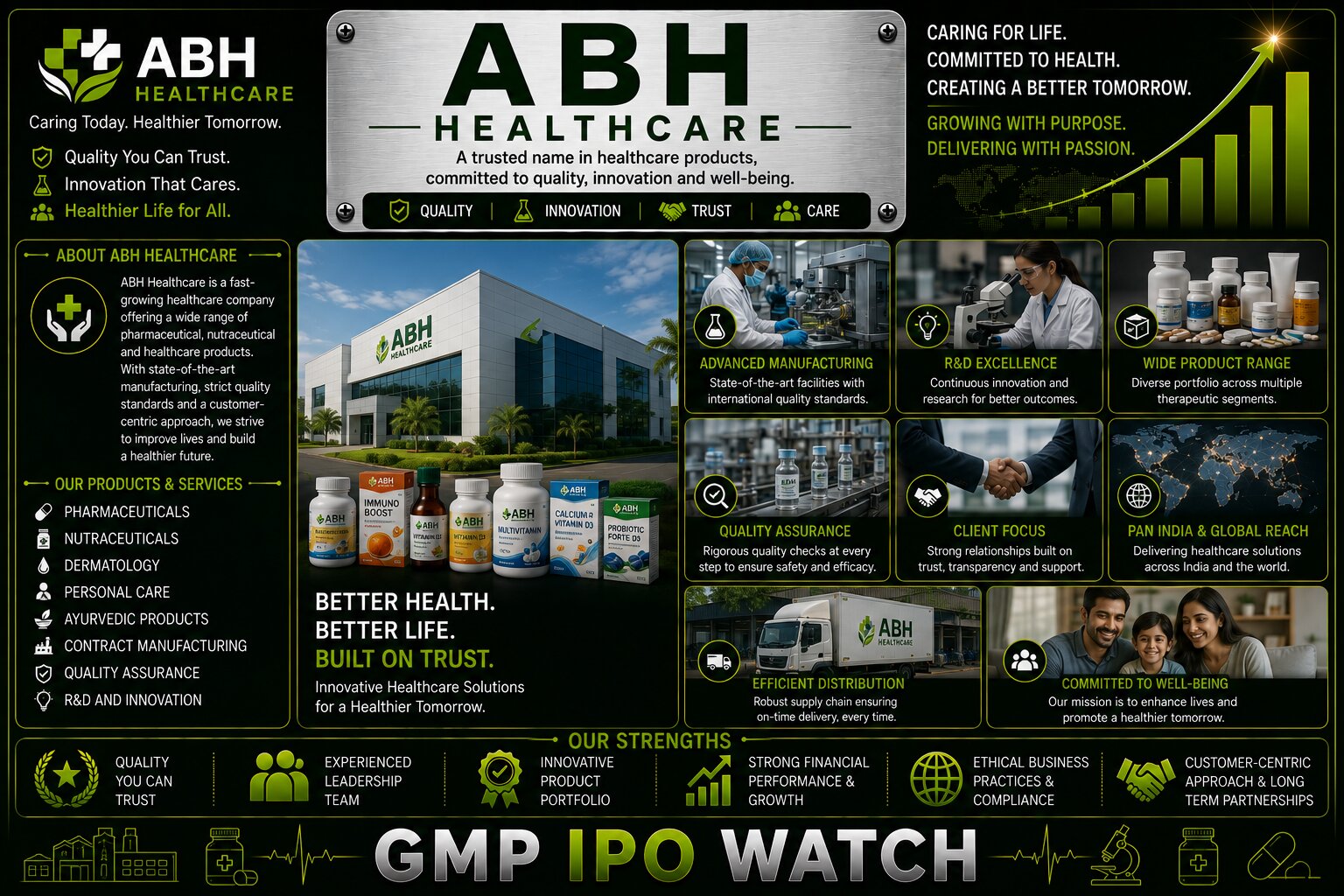
ABH Healthcare IPO 2026 – Can a Regional Hospital Build a Scalable Healthcare Business?
Healthcare businesses operate differently from most conventional companies.
A hospital does not simply sell a product.
It needs to combine:
doctors + nurses + medical infrastructure + diagnostic facilities + operating theatres + equipment + emergency care + patient trust.
This makes healthcare both capital intensive and reputation sensitive.
ABH Healthcare Limited is entering the public market with an SME IPO scheduled to open on August 24, 2026 and close on August 26. The company operates its healthcare business through Anil Baghi Hospital in Firozpur, Punjab.
ABH is looking to raise approximately ₹34.98 crore through a completely fresh issue.
A major portion of the proceeds is intended to reduce debt, which could strengthen the balance sheet and reduce finance costs.
The important long-term question is:
Can ABH use a stronger post-IPO balance sheet to expand its healthcare operations while reducing its heavy dependence on a single geographic market?
That is the central investment story.
ABH Healthcare IPO Details
| Particular | Details |
|---|---|
| Company | ABH Healthcare Limited |
| IPO Type | Book Built SME IPO |
| Issue Size | ₹34.98 Crore |
| Fresh Issue | ₹34.98 Crore |
| Offer for Sale | Nil |
| Price Band | ₹96 – ₹102 |
| Face Value | ₹10 Per Share |
| IPO Open Date | August 24, 2026 |
| IPO Close Date | August 26, 2026 |
| Basis of Allotment | August 27, 2026 |
| Refunds | August 28, 2026 |
| Demat Credit | August 28, 2026 |
| Expected Listing | August 31, 2026 |
| Listing Platform | NSE SME |
The issue is entirely fresh capital, meaning there is no OFS component in the current ₹34.98 crore offer.
That distinction is important because the IPO money is intended to strengthen and support the business rather than primarily provide an exit to existing shareholders.
ABH Healthcare IPO Has Not Opened Yet
As of August 19, 2026, public bidding has not started.
The IPO opens on:
August 24, 2026
and closes on:
August 26, 2026.
Therefore, there is currently no valid:
- QIB subscription
- NII subscription
- Retail subscription
- Overall subscription
data.
Subscription trends should only be analysed after bidding begins.
ABH Healthcare IPO GMP Today
As of today's available update, ABH Healthcare IPO GMP has not started.
IPO Watch currently shows no active grey-market premium for the issue.
| Particular | Current Status |
|---|---|
| Upper Price Band | ₹102 |
| Current GMP | Not Available |
| Estimated Listing Price | Not Available |
| IPO Opens | August 24, 2026 |
GMP is unofficial and unregulated, so even once quotations become available they should not be considered guaranteed listing returns.
What Does ABH Healthcare Actually Do?
ABH Healthcare operates Anil Baghi Hospital in Firozpur, Punjab.
The company describes itself in its prospectus as ABH Healthcare Limited, while its registered office is located on Martyr Anil Baghi Road in Firozpur.
The underlying hospital has a longer operating history than the current corporate entity.
This is an important distinction because ABH Healthcare Limited itself was incorporated in March 2021, while the Anil Baghi Hospital brand dates back much further.
Hospital Businesses Depend Heavily on Trust
Healthcare is unusual because patients do not generally select hospitals based solely on price.
They also consider:
- Doctor reputation
- Emergency capability
- Treatment quality
- Medical infrastructure
- Previous experience
- Location
- Hospital reputation
This means a well-established regional hospital can potentially build a strong local competitive position.
Unlike many consumer businesses, reputation in healthcare can take years to develop.
Regional Healthcare Can Be a Strong Opportunity
India's healthcare infrastructure is highly uneven.
Large metropolitan areas generally have numerous major hospitals.
Smaller cities and regional markets may have fewer high-quality healthcare options.
This creates an opportunity for established regional hospitals.
A patient who can receive suitable treatment locally may prefer that instead of travelling several hours to:
- Chandigarh
- Ludhiana
- Delhi
- Other major medical centres
Regional healthcare providers can therefore capture demand by improving the availability and quality of local treatment.
ABH Healthcare FY2026 Financial Performance
The company reported improved revenue and profitability in FY2026.
| Financial Year | Revenue | PAT |
|---|---|---|
| FY2025 | ₹49.32 Cr | ₹5.35 Cr |
| FY2026 | ₹52.59 Cr | ₹5.64 Cr |
The numbers show continued growth, although the pace is relatively moderate.
Revenue increased by approximately:
6.6%
while PAT increased by approximately:
5.4%.
This is very different from an early-stage company doubling revenue each year.
ABH currently looks more like an established regional healthcare operation growing gradually.
FY2026 PAT Reached ₹5.64 Crore
ABH reported approximately ₹5.64 crore profit after tax in FY2026.
Against revenue of roughly ₹52.5 crore, this implies a PAT margin of approximately:
10.7%.
That indicates the hospital is profitable before entering the public market.
For investors, this is important because the IPO is not being used to finance an entirely unproven operating model.
Healthcare Revenue Can Be More Defensive
Hospital demand behaves differently from many discretionary industries.
Consumers can postpone buying:
- Cars
- Electronics
- Luxury goods
But many medical treatments cannot be postponed indefinitely.
This can make healthcare revenue comparatively defensive.
However, not all hospital procedures are essential.
Some elective procedures can still be delayed when consumers face financial pressure.
Hospital Economics Depend on Utilisation
A hospital incurs significant fixed expenses regardless of whether every bed is occupied.
These expenses can include:
- Doctors
- Nurses
- Equipment
- Electricity
- Maintenance
- Administration
- Medical infrastructure
This makes utilisation extremely important.
Suppose a hospital has 100 beds.
At 40% occupancy, the same infrastructure supports only 40 occupied beds.
At 70% occupancy, considerably more revenue can be generated from largely the same physical facility.
Higher utilisation can therefore improve operating leverage.
ABH's Hospital Infrastructure Is a Core Asset
A Punjab Pollution Control Board consent document identifies ABH Healthcare's facility as a 100-bed hospital in Firozpur.
This provides the company with an established physical healthcare platform.
But beds alone do not generate revenue.
The important operational metrics are:
occupancy + revenue per occupied bed + treatment mix + doctor utilisation.
These are useful numbers for investors to monitor after listing.
Specialised Treatments Can Improve Hospital Economics
Hospitals generally earn different amounts from different procedures.
Basic consultations may generate relatively low revenue.
Complex procedures involving:
- Surgery
- Intensive care
- Advanced diagnostics
- Specialist treatment
can generate substantially higher revenue per patient.
Therefore, ABH's future profitability will depend not only on patient numbers but also on the mix of medical services delivered.
Doctors Are One of the Company's Most Important Assets
Hospital buildings can be replicated.
Medical equipment can be purchased.
But experienced doctors with strong reputations are much harder to replicate.
A specialist physician or surgeon can attract patients to a hospital.
This makes doctor retention extremely important.
If key specialists leave, patients may follow them elsewhere.
For ABH, maintaining strong relationships with medical professionals is therefore critical to long-term growth.
₹17 Crore Debt Repayment Is a Major IPO Objective
One of the most important uses of IPO proceeds is approximately:
₹17 crore for debt repayment.
Relative to the ₹34.98 crore issue, this is significant.
It represents nearly half of the total IPO size.
The IPO therefore has a meaningful balance-sheet restructuring component.
Why Debt Reduction Matters for a Hospital
Hospitals require substantial capital investment.
Money is needed for:
- Buildings
- Medical equipment
- Diagnostic systems
- ICU facilities
- Operating theatres
If these investments are funded through debt, the hospital must pay interest regardless of patient volumes.
Reducing borrowings can lower:
interest expense → financial risk → cash-flow pressure.
That can allow a greater portion of operating profit to reach shareholders.
Debt Repayment Could Improve Future PAT
Consider a simplified example.
Suppose ABH earns ₹8 crore before finance costs and tax.
If annual interest costs are ₹2 crore, only ₹6 crore remains before tax.
If debt repayment reduces interest expense to ₹1 crore:
₹1 crore of additional earnings becomes available before tax
without requiring a single additional patient.
This illustrates why deleveraging can be an important post-IPO earnings driver.
IPO Proceeds Will Also Support Working Capital
Current IPO information also indicates that proceeds will be used for working-capital requirements.
Hospitals need ongoing liquidity to pay for:
- Medicines
- Consumables
- Employees
- Vendors
- Maintenance
before all patient or insurance receivables are collected.
Therefore, working capital remains important even for a service-oriented healthcare business.
Insurance Payments Can Create Receivables
Hospitals do not always receive payment immediately.
Patients may be covered through:
- Insurance companies
- Corporate health plans
- Government schemes
The hospital provides treatment first and may collect payment later.
This creates receivables.
As the hospital grows, investors should monitor whether receivable days increase.
Revenue growth that does not translate into cash collection can create financial pressure.
100% Fresh Issue Is a Positive Structural Feature
The approximately ₹34.98 crore IPO is entirely a fresh issue.
There is no reported OFS.
This means the capital raised is intended for the company itself rather than being primarily paid to existing shareholders.
For a relatively small hospital operator, fresh equity can have a meaningful effect on the balance sheet.
But IPO Size Is Large Relative to Existing Profit
Compare:
FY2026 PAT: ₹5.64 crore
with:
IPO size: ₹34.98 crore.
The new capital equals more than six times FY2026 PAT.
That makes capital allocation extremely important.
Management needs to ensure that the additional equity produces enough future earnings to justify the dilution.
Geographic Concentration Is the Biggest Risk
Current IPO coverage identifies 100% geographic concentration as a major risk.
This is particularly important.
ABH currently depends heavily on one regional healthcare market.
That means local events can disproportionately affect the business.
Potential risks include:
- New competing hospitals
- Doctor departures
- Regional economic weakness
- Regulatory changes
- Local disruptions
A multi-hospital chain can diversify these risks.
ABH currently has much less geographic diversification.
Single-Facility Dependence Increases Operational Risk
Suppose a healthcare company owns 20 hospitals.
A temporary disruption at one facility affects only a small part of group revenue.
If a company relies heavily on one hospital, the same disruption can have a much larger financial impact.
This makes operational continuity particularly important for ABH.
Property-Related Disputes Are Another Risk
Recent IPO reporting also identifies property ownership disputes among the key risks disclosed for ABH Healthcare.
For a hospital, property-related legal issues can be particularly important because operations depend on the physical facility.
Investors should therefore review the relevant prospectus disclosures carefully rather than treating land and property matters as a minor administrative issue.
Healthcare Regulation Is Extensive
Hospitals must comply with numerous rules relating to areas such as:
- Medical operations
- Biomedical waste
- Fire safety
- Pharmacy
- Pollution control
- Clinical establishments
- Patient safety
Failure to maintain necessary approvals can disrupt operations.
The Punjab Pollution Control Board documentation, for example, identifies the Firozpur facility as a hospital with consent validity extending to March 31, 2027.
Regulatory compliance is therefore an ongoing operating requirement.
Medical Equipment Requires Continuous Investment
Hospital technology does not remain competitive forever.
Over time, ABH may need to upgrade:
- Diagnostic machines
- Surgical equipment
- ICU systems
- Imaging technology
- Laboratory equipment
Therefore, accounting profit should not be confused with permanently available free cash flow.
Some cash must continuously be reinvested to maintain healthcare quality.
Patient Experience Can Become a Competitive Advantage
Healthcare reputation is influenced by more than clinical outcomes.
Patients also care about:
- Waiting time
- Staff behaviour
- Cleanliness
- Billing transparency
- Room quality
- Communication
A regional hospital that consistently provides a strong patient experience can generate:
repeat patients + referrals + stronger local reputation.
This creates an intangible competitive advantage.
Local Brand Recognition Can Matter More Than National Advertising
ABH operates under the Anil Baghi Hospital identity.
In a regional healthcare market, word-of-mouth reputation can be particularly powerful.
Patients frequently choose hospitals based on recommendations from:
- Family
- Doctors
- Previous patients
- Local communities
This means long-term local trust can be difficult for a newly established competitor to reproduce quickly.
Future Expansion Could Transform the Investment Case
Today, geographic concentration is a weakness.
But it also creates an obvious potential growth route.
If ABH eventually expands into:
- Nearby cities
- Satellite clinics
- Diagnostic centres
- Additional hospitals
it could diversify revenue.
However, healthcare expansion is capital intensive.
Management should therefore avoid expanding simply for the sake of becoming larger.
New facilities need to generate adequate returns.
Competitive Strengths
ABH Healthcare enters the IPO with several potential strengths.
Established hospital operations: The business operates through Anil Baghi Hospital in Firozpur.
Profitable business: FY2026 PAT was approximately ₹5.64 crore.
Growing revenue: Revenue increased to approximately ₹52.59 crore in FY2026.
Healthcare demand: Hospital services benefit from comparatively defensive underlying demand.
100-bed facility: Regulatory documentation identifies a 100-bed hospital operation.
100% fresh IPO: No OFS component is reported.
Debt reduction: Approximately ₹17 crore is intended for repayment of borrowings.
Major Risks
Geographic Concentration
The company's healthcare operations are heavily concentrated in one geography.
Single-Hospital Dependence
A major operational disruption can have an outsized effect on revenue.
Property Disputes
Current IPO reporting highlights property ownership disputes among the disclosed risks.
Doctor Dependence
Loss of important specialists can affect patient volumes.
Healthcare Regulation
Hospital operations require continuing regulatory compliance.
Capital Intensity
Medical infrastructure and equipment require recurring investment.
Receivables
Insurance and institutional payments can increase the cash-conversion cycle.
SME Liquidity
ABH will list on NSE SME, where liquidity can be lower and volatility higher than in many mainboard stocks.
What Could Drive ABH Healthcare's Next Growth Phase?
Higher Bed Occupancy
Better utilisation can increase revenue from existing infrastructure.
More Specialised Procedures
Higher-value medical treatments can increase revenue per patient.
Debt Reduction
The planned ₹17 crore repayment can lower future finance costs.
Doctor Recruitment
Adding recognised specialists can attract additional patients.
Better Diagnostics
Expanded diagnostic capabilities can increase revenue per patient.
Geographic Expansion
New facilities could reduce dependence on Firozpur over time.
Working-Capital Support
IPO capital can strengthen day-to-day financial flexibility.
What Investors Should Track After Listing
| Metric | Why It Matters |
|---|---|
| Revenue Growth | Patient/business expansion |
| Bed Occupancy | Hospital utilisation |
| Revenue Per Bed | Asset productivity |
| EBITDA Margin | Operating efficiency |
| PAT Margin | Profitability |
| Finance Cost | Benefit from debt repayment |
| Net Debt | Balance-sheet strength |
| Receivable Days | Cash collection |
| Operating Cash Flow | Earnings quality |
| New Facilities | Geographic diversification |
For ABH, occupancy, cash flow and post-IPO debt reduction may be more meaningful than simply tracking revenue.
The Most Important Post-IPO Equation
The attractive scenario looks like:
IPO capital → ₹17 crore debt repayment → lower interest expense → stronger cash flow → higher hospital utilisation → growing PAT → disciplined regional expansion.
The weaker scenario looks like:
IPO capital → debt reduction → expensive expansion → new borrowing → weak utilisation at new facilities.
Both scenarios can create a larger company.
Only the first creates sustainable shareholder value.
Should Investors Consider ABH Healthcare IPO?
The positive case includes:
- Profitable hospital operations
- ₹52 crore-plus FY2026 revenue
- ₹5.64 crore FY2026 PAT
- Healthcare-sector exposure
- Established regional hospital
- 100% fresh issue
- ₹17 crore planned debt repayment
- Potential improvement in finance costs.
The caution case includes:
- Moderate recent revenue growth
- Geographic concentration
- Dependence on a single regional healthcare platform
- Property-related disputes disclosed as a risk
- Dependence on doctors
- Capital-intensive healthcare infrastructure
- NSE SME liquidity risk.
ABH should therefore be analysed as an established but geographically concentrated regional hospital operator, rather than simply as another fast-growing healthcare IPO.
Final View on ABH Healthcare IPO 2026
The ABH Healthcare IPO opens on August 24, 2026 and closes on August 26. The approximately ₹34.98 crore NSE SME issue has a price band of ₹96–₹102 per share and consists entirely of fresh shares. Allotment is expected on August 27, with listing scheduled for August 31.
Financially, ABH reported approximately ₹52.59 crore revenue and ₹5.64 crore PAT in FY2026, compared with ₹49.32 crore revenue and ₹5.35 crore PAT in FY2025.
The IPO's most important financial feature is its planned debt reduction. Current issue reporting indicates approximately ₹17 crore of proceeds will be used to repay borrowings, alongside funding working-capital requirements.
This can strengthen the balance sheet and potentially improve future profitability through lower finance costs.
However, the investment case comes with meaningful concentration risk. ABH remains heavily dependent on its Firozpur operations, while current IPO coverage also identifies geographic concentration and property-related disputes among the important risks investors should consider.
There is currently no active GMP or public subscription figure, because the IPO has not yet opened.
The long-term opportunity is therefore straightforward:
established regional healthcare brand + profitable hospital + debt reduction + better utilisation + disciplined expansion = potential earnings growth.
For investors, the most important post-listing questions will be whether ABH can increase hospital utilisation, reduce finance costs, generate strong operating cash flow and eventually diversify beyond its concentrated Firozpur market without taking excessive new debt.


Loading comments...