

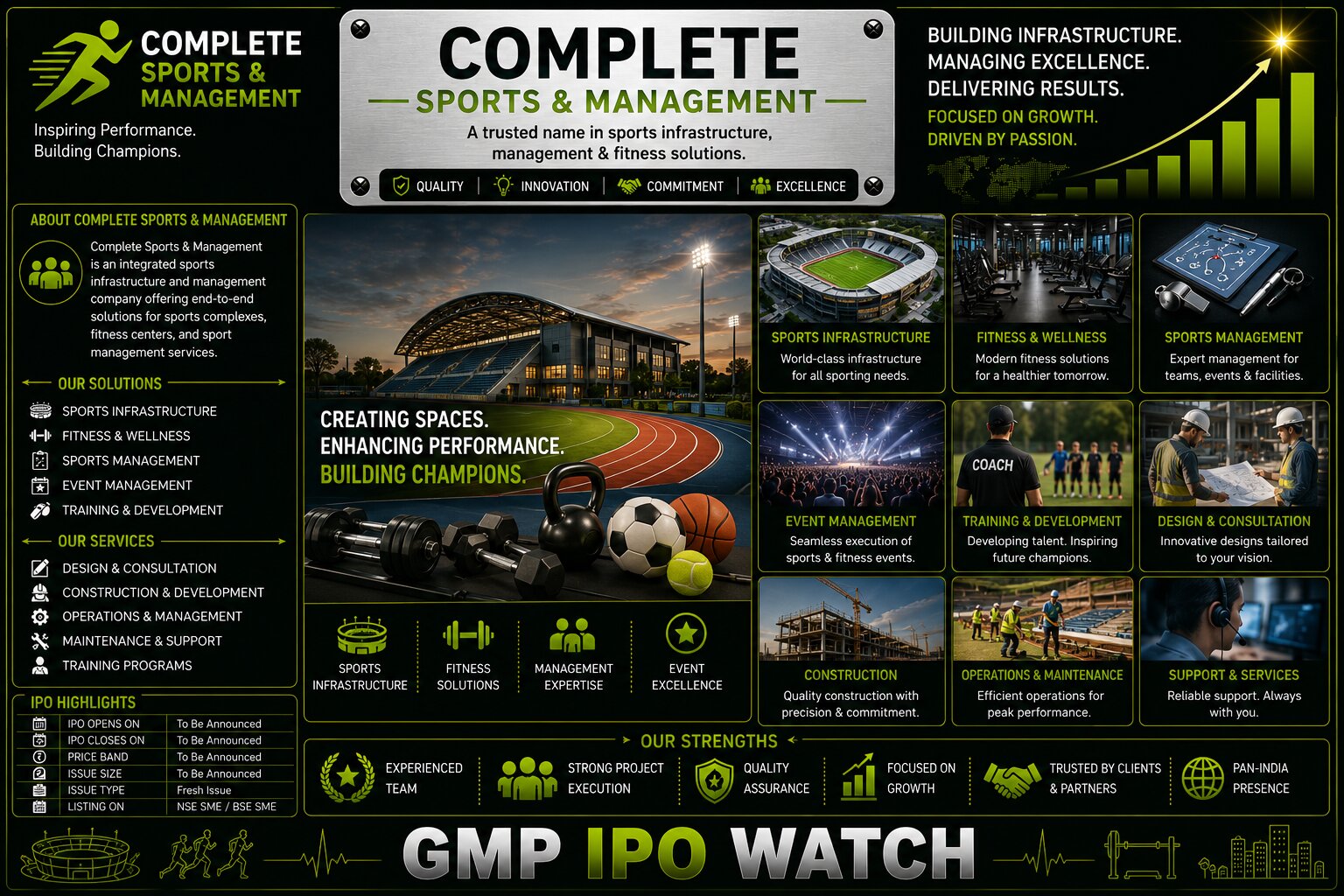
Complete Sports and Management India IPO 2026 – Can Sports and Family Entertainment Drive the Next Growth Phase?
Complete Sports and Management India Limited is preparing for its BSE SME IPO, opening on August 28, 2026 and closing on September 1.
The Mumbai-based company operates in the broader sports, gaming and entertainment space. Its business is unusual compared with conventional manufacturing SME IPOs because a meaningful part of its activity is linked to sports products and family entertainment centres.
The key investment question is whether Complete Sports and Management can use fresh IPO capital to scale this niche business while maintaining the strong return ratios reported before listing.
Complete Sports and Management India IPO Details
| Particular | Details |
|---|---|
| Company | Complete Sports and Management India Ltd. |
| IPO Type | SME IPO |
| Issue Type | Book Built Issue |
| Listing | BSE SME |
| Issue Size | ₹74.92 Crore |
| Fresh Issue | ₹74.92 Crore |
| Offer for Sale | Nil |
| Total Shares | 55.50 Lakh |
| Price Band | ₹128 – ₹135 |
| Face Value | ₹10 |
| Lot Size | 1,000 Shares |
| Minimum Individual Application | 2,000 Shares |
| Minimum Investment | ₹2.70 Lakh at ₹135 |
| IPO Open Date | August 28, 2026 |
| IPO Close Date | September 1, 2026 |
| Allotment Date | September 2, 2026 |
| Refund / Demat | September 3, 2026 |
| Listing Date | September 4, 2026 |
| Lead Manager | Smart Horizon Capital Advisors |
| Registrar | Bigshare Services |
The IPO consists of 55.50 lakh fresh equity shares, aggregating to approximately ₹74.92 crore at the upper price band. There is no OFS component.
Complete Sports and Management IPO GMP Today
As of the latest available tracker, the IPO GMP is currently shown at approximately:
₹0 per share.
| GMP Particular | Current Status |
|---|---|
| Upper Price Band | ₹135 |
| Latest GMP | ₹0 |
| Indicative Price | ₹135 |
| Indicative Premium | 0% |
| IPO Status | Upcoming |
This should not be interpreted as a negative signal by itself.
The IPO is still a few days away from opening, and SME GMP can remain inactive until closer to the bidding period.
GMP is unofficial and can change quickly.
What Does Complete Sports and Management India Do?
Complete Sports and Management India was incorporated in December 2002 and operates in sporting activities.
Its business includes exposure to areas such as:
sports products + entertainment centres + gaming-related activities + family entertainment.
Current IPO risk disclosures specifically state that the business is substantially dependent on demand from family entertainment centres.
This gives the company exposure to discretionary consumer spending rather than purely industrial or infrastructure demand.
Family Entertainment Centres Are an Important Part of the Story
Family entertainment centres can include venues where customers spend money on:
- Bowling
- Arcade gaming
- Indoor sports
- Recreational experiences
- Group entertainment
Demand for such venues can benefit from:
higher urban incomes + mall culture + organised leisure spending + younger demographics.
But the same business can be sensitive to consumer sentiment.
If households reduce discretionary spending, entertainment-centre activity can weaken.
Brunswick Relationship Is a Key Business Dependency
Current IPO disclosures identify the company's relationship with Brunswick as an important risk factor.
The risk disclosure states that any loss of exclusivity, deterioration in the relationship or disruption in the supply of Brunswick products could materially affect the business.
That means this relationship is strategically important to Complete Sports and Management.
For investors, this creates both a strength and a concentration risk.
A recognised global relationship can support product quality and market positioning.
But dependence on one major supplier or partner can create vulnerability.
The IPO Is 100% Fresh Issue
One of the strongest structural features of the IPO is that there is no Offer for Sale.
All 55.50 lakh shares are fresh issue shares.
This means:
IPO investors → fresh capital → company
rather than existing shareholders selling a large portion of their holdings.
For investors, this usually makes the use of proceeds particularly important because the money can directly support the business.
Return Ratios Are Strong
Current IPO valuation data reports the following pre-issue metrics:
| Metric | Value |
|---|---|
| ROE | 53.55% |
| ROCE | 47.97% |
| RoNW | 42.27% |
| Debt / Equity | 0.21× |
| PAT Margin | 15.81% |
| EBITDA Margin | 13.39% |
| NAV | ₹28.29 |
| Price / Book | 4.77× |
The return ratios are notably strong.
An ROE above 50% and ROCE close to 48% indicate that the company has historically generated significant earnings relative to its capital base.
However, fresh IPO equity will increase the company's net worth materially.
Therefore, post-IPO return ratios may initially decline unless the new capital generates proportionate earnings growth.
Debt Is Relatively Low
The current debt-to-equity ratio is reported at around:
0.21×.
This is relatively low.
That means Complete Sports and Management does not appear to be approaching the IPO primarily to repair an excessively leveraged balance sheet.
Instead, the fresh issue is more likely to support business expansion and corporate requirements.
This can be an important positive when compared with IPOs where most fresh capital is used only to repay heavy borrowings.
PAT Margin Is Around 15.8%
Current IPO valuation data reports a PAT margin of approximately:
15.81%.
For a sports and entertainment-related SME, that is a healthy margin.
The key question is whether this profitability can remain stable as the business becomes larger.
Expansion often brings additional costs involving:
staff + marketing + inventory + facilities + logistics + technology.
Maintaining margins after deployment of IPO proceeds will therefore be important.
EBITDA Margin Is Around 13.4%
The current reported EBITDA margin is approximately:
13.39%.
Investors should eventually compare this with post-listing operating performance.
A stronger long-term outcome would involve:
revenue growth + stable/improving EBITDA margin + healthy operating cash flow.
If revenue grows but margins decline sharply, the quality of growth would be weaker.
Valuation at the Upper Band
The upper price band is:
₹135 per share.
With reported NAV of ₹28.29, the IPO is priced at approximately:
4.77× price-to-book value.
There are currently no directly comparable listed Indian companies engaged in a sufficiently similar business, according to IPO analysis.
This makes peer valuation more difficult.
Investors therefore need to evaluate the company using:
growth + margins + ROE + ROCE + cash flow + business concentration
rather than relying heavily on a conventional peer P/E comparison.
Sports and Recreation Can Benefit From Urban Consumer Growth
India's organised leisure and recreation market can benefit as urban consumers spend more on experiences.
The shift can be described as:
goods-focused spending → experiences + entertainment + recreation.
Family entertainment centres, gaming venues and organised sports experiences can benefit from this trend.
Complete Sports and Management is therefore exposed to a consumer category that could expand as disposable incomes rise.
But Leisure Spending Is Discretionary
The opposite side is equally important.
Entertainment spending is not essential in the same way as:
- Food
- Healthcare
- Utilities
During periods of weaker consumer confidence, families may reduce spending on recreational activities.
This can make demand more cyclical.
For Complete Sports and Management, revenue growth therefore depends partly on the health of discretionary consumer spending.
Supplier Concentration Is a Key Risk
The identified relationship with Brunswick should be monitored closely.
If a major supplier relationship weakens, the company could face:
- Product availability issues
- Higher sourcing costs
- Customer dissatisfaction
- Delays in project execution
This is particularly relevant if certain entertainment or sports products are difficult to replace quickly with comparable alternatives.
Family Entertainment Demand Is Another Key Risk
The company's IPO disclosures specifically note dependence on demand from family entertainment centres.
This means the company is indirectly exposed to the expansion plans of entertainment-centre operators.
If new venues open rapidly, demand for products and services can grow.
If operators postpone expansion, Complete Sports and Management may see slower business activity.
Geographic and Customer Diversification Will Matter
For a relatively small SME, diversification becomes increasingly important as the company scales.
A stronger business would gradually reduce dependence on:
one supplier + one customer group + one entertainment format.
Potential diversification areas could include:
- New sports products
- Different gaming categories
- Broader recreation formats
- More geographic markets
This can reduce volatility.
SME Listing Risk Should Be Considered
Complete Sports and Management will list on BSE SME rather than the mainboard.
SME shares can experience:
lower liquidity + wider bid-ask spreads + larger price movements.
The minimum individual application is also substantial:
2,000 shares × ₹135 = ₹2.70 lakh.
That makes position sizing especially important for retail investors.
Key Strengths
Complete Sports and Management India enters the IPO with several positives.
Long operating history: The company was incorporated in 2002 and has more than two decades of experience.
100% fresh issue: The entire ₹74.92 crore issue goes into the company rather than through OFS.
Strong return ratios: ROE is reported at 53.55%, ROCE at 47.97% and RoNW at 42.27%.
Low leverage: Debt-to-equity is approximately 0.21×.
Healthy profitability: PAT margin is reported around 15.81%.
Exposure to organised recreation: Family entertainment and sports spending can benefit from urban consumer growth.
Major Risks
The most important risks include:
Brunswick dependence: Any disruption in the relationship or supply of Brunswick products could materially affect the business.
Family entertainment dependence: Demand from family entertainment centres is a major business driver.
Discretionary spending: Consumers can reduce entertainment spending during weaker economic periods.
SME liquidity: BSE SME shares may have lower trading liquidity.
Limited direct peer comparison: There are no close listed Indian peers, making valuation assessment harder.
Post-IPO return dilution: Fresh equity may temporarily reduce ROE unless earnings expand.
What Investors Should Track After Listing
| Metric | Why It Matters |
|---|---|
| Revenue Growth | Business expansion |
| PAT Growth | Earnings scalability |
| EBITDA Margin | Operating profitability |
| PAT Margin | Profit sustainability |
| ROE | Shareholder returns |
| ROCE | Capital efficiency |
| Debt / Equity | Financial strength |
| Family Entertainment Revenue | Core demand |
| Supplier Concentration | Brunswick dependency |
| Customer Diversification | Business risk |
| Operating Cash Flow | Earnings quality |
| New Business Verticals | Future growth |
The most important post-IPO question will be whether the company can maintain its high ROE and ROCE after receiving a much larger equity base.
Final View on Complete Sports and Management India IPO 2026
The Complete Sports and Management India IPO is scheduled to open on August 28 and close on September 1, 2026. The BSE SME issue has a price band of ₹128–₹135 per share and consists entirely of a fresh issue of 55.50 lakh shares worth approximately ₹74.92 crore. Listing is scheduled for September 4.
At the upper band, individual investors need to apply for at least 2,000 shares, requiring approximately ₹2.70 lakh.
Current grey-market tracking shows ₹0 GMP, although the issue has not yet opened and grey-market activity can change significantly closer to the bidding period.
Fundamentally, the company enters the IPO with attractive reported metrics, including 53.55% ROE, 47.97% ROCE, 42.27% RoNW, 0.21× debt-to-equity and a 15.81% PAT margin.
The business opportunity lies in India's growing organised sports and family-entertainment market.
The major risks are equally clear: dependence on family entertainment demand and the company's important relationship with Brunswick.


Loading comments...