

Credent Connect N Care IPO 2026 – Can Healthcare Outsourcing Become the Company's Next Big Growth Engine?
Healthcare companies do not generate value only inside hospitals and diagnostic laboratories.
A large operational network works behind them.
Blood samples must be collected.
Phlebotomists need to reach patients.
Samples must reach laboratories within required timelines.
Reagents and medical products need transportation.
Healthcare employees must be deployed across multiple locations.
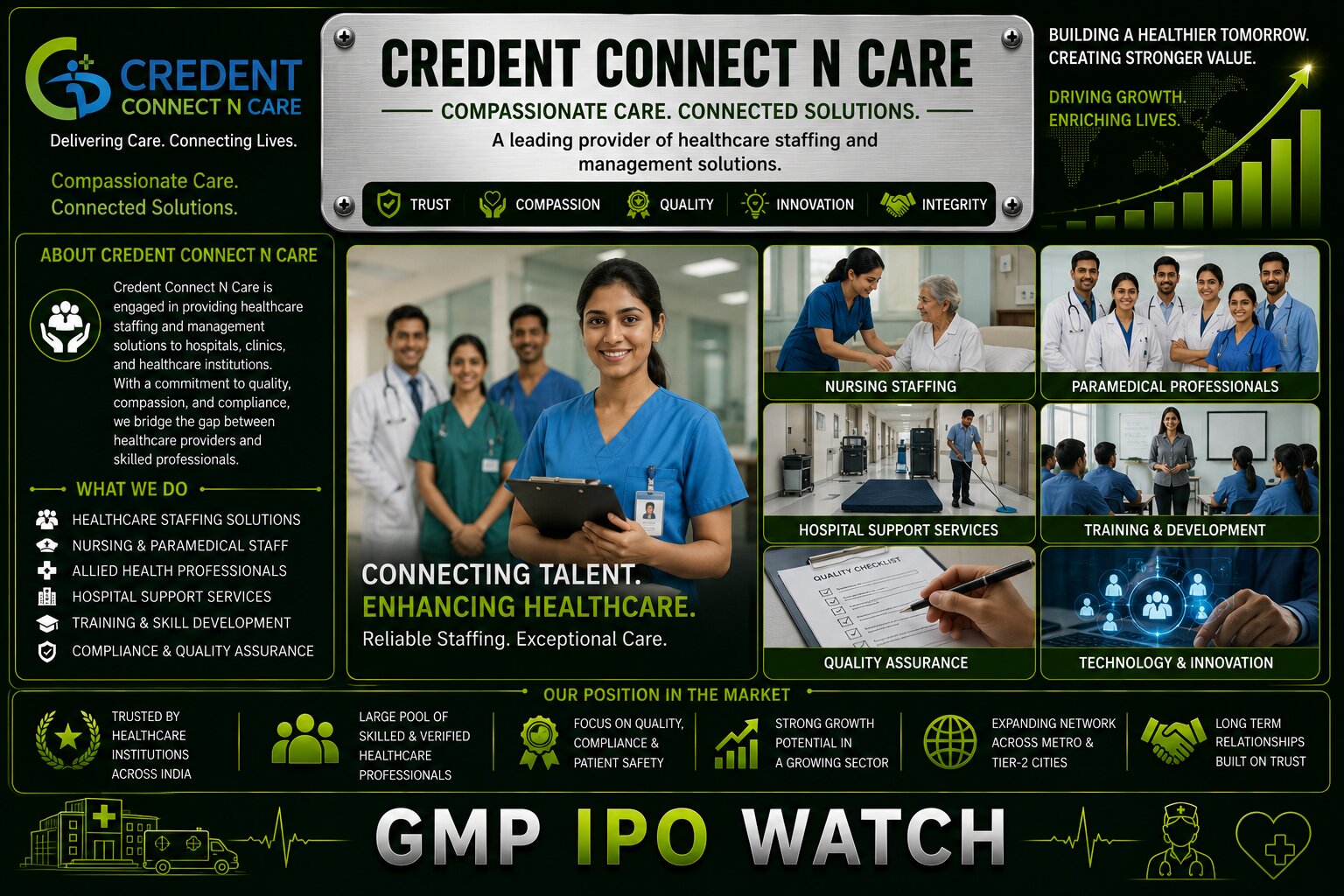
Credent Connect N Care Limited operates inside this less-visible healthcare infrastructure layer.
The company provides healthcare institutions with logistics, workforce solutions and technology-enabled support. Its services include home sample collection, phlebotomist deployment, laboratory technicians, paramedical staffing and inter-state and intra-state movement of diagnostic samples, medical products and reagents.
That makes Credent's growth story different from a conventional logistics company.
It is attempting to build a scalable healthcare-support network.
And today's IPO gives it substantially more capital to pursue that opportunity.
Why Credent's Business Model Is Interesting
Imagine a diagnostic company entering ten new cities.
It has two choices.
It can build every operational function itself:
recruit staff → train phlebotomists → create collection routes → manage sample transport → supervise field workers.
Or it can outsource portions of this infrastructure to a specialised company.
Credent is positioned to provide that second option.
The model becomes attractive when healthcare organisations want to expand faster without creating large internal operational teams.
Credent Does More Than Transport Medical Samples
It would be inaccurate to look at Credent purely as a courier or transportation company.
Its services span multiple parts of healthcare operations, including:
- Diagnostic sample logistics
- Home sample collection
- Phlebotomist deployment
- Laboratory technicians
- Paramedical workforce
- Medical-product logistics
- Reagent transportation
- Technology-enabled healthcare support.
The combination matters.
A customer purchasing several services from the same provider can become much more valuable than a customer using Credent only for transportation.
Cross-Selling Could Become an Important Growth Driver
Suppose a diagnostic chain initially hires Credent only to move samples.
After a successful relationship, it may also use Credent for:
phlebotomists + home collection + workforce + other logistics.
Credent then increases revenue from the existing customer without incurring the full cost of acquiring another client.
This can increase customer lifetime value.
For investors, one useful future indicator would therefore be:
average services used per major customer.
If this rises, the company's relationship with healthcare clients is becoming deeper.
Home Diagnostics Can Expand the Addressable Market
Healthcare is increasingly moving beyond hospitals and laboratories.
Home sample collection has become a useful convenience for:
- Elderly patients
- Preventive health packages
- Routine blood tests
- Chronic-disease monitoring
- Customers preferring home services
Every home collection requires field execution.
A trained person must reach the customer, collect the sample correctly and ensure that it reaches the laboratory under appropriate conditions.
This creates demand for precisely the type of workforce and logistics network Credent provides.
Why Phlebotomist Density Matters
Consider two operating areas.
Area A
A phlebotomist travels long distances between three appointments.
Area B
The same employee completes ten appointments within a smaller geographic area.
Area B can generate substantially better economics.
The employee produces more revenue during the same working period while travel cost per collection declines.
This is called network density.
As Credent gains more healthcare clients within existing cities, its economics could potentially improve without costs increasing at exactly the same pace as revenue.
Route Density Can Create Similar Operating Leverage
The same principle applies to diagnostic logistics.
A vehicle carrying one sample has poor economics.
A route collecting samples from several locations before reaching the laboratory spreads transportation costs across more revenue.
Therefore, Credent does not necessarily need to enter hundreds of new cities to improve profitability.
It can also grow by becoming denser within existing operating regions.
That can be a more efficient form of expansion.
Technology Can Improve Field Productivity
Technology becomes valuable when hundreds or thousands of activities need coordination.
Credent's technology-enabled approach can potentially support:
- Route allocation
- Workforce deployment
- Collection scheduling
- Sample tracking
- Customer reporting
- Operational monitoring.
Better technology can reduce manual coordination.
More importantly, it can help the company process greater healthcare volume without expanding administrative overhead at the same rate.
The IPO Is Primarily Growth Capital
Credent's ₹93.90 crore IPO includes approximately ₹89.13 crore of fresh issue, according to the current issue tracker.
This is important.
A large portion of the money raised is therefore intended to enter the business rather than simply providing an exit to existing investors.
Fresh capital can support the company's next expansion phase.
Working Capital Is the Largest Identified Requirement
Prospectus-related disclosures indicate approximately ₹26.30 crore is proposed for working-capital requirements.
That may sound less exciting than building a new factory.
But for Credent's business model, working capital is essential.
Employees and vendors often need to be paid before customers settle invoices.
As contracts become larger, that gap can require substantially more cash.
Why ₹26.30 Crore of Working Capital Can Support Growth
Imagine Credent wins a national healthcare contract.
It may immediately need to:
- Recruit people
- Pay salaries
- Arrange transport
- Pay vendors
- Deploy teams
But the customer may settle invoices later.
Credent therefore needs enough capital to fund the operating cycle.
In this business:
working capital is effectively capacity.
Without sufficient liquidity, the company may not be able to accept large contracts even when demand exists.
₹17.88 Crore Is Earmarked for Healthcare Operations
Prospectus-linked information identifies approximately ₹17.88 crore toward expanding its healthcare-services operations involving integrated logistics, workforce solutions and technology-enabled support.
This is strategically important.
It indicates that Credent is using IPO proceeds to strengthen the core platform rather than merely repair its balance sheet.
If deployed effectively, the investment can potentially increase:
customer capacity + geographic coverage + workforce capability + technology infrastructure.
Credent Healthcare Will Also Receive Capital
Approximately ₹2.05 crore is proposed for investment in wholly owned subsidiary Credent Healthcare Private Limited for machinery-related capital expenditure.
The amount is relatively small compared with the overall IPO.
But strategically, the subsidiary can help broaden the group's exposure to healthcare services beyond the original logistics business.
The key question will be whether these additional capabilities increase revenue from existing customers.
₹4.11 Crore Is Planned for Debt Repayment
Credent also proposes using around ₹4.11 crore toward repayment or prepayment of borrowings.
Reducing debt can lower finance expenses and improve financial flexibility.
For a rapidly expanding SME, that matters.
The company can use more internally generated cash for growth instead of servicing debt.
The Earlier Financial Base Was Much Smaller
Restated financial information shows how quickly Credent has changed.
| Financial Year | Revenue | PAT |
|---|---|---|
| FY2023 | ₹59.75 Cr | ₹2.69 Cr |
| FY2024 | ₹75.73 Cr | ₹2.66 Cr |
| FY2025 | ₹77.94 Cr | ₹2.24 Cr |
The September 2025 half-year period then reported approximately ₹90.02 crore revenue and ₹7.60 crore PAT.
That half-year revenue alone exceeded the company's entire FY2025 revenue.
This was the first clear signal that Credent had entered a much faster growth phase.
Profitability Also Changed Dramatically
During FY2023–FY2025, Credent's PAT remained around ₹2–₹3 crore.
Then the six months ended September 2025 produced approximately:
₹7.60 crore PAT.
The improvement suggests that greater scale can potentially produce meaningful operating leverage.
However, investors need more than one strong period before assuming those economics are permanent.
Scale Can Improve Margins
Credent has several costs that may not need to grow at exactly the same rate as revenue.
These can include:
- Corporate management
- Technology systems
- Administrative teams
- Compliance
- Central operations
If revenue doubles while central overhead rises only 30%, margins can improve.
That is one possible explanation for why a healthcare-outsourcing platform can become more profitable as it becomes larger.
But Workforce Costs Remain Variable
Credent is not a pure software company.
People remain essential.
More home collections and healthcare contracts can require more:
- Phlebotomists
- Technicians
- Paramedical staff
- Field workers
Therefore, revenue cannot grow indefinitely without additional labour expense.
The key is whether revenue per deployed employee improves.
That could become one of the company's most useful operating metrics.
Employee Productivity Can Be a Powerful Profit Lever
Suppose one field employee generates ₹40,000 monthly revenue.
If better scheduling and route density increase this to ₹50,000 while salary remains broadly similar, profitability improves significantly.
Multiply that improvement across a large workforce and the impact becomes meaningful.
This is where technology and geographic density can work together.
Healthcare Logistics Has Higher Execution Requirements
Transporting ordinary goods and transporting diagnostic samples are not identical activities.
Medical logistics can require tighter control over:
- Handling
- Timing
- Temperature
- Traceability
- Documentation
Failure can have consequences beyond a delayed parcel.
That creates operational risk.
But it can also create a competitive barrier.
Healthcare customers may prefer proven providers rather than repeatedly changing vendors based solely on price.
Service Reliability Can Become a Moat
Suppose Credent consistently achieves high on-time collection and delivery performance.
The customer begins integrating its operations around Credent's network.
Switching providers then becomes more complicated.
This creates operational stickiness.
For a B2B services company, such customer integration can be more valuable than conventional consumer branding.
Large Contracts Can Accelerate Growth Quickly
One attraction of Credent's model is that a single healthcare relationship can produce significant scale.
If a large diagnostic company awards a multi-city contract, Credent can add substantial revenue without acquiring thousands of individual consumers.
This partly explains why B2B healthcare outsourcing businesses can grow rapidly.
But it creates the opposite risk as well.
Large customers matter disproportionately.
Diversification Should Become a Post-IPO Priority
The ideal future is not necessarily losing large customers.
It is adding enough new customers that no single relationship becomes excessively important.
For example:
existing large accounts continue growing + new diagnostic companies are added + additional services are cross-sold.
That can create a healthier revenue mix.
Anchor Investors Put in ₹26.53 Crore
Ahead of the public issue, Credent raised approximately ₹26.53 crore from 10 anchor investors.
The anchor book included institutional participation including Abakkus Asset Manager.
Existing/pre-IPO investor interest has also included well-known market participants.
Anchor participation is encouraging, but it should not replace independent analysis of the business and valuation.
Credent Connect N Care IPO Subscription Today
The IPO is on its final bidding day today, August 17.
The latest InvestorGain recommendation/tracking page shows overall subscription at approximately:
30.11×.
This is substantially higher than the early subscription recorded when the issue opened.
Since bidding remains active today, the final closing figure may still change.
What Strong Subscription Tells Investors
High subscription indicates demand for the shares exceeds the quantity offered.
But it does not automatically mean the stock is undervalued.
Subscription can be influenced by:
- GMP
- Listing expectations
- Market sentiment
- Funding availability
- Business fundamentals
Investors should therefore treat subscription as a demand indicator, not an investment thesis.
Credent Connect N Care IPO GMP Today
The latest InvestorGain update at 10:31 AM on August 17 reports GMP of approximately:
₹55 per share.
Against the upper issue price of ₹189:
₹189 + ₹55 = ₹244
This implies an unofficial premium of approximately:
29.1%.
GMP is an unofficial market indicator and can change rapidly before listing.
GMP Has Cooled From Earlier Levels
Earlier in the IPO period, Credent's GMP was reported at higher levels.
The latest reading is around ₹55.
This is a useful reminder that grey-market sentiment can move quickly even before an IPO lists.
A falling or rising GMP does not change the company's:
- Contracts
- Revenue
- Workforce
- Technology
- Cash generation
Long-term performance will ultimately depend on these business factors.
Why Listing Day Is Only the Beginning
The tentative listing date is August 20, 2026.
Listing-day performance will attract attention.
But the more important period begins after listing.
Credent will need to demonstrate what it does with almost ₹90 crore of fresh capital.
Public investors will be able to evaluate whether the money actually produces additional earnings.
What Could Drive Credent's Next Growth Phase?
Several areas could become important.
More Healthcare Clients
Additional diagnostic chains can reduce customer concentration.
Deeper Existing Relationships
Cross-selling workforce, logistics and home-collection services can increase revenue per customer.
Geographic Density
More collections within existing cities can reduce operating cost per transaction.
Technology
Better scheduling and tracking can improve workforce productivity.
Working Capital
Additional liquidity can enable larger contracts.
Healthcare Subsidiary
New capabilities can broaden the group's service offering.
Debt Reduction
Lower finance costs can improve earnings quality.
Major Strengths
Credent's investment case benefits from several factors.
Healthcare-focused model: It operates in specialised logistics and workforce services rather than generic transportation.
Rapid recent scale-up: Half-year FY2026 revenue already exceeded the entire FY2025 revenue base.
Improving profitability: PAT accelerated sharply during the latest reported period.
Fresh IPO capital: Approximately ₹89.13 crore of the issue is fresh capital.
Working-capital funding: ₹26.30 crore can support larger operating contracts.
Anchor participation: The company raised ₹26.53 crore from 10 anchor investors.
Major Risks
Rapid Growth May Be Difficult to Sustain
The latest growth rate is significantly higher than the company's historical trend.
Workforce Dependence
Healthcare operations require trained people and effective employee management.
Customer Concentration
Large B2B contracts can make individual customers economically important.
Working-Capital Intensity
Credent may need to pay operating costs before collecting from customers.
Execution Risk
Rapid geographic expansion can reduce service quality if operations do not scale properly.
SME Liquidity
NSE Emerge shares can experience lower liquidity and greater volatility than larger mainboard companies.
GMP Volatility
The latest ₹55 GMP can change materially before listing.
What Investors Should Track After Listing
The most important post-IPO indicators will be:
Revenue growth: Does the expansion continue after the IPO?
PAT margin: Can recent profitability be maintained?
Revenue per employee: Is workforce productivity improving?
Revenue per customer: Is cross-selling working?
Customer concentration: Is the revenue base becoming more diversified?
Receivable days: Are customers paying efficiently?
Operating cash flow: Are reported profits turning into cash?
ROCE: Is the new IPO capital producing attractive returns?
These metrics will tell investors far more about the long-term business than listing-day GMP.
The Most Important Post-IPO Equation
Credent now has an opportunity to create a stronger healthcare-services platform.
The attractive path is:
IPO capital → larger healthcare network → denser routes → higher workforce productivity → more services per customer → stronger margins and cash flow.
The weaker path is:
IPO capital → rapid expansion → higher employees and receivables → weak utilisation → lower returns on capital.
The difference will come down to execution.
Should Investors Consider Credent Connect N Care IPO?
Credent has several attractive characteristics.
It operates in a specialised healthcare-services segment, recent growth has been exceptionally strong, fresh IPO capital is being directed toward expansion, working capital and debt reduction, and investor demand has been strong.
However, this remains an SME company undergoing rapid transformation.
Investors need to consider:
- Sustainability of recent growth
- Customer diversification
- Working-capital requirements
- Workforce execution
- Post-IPO return on capital
- SME-market liquidity
The business therefore deserves analysis beyond the current GMP.
Final View on Credent Connect N Care IPO 2026
Credent Connect N Care IPO closes today, August 17, 2026, after opening on August 13. The ₹93.90 crore NSE SME issue is priced between ₹179 and ₹189 per share, with tentative listing scheduled for August 20.
Investor demand has strengthened considerably. The latest available tracker shows overall subscription around 30.11×, while the latest reported GMP at 10:31 AM is approximately ₹55, implying an unofficial price near ₹244 against the ₹189 upper band.
But Credent's more interesting long-term story is not the grey-market premium.
It is the possibility of building a scalable healthcare-outsourcing platform around diagnostic logistics, home sample collection, phlebotomy, paramedical workforce and technology-enabled operations.
The company is also receiving meaningful growth capital. Prospectus-related disclosures earmark approximately ₹26.30 crore for working capital, ₹17.88 crore for healthcare operations, ₹2.05 crore for subsidiary machinery and ₹4.11 crore for repayment of borrowings.
The investment thesis can therefore be summarised as:
healthcare outsourcing demand + larger operating network + technology + working capital + cross-selling = potential scalable growth.
The critical question is whether that scale creates operating leverage.
If Credent can increase collections per route, improve workforce productivity, add customers, cross-sell more services and convert earnings into cash, the IPO capital could materially strengthen the business.
If expansion instead produces disproportionately higher workforce costs, receivables and working-capital requirements, returns could weaken despite strong revenue growth.


Loading comments...