

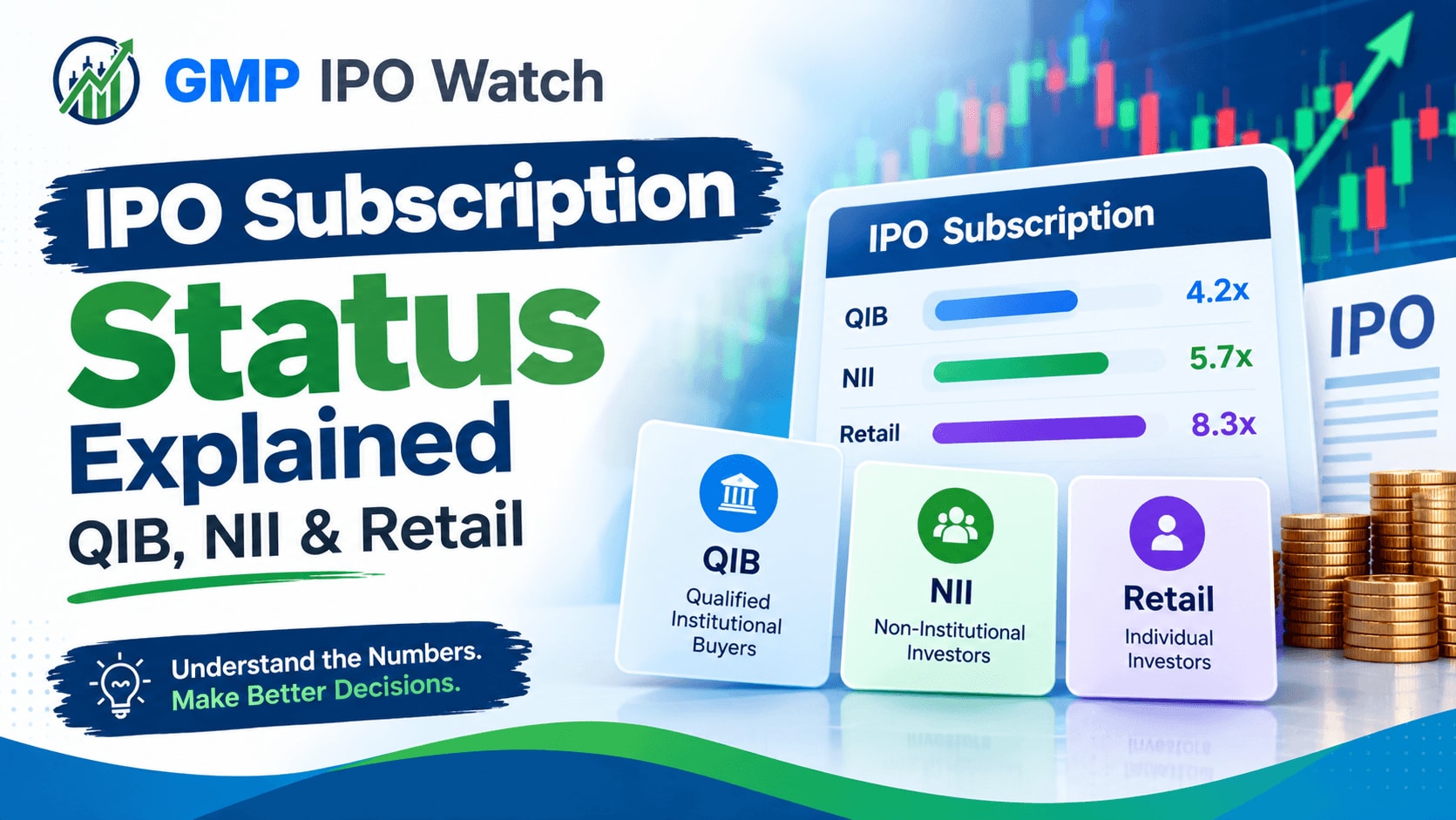
IPO Subscription Status Explained: QIB, NII and Retail
When an IPO opens for applications, one of the first things investors look at is its subscription status. You may see an IPO subscribed 5 times, 20 times, or even more than 100 times. But what do these numbers actually mean?
The subscription figures become more useful when you understand who is applying. In the Indian IPO market, demand is generally reported across different investor categories, including Qualified Institutional Buyers (QIBs), Non-Institutional Investors (NIIs), and Retail Individual Investors.
These categories can show very different levels of demand for the same IPO. An issue might attract strong institutional interest while retail participation remains moderate, or it may see heavy applications across several categories.
In this guide, we'll explain how IPO subscription status works, what each category means, how to read oversubscription figures, and what investors should keep in mind before applying.
What Is IPO Subscription Status?
IPO subscription status shows how much demand an IPO has received compared with the number of shares available for subscription in the relevant investor category.
For example, suppose a company offers 10 lakh shares to a particular category of investors. If applications are received for 30 lakh shares, the category is subscribed 3 times, or 3x.
Here's a simple example:
| Subscription detail | Example |
|---|---|
| Shares available in a category | 10 lakh |
| Shares applied for | 30 lakh |
| Subscription status | 3x |
A subscription of 3x means demand was three times the shares available in that category. It does not mean every applicant will receive three times the shares they requested.
Subscription data is updated during the IPO bidding period and is typically reported separately for different investor categories. The final figures can change until the issue closes.
What Are QIB, NII and Retail Categories in an IPO?
IPO subscription data is easier to understand once you know the investor categories.
1. QIB: Qualified Institutional Buyers
QIB stands for Qualified Institutional Buyers. This category includes eligible institutional investors such as mutual funds, insurance companies, and certain other financial institutions.
Institutional participation is often watched closely because these investors may have professional research teams and access to detailed financial analysis. However, QIB demand alone does not prove that an IPO is attractively priced or likely to deliver listing gains.
Investors should consider the company's business, financial position, valuation, and risks rather than treating institutional subscription as a recommendation.
2. NII: Non-Institutional Investors
NII stands for Non-Institutional Investors. This category generally includes eligible applicants who are not classified as retail individual investors or QIBs.
In IPO coverage, the NII category is also commonly referred to as the HNI category. Under applicable IPO rules, the NII segment may be divided into subcategories based on application size.
For example, an IPO subscription page may show separate figures for smaller and larger NII applications. The precise categories and allocation rules depend on the applicable issue regulations.
High NII subscription can indicate strong demand from this segment, but it doesn't guarantee that every applicant will receive an allotment.
3. Retail Individual Investors
The retail category is intended for eligible individual investors applying within the applicable retail investment limit.
Retail subscription figures show how much demand has come from this category compared with the shares available to it.
For instance, if the retail category is subscribed 8x, the demand is eight times the shares available in that category.
A heavily subscribed retail category can mean greater competition for shares. The actual allotment outcome depends on the applicable rules and the final allocation process.
What Does IPO Oversubscription Mean?
An IPO is oversubscribed when the demand in a category exceeds the shares available in that category.
Consider this example:
| Investor category | Shares available | Shares applied for | Subscription |
|---|---|---|---|
| QIB | 20 lakh | 80 lakh | 4x |
| NII | 10 lakh | 50 lakh | 5x |
| Retail | 10 lakh | 70 lakh | 7x |
In this example, all three categories are oversubscribed, but retail demand is the highest relative to its available allocation.
These figures are illustrative, not data from a live IPO.
It is important to compare like with like. A category subscribed 7x is not necessarily receiving more total applications than a category subscribed 5x, because the number of shares available to each category may differ.
How to Read IPO Subscription Status Today
When checking an IPO's subscription figures, avoid looking at just one number. Review the overall picture.
Here are five useful things to check:
1. Overall subscription
This gives a broad view of demand across the issue. Remember that the overall ratio can hide differences between investor categories.
2. QIB subscription
Check institutional demand, but don't assume that a high figure guarantees a strong listing.
3. NII subscription
Review demand from non-institutional applicants and any subcategories displayed for the issue.
4. Retail subscription
This helps you understand demand from individual investors applying within the retail category.
5. Changes during the bidding period
Subscription figures can move significantly between the opening day and the final day. Early numbers are not the final result.
For official information, check the relevant stock exchange disclosures and the IPO's published documents. You can also follow IPO updates through GMP IPO Watch.
Does High IPO Subscription Mean a Good IPO?
Not necessarily.
A heavily subscribed IPO may attract significant attention, but subscription measures demand for the issue rather than the company's long-term business quality.
Before making an investment decision, consider:
-
Company financials: Revenue, profitability, cash flow, debt, and financial trends.
-
Valuation: Whether the issue price appears reasonable compared with relevant listed companies.
-
Use of proceeds: Whether the money raised will support business growth, debt repayment, or other stated objectives.
-
Offer structure: Whether the issue includes a fresh issue, an offer for sale (OFS), or both.
-
Risk factors: Competitive pressure, customer concentration, legal matters, and other risks disclosed in the offer documents.
-
Market conditions: Broader market sentiment can change between the IPO closing date and listing day.
Read the company's Red Herring Prospectus (RHP) and other official disclosures before deciding whether to apply.
Does IPO Subscription Affect Allotment?
Subscription figures can help investors understand the level of competition, but they do not tell you the exact outcome of an individual application.
In an oversubscribed category, allocation follows the applicable rules for that issue and investor category. A valid application does not guarantee an allotment.
For retail applicants, where demand exceeds the available allocation, the process can involve allotment of minimum lots to eligible applicants according to the applicable rules, with any remaining shares allocated as prescribed. Other investor categories may follow different allocation methods.
Your final allotment depends on the official basis of allotment, not simply on the subscription ratio displayed during bidding.
Once the result is published, use the official exchange or registrar facility to check your application.
IPO Subscription vs IPO GMP: What's the Difference?
IPO subscription and IPO GMP are often discussed together, but they measure different things.
| Feature | IPO subscription | IPO GMP |
|---|---|---|
| What it indicates | Demand for shares during the IPO | Unofficial grey market sentiment |
| Main source | Exchange and issue-related application data | Informal grey market observations |
| Category-wise data | Usually available for QIB, NII and retail | Generally reported as a premium per share |
| Can it guarantee listing gains? | No | No |
| Can it determine allotment? | Subscription affects the allocation context, but official rules determine allotment | No |
A popular IPO may have both high subscription and a high reported GMP, but neither guarantees a profitable listing.
GMP is unofficial, may be unreliable, and can change quickly. It should be considered alongside the company's fundamentals and official disclosures, not used as a standalone investment signal.
Where Can You Check IPO Subscription Status?
Investors can follow IPO subscription updates through stock exchange disclosures and reliable IPO information platforms.
On GMP IPO Watch, you can start at the official website to explore available IPO updates and grey market premium information.
When checking any issue, make sure you distinguish between live subscription figures during the bidding period and the final figures after the issue closes.
For information about the company's business, financials, and issue risks, refer to its official offer documents and regulatory disclosures.
Frequently Asked Questions
1. What does 10x subscription mean in an IPO?
It means the demand for shares in the reported category is ten times the shares available for that category. It does not mean each applicant will receive ten times their requested shares.
2. What is QIB in an IPO?
QIB stands for Qualified Institutional Buyers. It includes eligible institutional investors, such as certain mutual funds, insurance companies, and other financial institutions.
3. What is NII in an IPO?
NII stands for Non-Institutional Investors. This category covers eligible applicants who do not fall under the retail or QIB categories, according to the applicable rules.
4. Why is retail subscription important?
Retail subscription helps show the level of demand from individual investors in the retail category. It can also provide context about the competition for available shares.
5. Can I get an IPO allotment if the issue is oversubscribed?
Yes, it is possible, but allotment is not guaranteed. The result depends on the final allocation process and the applicable rules for your investor category.
6. Is high QIB subscription a guarantee of listing gains?
No. QIB subscription is only one piece of information. Listing performance can be affected by valuation, company fundamentals, market conditions, and investor sentiment.
7. Does IPO GMP increase when subscription rises?
Not always. Subscription and GMP may move in the same direction, but they measure different things. GMP is unofficial and can change independently of subscription data.
Final Thoughts
IPO subscription status is a useful way to understand demand during a public issue, but the numbers make more sense when you look at each investor category separately.
QIB, NII, and retail subscription figures can help you compare participation across an IPO. Still, they should not replace research into the company's financials, valuation, business model, and risk factors.
Before applying, understand what the company does, read its offer documents, and make decisions based on your own financial situation and risk tolerance.
Follow GMP IPO Watch for IPO-related updates, grey market premium information, and educational guides to help you understand the IPO process.
Disclaimer: This article is for educational and informational purposes only and is not investment advice. Subscription figures, allotment procedures, and category rules should be verified using current official exchange disclosures and offer documents. Stock market investments involve risk.


Loading comments...