

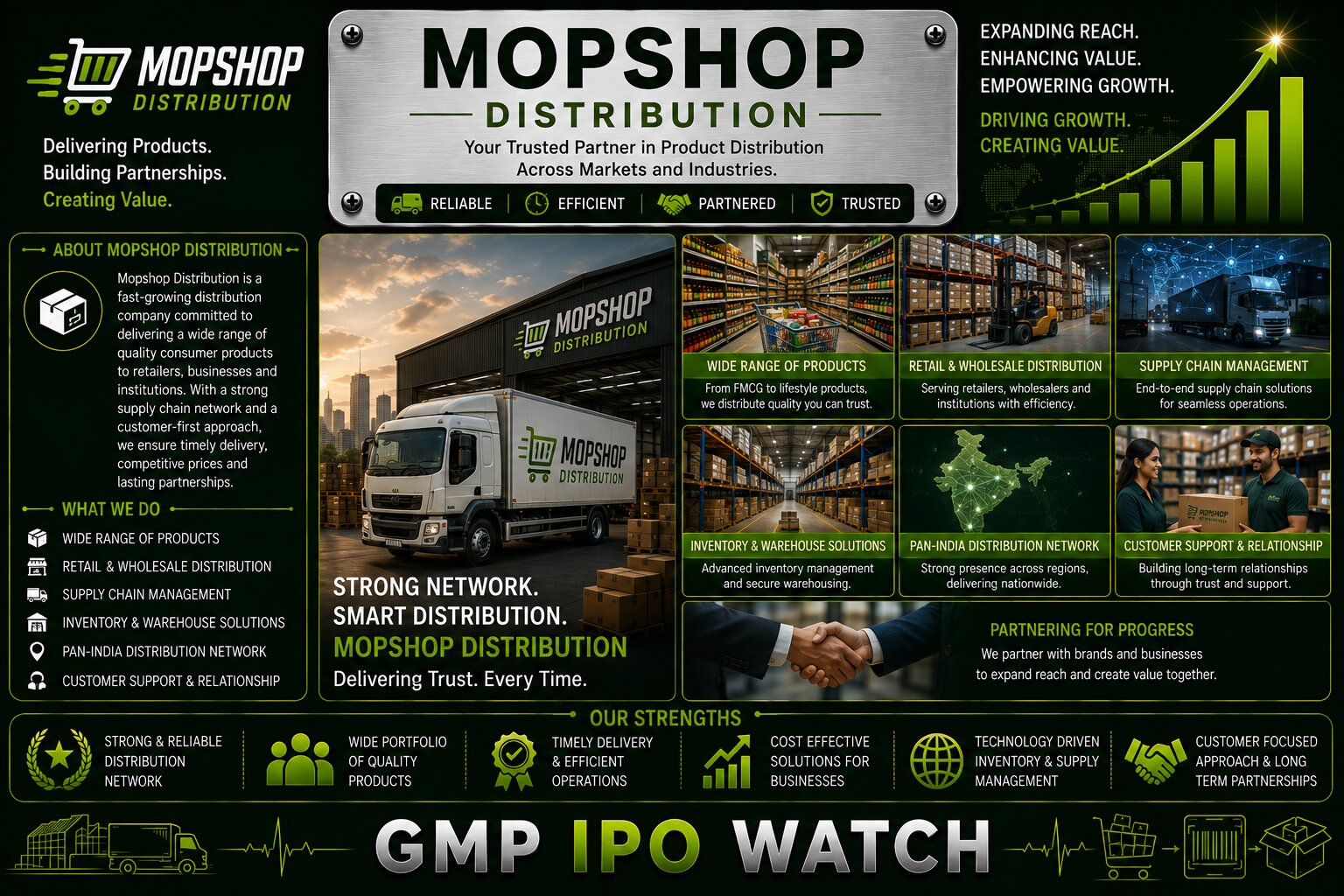
Mopshop Distribution IPO 2026 – Can a B2B Cleaning-Supplies Company Build a Scalable Corporate Procurement Network?
Office buildings, banks, hospitals, airports, malls and large residential complexes all require cleaning and hygiene supplies.
But a large company operating hundreds of sites does not necessarily want every location to negotiate separately for:
- Cleaning chemicals
- Garbage bags
- Microfiber cloths
- Dispensers
- Vacuum cleaners
- Hygiene consumables
That creates an opportunity for companies such as Mopshop Distribution Limited.
Mopshop operates a B2B facility-management supplies model, providing housekeeping, hygiene and maintenance products to corporate customers across India. Its own company profile says it serves 300+ active clients and more than 7,000 sites per month, including corporates, banks, NBFCs, HORECA businesses, IT parks, airports, malls, multiplexes and facility-management contractors.
The company's IPO opens tomorrow.
But the more interesting investment question is not simply whether more companies need cleaning products.
It is:
Can Mopshop become an increasingly important procurement platform for large enterprises while improving logistics efficiency, reducing debt and increasing revenue from its existing corporate relationships?
That is the key long-term story.
Mopshop Distribution IPO Details
| Particular | Details |
|---|---|
| Company | Mopshop Distribution Ltd. |
| IPO Type | Fixed Price SME IPO |
| Listing Platform | BSE SME |
| Issue Size | ₹27.26 Crore |
| Fresh Issue | ₹22.08 Crore |
| OFS | ₹5.18 Crore |
| Issue Price | ₹138 Per Share |
| Face Value | ₹10 Per Share |
| Lot Size | 1,000 Shares |
| Retail Minimum | 2,000 Shares |
| Retail Investment | ₹2,76,000 |
| IPO Open Date | August 19, 2026 |
| IPO Close Date | August 21, 2026 |
| Allotment Date | August 24, 2026 |
| Refund Date | August 25, 2026 |
| Listing Date | August 26, 2026 |
| Lead Manager | Khandwala Securities |
| Registrar | Cameo Corporate Services |
The offer comprises 19.75 lakh shares, including a fresh issue of 16 lakh shares and an OFS of 3.75 lakh shares. Around 99,000 shares are reserved for the market maker.
What Does Mopshop Distribution Actually Do?
Mopshop supplies facility-management products through a business-to-business model.
Its product portfolio includes items such as:
- Cleaning tools
- Hygiene consumables
- Microfiber cloths
- Surface disinfectants
- Garbage bags
- Sensor-based dispensers
- Vacuum cleaners
- Maintenance products.
These products may appear ordinary.
But the business opportunity comes from aggregating corporate demand.
A large customer may need the same supplies across hundreds of locations.
Instead of dealing with many regional vendors, it can work with one supplier capable of providing standardised products and pricing across different markets.
That is where Mopshop's model can become valuable.
Mopshop Is Essentially a Corporate Procurement Business
A better way to understand Mopshop is not:
“a company that sells cleaning products.”
It is:
“a company that simplifies repetitive procurement for enterprises.”
Imagine a bank with 500 branches.
Every branch requires:
- Cleaning materials
- Garbage bags
- Hygiene products
- Maintenance consumables
If each branch purchases independently, the bank faces:
- Different prices
- Different product quality
- More vendor invoices
- Procurement complexity
A centralised supplier can simplify this process.
That is the problem Mopshop is trying to solve.
Its Online Order Platform Is Strategically Important
Mopshop operates a proprietary online order-management platform through which corporate customers can place and manage procurement orders.
This matters because the platform can make the relationship more difficult to replace.
Once a customer's procurement workflow becomes integrated with Mopshop's system, repeat purchasing can become easier.
The ideal evolution is:
supplier → preferred procurement vendor → embedded procurement platform.
That can improve customer retention.
Repeat Orders Are More Valuable Than One-Time Sales
Facility-management supplies are consumable.
A customer does not buy garbage bags once.
It needs them repeatedly.
The same is true for:
- Cleaning chemicals
- Microfiber products
- Hygiene consumables
That makes the business inherently capable of producing repeat revenue.
This is different from selling expensive capital equipment where the same customer may not purchase again for several years.
For Mopshop, a successfully acquired corporate account can potentially produce orders month after month.
Customer Lifetime Value Can Become a Major Advantage
Suppose Mopshop wins a corporate client and generates ₹10 lakh in the first year.
If that customer remains for five years and gradually increases its locations, cumulative revenue may be many times higher.
This means customer economics depend on:
retention + order frequency + number of sites served.
The company already says it serves more than 7,000 sites every month.
That scale provides an important base for future cross-selling.
More Products Per Customer Can Drive Growth
Mopshop does not necessarily need to win thousands of new companies.
It can also grow by selling more categories to existing customers.
For example, a customer currently buying:
garbage bags + cleaning cloths
could later purchase:
dispensers + vacuum cleaners + chemicals + other consumables.
That increases wallet share.
For investors, one useful future metric would therefore be:
revenue per active corporate client.
300+ Active Clients Create a Useful Platform
Mopshop says it has more than 300 active clients across India.
That means average customer relationships can potentially be expanded in several directions.
A large client may:
- Add new sites
- Purchase more product categories
- Increase order frequency
This provides three different growth routes without needing to acquire a completely new customer each time.
Pan-India Presence Is Important
The company highlights a pan-India operating presence with dedicated key-account management.
This is strategically important for corporate procurement.
Large customers often prefer suppliers capable of supporting multiple regions.
A national bank or facility-management company may not want separate vendors for:
- Mumbai
- Delhi
- Bengaluru
- Chennai
A single-rate, multi-region supplier can simplify procurement.
Single Pricing Across Regions Can Help Corporate Customers
Mopshop states that it offers single rates across regions.
From a customer's perspective, that can improve:
- Budgeting
- Procurement control
- Invoice consistency
For Mopshop, however, national pricing creates its own challenge.
Transport costs differ considerably by geography.
Therefore, logistics efficiency becomes critical to protecting margins.
Logistics Is One of the Biggest Economic Drivers
Selling a ₹500 carton is not enough.
It must reach the customer's location efficiently.
If transport costs consume too much of the order value, profitability suffers.
That means Mopshop needs:
- Efficient warehousing
- Route planning
- Delivery vehicles
- Regional demand density
This helps explain why part of the IPO proceeds will be used to purchase commercial vehicles.
₹2.21 Crore Is Planned for Commercial Vehicles
According to the current issue documents, approximately ₹2.21 crore of fresh proceeds is planned for purchasing commercial vehicles for logistics operations.
This is strategically relevant.
If owned or controlled transport helps reduce dependence on expensive third-party logistics, the company can potentially:
- Improve delivery reliability
- Lower transport costs
- Improve customer service
But vehicle ownership also creates:
- Maintenance
- Fuel
- Driver
- Depreciation costs
The economics depend on utilisation.
Vehicle Utilisation Will Matter
Imagine Mopshop buys ten delivery vehicles.
Scenario A
Each vehicle makes productive deliveries throughout the day.
Scenario B
Several vehicles remain underused.
Both require the same capital investment.
But Scenario A generates far better returns.
Post-IPO investors should therefore watch whether logistics expenses decline as a percentage of sales.
₹11.50 Crore Will Be Used for Debt Repayment
The largest identified use of the fresh IPO proceeds is approximately ₹11.50 crore toward repayment of outstanding borrowings.
This is more than half of the disclosed fresh-proceeds deployment.
That makes the IPO partly a balance-sheet strengthening transaction.
Debt reduction can provide several benefits:
- Lower interest expenses
- Better cash flow
- Lower financial risk
- More borrowing capacity for future growth
For a small SME, this can materially improve financial flexibility.
Debt Reduction Can Directly Increase PAT
Suppose Mopshop currently spends ₹1 crore annually on finance costs.
If debt repayment lowers that expense substantially, part of those savings can move directly to pre-tax profit.
The company does not need additional revenue to benefit.
That makes debt repayment one of the more predictable financial benefits of the IPO.
₹1.05 Crore Is Planned for Rooftop Solar
Mopshop also intends to spend approximately ₹1.05 crore on a rooftop grid-connected solar plant at its Vasai warehouse.
The investment is smaller than the debt or logistics allocations.
But it can still reduce recurring electricity expenses over time.
Warehouse operations can consume electricity through:
- Lighting
- Office systems
- Equipment
Solar generation can partly offset those costs.
Solar Can Produce Long-Term Cost Savings
The economic logic is straightforward.
The company spends money upfront on solar infrastructure.
Then electricity savings accumulate over several years.
If the payback period is reasonable, this can reduce operating costs and improve margins gradually.
For a small company, even modest recurring savings can be valuable.
FY2025 Revenue Reached About ₹42 Crore
Mopshop reported approximately:
| Financial Year | Revenue | PAT |
|---|---|---|
| FY2024 | ₹37.86 Cr | ₹1.42 Cr |
| FY2025 | ₹42.00 Cr | ₹3.48 Cr |
Revenue increased by approximately 11%, while PAT increased by around 145%.
This is an important financial trend.
Profit grew significantly faster than sales.
That suggests margins improved materially.
Profit Growth Was Much Stronger Than Revenue Growth
Revenue increased by only around ₹4 crore.
But PAT increased by more than ₹2 crore.
That indicates stronger:
- Gross margin
- Operating efficiency
- Lower relative expenses
or some combination of these.
Investors should determine whether that improvement is structural.
If margins revert toward earlier levels, profit growth may slow significantly.
Latest FY2026 Data Shows Further Growth
One prospectus-based IPO analysis reports annualised FY2026 figures of approximately:
Revenue: ₹45.81 crore
EBITDA: ₹6.71 crore
PAT: ₹3.79 crore.
The reported EBITDA margin is around 14.65%.
This indicates the company continued growing beyond the FY2025 revenue base, although the growth rate is much more moderate than the earlier PAT jump.
EBITDA Margin Around 14.65% Is Important
For a distribution company, a mid-teens EBITDA margin is notable because the business must absorb:
- Product procurement
- Warehousing
- Employees
- Transportation
Distribution businesses often operate on relatively thin margins.
Maintaining this profitability as the company expands would therefore be important.
But Distribution Margins Can Be Fragile
Customers can compare product prices easily.
If a competitor offers similar supplies for less, corporate procurement teams may negotiate aggressively.
Mopshop therefore needs advantages beyond simply stocking products.
These can include:
- Consistent nationwide pricing
- Reliable delivery
- Online ordering
- Product range
- Account management
The more value customers place on the complete service, the less competition becomes purely price-based.
Cleaning and Hygiene Products Dominate Revenue
Current risk disclosures indicate Mopshop generates a substantial portion of its revenue from the single broad category of cleaning tools and hygiene consumables.
This creates concentration risk.
If demand weakens or competition intensifies in this category, overall financial performance could be affected materially.
Product diversification is therefore a potential growth opportunity.
Mopshop Could Expand Into Adjacent Facility Categories
Corporate facilities require much more than cleaning products.
Potential adjacent categories can include:
- Pantry supplies
- Washroom consumables
- Safety products
- Maintenance products
- Other facility supplies
The company's existing corporate relationships may make cross-selling these products easier than acquiring completely new customers.
The opportunity is to become a broader corporate supplies platform.
Customer Retention Is a Major Risk
The offer documents specifically highlight the risk that customers may fail to renew accounts or reduce order frequency through the B2B online platform.
This is important.
Because products are relatively standardised, customers can potentially switch vendors.
Mopshop therefore needs to retain clients through:
- Service quality
- Pricing
- Reliability
- Digital convenience
A strong retention rate can make the business much more valuable.
Order Frequency Matters as Much as Client Count
Suppose Mopshop has 300 clients.
If each customer orders once per year, the economics are very different from customers placing orders every month.
Therefore, a better operating metric is:
orders per active client.
If this increases, customer engagement is becoming stronger.
Geographic Concentration Can Affect Margins
Risk disclosures also note that a meaningful portion of revenue comes from regions surrounding warehouse locations and that transportation costs create geographic concentration risk.
This makes sense.
Customers located close to the warehouse are cheaper to serve.
Distant customers can require more:
- Freight
- Transit time
- Inventory planning
National expansion is valuable only when the logistics economics remain attractive.
Revenue Density Can Improve Logistics Economics
Suppose Mopshop serves one customer in a distant city.
Delivery costs may be high.
If it serves 50 customers in the same region, shipments can be consolidated.
That increases revenue density.
The ideal expansion strategy is therefore not simply:
serve more states.
It is:
build dense customer clusters within each region.
Warehousing Is a Critical Part of the Model
Mopshop's primary warehousing operations are based in Vasai, Maharashtra.
A distributor needs inventory available when customers place orders.
Too little inventory leads to:
- Stock-outs
- Delayed deliveries
Too much inventory leads to:
- Cash tied up
- Slow-moving products
This makes inventory management a key part of profitability.
Inventory Turnover Should Be Watched
Imagine Mopshop holds ₹10 crore of inventory.
If that inventory turns over six times annually, it supports far more revenue than if it turns only twice.
Faster inventory turnover generally means:
- Better capital efficiency
- Lower warehousing pressure
- Less cash locked in stock
Post-listing investors should therefore watch inventory days.
Suppliers Are Another Important Part of the Business
Mopshop does not manufacture every product it sells.
Distribution requires dependable suppliers capable of providing:
- Competitive pricing
- Consistent quality
- Reliable supply
If input prices rise, Mopshop may need to pass those increases to corporate customers.
Its ability to do so depends on pricing agreements and competitive conditions.
Fixed Corporate Pricing Can Create Margin Pressure
Suppose Mopshop agrees to supply a customer at a fixed rate for one year.
If supplier prices increase halfway through that period, margins can decline.
This is one of the key risks in corporate distribution.
The company needs disciplined:
- Procurement
- Contract pricing
- Inventory planning
to protect profitability.
The IPO Is a Fixed-Price Issue
Unlike a book-built IPO where investors bid within a range, Mopshop has fixed its offer price at:
₹138 per share.
The minimum retail application is 2,000 shares, even though the lot size is 1,000 shares.
At ₹138:
2,000 × ₹138 = ₹2,76,000.
This is typical of SME IPO requirements where retail applications can require significantly more capital than mainboard IPOs.
Retail and NII Allocation Is Evenly Split
Economic Times currently shows:
- NII: 9,38,000 shares
- Retail: 9,38,000 shares
- Market Maker: 99,000 shares.
There is no separate QIB quota in the fixed-price structure shown on the issue page.
This means retail and non-institutional demand will be particularly important once bidding begins.
Mopshop Distribution IPO GMP Today
As of August 18, 2026, InvestorGain reports:
GMP: ₹18 per share.
Against the ₹138 issue price:
₹138 + ₹18 = ₹156
That represents an unofficial premium of approximately:
13.04%.
The recent GMP trend was:
| Date | GMP |
|---|---|
| August 14 | ₹10 |
| August 15 | ₹10 |
| August 16 | ₹10 |
| August 17 | ₹18 |
| August 18 | ₹18 |
This shows stronger pre-opening sentiment compared with the previous week.
There Is No Subscription Data Today
Public bidding starts tomorrow, August 19.
Therefore, as of August 18 there is no valid:
- Retail subscription
- NII subscription
- Overall public subscription
to report.
The first actual demand data will become available once the issue opens.
Any subscription number shown before the opening should be treated cautiously.
Post-IPO Market Capitalisation Is Around ₹99 Crore
IPOPlatform estimates post-issue market capitalisation at approximately:
₹99.36 crore.
On its annualised FY2026 numbers, it estimates a P/E around:
28.57×
and EV/EBITDA around:
15.20×.
These are not extremely low multiples for a small distribution SME.
Therefore, future growth execution matters.
Valuation Requires Growth to Continue
A P/E near 28× means investors are paying more than 28 times the cited earnings base.
That can be justified when:
- Revenue continues growing
- Margins remain healthy
- Debt falls
- Customer relationships strengthen
But if growth slows significantly, the valuation can become less comfortable.
This makes post-IPO earnings growth important.
Debt Repayment Could Improve Valuation Quality
The valuation becomes more interesting if the ₹11.50 crore debt repayment materially improves:
- Finance costs
- Net profit
- Cash generation.
This means the post-IPO business may look financially stronger than the historical pre-IPO balance sheet.
Investors should compare future results against this improved capital structure.
Competitive Strengths
Mopshop has several identifiable strengths.
Pan-India corporate client base: More than 300 active customers and 7,000+ sites served monthly.
Recurring-use products: Cleaning and hygiene consumables create repeat purchasing.
Online order platform: Helps corporate clients manage purchasing centrally.
Established logistics support: Distribution capability is central to service quality.
Strong FY2025 PAT growth: Profit increased from ₹1.42 crore to ₹3.48 crore.
Debt repayment: ₹11.50 crore IPO allocation can strengthen the balance sheet.
Logistics investment: ₹2.21 crore is earmarked for commercial vehicles.
Major Risks
The first major risk is product concentration, because cleaning tools and hygiene consumables account for a large part of the business.
The second is customer retention risk. Corporate clients can reduce orders or move to competing suppliers.
The third is logistics cost. Nationwide distribution can become expensive, particularly in regions far from warehousing operations.
Other risks include:
- Supplier-price increases
- Inventory management
- Corporate credit periods
- Competition from regional distributors
- SME-market liquidity
- Execution of logistics expansion
What Could Drive Mopshop's Next Growth Phase?
Several growth avenues are available.
More Revenue From Existing Customers
Selling more categories to the same 300+ corporate clients could improve customer lifetime value.
More Sites Per Customer
If existing customers expand their branch or facility networks, Mopshop can potentially grow alongside them.
Broader Product Portfolio
Moving into adjacent facility-management categories can reduce cleaning-product concentration.
Better Logistics
Commercial vehicles could improve delivery economics.
Lower Debt
Debt repayment can increase financial flexibility.
Digital Procurement
Greater use of its online platform can make customer relationships more integrated.
What Investors Should Track After Listing
The most useful future metrics will be:
| Metric | Why It Matters |
|---|---|
| Active Clients | Customer-base growth |
| Revenue Per Client | Cross-selling strength |
| Sites Served | Network expansion |
| Repeat Orders | Customer retention |
| EBITDA Margin | Pricing discipline |
| Inventory Days | Capital efficiency |
| Receivable Days | Cash collection |
| Logistics Cost | Distribution efficiency |
| Debt | IPO deleveraging impact |
| Operating Cash Flow | Profit quality |
These metrics would provide a much clearer view of the business than share-price movement alone.
The Most Important Post-IPO Equation
Mopshop's attractive growth cycle is:
lower debt + better logistics → more corporate customers → more products per customer → more repeat orders → better revenue density → stronger cash flow.
The weaker scenario is:
more geographic expansion → higher freight and inventory → weak order density → lower margins and cash conversion.
Both can produce higher revenue.
Only the first produces better business economics.
Should Investors Consider Mopshop Distribution IPO?
The positive investment case includes:
- 300+ active corporate clients
- 7,000+ sites served monthly
- Recurring consumable products
- Proprietary online ordering platform
- Strong recent PAT growth
- Major IPO-funded debt repayment
- Logistics investment
- Positive ₹18 pre-opening GMP.
The caution points include:
- Small revenue scale
- Product concentration
- Customer-switching risk
- Logistics cost pressure
- SME liquidity
- Post-issue valuation around 28× earnings on one annualised basis.
Mopshop should therefore be analysed as a B2B corporate procurement and facility-supplies distribution platform, rather than simply as a cleaning-products trader.
Final View on Mopshop Distribution IPO 2026
The Mopshop Distribution IPO opens tomorrow, August 19, 2026, and closes August 21. The ₹27.26 crore BSE SME fixed-price issue is offered at ₹138 per share, with listing scheduled for August 26.
The offer includes approximately ₹22.08 crore of fresh issue and ₹5.18 crore OFS, meaning most of the capital raised is intended for company-level use.
Operationally, Mopshop has built a B2B platform serving 300+ active corporate clients and more than 7,000 sites each month across categories such as banking, NBFCs, hospitality, IT parks, airports, malls and facility-management companies.
Financially, FY2025 revenue reached around ₹42 crore, while PAT increased to approximately ₹3.48 crore from ₹1.42 crore in FY2024. A prospectus-based FY2026 annualised analysis shows revenue around ₹45.81 crore, EBITDA around ₹6.71 crore and PAT around ₹3.79 crore.
The IPO's use of proceeds is particularly important.
Approximately ₹11.50 crore is planned for debt repayment, ₹2.21 crore for commercial vehicles and ₹1.05 crore for a rooftop solar installation at the Vasai warehouse.
This creates a straightforward long-term thesis:
lower debt + stronger logistics + recurring corporate demand + digital procurement = potential scalable growth.
As of August 18, the latest GMP is around ₹18, implying an unofficial price near ₹156 and a premium of approximately 13%. Public subscription has not started, so there is no valid subscription data yet.
Loading comments...