

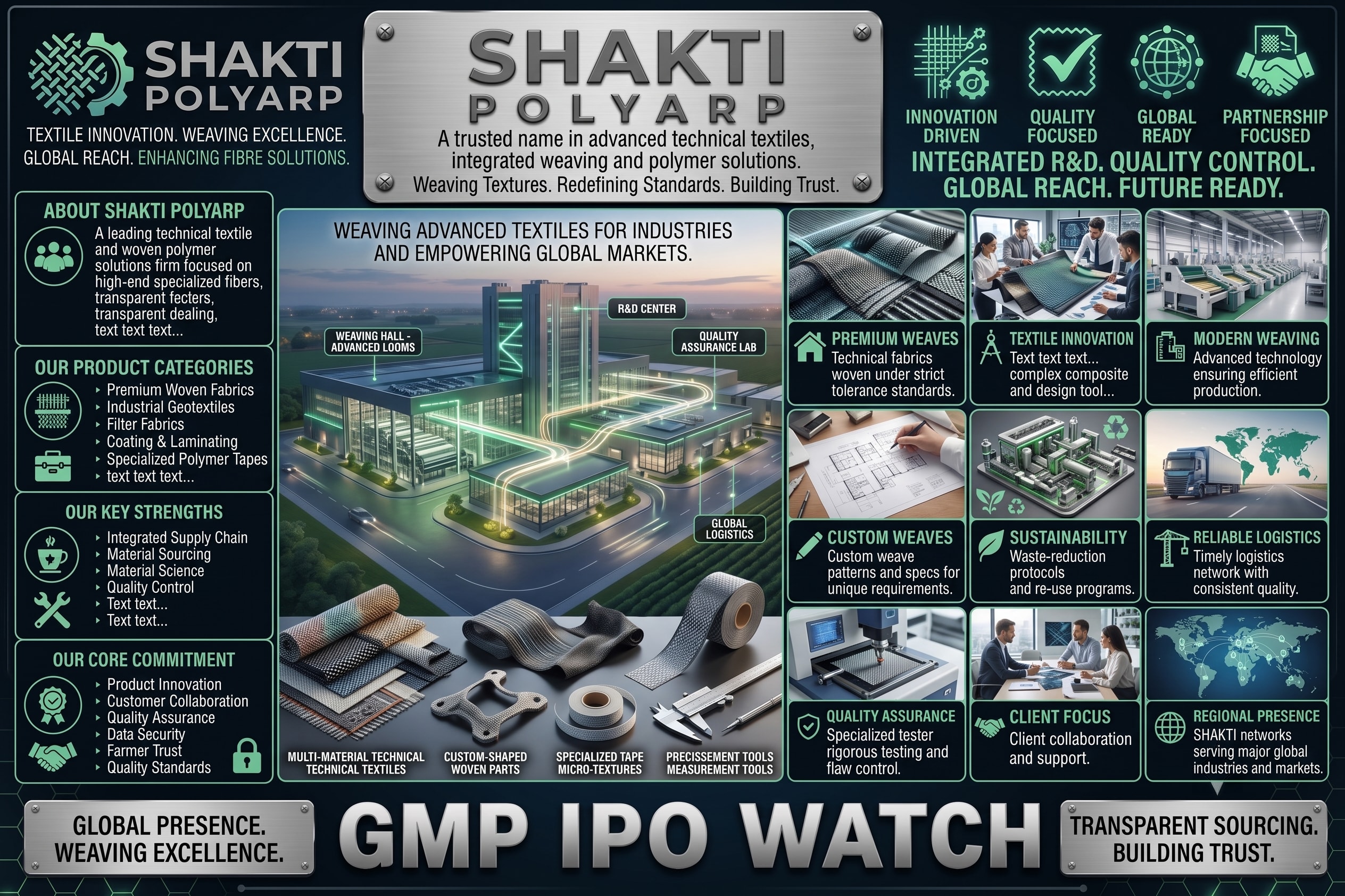
Shakti Polytarp IPO Overview
Shakti Polytarp IPO is a ₹26.93 crore BSE SME IPO opening for subscription on September 15, 2026. The issue will close on September 17, 2026, with the shares proposed to be listed on the BSE SME platform. The price band has been fixed at ₹56 to ₹59 per share.
The IPO is a fresh issue, and the company plans to use the proceeds primarily for capital expenditure and strengthening its manufacturing capabilities.
| Particular | Details |
|---|---|
| IPO Name | Shakti Polytarp IPO |
| IPO Type | BSE SME |
| IPO Dates | Sep 15–17, 2026 |
| Price Band | ₹56–₹59 |
| Issue Size | ₹26.93 Cr |
| Issue Type | Fresh Issue |
| Lot Size | 2,000 Shares |
| Retail Minimum | 4,000 Shares |
| Minimum Investment | ₹2.36 Lakh |
| Allotment | Sep 18, 2026 |
| Refund / Demat | Sep 21, 2026 |
| Listing Date | Sep 22, 2026 |
| Exchange | BSE SME |
| Lead Manager | Narnolia Financial |
| Registrar | Bigshare Services |
At the upper price of ₹59, one lot is worth ₹1.18 lakh. However, the minimum retail application requires two lots, making the minimum retail investment approximately ₹2.36 lakh.
Shakti Polytarp IPO GMP Today
The Shakti Polytarp IPO GMP is currently around ₹0, according to the latest available grey-market trackers. IPOGram and IPO Premium are both showing no premium as of September 15, 2026.
With an IPO price of ₹59 at the upper band and GMP of ₹0, the indicative GMP-based listing price is around ₹59 per share.
| Particular | Value |
|---|---|
| Upper IPO Price | ₹59 |
| Latest GMP | ₹0 |
| Estimated Listing Price | ₹59 |
| Estimated Gain | ₹0 |
| GMP Return | 0% |
GMP is an unofficial and unregulated market indicator. It can change before listing and should not be considered a guaranteed listing price.
Shakti Polytarp IPO Subscription
Shakti Polytarp IPO opened on September 15 and will remain open until September 17. Initial subscription data showed a relatively muted response, with one tracker reporting around 0.10x overall subscription during the opening period.
The issue is targeted at SME investors and carries a relatively high minimum retail application of ₹2.36 lakh. Therefore, subscription levels can behave differently from mainboard IPOs.
Investors should consider the final category-wise subscription numbers after the issue closes rather than relying on early Day 1 figures.
Shakti Polytarp Business
Shakti Polytarp operates in the plastic and polymer products manufacturing industry.
The company manufactures products such as tarpaulins, woven fabrics, shade nets, polymer granules and related products. Its manufacturing operations are based in Madhya Pradesh.
The company follows an integrated manufacturing approach, using polymer-based raw materials to produce various finished products for agricultural, industrial, commercial and other applications.
Tarpaulins and woven polymer products are used for applications such as covering materials, storage, transportation and protection from weather conditions.
Shakti Polytarp Financial Performance
Shakti Polytarp has recorded substantial growth in revenue over the last few financial years.
| Financial Year | Revenue | PAT |
|---|---|---|
| FY24 | ₹62.01 Cr | ₹0.98 Cr |
| FY25 | ₹166.50 Cr | ₹4.97 Cr |
| FY26 | ₹216.10 Cr | ₹10.06 Cr |
Revenue increased from approximately ₹62.01 crore in FY24 to ₹216.10 crore in FY26, while profit after tax increased from ₹0.98 crore to ₹10.06 crore. FY26 revenue growth was approximately 29.8% year-on-year, while PAT increased by more than 100%.
The company reported FY26 EBITDA of approximately ₹19.29 crore, giving it an EBITDA margin of around 8.9%.
Shakti Polytarp IPO Financial Ratios
The FY26 financial ratios provide a more complete picture of the company's profitability and capital structure.
| Particular | FY26 |
|---|---|
| Revenue | ₹216.10 Cr |
| EBITDA | ₹19.29 Cr |
| PAT | ₹10.06 Cr |
| EBITDA Margin | 8.94% |
| PAT Margin | 4.66% |
| RoNW | 44.04% |
| ROCE | 17.87% |
| Debt/Equity | 2.60 |
| NAV | ₹22.18 |
| P/E | ~10.05x |
The company has delivered strong improvement in profitability, but the 2.60x debt-to-equity ratio is an important point for investors to monitor. Total borrowings were reported at around ₹72.51 crore in FY26.
Shakti Polytarp IPO Objects
The IPO proceeds are primarily intended to support the company's expansion and capital expenditure plans.
A significant portion of the funds is proposed for capital expenditure, including machinery and equipment required for expanding production capabilities.
The company also intends to use part of the proceeds toward repayment of a SIDBI term loan used for machinery purchases. Angel One reports approximately ₹5.98 crore earmarked for this repayment.
The remaining funds are intended for general corporate purposes and issue-related requirements.
Shakti Polytarp Growth Prospects
Shakti Polytarp operates in a segment with applications across agriculture, transportation, construction, industrial packaging and other areas.
The sharp increase in revenue over FY24–FY26 indicates that the company has significantly expanded its operating scale. Its manufacturing capacity and product portfolio could provide opportunities to capture additional demand from agriculture and industrial customers.
The company can also benefit from increased adoption of durable polymer-based products in applications where conventional materials may have limitations.
However, future growth will depend on maintaining utilisation levels, controlling raw-material costs and managing the company's relatively high leverage.
Shakti Polytarp IPO Strengths
Some of the key positives of the Shakti Polytarp IPO include:
- Strong revenue growth over FY24–FY26.
- PAT increased substantially during the same period.
- FY26 revenue reached approximately ₹216.10 crore.
- Diverse polymer-based product portfolio.
- Integrated manufacturing operations.
- Strong FY26 RoNW of around 44%.
- IPO proceeds will support capacity expansion.
- Part of the issue proceeds will reduce debt.
- Valuation at the upper band appears moderate on reported FY26 earnings.
Shakti Polytarp IPO Risks
The biggest concern is the company's relatively high leverage. FY26 debt-to-equity was around 2.60x, with borrowings of approximately ₹72.51 crore. Higher interest and repayment obligations can affect profitability and cash flows.
The company is also exposed to fluctuations in polymer and other raw-material prices. Since raw materials form an important part of manufacturing costs, sudden price increases could pressure margins.
Other important risks include:
- High debt levels.
- Raw-material price volatility.
- Competition in polymer products.
- Relatively thin PAT margins.
- Dependence on manufacturing capacity utilisation.
- Regional concentration of operations.
- Working-capital requirements.
- SME-platform liquidity risk.
- High minimum investment for retail investors.
The company is therefore better suited to investors who understand the additional risks associated with SME-listed businesses.
Shakti Polytarp IPO Valuation
At the upper price band of ₹59, Shakti Polytarp is valued at approximately 10 times FY26 earnings, based on the reported FY26 EPS and post-issue calculations. The valuation appears relatively moderate compared with many growth-oriented manufacturing businesses.
However, the lower valuation should be considered alongside the company's high debt-to-equity ratio and relatively low PAT margin.
The current ₹0 GMP also means that the grey market is not indicating a premium listing at present.
Therefore, the valuation may look reasonable on earnings, but investors should not ignore balance-sheet risk.
Shakti Polytarp IPO Review
Shakti Polytarp IPO has a mixed fundamental profile.
On the positive side, the company has delivered strong revenue growth and a significant improvement in profitability. FY26 revenue crossed ₹216 crore, while PAT reached around ₹10 crore. The company's polymer product portfolio and planned capacity expansion provide potential for further growth.
The main concern is leverage. A debt-to-equity ratio of around 2.60x is high, particularly for an SME company. Raw-material price fluctuations and relatively thin profit margins add further risk.
The current ₹0 GMP also does not provide any indication of a listing premium. Subscription data during the opening phase has been relatively modest.
For investors with a high risk appetite and a medium- to long-term horizon, the company's growth may be worth studying. Conservative investors may prefer to wait for stronger subscription demand, deleveraging or additional evidence of sustainable cash-flow generation.
Shakti Polytarp IPO Key Highlights
- IPO Size: ₹26.93 crore
- IPO Type: BSE SME
- Price Band: ₹56–₹59
- IPO Dates: September 15–17, 2026
- Lot Size: 2,000 shares
- Retail Minimum: 4,000 shares
- Minimum Investment: ₹2.36 lakh
- Allotment: September 18, 2026
- Refund/Demat: September 21, 2026
- Listing: September 22, 2026
- Latest GMP: ₹0
- FY26 Revenue: ₹216.10 crore
- FY26 PAT: ₹10.06 crore
- FY26 EBITDA: ₹19.29 crore
- FY26 Debt/Equity: 2.60x
- Issue Type: Fresh Issue
- Listing Platform: BSE SME
The issue dates, price band and issue size are consistent across current IPO sources.
Shakti Polytarp IPO Conclusion
Shakti Polytarp IPO offers exposure to a growing polymer-products manufacturing business with tarpaulins, woven products, shade nets and related materials in its portfolio. The company's revenue and profit have grown strongly over the last three financial years, which is a key positive.
The planned capital expenditure could further increase production capacity, while partial debt repayment may provide some balance-sheet support.
However, the company's high leverage, raw-material sensitivity, thin profit margins and SME-market liquidity risk need careful consideration. The current GMP of ₹0 does not indicate a grey-market listing premium either.
Overall, Shakti Polytarp IPO may appeal to high-risk investors looking for a small-cap manufacturing growth story, but the elevated debt level makes a cautious approach more appropriate.
Disclaimer: IPO GMP is unofficial and can change rapidly. GMP should not be considered a guaranteed listing price or investment recommendation. Investors should read the company's offer documents and evaluate its financials, valuation and risk factors before investing.
Loading comments...