

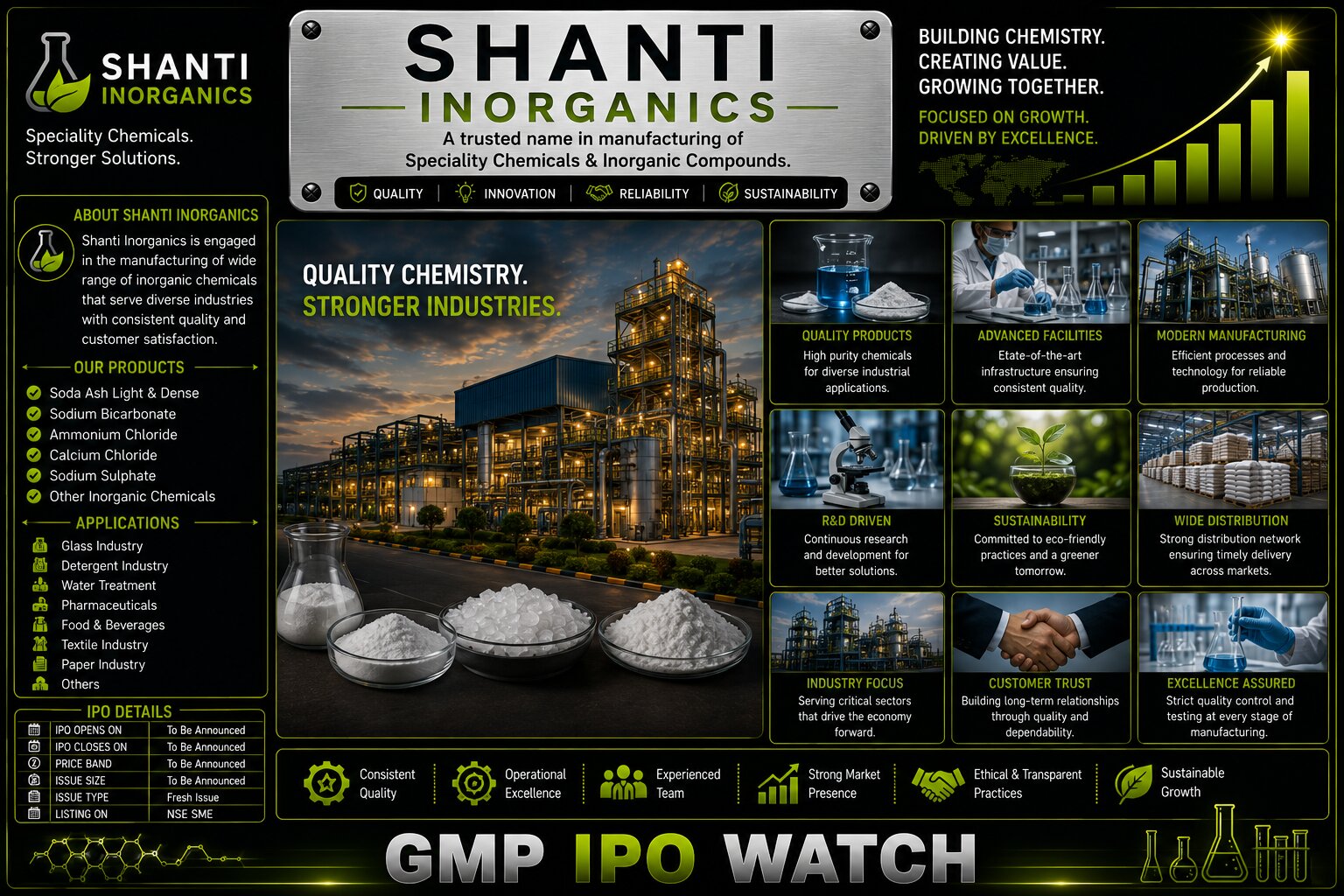
Shanti Inorganics IPO 2026 – Specialty Chemical Manufacturer Heads to NSE SME
Shanti Inorganics Limited is preparing to launch its IPO on August 31, 2026, with bidding scheduled to remain open until September 2.
The Ahmedabad-headquartered company manufactures and supplies sulphur-based inorganic chemicals used by customers across different industrial applications. The shares are proposed to list on the NSE Emerge platform.
The IPO comes at an important stage for the business because Shanti Inorganics is planning a significant increase in manufacturing capacity at its Bavla facility.
Shanti Inorganics IPO Details
| Particular | Details |
|---|---|
| Company | Shanti Inorganics Limited |
| IPO Type | SME IPO |
| Issue Type | Book Built Issue |
| Issue Size* | Up to ~₹47.24 Crore |
| Shares Offered* | 56,91,200 Shares |
| Price Band | ₹79 – ₹83 |
| Face Value | ₹10 |
| IPO Open Date | August 31, 2026 |
| IPO Close Date | September 2, 2026 |
| Anchor Date | August 28, 2026 |
| Allotment Date | September 3, 2026 |
| Expected Listing | September 7, 2026 |
| Listing Platform | NSE Emerge |
| Lead Manager | Vivro Financial Services |
| Registrar | KFin Technologies |
*Recent sources conflict on the issue size: the August 24 issue announcement reports 56,91,200 shares and approximately ₹47.24 crore at ₹83, while some IPO trackers still display ₹41.50 crore. The newer announced share count implies ₹47.24 crore at the upper band.
What Does Shanti Inorganics Do?
Shanti Inorganics operates in the chemical manufacturing sector with a focus on sulphur-based inorganic chemicals.
These chemicals can be used as intermediates or processing inputs by downstream industries. Unlike a consumer-facing business, Shanti primarily operates in a B2B environment where product quality, consistency, pricing and reliable supply are important factors in maintaining customer relationships.
The business model can broadly be understood as:
raw materials → chemical processing → quality control → industrial chemicals → B2B customers.
Manufacturing Capacity Is a Major Part of the Growth Story
The company's existing Vatva facility has installed capacity of 18,800 MTPA.
At Bavla, Phase I provides another 18,000 MTPA of capacity. More importantly, the company proposes to add approximately 78,544 MTPA under Phase II at Bavla.
Manufacturing Capacity
| Facility / Phase | Capacity |
|---|---|
| Vatva Facility | 18,800 MTPA |
| Bavla – Phase I | 18,000 MTPA |
| Bavla – Proposed Phase II | 78,544 MTPA |
| Existing Capacity | 36,800 MTPA |
| Potential Capacity After Phase II | 1,15,344 MTPA |
If completed as planned, Phase II would represent a major increase in the company's manufacturing capability.
Why the Bavla Expansion Matters
The proposed 78,544 MTPA addition is much larger than Shanti's current installed capacity.
This creates considerable growth potential, but it also changes what investors need to monitor.
The expansion equation is:
new capacity → higher production capability → more customer orders → higher sales → operating leverage.
But new manufacturing capacity alone does not guarantee higher earnings.
Shanti will need to generate sufficient customer demand to keep the expanded facilities operating efficiently.
Therefore, capacity utilisation could become one of the most important post-IPO metrics.
FY2026 Profitability Improved
Shanti Inorganics reported healthy growth in FY2026.
| Financial Metric | FY2025 | FY2026 |
|---|---|---|
| Revenue* | ₹58.46 Cr | ₹71.22 Cr |
| PAT | ₹8.00 Cr | ₹10.22 Cr |
| Revenue Growth | — | ~21.8% |
| PAT Growth | — | ~27.8% |
*One tracker reports FY2026 revenue at ₹72.93 crore, while the recent issue announcement reports ₹71.22 crore. The latter is used here for consistency with the latest announcement.
Profit growth therefore outpaced revenue growth during FY2026.
That is a useful trend because it suggests improving profitability alongside business expansion.
FY2027 Has Also Started Profitably
The company has already disclosed numbers for the two months ended May 31, 2026.
| Particular | 2M FY2027 |
|---|---|
| Revenue | ₹15.98 Cr |
| EBITDA | ₹4.02 Cr |
| PAT | ₹2.50 Cr |
The early FY2027 numbers show that the company has continued to generate profits ahead of the IPO.
However, two months is a short reporting period, so investors should avoid simply annualising these figures without considering seasonality and operating conditions.
Profit Margins Are Worth Watching
Based on the reported FY2026 figures:
PAT of ₹10.22 crore ÷ revenue of ₹71.22 crore = approximately 14.4% net margin.
That is a meaningful profitability level for a small industrial chemical manufacturer.
The company's ability to maintain margins while expanding capacity will be particularly important.
New capacity can improve operating leverage when utilisation is high, but underutilised plants can increase depreciation and fixed costs without generating proportionate revenue.
Chemical Manufacturing Has High Entry Requirements
Industrial chemical manufacturing is not simply about adding machinery.
Companies must manage:
chemical processes + product specifications + quality control + environmental compliance + employee safety + raw-material handling + waste management.
Existing manufacturing experience can therefore provide an advantage.
Customers also tend to value consistent specifications because changes in input quality can affect their own production processes.
Expansion Could Change the Scale of the Company
Shanti currently has approximately 36,800 MTPA of installed capacity across Vatva and Bavla Phase I.
Adding 78,544 MTPA through Bavla Phase II would potentially take total capacity above 1.15 lakh MTPA.
That represents more than a simple incremental expansion.
If utilisation develops successfully, the company could operate at a materially different scale.
The challenge will be matching this capacity with demand.
Capacity Utilisation Matters More Than Installed Capacity
Consider a company with 100,000 tonnes of capacity but only 40% utilisation.
It produces 40,000 tonnes.
Another company with 70,000 tonnes of capacity and 80% utilisation produces 56,000 tonnes.
So simply having larger capacity does not necessarily create a better business.
For Shanti Inorganics, investors should therefore track:
installed capacity + actual production + utilisation rate + sales volume + realisation per tonne.
Together, these metrics will provide a better picture of whether the expansion is delivering value.
Raw-Material Prices Can Affect Margins
Chemical manufacturers are exposed to fluctuations in raw-material costs.
If input prices rise sharply, Shanti may need to pass those increases to customers.
The problem occurs when:
raw-material costs rise quickly → selling prices adjust slowly → gross margins decline.
Procurement strategy and the company's ability to negotiate pricing with customers will therefore influence profitability.
Environmental Compliance Is Critical
Chemical manufacturing is subject to environmental and safety regulations.
Manufacturing facilities need to comply with requirements related to areas such as:
emissions + effluent treatment + hazardous materials + waste disposal + worker safety.
Failure to maintain required standards can potentially lead to additional costs, operating restrictions or regulatory action.
As Shanti expands manufacturing capacity, compliance requirements will also become more significant.
Expansion Execution Is Another Important Risk
The proposed Bavla Phase II project is large compared with the company's existing capacity.
Management must successfully handle:
construction → machinery installation → commissioning → trial production → customer approvals → commercial production → capacity ramp-up.
Delays at any stage could push back the expected financial benefits.
Once operations begin, the company must also generate enough orders to achieve attractive utilisation.
SME Listing Adds Liquidity Risk
Shanti Inorganics will list on NSE Emerge, meaning it will trade as an SME stock rather than a mainboard company.
SME shares can have lower trading liquidity and greater price volatility.
Investors therefore need to evaluate both the underlying business and the characteristics of SME-market trading.
Shanti Inorganics IPO GMP
As of the latest available update, reliable grey-market data for Shanti Inorganics has not yet become established.
| GMP Indicator | Current Position |
|---|---|
| Upper Price Band | ₹83 |
| Reliable GMP | Not Available Yet |
| IPO Opens | August 31 |
| Anchor Bidding | August 28 |
| Expected Listing | September 7 |
One current IPO tracker specifically reports that GMP data is not available yet and notes that it typically begins appearing closer to the opening date.
It is better to wait for actual grey-market activity than assign an unsupported premium.
Key Strengths of Shanti Inorganics
Shanti enters the IPO with a profitable operating business and an established chemical manufacturing base.
FY2026 revenue reached approximately ₹71.22 crore, EBITDA ₹15.40 crore and PAT ₹10.22 crore. During the first two months of FY2027, the company reported ₹15.98 crore revenue and ₹2.50 crore PAT.
The most important growth opportunity is its manufacturing expansion. Existing capacity of 36,800 MTPA could potentially rise to approximately 1,15,344 MTPA following the proposed Bavla Phase II expansion.
Major Risks
The main areas investors should monitor include raw-material price volatility, environmental and regulatory compliance, customer demand, capacity-expansion execution and utilisation of the proposed Bavla facility.
A large capacity increase can become a strength if demand develops as expected, but it can also pressure returns if utilisation remains low.
Other considerations include working-capital requirements, competition within industrial chemicals, customer concentration and the lower liquidity typically associated with SME-listed shares.
What Investors Should Track After Listing
| Metric | Why It Matters |
|---|---|
| Revenue Growth | Business expansion |
| Sales Volume | Product demand |
| EBITDA Margin | Operating profitability |
| PAT Growth | Earnings momentum |
| Capacity Utilisation | Expansion success |
| Bavla Phase II Progress | Future growth |
| Raw-Material Costs | Margin pressure |
| Operating Cash Flow | Earnings quality |
| Working-Capital Days | Cash efficiency |
| Debt | Balance-sheet risk |
| Customer Concentration | Revenue stability |
| ROCE | Capital efficiency |
For Shanti Inorganics, capacity utilisation at the expanded Bavla operation could eventually become one of the most important measures of whether its growth strategy is succeeding.
Final View on Shanti Inorganics IPO 2026
The Shanti Inorganics IPO is scheduled to open on August 31 and close on September 2, 2026, with a price band of ₹79–₹83 per share and proposed listing on NSE Emerge on September 7.
The business enters the IPO with positive financial momentum. FY2026 revenue was reported at approximately ₹71.22 crore, EBITDA at ₹15.40 crore and PAT at ₹10.22 crore. For the first two months of FY2027, revenue stood at ₹15.98 crore and PAT at approximately ₹2.50 crore.
But the more interesting long-term story is capacity.
Shanti currently has 18,800 MTPA at Vatva and 18,000 MTPA under Bavla Phase I, while another 78,544 MTPA is proposed under Bavla Phase II.





Loading comments...