

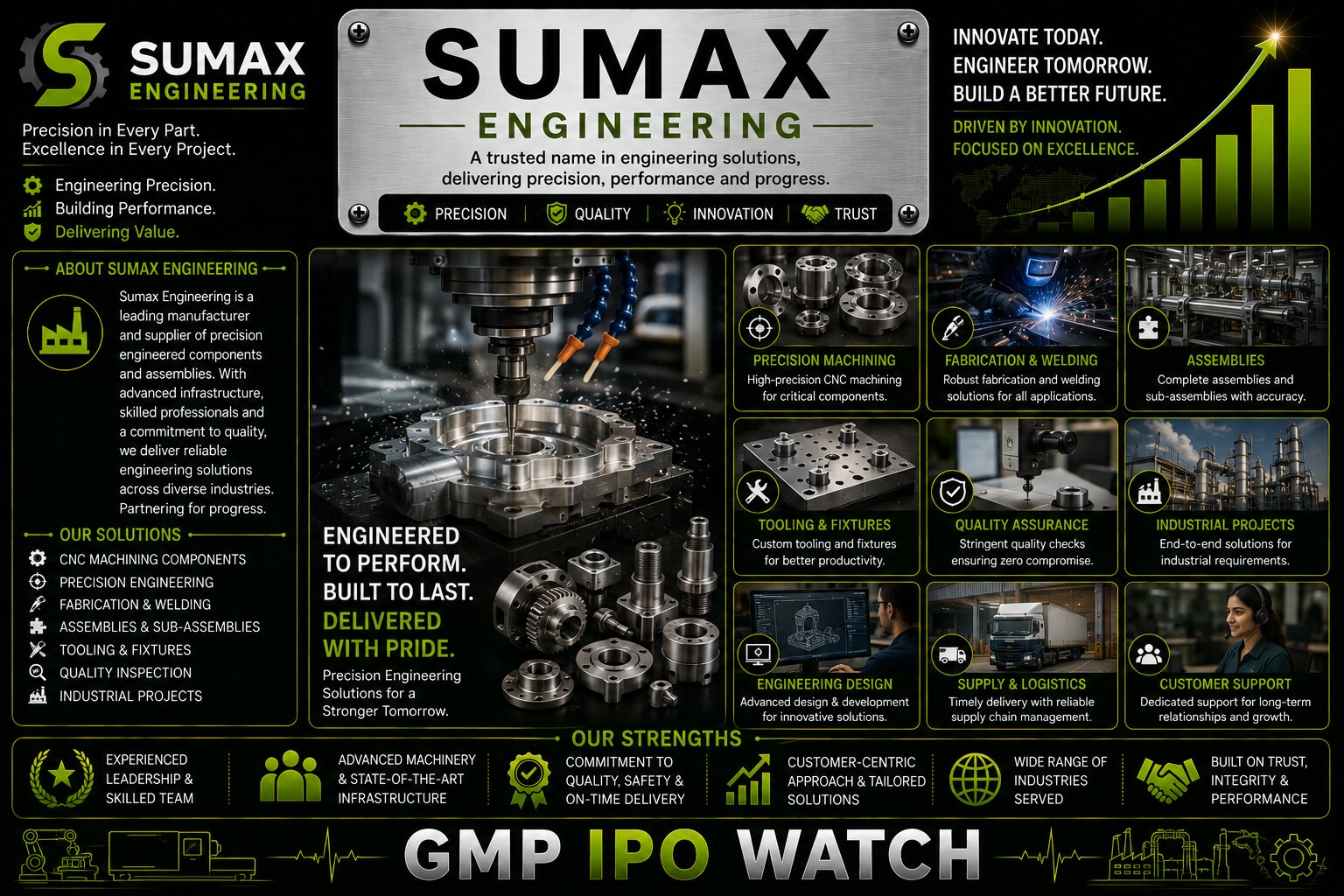
Sumax Engineering IPO 2026 – NSE SME Issue Opens for Subscription
Sumax Engineering Limited has entered the primary market today, August 25, 2026, with its SME IPO opening for public subscription.
The IPO will remain open until August 28, followed by expected allotment on August 31 and listing on the NSE SME platform on September 2.
Sumax operates in the automotive-products industry, with a portfolio covering several products used by OEMs as well as the automotive aftermarket.
Sumax Engineering IPO Details
| Particular | Details |
|---|---|
| Company | Sumax Engineering Limited |
| IPO Type | SME IPO |
| Issue Type | Book Built Issue |
| Listing Platform | NSE SME / NSE Emerge |
| Total Issue Size | ₹53.40 Crore |
| Fresh Issue | ₹43.34 Crore |
| Offer for Sale | ₹10.06 Crore |
| Total Shares Offered | 52,87,200 Shares |
| Fresh Issue Shares | 42,91,200 Shares |
| OFS Shares | 9,96,000 Shares |
| Price Band | ₹95 – ₹101 |
| Face Value | ₹10 |
| Lot Size | 1,200 Shares |
| Retail Minimum | 2,400 Shares |
| Minimum Retail Investment | ₹2,42,400 |
| IPO Open Date | August 25, 2026 |
| IPO Close Date | August 28, 2026 |
| Allotment Date | August 31, 2026 |
| Refund / Demat | September 1, 2026 |
| Expected Listing | September 2, 2026 |
The IPO comprises 42,91,200 fresh shares worth ₹43.34 crore and 9,96,000 OFS shares worth ₹10.06 crore at the upper price band.
Sumax Engineering IPO GMP Today
Sumax Engineering entered its opening day with positive activity in the unofficial grey market.
The latest report today indicates a ₹32 GMP, which against the ₹101 upper issue price represents an unofficial premium of roughly 31.7%.
| GMP Particular | Latest Update |
|---|---|
| Upper Price Band | ₹101 |
| Reported GMP | ₹32 |
| Indicative Price | ₹133 |
| Indicative Premium | ~31.7% |
| IPO Status | Open Today |
At this level, the grey market is indicating a price of roughly ₹133, but GMP is unofficial and can move sharply before listing.
What Does Sumax Engineering Do?
Sumax Engineering is involved in the manufacturing and trading of automotive products, serving both OEM and auto-refinish markets.
Its manufacturing portfolio includes products such as:
adhesive tapes + die-cuts + rubbing & polishing compounds + buffing pads + reflective tapes + printing solutions + domes + graphics + car-care products.
This diversified portfolio means Sumax is not dependent on a single automotive component.
Instead, it participates across several product categories connected with automotive manufacturing, finishing, repair, detailing and aftermarket demand.
OEM and Aftermarket Exposure Creates Two Demand Channels
Sumax's presence in both the OEM and auto-refinish markets is an important part of its business model.
OEM demand is connected primarily with production of new vehicles.
The aftermarket, meanwhile, can generate demand throughout a vehicle's life through:
repair + refinishing + detailing + maintenance + replacement products.
This creates two different demand engines:
new vehicle production → OEM sales
and
existing vehicle population → aftermarket sales.
A growing installed base of vehicles can therefore support demand even when new-vehicle production temporarily slows.
FY2026 Profit Increased Despite Modest Revenue Growth
Sumax Engineering's latest financial performance shows an interesting trend.
| Financial Metric | FY2025 | FY2026 |
|---|---|---|
| Revenue | ₹147.18 Cr | ₹148.34 Cr |
| PAT | ₹9.98 Cr | ₹12.76 Cr |
| Revenue Growth | ~0.8% | — |
| PAT Growth | ~27.9% | — |
The company reported ₹148.34 crore revenue in FY2026 compared with ₹147.18 crore in FY2025, while PAT increased from ₹9.98 crore to ₹12.76 crore.
This means profit growth significantly outpaced revenue growth.
Margin Improvement Is Worth Watching
The latest numbers suggest that Sumax generated substantially higher earnings without a similar increase in revenue.
PAT increased by nearly 28%, while revenue grew by less than 1%.
That can happen because of:
better product mix + improved manufacturing efficiency + lower costs + stronger pricing + operating leverage.
For IPO investors, the key question is whether this improvement is sustainable.
If margins remain at the newer level while revenue starts growing faster, earnings could benefit considerably.
On the other hand, if FY2026 profitability included temporary benefits, margins could normalise later.
Fresh Issue Forms Most of the IPO
One positive feature of the IPO structure is that the majority of the issue represents fresh capital.
| IPO Component | Amount | Approx. Share |
|---|---|---|
| Fresh Issue | ₹43.34 Cr | ~81.2% |
| Offer for Sale | ₹10.06 Cr | ~18.8% |
| Total IPO | ₹53.40 Cr | 100% |
The fresh issue accounts for approximately 81% of the total IPO, while the OFS contributes around 19%.
This means most of the capital raised through the public offering is intended for the company rather than being entirely an exit for existing shareholders.
Automotive Industry Provides a Large Addressable Market
India has a large and expanding automotive ecosystem.
The opportunity extends beyond vehicle manufacturers themselves and includes thousands of suppliers providing:
components + consumables + finishing products + adhesives + graphics + maintenance products + accessories.
Sumax operates within this broader ecosystem.
Demand can therefore be supported by both expansion in vehicle production and growth in India's existing vehicle population.
Adhesive and Die-Cut Products Have Wider Applications
Adhesive tapes and precision die-cut products are used for joining, sealing, masking, insulation and other applications.
For automotive manufacturers, such products can form small parts of the overall vehicle cost but remain important for assembly and finishing.
Customer qualification can also matter.
Once a supplier's product is approved for a particular manufacturing process, consistency in quality and delivery can help create repeat business.
Car-Care Products Add Aftermarket Exposure
Sumax's car-care products provide exposure beyond industrial manufacturing.
As India's vehicle population expands, demand can increase for products related to:
cleaning + polishing + detailing + surface protection + vehicle maintenance.
Unlike OEM sales, which are closely linked with current automobile production, aftermarket products can serve vehicles already on the road.
This provides a potentially recurring source of demand.
Competition Remains an Important Factor
Automotive components and consumables are highly competitive markets.
Sumax competes on factors such as:
product quality + pricing + innovation + delivery reliability + customer relationships.
OEM customers can also have considerable bargaining power because of their scale.
This means maintaining margins while remaining competitive can be challenging.
Raw-Material Costs Can Influence Profitability
Products such as tapes, compounds, pads and automotive consumables require multiple industrial raw materials.
Changes in input costs can therefore affect profitability.
The basic risk is:
raw-material prices rise → selling prices adjust slowly → gross margins decline.
The company's ability to pass higher costs to customers and manage procurement efficiently will therefore remain important.
Customer Diversification Matters
Automotive-component suppliers can sometimes generate a meaningful share of revenue from a relatively small number of customers.
Large customers can provide stable order volumes, but excessive dependence creates risk.
If a major customer:
reduces production + changes suppliers + renegotiates pricing + develops an alternative product
the supplier's revenue can be affected.
Investors should therefore watch customer concentration and the company's ability to add new OEM and aftermarket relationships.
IPO Lot Size Requires Higher Retail Capital
Sumax Engineering is an SME IPO, so the required retail investment is considerably higher than in most mainboard IPOs.
The market lot is 1,200 shares, but current IPO application data shows a minimum retail application of 2 lots or 2,400 shares.
At the upper price band:
2,400 × ₹101 = ₹2,42,400
Retail Application
| Particular | Details |
|---|---|
| Lot Size | 1,200 Shares |
| Retail Minimum Lots | 2 |
| Retail Minimum Shares | 2,400 |
| Upper Price | ₹101 |
| Minimum Application | ₹2,42,400 |
Investors should therefore distinguish between the market lot of 1,200 shares and the minimum retail application requirement.
Anchor Allocation Was Scheduled Before Opening
Anchor bidding for Sumax Engineering took place on August 24, a day before the public issue opened.
Current IPO data shows 14,35,200 shares allocated for the anchor investor portion.
The broader reservation structure includes QIB, NII and retail investor categories, with the public subscription continuing through August 28.
SME Listing Brings Additional Liquidity Risk
Sumax Engineering will list on the NSE SME platform rather than the mainboard.
This matters because SME stocks can experience:
lower trading volumes + wider bid-ask spreads + higher volatility + difficulty exiting large positions.
Strong GMP before listing does not remove these risks.
Investors evaluating the business for the longer term should therefore consider both company fundamentals and SME-market liquidity.
Key Strengths of Sumax Engineering
Sumax enters the IPO with an established automotive-products business serving OEM and auto-refinish markets.
Its broad manufacturing portfolio includes adhesive tapes, die-cuts, polishing compounds, buffing pads, reflective tapes, printing solutions, graphics and car-care products.
Recent profitability has also improved. PAT increased from ₹9.98 crore in FY2025 to ₹12.76 crore in FY2026, even though revenue remained relatively stable at around ₹148 crore.
Another notable factor is the IPO structure, with more than 80% of the ₹53.40 crore issue consisting of fresh capital.
Major Risks
The biggest question from the latest financial performance is whether the company's improved profitability can be sustained despite relatively modest revenue growth.
Other risks include:
- Automotive-sector cyclicality
- OEM customer concentration
- Raw-material price volatility
- Pricing pressure from large customers
- Competition in automotive consumables
- Working-capital requirements
- Execution of expansion plans
- Maintaining recent profit margins
- SME-market liquidity
- Post-listing price volatility
The current ₹32 GMP indicates positive short-term sentiment, but it should be viewed separately from these underlying business risks.
What Investors Should Track After Listing
| Metric | Why It Matters |
|---|---|
| Revenue Growth | Underlying demand |
| OEM Revenue | New vehicle exposure |
| Aftermarket Revenue | Diversification |
| EBITDA Margin | Operating efficiency |
| PAT Margin | Profit sustainability |
| PAT Growth | Earnings momentum |
| Customer Concentration | Revenue risk |
| Raw-Material Costs | Margin pressure |
| Working Capital | Cash efficiency |
| Receivable Days | Collection cycle |
| Operating Cash Flow | Earnings quality |
| ROCE | Capital efficiency |
For Sumax, margin sustainability alongside renewed revenue growth could be one of the most important indicators after listing.
Final View on Sumax Engineering IPO
The Sumax Engineering IPO opened today, August 25, 2026, and closes on August 28. The ₹53.40 crore NSE SME issue has a price band of ₹95–₹101, with allotment expected on August 31 and listing scheduled for September 2.
The IPO consists of a ₹43.34 crore fresh issue and ₹10.06 crore OFS, meaning roughly 81% of the total offering represents fresh capital.
Financially, the company reported ₹148.34 crore revenue and ₹12.76 crore PAT in FY2026, compared with ₹147.18 crore revenue and ₹9.98 crore PAT in FY2025. The sharp improvement in profit despite relatively flat revenue makes margin sustainability an important factor to monitor.
Meanwhile, today's reported ₹32 GMP implies an unofficial premium of approximately 32% over the ₹101 upper issue price, showing positive early market sentiment.





Loading comments...