

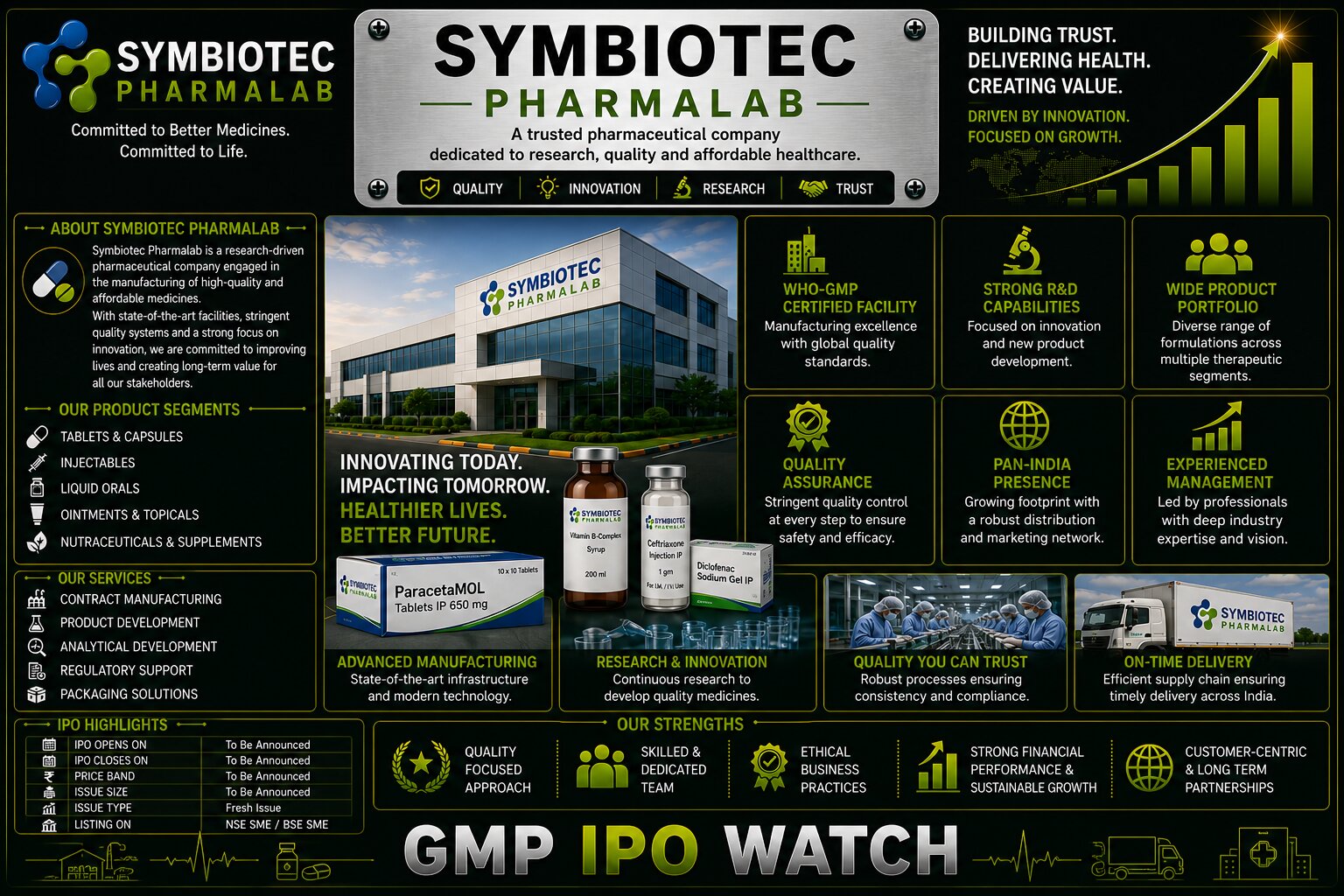
Symbiotec Pharmalab IPO 2026 – A High-Value Pharma IPO With a Small Fresh Issue
Symbiotec Pharmalab Limited is preparing to enter the primary market with a ₹1,757 crore mainboard IPO, opening for subscription on August 24, 2026.
The company operates in specialised pharmaceutical manufacturing and has capabilities spanning active pharmaceutical ingredients (APIs), biotechnology, CDMO services and complex injectables. Its technology platforms include organic chemistry, biosynthesis, biotransformation and recombinant biologics.
One aspect immediately stands out in this IPO:
Only ₹150 crore of the ₹1,757 crore issue is fresh capital.
The remaining approximately ₹1,607 crore is Offer for Sale (OFS) by existing shareholders.
This makes the composition of the offer an important part of the investment analysis.
Symbiotec Pharmalab IPO Details
| Particular | Details |
|---|---|
| Company | Symbiotec Pharmalab Ltd. |
| IPO Type | Mainboard IPO |
| Listing | BSE & NSE |
| Issue Size | ~₹1,757 Crore |
| Fresh Issue | ₹150 Crore |
| Offer for Sale | ~₹1,607 Crore |
| Price Band | ₹938 – ₹988 |
| Face Value | ₹2 Per Share |
| Lot Size | 15 Shares |
| Minimum Retail Investment | ₹14,820 at ₹988 |
| IPO Open Date | August 24, 2026 |
| IPO Close Date | August 27, 2026 |
| Expected Allotment | August 28, 2026 |
| Expected Listing | September 1, 2026 |
| Industry | Pharmaceuticals |
| Issue Type | Book Built Issue |
The ₹938–₹988 price band and August 24–27 bidding period have now been announced. A bid lot is 15 shares and multiples thereof.
Symbiotec Pharmalab IPO GMP Today
Grey-market sentiment ahead of the IPO is currently strong.
As of August 20, 2026, the latest reported Symbiotec Pharmalab IPO GMP is approximately:
₹200 per share.
At the upper issue price of ₹988:
₹988 + ₹200 = ₹1,188
This indicates an unofficial premium of approximately 20.24%.
| GMP Particular | Current Status |
|---|---|
| Upper IPO Price | ₹988 |
| Latest GMP | ₹200 |
| Indicative Price | ₹1,188 |
| Indicative Premium | ~20.24% |
| GMP Trend | Positive |
The IPO has not opened yet, so there is no public subscription data at present. Bidding begins on August 24.
GMP is an unofficial, unregulated market indicator and can change sharply before listing. It should not be considered a guaranteed listing return.
What Does Symbiotec Pharmalab Do?
Symbiotec is not simply a conventional generic-drug manufacturer.
Its capabilities span three interconnected technology platforms:
Organic Chemistry – including flow chemistry, hydrogenation and photochemistry.
Biotechnology – including biosynthesis, biotransformation and recombinant biologics.
Complex Injectables – including double-chamber vials, bags and syringes.
This allows the company to work on pharmaceutical products that can be technically more difficult to manufacture.
Steroidal APIs Are an Important Strength
Symbiotec has developed a significant position in corticosteroid and steroidal-hormone APIs.
APIs are the biologically active ingredients used in finished pharmaceutical medicines.
For example:
API manufacturer → formulation company → finished medicine → patient.
Symbiotec operates toward the upstream part of this pharmaceutical value chain.
Its manufacturing expertise can therefore serve pharmaceutical companies rather than depending solely on selling its own finished medicines.
Biotechnology Expands the Opportunity
The company's capabilities also include biotechnology processes such as:
- Biosynthesis
- Biotransformation
- Fermentation
- Recombinant biologics
Its platform extends into areas involving GLP-1 and insulin-related capabilities.
This is strategically important because modern pharmaceutical development is increasingly moving toward more complex biologically derived products.
However, having technical capabilities does not automatically guarantee commercial success.
New products still need regulatory approvals, customer acceptance and competitive economics.
700 KL Fermentation Capacity Provides Scale
One of Symbiotec's notable manufacturing strengths is its approximately 700 KL industrial-scale fermentation capacity.
Fermentation capabilities can create meaningful barriers to entry because these processes require:
specialised infrastructure + process expertise + quality control + regulatory compliance.
This is different from relatively simple pharmaceutical manufacturing where new competitors may enter more easily.
CDMO Could Become an Important Growth Engine
Symbiotec also operates within the Contract Development and Manufacturing Organisation (CDMO) market.
Under this model, pharmaceutical and life-sciences companies can outsource development or manufacturing activities to specialised companies such as Symbiotec.
The economics can be attractive when customer relationships become long term.
A successful CDMO relationship can evolve from:
development project → commercial manufacturing → larger volumes → repeat business.
That can provide better revenue visibility than purely transactional product sales.
Complex Injectables Add Another Layer of Specialisation
Symbiotec is also developing complex injectable products, including double-chamber formats.
Complex injectables generally have higher technical and regulatory barriers than conventional oral medicines.
They can require specialised:
- Manufacturing environments
- Sterility controls
- Drug-delivery systems
- Packaging
- Regulatory documentation
If Symbiotec can successfully commercialise these products at scale, they could diversify the business beyond its traditional API base.
Revenue Has Grown Over Recent Years
Available restated financial information shows the company's revenue from operations increasing from approximately:
₹566.51 crore in FY2023
to:
₹716.25 crore in FY2024
and:
₹751.55 crore in FY2025.
| Financial Year | Revenue from Operations | PAT |
|---|---|---|
| FY2023 | ₹566.15 Cr | ₹23.49 Cr |
| FY2024 | ₹716.25 Cr | ₹100.05 Cr |
| FY2025 | ₹751.55 Cr | ₹96.78 Cr |
The trend shows solid top-line expansion, although profit has not moved in a perfectly straight line.
That makes earnings quality and margin sustainability worth monitoring after listing.
EBITDA Margin Has Improved Significantly
One of the more encouraging financial trends is operating profitability.
Symbiotec's EBITDA margin increased from approximately:
12.96% in FY2023
to:
27.26% in FY2025.
This is a substantial improvement.
Higher margins can indicate:
- Better product mix
- Improved capacity utilisation
- Manufacturing efficiencies
- Higher-value products
- Better operating leverage
For a specialised pharmaceutical manufacturer, maintaining this improvement would be an important post-IPO indicator.
The IPO Is Dominated by OFS
This is one of the most important points for investors.
Of the approximately ₹1,757 crore final IPO size:
₹150 crore is fresh issue
while approximately:
₹1,607 crore is OFS.
That means only around 8.5% of the total IPO size represents fresh money going into Symbiotec itself.
The remaining proceeds go to selling shareholders.
This doesn't automatically make the IPO unattractive, but investors should understand that most of the transaction is a shareholder monetisation rather than fresh growth capital.
Existing Investors Are Selling Shares
The OFS includes shares being sold by promoter Satwani Holdings LLP and investors India Business Excellence Fund-III and Rosewood Investments.
Private-equity investors exiting through an IPO is common.
However, investors should distinguish between:
money raised by the company
and
money received by existing shareholders.
Only the fresh issue strengthens Symbiotec's balance sheet directly.
₹112.5 Crore Is Intended for Debt Repayment
Of the ₹150 crore fresh issue, approximately ₹112.5 crore is intended for repayment or prepayment of company borrowings, with the remaining amount available for general corporate purposes.
Fresh Issue Utilisation
| Purpose | Amount |
|---|---|
| Debt Repayment / Prepayment | ₹112.50 Cr |
| General Corporate Purposes | ~₹37.50 Cr |
| Total Fresh Issue | ₹150 Cr |
This means approximately 75% of fresh proceeds will be used for deleveraging.
Debt Reduction Can Improve Future Profitability
Debt repayment does not directly increase revenue.
But it can improve earnings through lower finance costs.
The equation is simple:
lower borrowings → lower interest expense → stronger PAT and cash flow.
This can be particularly useful for a manufacturing company that already generates substantial EBITDA.
The real test after listing will be whether debt actually remains lower or rises again because of future capacity investments.
Export Business Provides Geographic Diversification
Symbiotec already has meaningful international exposure.
Its FY2023-24 sustainability disclosures showed export revenue of approximately ₹385.31 crore, representing around 59% of turnover, with markets across multiple countries.
Exports provide several potential benefits:
larger addressable market + diversified customers + access to regulated pharmaceutical markets.
But they also introduce:
- Currency risk
- Regulatory risk
- International competition
- Country-specific compliance requirements
Pharmaceutical Manufacturing Has High Regulatory Barriers
A pharmaceutical plant cannot operate like a conventional factory.
Customers and regulators can require extensive compliance involving:
- Manufacturing practices
- Product purity
- Documentation
- Quality control
- Validation
- Regulatory inspections
This creates barriers for new competitors.
Once a manufacturer has successfully passed customer and regulatory qualification processes, commercial relationships can become relatively sticky.
But the downside is equally significant.
A serious regulatory observation can disrupt production or exports.
Backward Integration Can Improve Supply Security
Symbiotec has backward integration capabilities for certain key intermediates.
This can reduce reliance on external suppliers.
For pharmaceutical companies, supply-chain security matters because shortages of critical raw materials can interrupt manufacturing and customer deliveries.
Backward integration can potentially support:
better availability + cost control + quality consistency.
However, it also increases operational complexity.
Customer Concentration Is a Risk
Current IPO disclosures highlight dependence on key customers as an important risk.
Large pharmaceutical customers can provide significant and repeat business.
But concentration creates vulnerability.
If a major customer:
- Changes supplier
- Reduces orders
- Develops manufacturing internally
- Faces regulatory problems
Symbiotec's revenue could be affected.
The ideal future trend would be growth in both:
existing customer business + new customer additions.
API Concentration Is Another Important Risk
Despite its diversified technology capabilities, a large share of Symbiotec's existing revenue still comes from APIs.
This means the investment story should not yet be viewed as fully diversified across APIs, CDMO and complex injectables.
The future opportunity is to gradually increase the contribution from higher-value and differentiated platforms.
If that happens, revenue quality and margins could potentially improve.
R&D Is Critical to Long-Term Growth
Pharmaceutical businesses cannot depend forever on the same product portfolio.
Competitors eventually enter.
Pricing changes.
Customers shift.
Therefore, Symbiotec needs continuous research and development to create:
new APIs + improved processes + biologics capabilities + complex injectables + CDMO opportunities.
R&D is not simply an expense in this industry.
It is part of the company's future product pipeline.
Key Strengths
Symbiotec enters the IPO with several meaningful strengths:
Specialised pharma capabilities: The company operates across organic chemistry, biotechnology and complex injectables.
Strong steroid API position: Its established expertise provides a specialised market presence.
Large fermentation capability: Approximately 700 KL capacity supports biotechnology operations.
Export exposure: International sales provide geographic diversification.
Improving margins: EBITDA margin increased substantially between FY2023 and FY2025.
CDMO opportunity: Long-term pharmaceutical outsourcing can create recurring customer relationships.
Debt repayment: ₹112.5 crore of fresh proceeds is intended to reduce borrowings.
Positive pre-IPO GMP: Current reported GMP is approximately ₹200.
Major Risks
The first major risk is the large OFS component. Only ₹150 crore of the approximately ₹1,757 crore IPO goes directly to the company.
The second is API revenue concentration, despite the company's broader technology capabilities.
Other important risks include:
- Dependence on key customers
- Raw-material availability
- Pharmaceutical regulatory compliance
- Manufacturing disruptions
- Currency fluctuations
- Competitive pricing
- R&D execution
- Product approval delays
- Debt and financing requirements
The company also operates in an industry where even a temporary manufacturing or regulatory issue can have a disproportionate financial impact.
What Could Drive Symbiotec's Next Growth Phase?
The first growth driver is expanding its CDMO business.
The second is commercialising more complex injectable products.
The third is expanding biotechnology capabilities, including recombinant products.
The fourth is increasing business from global pharmaceutical customers.
The fifth is improving capacity utilisation across existing manufacturing infrastructure.
Finally, debt repayment can allow more operating profit to reach the bottom line through reduced finance costs.
What Investors Should Track After Listing
| Metric | Why It Matters |
|---|---|
| Revenue Growth | Business expansion |
| EBITDA Margin | Manufacturing economics |
| PAT Margin | Earnings quality |
| API Revenue Share | Concentration risk |
| CDMO Revenue | Diversification |
| Export Revenue | Global growth |
| R&D Spending | Future pipeline |
| Capacity Utilisation | Asset efficiency |
| Borrowings | Deleveraging progress |
| Finance Cost | IPO benefit |
| Customer Concentration | Revenue risk |
| Operating Cash Flow | Earnings conversion |
For Symbiotec, the most important long-term transition will be whether it can move from being heavily API-led toward a more diversified combination of:
APIs + CDMO + biotechnology + complex injectables.
Final View on Symbiotec Pharmalab IPO 2026
The Symbiotec Pharmalab IPO will open on August 24 and close on August 27, 2026, with a price band of ₹938–₹988 per share. The minimum bid is 15 shares, translating into ₹14,820 at the upper band. Listing is currently expected on September 1.
The final IPO size is approximately ₹1,757 crore, comprising a ₹150 crore fresh issue and roughly ₹1,607 crore OFS.
As of August 20, the latest reported GMP is around ₹200 per share, implying an unofficial estimated price near ₹1,188 and a premium of roughly 20.24% over the ₹988 upper price.
The company's fundamental story is more interesting than its GMP.
Symbiotec has established specialised capabilities across steroidal APIs, organic chemistry, biotechnology, fermentation, CDMO and complex injectable products. Revenue from operations increased from around ₹566 crore in FY2023 to approximately ₹752 crore in FY2025, while EBITDA margins improved substantially.
The biggest structural caution is the IPO composition: only about 8.5% of the ₹1,757 crore offer is fresh capital, while the rest is an OFS.
For long-term investors, the key question will therefore be whether Symbiotec can use its existing manufacturing and R&D capabilities—not simply IPO capital—to scale higher-value businesses such as CDMO, biotechnology and complex injectables.
Loading comments...