

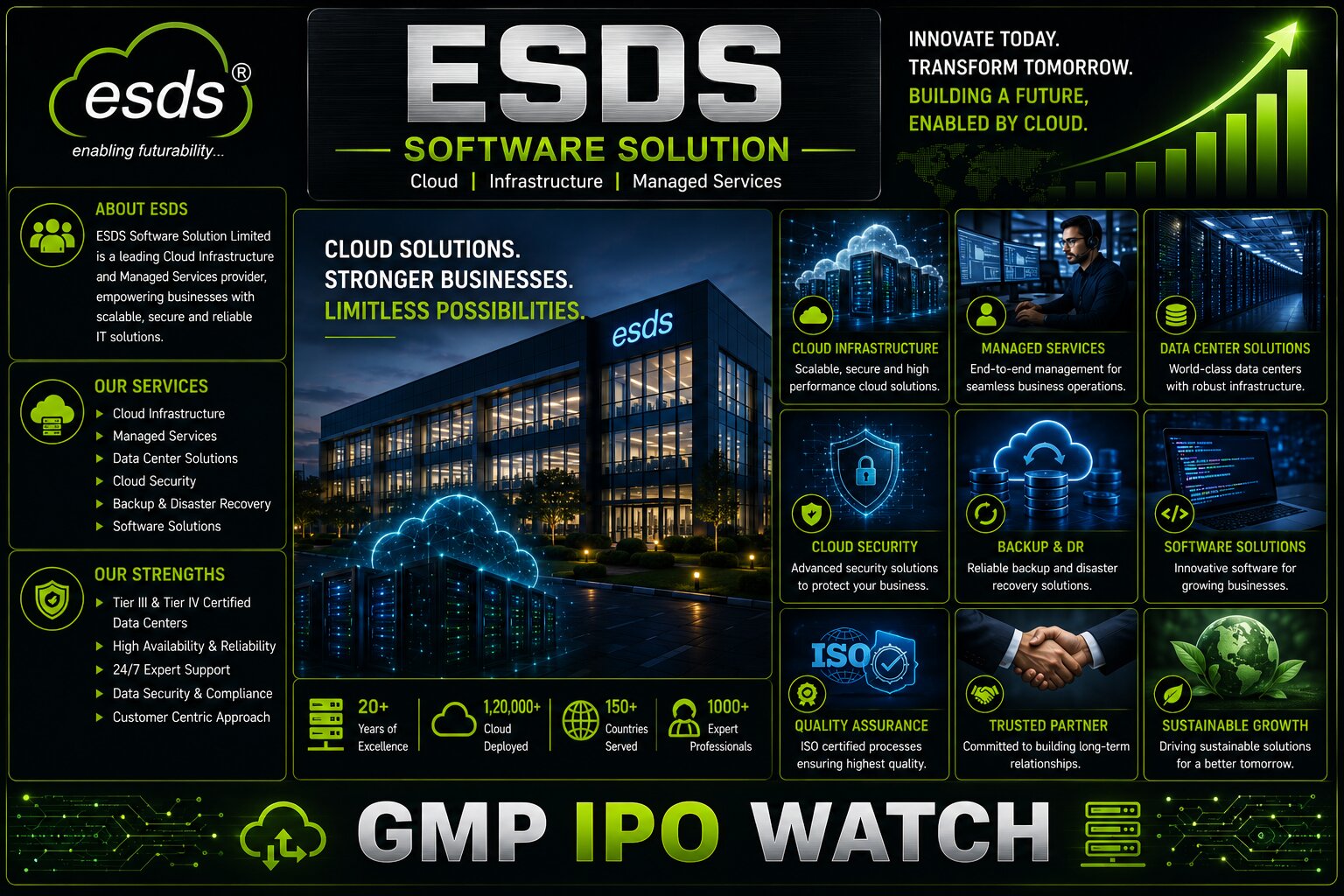
ESDS Software Solution IPO 2026 – ₹720 Crore Mainboard Issue Coming This Week
ESDS Software Solution Limited is preparing to enter the primary market with its IPO opening on Friday, August 28, 2026.
The issue will remain open until September 1, while anchor investors can participate on August 27. ESDS has fixed the IPO price band at ₹408 to ₹429 per equity share.
The IPO arrives at an interesting time for India's data centre and cloud-computing industry, with enterprises, governments and digital businesses requiring increasing amounts of computing infrastructure.
ESDS Software Solution IPO Details
| Particular | Details |
|---|---|
| Company | ESDS Software Solution Limited |
| IPO Type | Mainboard IPO |
| Issue Type | Book Built Issue |
| Total Issue Size | ₹720 Crore |
| Fresh Issue | ₹720 Crore |
| Offer for Sale | Nil |
| Approx. Shares Offered | 1.68 Crore |
| Price Band | ₹408 – ₹429 |
| Face Value | ₹1 |
| Lot Size | 34 Shares |
| Minimum Investment | ₹14,586 |
| Anchor Date | August 27, 2026 |
| IPO Open Date | August 28, 2026 |
| IPO Close Date | September 1, 2026 |
| Expected Listing | September 4, 2026 |
| Listing Exchange | BSE & NSE |
| Registrar | MUFG Intime India |
| Lead Managers | DAM Capital & Systematix |
The ₹720 crore IPO consists entirely of fresh shares, with no Offer for Sale by existing shareholders.
What Does ESDS Software Solution Do?
Founded in 2005, ESDS operates across the cloud computing, data centre, managed services and enterprise software ecosystem.
Its business can broadly be divided into:
| Business Area | Services |
|---|---|
| Cloud Services | Enterprise cloud infrastructure |
| Data Centres | Hosting & computing infrastructure |
| Managed Services | IT infrastructure management |
| SaaS | Subscription software solutions |
| AI Solutions | AI-enabled enterprise services |
| Government Solutions | Digital infrastructure & cloud |
| Security Services | Managed cybersecurity solutions |
The company generates revenue using models including pay-per-consumption, subscriptions and pay-per-branch arrangements.
This creates an important recurring-revenue element because customers can continue using cloud infrastructure and managed services over extended periods.
ESDS Is More Than a Traditional Data Centre Operator
ESDS should not be viewed only as a company that rents physical server space.
Its broader model combines:
data centre infrastructure + cloud computing + managed services + SaaS + cybersecurity + AI-enabled solutions.
This allows ESDS to provide multiple services to the same enterprise or government customer.
A customer may initially use ESDS for cloud infrastructure and later add managed services, security or software products.
That creates opportunities for higher revenue per customer.
FY2026 Revenue Reached ₹480.65 Crore
ESDS has reported strong growth in recent years.
| Financial Metric | FY2024 | FY2025 | FY2026 |
|---|---|---|---|
| Total Income | ₹292.14 Cr | ₹376.64 Cr | ₹480.65 Cr |
| PAT | ₹13.61 Cr | ₹55.61 Cr | ₹120.82 Cr |
| Revenue / Income Growth | — | ~28.9% | ~27.6% |
| PAT Growth | — | ~308.6% | ~117.3% |
ESDS' total income increased from ₹292.14 crore in FY2024 to ₹480.65 crore in FY2026, while PAT expanded from ₹13.61 crore to ₹120.82 crore over the same period.
The profit trajectory is particularly notable.
PAT More Than Doubled in FY2026
Profit increased from ₹55.61 crore in FY2025 to ₹120.82 crore in FY2026, representing growth of approximately 117%.
This means earnings grew considerably faster than total income.
The progression has been:
₹13.61 Cr → ₹55.61 Cr → ₹120.82 Cr PAT.
That sharp increase makes margin sustainability one of the most important financial questions around the IPO.
Investors should watch whether ESDS can maintain its stronger profitability as it adds new data centre infrastructure.
IPO Is 100% Fresh Issue
The structure of the ESDS IPO is worth highlighting.
| IPO Component | Amount | Share |
|---|---|---|
| Fresh Issue | ₹720 Cr | 100% |
| Offer for Sale | Nil | 0% |
| Total IPO | ₹720 Cr | 100% |
Unlike an OFS-heavy IPO, all ₹720 crore is being raised by ESDS itself.
This means existing shareholders are not using the IPO to sell shares through an Offer for Sale.
The proceeds instead strengthen the company's capital base and support its expansion strategy.
Data Centre Expansion Is the Core IPO Story
The central reason behind the IPO is expansion of ESDS' data centre infrastructure.
The company intends to deploy a significant portion of the fresh proceeds toward purchasing cloud computing and data centre equipment for its facilities. It is also targeting broader expansion of its data centre footprint and international business.
For ESDS, the growth cycle can be viewed as:
IPO capital → new servers & infrastructure → higher computing capacity → more customers/workloads → higher cloud revenue.
However, simply installing infrastructure does not guarantee higher returns.
The company must attract sufficient customer workloads to utilise that capacity efficiently.
Why Data Centre Capacity Matters
Cloud companies require substantial computing infrastructure.
Customers increasingly need capacity for:
enterprise applications + databases + digital transactions + AI workloads + government platforms + cybersecurity + backup & disaster recovery.
As those workloads expand, cloud providers need additional servers, networking equipment, storage and supporting data centre infrastructure.
ESDS' IPO therefore provides capital to increase the infrastructure available to serve future demand.
AI Could Create Another Demand Driver
Artificial intelligence is increasing computing requirements across industries.
AI workloads can require considerably more processing capacity than conventional applications.
For ESDS, this creates an opportunity because customers deploying AI solutions may need:
computing power + storage + cloud infrastructure + data security + managed services.
ESDS already positions itself as an AI-enabled cloud and data centre services provider.
The important question after listing will be whether AI-related demand translates into measurable revenue growth rather than remaining only a broader industry theme.
Government and Enterprise Customers Are Important
ESDS serves both enterprise and government-related customers.
Government digitalisation can create demand for:
cloud hosting + digital platforms + secure data storage + disaster recovery + managed infrastructure.
Enterprise customers, meanwhile, increasingly migrate workloads away from traditional on-premise IT systems toward cloud environments.
These two customer groups provide ESDS with exposure to India's broader digital transformation.
Recurring Revenue Can Improve Business Visibility
One attractive characteristic of cloud and managed-services businesses is the possibility of recurring revenue.
Unlike a company that sells equipment once, ESDS can generate revenue repeatedly while customers continue consuming infrastructure or software services.
Its revenue models include:
subscription + pay-per-consumption + pay-per-branch.
That can potentially create stronger revenue visibility and customer retention.
Investors should therefore track recurring revenue and customer renewal rates after listing.
Expansion Outside India Is Another Opportunity
ESDS is also looking beyond India's domestic cloud market.
Current IPO reporting indicates that the company intends to pursue international expansion, particularly across markets such as Europe and Southeast Asia.
International expansion can provide access to a larger addressable market.
However, it also introduces additional challenges involving:
competition + regulation + customer acquisition + foreign exchange + local infrastructure + data-protection requirements.
Execution will therefore matter more than simply entering new geographies.
Data Centres Require Continuous Capital Investment
Cloud infrastructure is not a one-time investment.
Technology changes quickly.
Servers, processors, storage and networking equipment can become outdated and require upgrades.
Therefore, even after the IPO-funded expansion, ESDS will likely need continuing investment in:
servers + networking + storage + power infrastructure + security + software + AI computing resources.
Investors should monitor capex intensity and whether new investments generate adequate returns.
Customer Retention Is Critical
Cloud migration can involve substantial work for customers.
Once an enterprise has moved applications and data to a particular provider, switching to another platform can involve:
migration cost + downtime risk + technical complexity + security reviews + employee effort.
This can create customer stickiness.
But larger cloud providers also compete aggressively on technology, pricing and service availability.
For ESDS, maintaining strong service quality will therefore be essential for customer retention.
Competition Comes From Much Larger Players
The cloud market is highly competitive.
ESDS competes not only with Indian data centre and managed-service providers but also with large global cloud platforms.
The company's competitive positioning therefore depends on factors such as:
local infrastructure + customer support + customised solutions + data residency + pricing + government-sector expertise + managed services.
ESDS does not necessarily need to compete with global hyperscalers purely on infrastructure scale.
Its opportunity can instead lie in specialised managed cloud solutions and customers requiring greater localisation.
Cybersecurity Is a Major Operational Risk
A cloud provider stores and processes critical customer data.
That makes cybersecurity one of the most important operational risks.
Potential threats include:
data breaches + ransomware + service disruption + unauthorised access + network attacks.
A serious security incident could damage customer confidence and create financial or regulatory consequences.
ESDS therefore needs continuous investment in security systems and operational resilience.
Power Availability Is Critical for Data Centres
Data centres require continuous electricity.
Servers must remain operational around the clock, and cooling systems also consume substantial power.
Therefore, ESDS needs reliable:
power supply + backup systems + cooling infrastructure + network connectivity.
Unexpected outages can affect service availability and customer relationships.
Operational uptime will remain a key performance factor as the company expands.
ESDS Software Solution IPO GMP
The IPO has not yet opened for public bidding, so grey-market activity should be treated cautiously.
| GMP Indicator | Current Position |
|---|---|
| Upper Price Band | ₹429 |
| IPO Opening | August 28 |
| Anchor Bidding | August 27 |
| Reliable GMP Trend | Early / Developing |
| Listing Date | September 4 |
Because the public issue opens only on August 28, it is better to monitor the GMP closer to subscription and listing rather than assign importance to very early unofficial quotes.
IPO Valuation
At the upper price band of ₹429, ESDS is reportedly valued at approximately ₹5,028 crore.
Using FY2026 PAT of ₹120.82 crore, the implied historical earnings valuation is roughly:
₹5,028 crore ÷ ₹120.82 crore = ~41.6× P/E.
| Valuation Indicator | Approx. Value |
|---|---|
| Upper Price Band | ₹429 |
| Implied Market Cap | ₹5,028 Cr |
| FY2026 PAT | ₹120.82 Cr |
| Implied P/E | ~41.6× |
This means future growth becomes important.
A higher valuation can be supported if ESDS continues delivering strong earnings growth, but slower-than-expected expansion could make the valuation more demanding.
Key Strengths of ESDS Software Solution
ESDS enters the IPO with a combination of strong recent financial growth and exposure to structurally growing technology markets.
Total income increased from ₹292.14 crore in FY2024 to ₹480.65 crore in FY2026, while PAT expanded from ₹13.61 crore to ₹120.82 crore.
The company also benefits from multiple technology offerings rather than depending solely on data centre space.
Its platform includes cloud infrastructure, managed services, SaaS and other enterprise technology solutions.
Another important positive is the 100% fresh-issue structure, allowing the entire ₹720 crore offering to strengthen the company rather than fund an OFS.
Major Risks
The biggest areas investors should monitor include intense competition, high ongoing technology investment, cybersecurity threats and execution of the planned data centre expansion.
The sharp increase in PAT also creates a high base for future comparisons. Investors will need to determine whether FY2026 profitability is sustainable.
Other risks include:
- Technology obsolescence
- Data centre capacity underutilisation
- Power and cooling costs
- Customer concentration
- Cybersecurity incidents
- Regulatory and data-residency requirements
- International expansion execution
- Competition from hyperscale cloud providers
- High valuation expectations
What Investors Should Track After Listing
| Metric | Why It Matters |
|---|---|
| Revenue Growth | Overall business expansion |
| Cloud Revenue | Core demand |
| Recurring Revenue | Earnings visibility |
| EBITDA Margin | Operating profitability |
| PAT Growth | Earnings momentum |
| Data Centre Capacity | Expansion progress |
| Capacity Utilisation | Capex efficiency |
| Customer Additions | Demand growth |
| Customer Retention | Revenue stability |
| Operating Cash Flow | Earnings quality |
| Capex | Infrastructure investment |
| ROCE | Return on expansion capital |
For ESDS, capacity utilisation and recurring cloud revenue could become two of the most important post-listing indicators.
Final View on ESDS Software Solution IPO
The ESDS Software Solution IPO opens on August 28, 2026 and closes on September 1, with a price band of ₹408–₹429 per share. The ₹720 crore offering is a 100% fresh issue, with no OFS.
Financially, ESDS enters the IPO after a particularly strong FY2026. Total income increased to ₹480.65 crore from ₹376.64 crore, while PAT jumped to ₹120.82 crore from ₹55.61 crore in FY2025.
The bigger long-term story, however, is what ESDS does with the ₹720 crore it raises. The company intends to strengthen data centre infrastructure while pursuing broader cloud and international expansion.






Loading comments...