

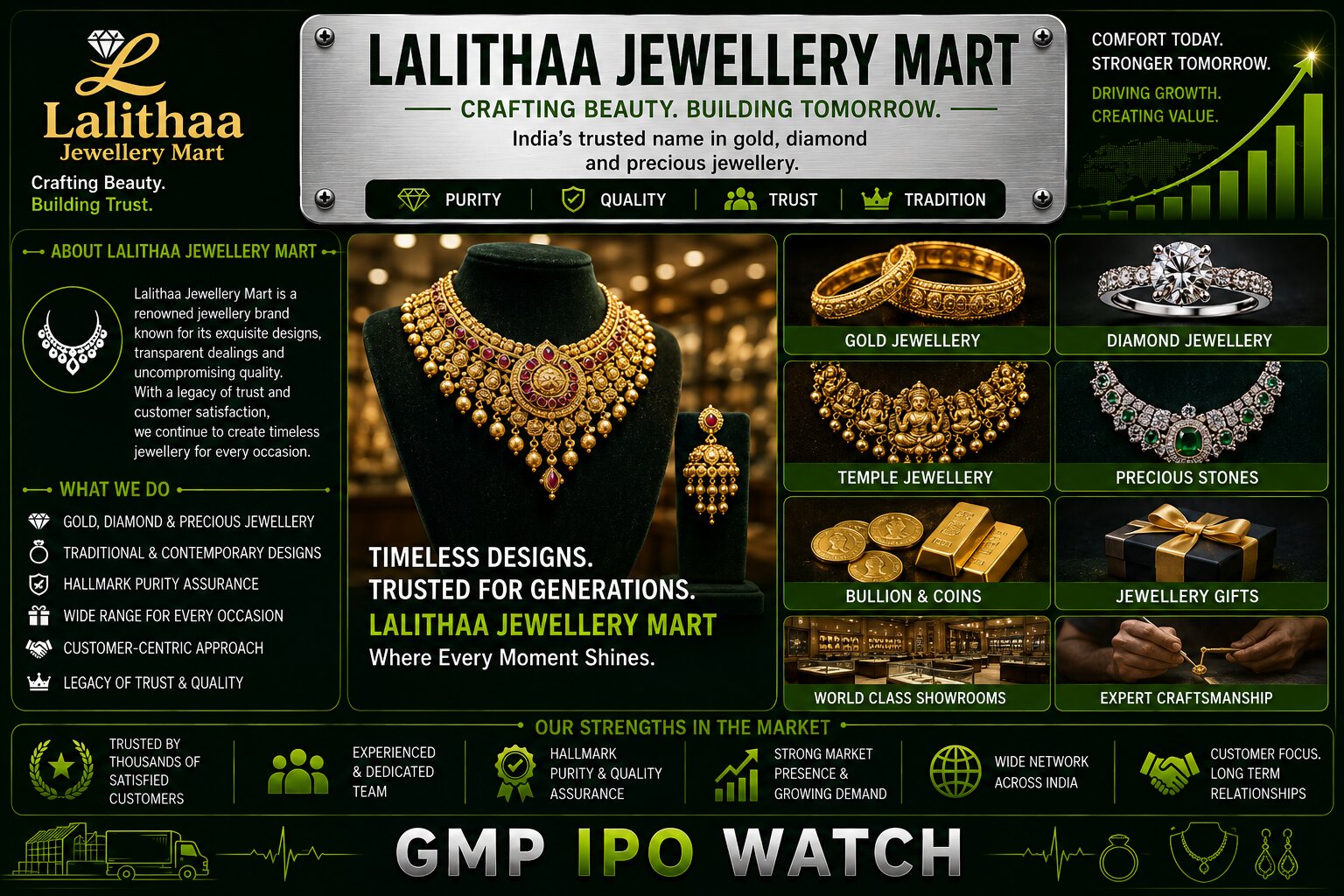
Lalithaa Jewellery Mart IPO 2026 – Can Its High-Volume Jewellery Model Scale Across More Stores?
Jewellery retail looks simple from outside.
Buy gold.
Design jewellery.
Sell it at a higher price.
But the economics are considerably more complicated.
A jewellery retailer needs to manage:
gold inventory + customer trust + making charges + store productivity + inventory turnover + working capital.
Lalithaa Jewellery Mart has built substantial scale around this model.
The Chennai-headquartered jewellery retailer operates 61 stores across southern India and sells gold, silver and diamond jewellery.
The company is now entering the public market after reporting a major jump in FY2026 profitability.
FY2026 revenue reached approximately ₹25,023.93 crore, while PAT surged to approximately ₹1,009.82 crore.
Those are substantial numbers.
But the IPO creates a more important question:
Can Lalithaa replicate its existing high-volume store economics as it expands into new locations?
That is the core long-term investment story.
Lalithaa's Business Model Is Built Around Volume
Jewellery retailers can broadly choose between two approaches.
One model emphasises:
high making charges + premium positioning + higher margins.
Another focuses more heavily on:
competitive pricing + high inventory turnover + larger sales volumes.
Lalithaa has historically built its positioning around competitive pricing and a high-volume jewellery-retail model.
That means store productivity becomes especially important.
A relatively small improvement in margin can create substantial additional profit when annual revenue exceeds ₹25,000 crore.
Revenue Per Store Is an Important Metric
With 61 stores and annual revenue above ₹25,000 crore, Lalithaa generates significant sales through its retail network.
This matters because jewellery stores require substantial investment.
A new showroom needs:
- Inventory
- Security
- Employees
- Interiors
- Marketing
- Working capital
Opening more stores does not automatically create shareholder value.
The new stores need to reach strong sales productivity.
Why Store Productivity Matters More Than Store Count
Imagine two jewellery chains.
Company A
100 stores generating ₹100 crore each.
Company B
50 stores generating ₹300 crore each.
Company A has twice as many stores.
But Company B generates substantially more revenue.
Therefore, investors should not judge Lalithaa's future growth merely by headlines such as:
“10 new stores opened.”
The better question is:
How much revenue and profit does each new store generate?
The IPO Will Fund New Stores
Current IPO reporting says fresh proceeds will be used toward establishing 10 new stores, alongside general corporate purposes.
This makes the IPO fundamentally an expansion transaction.
If those stores achieve economics comparable to Lalithaa's mature locations, they can create substantial incremental revenue.
But new jewellery stores require large upfront investment before they mature.
New Stores Need More Than Real Estate
Opening a jewellery showroom is different from opening many conventional retail outlets.
A significant portion of the investment sits inside the display cabinets.
The company needs inventory across:
- Gold necklaces
- Bangles
- Earrings
- Rings
- Chains
- Bridal jewellery
- Diamond products
- Silver products
Customers expect choice.
A poorly stocked jewellery store can struggle even if it is located in an attractive market.
Inventory Is Effectively the Product and the Capital Base
This creates one of the most interesting features of jewellery economics.
Suppose Lalithaa opens a new store.
It may spend money on interiors.
But a much larger economic commitment can be the gold and jewellery inventory required to make the store commercially attractive.
That capital remains tied up until products are sold.
Therefore:
inventory turnover is one of the most important metrics in jewellery retail.
Faster Inventory Turnover Can Transform Returns
Consider two stores holding ₹100 crore of jewellery.
Store A
Sells through its inventory twice per year.
Store B
Turns inventory four times.
Store B generates significantly more revenue from the same inventory capital.
This is why Lalithaa's high-volume model can be powerful.
If competitive pricing attracts more customers and moves jewellery faster, lower margins can still produce attractive returns.
Gold Prices Can Make Revenue Growth Misleading
Suppose Lalithaa sells exactly the same quantity of gold jewellery next year.
But gold prices rise 20%.
Reported rupee revenue can increase even if physical sales volumes remain unchanged.
Therefore, investors should not analyse jewellery retailers only through headline revenue growth.
They should also consider:
- Volume growth
- Same-store sales
- Store additions
- Gold prices
- Margins
This helps distinguish genuine business expansion from commodity-price inflation.
Gold Price Volatility Is a Major Risk
Gold prices can move sharply.
Higher prices can initially increase the value of jewellery inventory.
But they can also make jewellery less affordable.
A customer planning to buy a 50-gram necklace may:
- Buy a lighter product
- Postpone the purchase
- Switch designs
- Reduce discretionary spending
Therefore, rising gold prices are not automatically positive for a jewellery retailer.
Wedding Demand Provides Structural Support
India's jewellery market benefits from a powerful cultural demand driver:
weddings.
Gold jewellery is not purely discretionary fashion expenditure.
For many households, it is connected with:
- Marriage
- Festivals
- Family traditions
- Savings
This can provide more resilient demand than many other luxury categories.
Lalithaa's large presence in southern India places it in markets where gold jewellery has significant cultural importance.
Trust Is a Major Competitive Advantage
A jewellery purchase is different from buying ordinary retail merchandise.
Customers need confidence in:
- Gold purity
- Weight
- Pricing
- Buyback terms
- Brand reputation
Trust can take years to build.
This creates a barrier for new entrants.
An established jewellery retailer with strong brand recognition can therefore attract customers even when many local jewellers operate nearby.
Organised Jewellery Retail Has a Long-Term Opportunity
India's jewellery market has historically included a large unorganised segment.
But customers increasingly value:
- Hallmarking
- Transparent billing
- Standardised processes
- Exchange policies
- Brand trust
This supports organised jewellery chains.
Lalithaa's expansion can therefore benefit not only from overall jewellery-market growth but also from customers shifting toward organised retailers.
FY2026 Was a Breakout Profit Year
Lalithaa reported FY2026 revenue of approximately ₹25,023.93 crore and PAT of approximately ₹1,009.82 crore.
Current IPO reporting indicates PAT increased by roughly 177% during FY2026.
That is an extraordinary increase.
For investors, however, such rapid profit growth creates another question:
How much of FY2026 profitability is sustainable?
Profit Growth Faster Than Revenue Is Important
When profit grows much faster than revenue, several things may be happening:
- Better gross margins
- Better inventory economics
- Operating leverage
- Lower expenses relative to sales
- Product-mix improvement
If these improvements are structural, Lalithaa could maintain stronger profitability.
If they were influenced heavily by favourable gold-market conditions, future margins could normalise.
This deserves close attention after listing.
Cash Flow Is a Key Risk
Current IPO analysis specifically highlights negative operating cash flow as a risk despite strong FY2026 accounting profitability.
This matters because jewellery is extremely inventory intensive.
A company can report ₹1,000 crore of profit but still require substantial cash if it is continuously purchasing more gold for:
- Existing stores
- New stores
- Higher gold prices
Accounting profit and cash generation can therefore diverge.
Why Expansion Can Produce Negative Cash Flow
Suppose Lalithaa earns ₹1,000 crore profit.
Now suppose it invests:
₹600 crore in additional jewellery inventory and substantial amounts in new stores.
The income statement can remain profitable.
But cash flow can be much weaker.
This does not automatically mean the business is unhealthy.
It means investors need to understand where the cash is going.
Inventory Growth Should Be Compared With Revenue Growth
One useful post-IPO test is:
Inventory growth vs revenue growth.
If revenue grows 20% while inventory rises 15%, efficiency may be improving.
If revenue grows 20% while inventory rises 60%, more capital is being tied up to generate each rupee of sales.
That can reduce returns.
New-Store Payback Will Matter
Every new store should eventually repay the capital invested in:
- Fit-out
- Inventory
- Employees
- Marketing
Suppose a store requires ₹100 crore total capital.
If it generates ₹20 crore annual operating profit, economics can be attractive.
If it generates only ₹5 crore, capital productivity is much weaker.
After the IPO, investors should watch whether the new stores approach the economics of Lalithaa's established locations.
Expansion Into New Markets Can Be Difficult
A jewellery brand successful in Chennai does not automatically become equally successful everywhere.
Jewellery preferences vary by:
- Region
- Community
- Wedding traditions
- Income level
Designs popular in Tamil Nadu may differ from those preferred in another state.
Therefore, geographic expansion requires localisation.
Lalithaa needs to maintain its brand identity while adapting inventory to local preferences.
₹1,200 Crore Fresh Issue Provides Significant Expansion Capital
Of the ₹1,700 crore IPO, ₹1,200 crore is fresh capital entering the company.
This is important.
More than 70% of the IPO is being raised for company purposes rather than shareholder exits.
That capital can help fund the next stage of retail expansion.
₹500 Crore OFS Provides Promoter Liquidity
The remaining ₹500 crore is an Offer for Sale by promoter Kiran Kumar Jain.
The promoter group's holding is expected to decline from approximately 97.7% before the IPO to 82.9% afterward.
Promoters therefore remain firmly in control after listing.
Anchor Investors Put in ₹508 Crore
Before the IPO opened, Lalithaa Jewellery Mart raised approximately ₹508 crore from anchor investors.
Anchor participation indicates institutional interest before the public subscription period.
However, investors should still independently evaluate valuation, cash flow and expansion risks.
Valuation Appears Discounted to Several Listed Jewellery Peers
One of the interesting aspects highlighted in today's IPO analysis is that Lalithaa combines unusually high sales per store with a valuation multiple below many established listed jewellery peers.
A valuation discount can represent an opportunity.
But it can also compensate investors for risks such as:
- Regional concentration
- Cash-flow volatility
- Lower margins
- Gold-price exposure
- Expansion execution
Therefore, the discount should not automatically be treated as undervaluation.
Lower Margins Are Not Necessarily a Weakness
A retailer with a high-volume strategy may intentionally operate at lower margins.
Suppose:
Retailer A
10% margin × ₹1,000 crore sales = ₹100 crore profit.
Retailer B
5% margin × ₹3,000 crore sales = ₹150 crore profit.
Retailer B has half the margin but earns more total profit.
That is why Lalithaa's economics should be evaluated using:
margin + inventory turnover + capital efficiency
together.
Lalithaa Jewellery Mart IPO Subscription Today
The IPO opened today, August 17, 2026.
At one current Day-1 update, overall subscription stood around:
0.14×
with retail around:
0.22×.
An earlier NSE-based update at approximately 10:45 AM showed the issue around 11% subscribed, demonstrating how quickly the Day-1 figure is changing.
Because the issue remains open through August 19, early Day-1 demand should not be interpreted as the final subscription outcome.
Institutional Demand Will Be Important
Lalithaa is a ₹1,700 crore mainboard issue.
The final QIB book can provide useful insight into institutional demand.
Institutional investors are likely to focus heavily on:
- Store economics
- Cash flow
- Gold-price exposure
- Expansion returns
- Valuation
Final-day subscription will therefore be more meaningful than the first few hours of bidding.
Lalithaa Jewellery Mart IPO GMP Today
Current reports indicate a grey-market premium of approximately 15% over the ₹201 upper issue price.
At a 15% premium:
₹201 × 1.15 ≈ ₹231
This suggests an unofficial indicated price around ₹231.
Earlier on August 14, Business Standard reported GMP around ₹38, implying an unofficial price near ₹239.
The change demonstrates that GMP can move materially before listing.
GMP Is Positive but Should Not Drive the Investment Case
A 15% unofficial premium indicates positive short-term sentiment.
It does not tell investors whether:
- New stores will succeed
- Inventory turnover will remain healthy
- FY2026 margins are sustainable
- Operating cash flow will improve
These factors will determine long-term returns.
Key Strengths
Lalithaa has several important positives:
Large scale: FY2026 revenue exceeded ₹25,000 crore.
Strong profitability: FY2026 PAT reached approximately ₹1,009.82 crore.
Established retail network: The company operates 61 stores across southern India.
Brand recognition: Long operating presence supports customer trust.
Organised jewellery opportunity: Formal retailers can benefit from customers moving away from unorganised jewellery buying.
Fresh expansion capital: ₹1,200 crore of the IPO is fresh issue.
Anchor participation: Approximately ₹508 crore was raised before the IPO opened.
Major Risks
The biggest risks include:
Gold-price volatility: Higher gold prices can affect affordability and demand.
Inventory intensity: Jewellery expansion requires significant capital.
Negative operating cash flow: Current IPO analysis highlights cash-flow pressure despite strong profitability.
Regional concentration: Lalithaa remains heavily associated with southern Indian markets.
New-store execution: Existing store economics may not automatically transfer to new locations.
Margin sustainability: FY2026's substantial profit acceleration needs to be proven over multiple years.
Competition: Organised jewellery includes several large national and regional brands.
What Investors Should Track After Listing
The most important indicators will be:
Same-store sales growth — Are mature stores still growing?
Revenue per store — Are new locations becoming productive?
Inventory turnover — How efficiently is gold inventory being monetised?
PAT margin — Is FY2026 profitability sustainable?
Operating cash flow — Is accounting profit turning into cash?
New-store payback — Are expansion investments generating attractive returns?
Gold volume growth — Is revenue increasing because of customer demand rather than only higher gold prices?
ROCE — Is fresh IPO capital creating adequate returns?
The Most Important Post-IPO Equation
Lalithaa's strongest expansion path looks like:
₹1,200 crore fresh capital → successful new stores → high inventory turnover → greater sales volume → operating leverage → stronger cash generation.
The weaker path is:
fresh capital → expensive inventory + slower new stores → cash tied up → weaker capital returns.
Both scenarios can increase reported revenue.
Only the first creates sustainable shareholder value.
Should Investors Consider Lalithaa Jewellery Mart IPO?
The positive investment case includes:
- ₹25,000 crore-plus FY2026 revenue
- ₹1,000 crore-plus FY2026 PAT
- Established 61-store network
- Strong regional brand
- Organised jewellery-market opportunity
- ₹1,200 crore fresh expansion capital
- Anchor investor participation
- Positive current GMP.
The caution case includes:
- Negative operating cash-flow risk
- High inventory requirements
- Gold-price sensitivity
- Regional concentration
- New-store execution risk
- Sustainability of FY2026's exceptional profit growth.
Lalithaa should therefore be evaluated as a high-volume jewellery retailer entering a major store-expansion phase, rather than simply as another beneficiary of rising gold prices.
Final View on Lalithaa Jewellery Mart IPO 2026
The Lalithaa Jewellery Mart IPO opened today, August 17, 2026, and closes August 19. The ₹1,700 crore mainboard issue has a price band of ₹190–₹201, comprising ₹1,200 crore of fresh shares and a ₹500 crore OFS.
The company's financial scale is substantial.
FY2026 revenue reached approximately ₹25,023.93 crore, while PAT reached approximately ₹1,009.82 crore. The company currently operates 61 stores across southern India.
Short-term market sentiment is positive, with current reporting indicating GMP around 15% above the ₹201 upper band. Early Day-1 subscription is still developing and should not be treated as the final demand picture.
The more important story begins after listing.
Lalithaa now needs to demonstrate that it can use fresh IPO capital to open productive stores while preserving the inventory efficiency and pricing model that created its existing scale.
The long-term thesis is:
trusted jewellery brand + high-volume pricing + productive stores + organised-market growth + disciplined expansion = potential earnings growth.
The biggest challenge is capital efficiency.
Jewellery stores consume substantial cash because new locations require large inventories before they generate meaningful sales. Current analysis also highlights negative operating cash flow as a risk despite strong FY2026 profitability.
If Lalithaa's new stores achieve strong sales per square foot, maintain fast inventory turnover and convert profit into operating cash, the IPO-funded expansion could materially strengthen the company.
If expansion instead creates large inventories without equivalent sales productivity, headline revenue can continue increasing while returns on capital deteriorate.





Loading comments...