

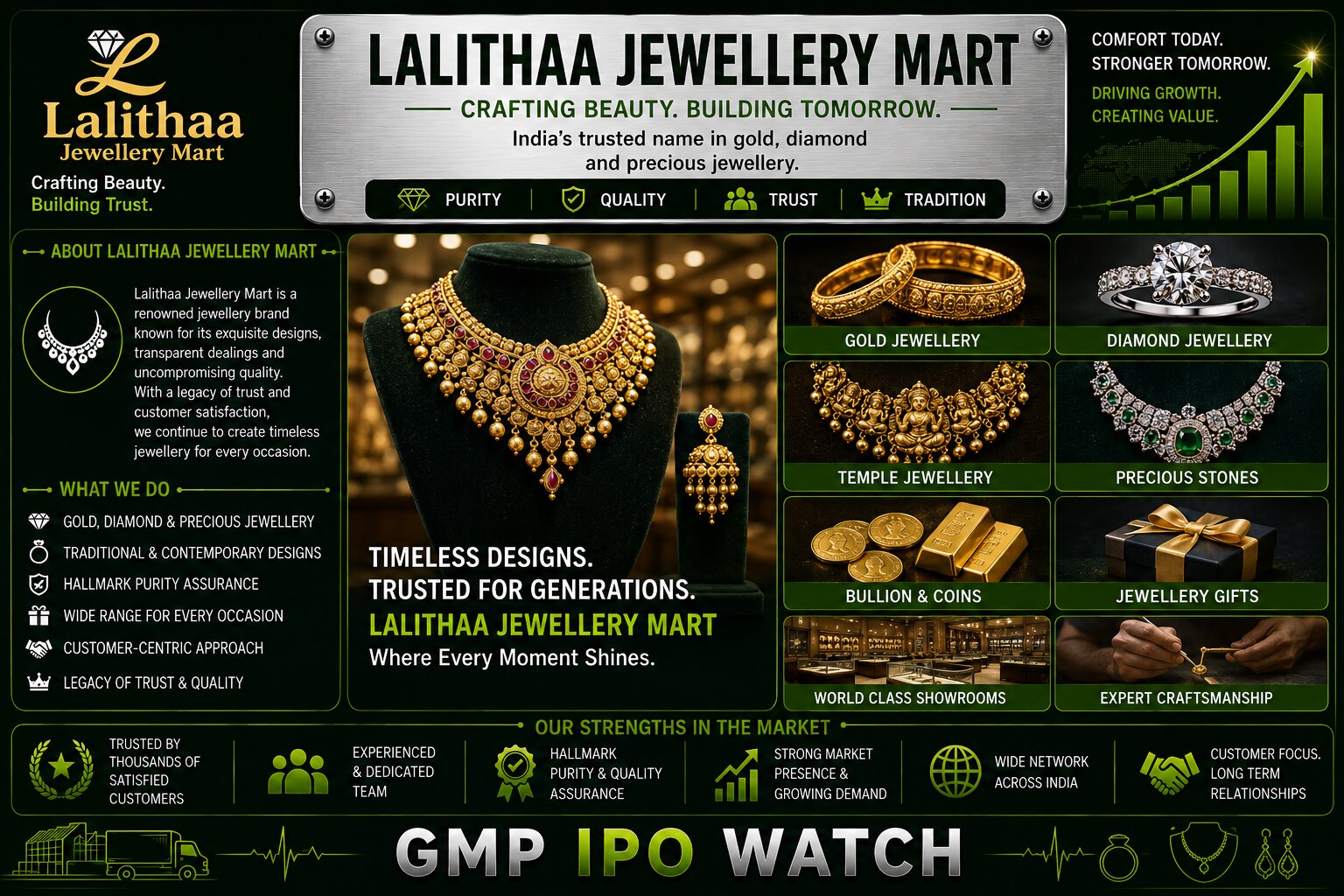
Lalithaa Jewellery Mart IPO 2026 – Can One of India’s Most Productive Jewellery Store Networks Stay Productive While Expanding?
Jewellery retail is usually analysed using three familiar numbers:
revenue, profit and number of stores.
But those numbers can hide the most important part of the business.
A jewellery retailer can open dozens of stores and still destroy capital if those stores do not generate enough sales from the gold inventory sitting inside them.
That makes store productivity a particularly important way to analyse Lalithaa Jewellery Mart.
Lalithaa operates 61 stores across 51 cities in Tamil Nadu, Andhra Pradesh, Telangana, Karnataka and Puducherry, and also operates two manufacturing facilities in Tamil Nadu.
The company already generates unusually high revenue per store compared with listed jewellery peers.
That creates a powerful opportunity.
But it also creates a difficult challenge:
Can the next 10 stores perform anywhere close to the existing 61?
That is the real post-IPO test.
Lalithaa Is Primarily a Gold Jewellery Business
Gold jewellery contributes approximately 92% of Lalithaa's revenue.
This tells investors two things.
First, the company benefits strongly from India's gold-jewellery demand.
Second, it is highly exposed to one product category.
Lalithaa also sells:
- Diamond jewellery
- Silver jewellery
- Other jewellery products
but gold remains economically dominant.
That means changes in:
- Gold prices
- Consumer affordability
- Wedding demand
- Making-charge competition
can materially affect the company.
45 of 61 Stores Are in Tier-II and Tier-III Cities
One of the more interesting details in Lalithaa's business is where its stores are located.
In FY2026, 45 of its 61 stores were located in Tier-II and Tier-III cities, and these stores contributed around 60.3% of total revenue.
This is strategically important.
Lalithaa's success is not based only on large metro showrooms.
The company has built meaningful scale in smaller cities.
That can provide:
- Lower occupancy costs
- Strong local brand loyalty
- Wedding demand
- Less dependence on expensive metro retail space
This Tier-II/Tier-III positioning is one of the most interesting parts of the IPO.
Why Smaller Cities Can Be Attractive for Jewellery Retail
A jewellery store does not require only wealthy urban professionals.
Demand can come from:
- Weddings
- Festivals
- Family savings
- Traditional purchases
These demand drivers exist strongly in smaller Indian cities.
At the same time, store operating costs can be lower than in premium metro locations.
If a store can achieve strong jewellery sales while paying lower rent and operating costs, its return on capital can be attractive.
That may partly explain Lalithaa's high store productivity.
Revenue Per Store Reached ₹410.2 Crore
Lalithaa's revenue per store increased from approximately:
₹316.8 crore in FY2024
to:
₹410.2 crore in FY2026.
Economic Times notes that this is well above the cited peer range of roughly ₹42 crore to ₹138 crore per store.
This is an unusually important metric.
It suggests Lalithaa is extracting much more sales from each store than many jewellery peers.
For long-term investors, maintaining this productivity may matter more than simply opening more locations.
Revenue Per Square Foot Is Also High
Revenue per square foot increased from approximately:
₹2.9 lakh in FY2024
to:
₹3.8 lakh in FY2026.
The cited peer range was around ₹1.4 lakh to ₹4.5 lakh.
So Lalithaa sits toward the stronger end of the industry range.
This suggests its stores are not just large.
They are productive.
Why Revenue Per Sq Ft Matters
Imagine two jewellery stores of the same size.
Store A
Generates ₹200 crore annually.
Store B
Generates ₹400 crore.
Store B earns far more revenue from:
- The same floor area
- Similar rent
- Similar basic infrastructure
That can produce much stronger economics.
For Lalithaa, the challenge is to ensure new stores do not dilute this highly productive existing network.
The New 10-Store Expansion Is the Most Important IPO Objective
The company intends to use IPO proceeds toward setting up 10 new stores in India, including capital expenditure for fit-outs and inventory.
This is important because jewellery-store expansion requires much more than:
- Rent
- Furniture
- Staff
A large amount of capital must be invested into actual jewellery inventory.
That means new-store economics depend heavily on how quickly that inventory begins generating sales.
Inventory Is the Largest Hidden Investment in a Jewellery Store
A new jewellery store may require hundreds or thousands of products across:
- Necklaces
- Chains
- Bangles
- Earrings
- Rings
- Bridal collections
Customers expect variety.
Therefore, opening a store with insufficient stock can reduce sales.
But carrying too much slow-moving inventory can trap capital.
This creates a constant balancing problem:
choice vs capital efficiency.
New-Store Payback Will Be Critical
Suppose Lalithaa invests ₹100 crore in:
- Inventory
- Fit-outs
- Store launch
for a new location.
If that store eventually produces ₹400 crore of annual sales and healthy profit, the economics could be attractive.
If it produces only ₹100 crore, the return becomes much weaker.
This means investors should track:
revenue per new store after 12, 24 and 36 months.
That will reveal whether Lalithaa's existing model is genuinely replicable.
Existing Store Productivity Sets a Very High Benchmark
This is both a strength and a risk.
Lalithaa's mature stores already generate more than ₹400 crore of average revenue per store.
That means investors will naturally expect new stores to approach strong productivity levels.
But mature stores may benefit from:
- Long-standing customer relationships
- Established local reputation
- Better inventory knowledge
- Repeat customers
A brand-new store may take several years to reach those economics.
Therefore, temporary dilution in average revenue per store after expansion would not automatically indicate failure.
Store Maturity Should Be Analysed Separately
A better way to measure future performance would be:
mature stores vs new stores.
For example:
- Mature-store same-store sales growth
- New-store revenue ramp-up
- New-store break-even period
This prevents investors from incorrectly interpreting a decline in overall average productivity when the company is simply adding young stores.
Same-Store Sales Growth Could Become One of the Best KPIs
Once a retail network becomes large, growth can come from two sources:
new stores
and
more sales from existing stores.
If existing stores continue growing strongly, the company does not need aggressive expansion to produce earnings growth.
This is usually higher-quality growth because the existing infrastructure is already in place.
After listing, investors should therefore watch same-store sales growth closely.
The Business Has Two Manufacturing Facilities
Lalithaa operates two jewellery manufacturing facilities in Tamil Nadu.
The Thirumudivakkam facility in Chennai is operated directly by the company, while another facility at Maraimalai Nagar in Kanchipuram is operated through wholly owned subsidiary Asita Jewellery Manufacturing.
This gives Lalithaa some level of vertical integration.
That can potentially improve:
- Product availability
- Design control
- Manufacturing turnaround
- Margin control
compared with relying entirely on external suppliers.
Manufacturing Can Support Faster Inventory Replenishment
Jewellery preferences can change quickly.
A design may sell extremely well in one region and poorly in another.
Internal manufacturing capability can help Lalithaa respond more quickly.
For example:
store data → popular design identified → manufacturing → rapid replenishment.
This can reduce lost sales from stock-outs.
It can also reduce dependence on third-party manufacturers.
Regional Jewellery Preferences Matter
Jewellery is not a completely standardised product.
Consumer preferences vary across:
- Tamil Nadu
- Andhra Pradesh
- Telangana
- Karnataka
Wedding jewellery designs can vary substantially by region.
Because Lalithaa's entire revenue is currently generated from southern India, the company has developed deep familiarity with these regional preferences.
That is an advantage inside its current markets.
It can become a challenge if the company expands far beyond them.
Southern India Concentration Is Still a Major Risk
Economic Times highlights that all of Lalithaa's revenue comes from southern India.
Geographic concentration creates two sides.
The positive side is:
- Strong local brand
- Deep customer understanding
- Dense store network
The risk side is dependence on:
- Regional demand
- Competition
- Economic conditions
in one part of India.
The company's long-term opportunity could eventually involve expanding beyond the South, but that needs to be done carefully.
Expansion Outside the South Would Require Brand Repositioning
A jewellery brand successful in Tamil Nadu may not automatically resonate in Maharashtra, Gujarat or North India.
New regions can have different preferences around:
- Designs
- Purity
- Product weight
- Bridal styles
Therefore, national expansion can be much more difficult than opening additional stores in familiar southern markets.
The most capital-efficient approach may be to deepen existing strongholds before attempting aggressive geographic diversification.
FY2026 Revenue Reached ₹25,023.9 Crore
Lalithaa reported FY2026 revenue from operations of approximately ₹25,023.9 crore.
Economic Times reports revenue grew at approximately 22.1% annually between FY2024 and FY2026.
This is substantial scale.
But jewellery revenue is heavily affected by gold prices.
Therefore, investors should not interpret every rupee of revenue growth as physical volume growth.
Higher Gold Prices Can Increase Revenue Without Increasing Volume
Suppose Lalithaa sells exactly the same number of grams of gold jewellery.
If gold prices rise 20%, rupee revenue can also increase significantly.
That means jewellery retailers should ideally be analysed using:
- Revenue growth
- Gold volume growth
- Same-store growth
- Gross margin
together.
This provides a more accurate picture of underlying consumer demand.
FY2026 PAT Reached ₹1,009.8 Crore
Net profit reached approximately ₹1,009.8 crore in FY2026.
Economic Times reports PAT increased at roughly 67.5% annually between FY2024 and FY2026.
Profit therefore grew much faster than revenue.
That is one of the strongest financial trends in the IPO.
EBITDA Margin Improved to 6.7%
Lalithaa's EBITDA margin increased from approximately:
4.1% in FY2024
to:
6.7% in FY2026.
For a high-volume jewellery retailer, a 2.6 percentage-point margin improvement can be extremely valuable because the revenue base exceeds ₹25,000 crore.
Even relatively small margin changes can have a large absolute impact on profit.
Why Small Margin Changes Matter So Much
Consider ₹25,000 crore of revenue.
A 1% change in margin equals approximately:
₹250 crore.
That means operational improvements such as:
- Better sourcing
- Higher making charges
- Inventory efficiency
- Product mix
can materially affect profit even without dramatic sales growth.
This is one reason investors should focus heavily on margin sustainability.
About 92% Revenue Comes From Gold Jewellery
This makes product diversification another potential future opportunity.
Diamond jewellery may offer different margin characteristics.
Silver can broaden price accessibility.
However, Lalithaa's brand and customer base are clearly built heavily around gold.
The company should not necessarily diversify simply for the sake of reducing concentration.
The better question is whether additional categories can increase customer spending without weakening inventory returns.
Working Capital Is Naturally High in Jewellery Retail
Jewellery companies hold significant inventory.
Inventory consists of something valuable—gold—but it still ties up capital.
When gold prices rise, the rupee value of required inventory also rises.
Therefore, even maintaining the same grams of jewellery across 61 stores can require more cash when gold becomes more expensive.
That makes working-capital management crucial.
Gold Metal Loans Can Influence Jewellery Economics
Jewellery retailers sometimes finance part of their gold requirement through metal-based borrowing structures rather than buying all inventory permanently using equity.
Such structures can reduce immediate capital requirements but introduce financing and price-management considerations.
For investors, the broader lesson is that jewellery balance sheets need to be analysed together with inventory and gold-price exposure rather than through debt numbers alone.
Competitive Pricing Can Increase Inventory Turnover
Lalithaa has built its market reputation around value-driven jewellery pricing.
A lower margin per item can still create strong economics when jewellery moves quickly.
Consider:
Model A
12% margin × slow inventory turnover.
Model B
7% margin × much faster turnover.
Model B can sometimes generate better returns on capital.
Lalithaa's very high revenue per store suggests that volume and turnover are central to its strategy.
Brand Trust Supports the High-Volume Model
Customers buying jewellery need confidence in:
- Purity
- Weight
- Price transparency
- Exchange policies
Without trust, customers may remain with long-established local jewellers.
Lalithaa's operating history since 1985 provides decades of brand building in southern India.
That trust is difficult for a new competitor to build quickly.
Anchor Investors Put in About ₹508 Crore
Ahead of public bidding, Lalithaa raised roughly ₹508 crore from anchor investors.
Kotak Neo's anchor data includes investors such as:
- ICICI Prudential Smallcap Fund
- Goldman Sachs Bank Europe
- Bandhan Small Cap Fund
- Kotak Mahindra Life Insurance.
This indicates meaningful institutional interest before the public issue opened.
Lalithaa Jewellery Mart IPO Subscription Today
At 12:15 PM on August 18, the issue was subscribed:
| Category | Subscription |
|---|---|
| QIB | 0.67× |
| NII | 2.08× |
| Retail | 1.59× |
| Employee | 2.24× |
| Overall | 1.44× |
InvestorGain's later live page showed overall demand around 2.11×, indicating the issue continued attracting bids through the afternoon.
Because today is Day 2 and the IPO closes tomorrow, final category-wise figures can still change substantially.
NII Demand Is Currently Leading
At the Kotak Neo timestamp, NII demand had reached around 2.08×, ahead of retail at 1.59×.
QIB subscription remained around 0.67×.
Institutional bidding often increases later in the offer period, so tomorrow's final QIB number will be more meaningful than today's intraday reading.
Employee Demand Is Also Strong
The employee category had reached around 2.24× by 12:15 PM.
The IPO also provides an ₹19-per-share employee discount.
This gives eligible employees a different effective purchase price than ordinary retail investors.
Lalithaa Jewellery Mart IPO GMP Today
Current grey-market sources are showing slightly different numbers.
InvestorGain's latest accessible update reports:
GMP: ₹33
Upper price band: ₹201
Estimated unofficial price: ₹234
Indicative premium: 16.42%.
IPOWatch reported approximately ₹30 GMP earlier today.
Because GMP is unofficial and can differ between dealers and update times, it is better to treat the current sentiment as roughly 15%–16% positive rather than rely on one exact number.
Valuation Is One of Lalithaa's Strongest Talking Points
Economic Times estimates the IPO at a post-issue FY2026 P/E of up to around 11×.
The cited peer range is approximately 9× to 46×.
This puts Lalithaa toward the lower end of the range despite its relatively strong revenue productivity.
However, lower valuation alone does not guarantee upside.
A discount may reflect risks including:
- Geographic concentration
- Gold dependence
- Expansion execution
- Cash and inventory intensity
FY2026 Diluted EPS Is ₹20.20
Kotak Neo reports FY2026 diluted EPS of approximately ₹20.20.
At the ₹201 upper band, the simple historical multiple is around:
₹201 ÷ ₹20.20 ≈ 10×
which is broadly consistent with the cited post-IPO valuation discussion.
That is relatively moderate compared with several established jewellery peers.
Why the Market May Apply a Discount
Lalithaa is exceptionally productive, but it also has concentrated exposure.
Around:
- 100% of revenue comes from southern India
- 92% comes from gold jewellery.
Investors may therefore demand a lower multiple than for a more nationally diversified jewellery retailer.
If Lalithaa expands successfully while preserving margins, that valuation gap could potentially narrow.
Major Strengths
Lalithaa enters the IPO with several meaningful positives.
Its 61-store network generates unusually high revenue per store, reaching about ₹410.2 crore in FY2026.
Its revenue per square foot is also toward the upper end of the cited peer range.
FY2026 revenue reached ₹25,023.9 crore and PAT exceeded ₹1,009 crore, while EBITDA margin improved to 6.7%.
The company has a strong Tier-II/Tier-III presence, with those markets contributing more than 60% of FY2026 revenue.
The IPO also brings ₹1,200 crore of fresh capital for expansion.
Major Risks
The biggest risk is geographic concentration, because essentially all revenue comes from southern India.
The second is gold concentration, with about 92% of revenue coming from gold jewellery.
The third is new-store execution. Adding 10 stores can dilute average productivity if new locations underperform.
Other major risks include:
- Gold-price volatility
- Inventory requirements
- Competitive making charges
- Store-level working capital
- Difficulty replicating existing store economics in unfamiliar markets
What Could Drive Lalithaa's Next Growth Phase?
The most important opportunities are straightforward.
Ten new stores: Direct expansion of the retail footprint.
Tier-II/Tier-III growth: Lalithaa already has proven demand in smaller cities.
Same-store growth: Existing stores can generate more revenue without additional store capital.
Manufacturing integration: Internal production can improve replenishment and product control.
Margin improvement: Even small percentage improvements create substantial absolute earnings because of the ₹25,000 crore-plus revenue base.
What Investors Should Track After Listing
The most useful post-IPO metrics will be:
Revenue per store: Can the company remain near its current high productivity?
Revenue per sq ft: Are new stores efficient?
Same-store sales growth: Are mature stores still expanding?
New-store payback: How quickly do the 10 IPO-funded stores reach profitability?
Inventory turnover: Is more capital being required for every rupee of sales?
Gold volume: Is revenue growth coming from actual jewellery demand rather than only gold inflation?
EBITDA margin: Can the FY2026 6.7% level be sustained?
The Most Important Post-IPO Equation
Lalithaa's strongest outcome looks like:
₹1,200 crore fresh capital → 10 productive stores → strong inventory turnover → higher sales per sq ft → stable margins → stronger earnings.
The weaker outcome would be:
fresh capital → expensive new inventory → slow store ramp-up → lower average productivity → weaker returns on capital.
That difference will determine whether the IPO expansion creates real shareholder value.
Should Investors Consider Lalithaa Jewellery Mart IPO?
The positive investment case includes:
- Very high revenue per store
- Strong revenue per square foot
- ₹25,000 crore-plus FY2026 revenue
- ₹1,000 crore-plus PAT
- Strong Tier-II/Tier-III presence
- Improving EBITDA margin
- Relatively moderate valuation
- ₹1,200 crore fresh issue
- Positive Day-2 subscription and GMP.
The caution points include:
- Southern India concentration
- 92% gold-jewellery concentration
- Inventory-heavy expansion
- Risk that new stores do not match existing productivity
- Gold-price volatility.
Lalithaa should therefore be analysed as a high-volume, high-productivity jewellery retailer entering a major capital-funded store expansion, rather than simply as a beneficiary of rising gold prices.
Final View on Lalithaa Jewellery Mart IPO 2026
The Lalithaa Jewellery Mart IPO is on Day 2 today, August 18, 2026, and closes tomorrow. The ₹1,700 crore mainboard issue is priced at ₹190–₹201 per share, with ₹1,200 crore of fresh equity and ₹500 crore OFS.
At 12:15 PM today, the issue was subscribed approximately 1.44× overall, including 2.08× NII, 1.59× retail, 0.67× QIB and 2.24× employee demand. A later live tracker showed overall subscription above 2×, so demand continues to build.
Current GMP is roughly ₹30–₹33, implying an unofficial premium of about 15%–16% over the ₹201 upper band.
The more important investment case, however, is operational.
Lalithaa operates 61 stores across 51 cities, with 45 stores in Tier-II and Tier-III markets. Those smaller-city stores generated about 60.3% of FY2026 revenue, while revenue per store reached roughly ₹410.2 crore and revenue per square foot increased to approximately ₹3.8 lakh.
Financially, FY2026 revenue reached approximately ₹25,023.9 crore, PAT reached ₹1,009.8 crore, and EBITDA margin improved to around 6.7%.
The IPO will now fund the next test of this model: 10 additional stores, including inventory and fit-out requirements.

Loading comments...