

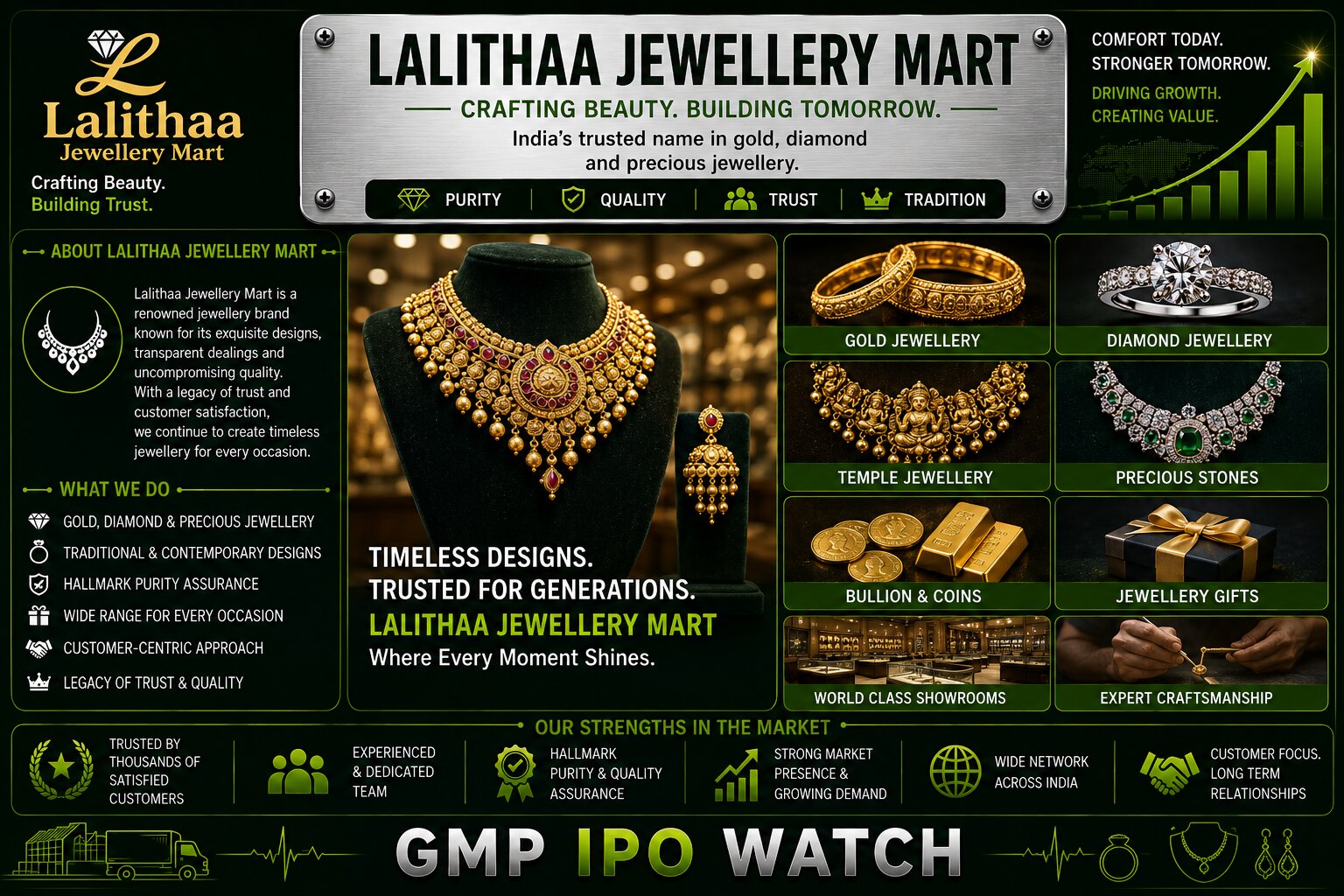
Lalithaa Jewellery Mart IPO 2026 – Strong Final-Day Demand Puts South India's Jewellery Retailer in Focus
India's jewellery market is gradually shifting.
For decades, jewellery buying was dominated by thousands of independent local jewellers. Today, organised brands are gaining customers by offering:
transparent pricing + purity assurance + wider designs + established brands + organised showrooms.
Lalithaa Jewellery Mart Limited is positioned directly within this transition.
The Chennai-headquartered jewellery retailer has built a major South Indian presence, with 61 physical stores across 51 cities. Its portfolio includes gold, diamond and silver jewellery, with the mass and value-conscious customer segment forming an important part of its positioning.
The company's ₹1,700 crore IPO closes today, August 19, 2026, and investor demand has accelerated sharply on the final day.
The investment question, however, goes beyond subscription and GMP:
Can Lalithaa use ₹1,200 crore of fresh IPO capital to expand its store network without weakening inventory efficiency and returns on capital?
That is the central long-term story.
Lalithaa Jewellery Mart IPO Details
| Particular | Details |
|---|---|
| Company | Lalithaa Jewellery Mart Ltd. |
| IPO Type | Book Built Mainboard IPO |
| Listing | BSE & NSE |
| Issue Size | ₹1,700 Crore |
| Fresh Issue | ₹1,200 Crore |
| Offer for Sale | ₹500 Crore |
| Price Band | ₹190 – ₹201 |
| Face Value | ₹5 Per Share |
| Lot Size | 74 Shares |
| Minimum Retail Investment | ₹14,874 |
| IPO Open Date | August 17, 2026 |
| IPO Close Date | August 19, 2026 |
| Allotment Date | August 20, 2026 |
| Refunds | August 21, 2026 |
| Demat Credit | August 21, 2026 |
| Listing Date | August 24, 2026 |
| Business | Jewellery Retail |
| Store Network | 61 Showrooms |
The final RHP was filed with SEBI on August 12. The ₹1,700 crore offer consists of ₹1,200 crore in fresh capital and ₹500 crore through an Offer for Sale.
Lalithaa Jewellery Mart IPO Subscription Today
Investor response strengthened dramatically on the third and final bidding day.
The latest available update shows the IPO subscribed approximately:
28.89 times overall.
Investors had placed bids for approximately 6.27 crore shares at the time of that update, while the retail portion was subscribed around 9.43 times.
| Subscription Metric | Latest Reported Status |
|---|---|
| Overall | 28.89× |
| Retail | 9.43× |
| IPO Status | Final Day |
| Closing Date | August 19, 2026 |
These are intraday final-day figures, so the eventual closing subscription can be higher.
The acceleration is notable because the issue was only around 69% subscribed during Day 2 before demand surged on the final day.
Lalithaa Jewellery Mart IPO GMP Today
Grey-market sentiment has also strengthened.
The latest available GMP tracker indicates approximately:
₹41 GMP
against the ₹201 upper issue price.
That gives an unofficial implied price of:
₹201 + ₹41 = ₹242
or approximately:
20.4% premium.
| GMP Particular | Current Status |
|---|---|
| Upper IPO Price | ₹201 |
| Latest GMP | ₹41 |
| Estimated Price | ₹242 |
| Indicative Premium | ~20% |
Recent market reporting also indicates a roughly 20% grey-market premium on the final bidding day.
GMP remains unofficial and can change before listing. It should not be treated as a guaranteed listing return.
₹508 Crore Raised From Anchor Investors
Before opening the public issue, Lalithaa Jewellery Mart raised approximately ₹508 crore from anchor investors.
Anchor participation provides another signal of institutional interest.
However, for long-term investors, the more important questions concern:
store expansion + inventory productivity + margins + cash flow + return on capital.
What Does Lalithaa Jewellery Mart Do?
Lalithaa Jewellery Mart is primarily a jewellery retail company serving customers across South India.
Its product portfolio includes:
- Gold jewellery
- Diamond jewellery
- Silver jewellery
- Precious and semi-precious jewellery
- Traditional jewellery
- Contemporary designs
The company targets a broad consumer base, with a particular emphasis on value-conscious customers.
This positioning is important because jewellery demand in India extends far beyond luxury buyers.
Gold jewellery is deeply connected with:
weddings + festivals + gifting + savings + cultural traditions.
61 Stores Create Significant Regional Scale
Lalithaa operates 61 showrooms across five southern states and 51 cities.
This gives the company meaningful regional scale.
A larger store network can improve:
- Brand recognition
- Customer accessibility
- Supplier relationships
- Marketing efficiency
- Inventory distribution
But jewellery stores require substantial capital.
A new showroom does not simply require rent and interiors.
It needs large quantities of jewellery inventory before meaningful sales can begin.
₹998.68 Crore Is Planned for New-Store Inventory
This is one of the most important numbers in the IPO.
Of the fresh proceeds, approximately:
₹998.68 crore
is intended to fund inventory requirements for new stores.
That represents around 83.2% of the fresh issue proceeds.
The remaining major allocations include approximately:
₹34.55 crore for capital expenditure related to new stores, with the balance allocated toward general corporate purposes.
IPO Proceeds Utilisation
| Purpose | Amount |
|---|---|
| Inventory for New Stores | ₹998.68 Cr |
| Capex for New Stores | ₹34.55 Cr |
| General Corporate Purposes | ₹166.77 Cr |
| Fresh Issue | ₹1,200 Cr |
This clearly shows what management wants to achieve:
expand the retail network.
Jewellery Expansion Is Primarily an Inventory Problem
Opening a normal retail store might require:
interiors + staff + rent + ₹1–2 crore inventory.
A jewellery showroom is different.
The company needs to stock substantial quantities of:
gold + diamonds + silver + multiple designs + different weights + different price points.
Therefore, inventory can represent far more capital than the physical showroom itself.
This explains why Lalithaa is allocating nearly ₹1,000 crore to inventory but only ₹34.55 crore to store capex.
Fresh Issue Dominates the IPO
The structure is also important.
Of the ₹1,700 crore total issue:
₹1,200 crore = fresh issue
₹500 crore = OFS.
This means approximately 70.6% of the IPO represents new capital going into the company.
That makes this primarily a growth-capital transaction rather than simply a promoter exit.
The ₹500 crore OFS proceeds, however, go to the selling shareholders rather than Lalithaa Jewellery Mart.
The Expansion Equation Is Straightforward
Management's strategy can be simplified as:
IPO money → inventory → new stores → higher sales → greater market share.
But successful execution requires more than simply opening showrooms.
Each new store needs to generate enough sales to justify the inventory invested in it.
That makes inventory turnover and sales per store extremely important.
High Sales Per Store Are an Existing Strength
One notable characteristic highlighted in current IPO analysis is Lalithaa's strong sales productivity per store.
This matters enormously in jewellery retail.
Suppose two companies each keep ₹100 crore of jewellery inventory.
Company A sells ₹200 crore annually.
Company B sells ₹500 crore.
Company B is using the same inventory base much more efficiently.
That efficiency can translate into stronger returns on capital.
Transparent Pricing Is Part of Lalithaa's Positioning
One of the company's recognised strengths is its emphasis on transparent jewellery pricing.
Jewellery customers do not pay only for gold.
The final price can involve:
gold value + making charges + wastage + stone value + taxes.
Customers can find these calculations confusing.
Transparent pricing can therefore help build trust, particularly among value-conscious buyers.
Jewellery Retail Is Fundamentally a Trust Business
Customers purchasing a ₹2 lakh necklace cannot easily verify every aspect of the product themselves.
They depend on the retailer for:
- Purity
- Weight
- Diamond quality
- Pricing
- Exchange policies
This means brand reputation has significant economic value.
Once customers trust a jeweller, repeat purchases can become easier.
But the reverse is equally important.
Any major reputation issue involving quality, pricing or governance can damage customer confidence quickly.
Gold Jewellery Is the Core Business
Gold remains the dominant product category for many Indian jewellery retailers, and Lalithaa has meaningful dependence on gold jewellery sales.
This provides exposure to India's structurally strong gold-jewellery demand.
But it also creates sensitivity to gold prices.
High Gold Prices Can Increase Revenue Without Increasing Volume
Suppose Lalithaa sells exactly:
100 kg of gold jewellery
in two different years.
If gold prices rise 25%, reported revenue can rise substantially even if the physical quantity sold remains unchanged.
Therefore, investors should not evaluate jewellery retailers using revenue growth alone.
Useful additional metrics include:
volume growth + same-store sales growth + inventory turnover + gross margin.
These reveal more about the underlying business.
Gold Prices Can Also Hurt Demand
Higher gold prices increase the rupee value of inventory.
But they can make jewellery less affordable.
Customers may respond by:
- Buying lighter jewellery
- Reducing purchase quantity
- Delaying purchases
- Exchanging old gold
This means rapidly rising gold prices can create both benefits and challenges for jewellery retailers.
Wedding Demand Is a Structural Advantage
India's wedding market provides recurring jewellery demand.
Gold jewellery remains important across many communities and regions.
This creates a demand base that is different from discretionary fashion jewellery alone.
Even when economic conditions weaken, weddings continue.
However, purchase values can still change based on:
gold prices + household income + consumer confidence.
Festivals Create Seasonal Demand
Jewellery sales can increase around:
- Dhanteras
- Diwali
- Akshaya Tritiya
- Pongal
- Regional festivals
- Wedding seasons
This means quarterly revenue can be uneven.
A weak quarter does not necessarily indicate structural deterioration if major festivals fall into another reporting period.
Investors should analyse annual and same-store performance rather than isolated quarters.
Tier II and Tier III Cities Offer Expansion Potential
Lalithaa's brand has developed meaningful acceptance beyond only the largest metropolitan areas.
This creates an attractive growth opportunity.
Smaller Indian cities are experiencing:
higher incomes + formal retail adoption + stronger branded-jewellery penetration.
Customers who previously depended entirely on local jewellers increasingly have access to regional and national chains.
A trusted South Indian brand can potentially capture part of this shift.
But Store Expansion Can Destroy Value if Done Too Quickly
Jewellery expansion is capital intensive.
Imagine Lalithaa deploys ₹25 crore of inventory into a new showroom.
If the store generates strong sales, returns can be attractive.
If customer traffic is weak, ₹25 crore may remain tied up in slow-moving jewellery.
Therefore:
more stores ≠ automatically more shareholder value.
The real objective should be:
profitable stores with strong inventory turnover.
Inventory Productivity Should Be the Key Post-IPO Metric
Because nearly ₹1,000 crore of IPO proceeds is going into inventory, investors should closely monitor:
revenue generated per rupee of inventory.
If inventory increases 40% while sales increase 50%, productivity improves.
If inventory increases 50% while sales increase only 15%, capital efficiency deteriorates.
This may ultimately determine whether the IPO expansion creates value.
Jewellery Inventory Has Unique Characteristics
Unlike fashion inventory, gold does not necessarily become worthless when a design gets old.
Gold can often be:
melted → redesigned → resold.
This reduces some inventory-obsolescence risk.
But there are still costs involving:
- Making charges
- Design changes
- Stones
- Labour
- Financing
So slow-moving inventory still carries an economic cost.
Competition Is Extremely Strong
Lalithaa competes with both organised and unorganised jewellers.
The organised market includes established brands such as Titan Company and Kalyan Jewellers, alongside numerous strong regional chains. Current IPO analysis identifies competition as a major risk.
Local family jewellers also remain important competitors because they can have decades-long customer relationships.
Therefore, Lalithaa must compete through:
pricing + trust + designs + showroom experience + inventory availability.
Geographic Concentration Remains Important
Lalithaa has built its strength primarily in South India.
That creates a regional competitive advantage.
But it also means the company is more exposed to consumer conditions in southern states than a fully pan-India jeweller.
Over time, geographic diversification could become another growth opportunity.
However, expanding outside a strong home market can be difficult because jewellery preferences differ significantly by region.
Promoters Retain Strong Control
Current IPO analysis indicates that promoter-group ownership is expected to decline from approximately:
97.7% pre-IPO
to:
82.9% post-IPO.
Promoters therefore retain overwhelming control after listing.
That maintains strategic continuity.
For minority shareholders, however, corporate governance, related-party transactions and capital allocation remain important areas to monitor.
Governance Deserves Investor Attention
The company's IPO process had previously attracted scrutiny around promoter remuneration, corporate governance and structural metrics before the current offering was revived.
This does not automatically determine the investment outcome.
But it means investors should read the RHP's governance, remuneration and related-party disclosures carefully rather than focusing exclusively on GMP and subscription numbers.
Valuation Is an Important Part of the Story
At the ₹201 upper band, current IPO analysis estimates Lalithaa Jewellery Mart's post-IPO market capitalisation at approximately:
₹11,250 crore.
IPO analysis has also highlighted that Lalithaa is being offered at a lower earnings multiple than several established listed jewellery companies.
A valuation discount can be attractive.
But investors need to determine why that discount exists.
Possible reasons include:
smaller geographic footprint + governance concerns + concentration + expansion execution risk.
A cheaper P/E alone does not automatically make an IPO undervalued.
Key Strengths
Lalithaa Jewellery Mart enters the IPO with several significant advantages.
Large South Indian network: 61 showrooms across 51 cities provide meaningful regional scale.
Established brand: The company has operated since the 1980s and has developed strong recognition in its core markets.
Transparent pricing model: This can strengthen customer trust and loyalty.
Strong store productivity: Current IPO analysis highlights high sales per store.
Fresh-issue-heavy IPO: ₹1,200 crore of the ₹1,700 crore issue goes to the company.
Expansion capital: Almost ₹1,000 crore is specifically earmarked for inventory at new stores.
Strong IPO demand: Final-day subscription has already reached approximately 28.89× in the latest update.
Positive GMP: The latest available grey-market indication is around ₹41, implying roughly 20% premium.
Major Risks
The first major risk is gold-price volatility.
The second is inventory intensity because jewellery expansion requires enormous amounts of working capital.
The third is competition from both national brands and strong local jewellers.
The fourth is regional concentration because the company's strongest presence remains South India.
The fifth is brand and reputation risk. Jewellery customers buy primarily on trust.
The sixth is store-expansion execution. New showrooms need to achieve sufficient sales to justify their inventory investment.
Finally, investors should consider corporate governance, given the scrutiny surrounding the company's earlier IPO process.
What Could Drive Lalithaa Jewellery Mart's Next Growth Phase?
The biggest driver is straightforward:
new stores.
The company is allocating ₹998.68 crore specifically to stocking new stores.
The second opportunity is deeper penetration of Tier II and Tier III cities.
The third is increasing sales of higher-value categories such as diamond jewellery.
The fourth is increasing repeat business from existing customers.
The fifth is improving inventory productivity through larger scale.
If Lalithaa can negotiate better procurement economics and rotate jewellery inventory faster, returns on capital can improve.
What Investors Should Track After Listing
| Metric | Why It Matters |
|---|---|
| Store Count | Expansion progress |
| Same-Store Sales Growth | Existing-store health |
| Revenue per Store | Store productivity |
| Inventory Turnover | Capital efficiency |
| Gold Sales Volume | Real underlying growth |
| Gross Margin | Pricing strength |
| PAT Margin | Profitability |
| Operating Cash Flow | Earnings quality |
| New-Store Payback | Expansion economics |
| Diamond Jewellery Share | Product diversification |
| ROCE | Return on IPO capital |
| Promoter Transactions | Governance |
For Lalithaa, inventory turnover and ROCE after deployment of the ₹1,200 crore fresh issue should be among the most important metrics.
The Most Important Post-IPO Equation
The strongest scenario looks like:
₹1,200 crore IPO capital → new-store inventory → productive showrooms → higher sales → faster inventory turnover → stronger profit and ROCE.
The weaker scenario looks like:
IPO capital → aggressive store expansion → excessive inventory → weak store productivity → capital trapped in jewellery → lower returns.
Both scenarios create a larger company.
Only the first creates a better company.
Final View on Lalithaa Jewellery Mart IPO 2026
The Lalithaa Jewellery Mart IPO closes today, August 19, 2026. The ₹1,700 crore mainboard issue has a price band of ₹190–₹201, with 74 shares in one retail lot and a minimum investment of ₹14,874 at the upper band. Allotment is scheduled for August 20, with listing expected on August 24.
The IPO consists of a substantial ₹1,200 crore fresh issue and ₹500 crore OFS. The company plans to use approximately ₹998.68 crore for inventory at new stores and ₹34.55 crore for related capital expenditure, making retail expansion the clear focus of the fundraising.
Market sentiment is currently strong. The latest final-day update shows approximately 28.89× overall subscription, while retail demand had reached around 9.43×. The company had also raised ₹508 crore from anchor investors before opening the public issue.
The latest available GMP is approximately ₹41, suggesting an unofficial price around ₹242 compared with the ₹201 upper issue price—a premium of roughly 20%.
Fundamentally, the investment case rests on Lalithaa's established South Indian brand, 61-showroom network, strong store productivity and ability to serve value-conscious jewellery customers.
The IPO also introduces a very clear capital-allocation test.
Nearly ₹1,000 crore will be converted into jewellery inventory for new stores. Investors should therefore watch whether that capital produces proportionately higher sales and profits.
Loading comments...