

Skyways Air Services IPO 2026 – Can India's Growing Trade and E-Commerce Market Drive Its Next Phase of Expansion?
Moving goods from one country to another sounds simple.
In reality, international logistics can involve:
airlines + airports + customs + warehouses + trucking + documentation + freight rates + multiple countries.
A company that can coordinate these moving parts efficiently becomes an important link between manufacturers, exporters, importers and customers.
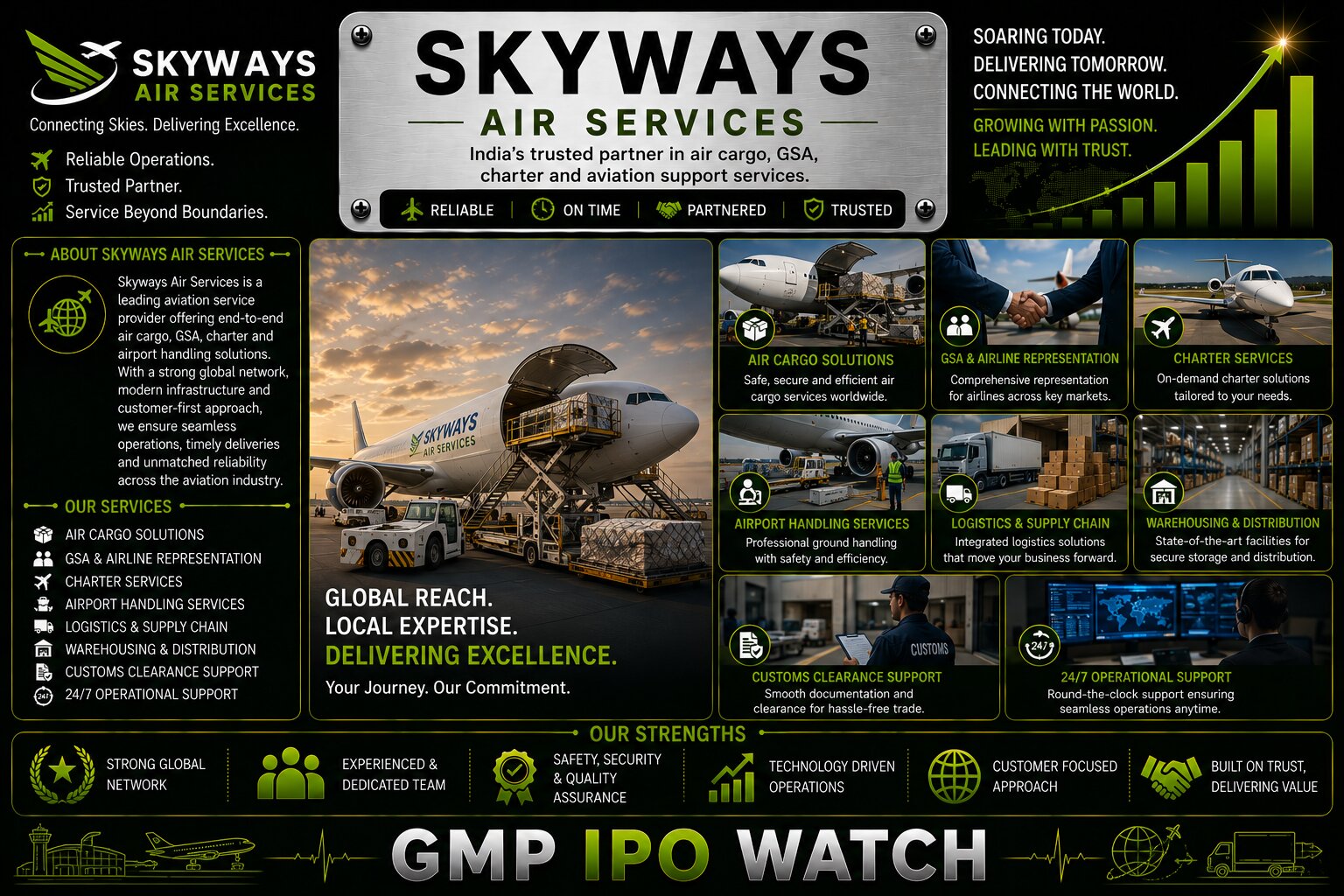
This is the business in which Skyways Air Services Limited operates.
Established in 1984, Skyways has evolved from a customs house agent into an integrated logistics company offering air freight, ocean freight, road transportation, warehousing and express-logistics solutions.
The company operates across 12 countries and more than 30 Indian cities, giving it a broader network than a conventional regional freight forwarder.
After postponing an earlier March 2026 IPO launch because of volatile global conditions, Skyways is now returning to the market with its IPO scheduled to open on August 24, 2026.
The investment question is:
Can Skyways convert India's expanding international trade, air cargo and express-logistics opportunity into sustainable profit and cash-flow growth while reducing debt and managing geopolitical risks?
That is the central IPO story.
Skyways Air Services IPO Details
| Particular | Details |
|---|---|
| Company | Skyways Air Services Ltd. |
| IPO Type | Book Built Mainboard IPO |
| Listing | BSE & NSE |
| Issue Size | ₹582.8 Crore |
| Fresh Issue | 2.89 Crore Shares |
| Offer for Sale | 1.33 Crore Shares |
| Total Offer | 4.22 Crore Shares |
| Price Band | ₹131 – ₹138 |
| Face Value | ₹10 Per Share |
| IPO Open Date | August 24, 2026 |
| IPO Structure | Fresh Issue + OFS |
| Business | Integrated Logistics |
| Core Segment | Air Freight Forwarding |
The current IPO is expected to raise approximately ₹582.8 crore, with the price band fixed at ₹131–₹138 per share.
The RHP provides for a fresh issue of up to 2,88,98,300 shares and an OFS of up to 1,33,33,300 shares.
Skyways IPO Was Earlier Postponed
Skyways' IPO story has an unusual history.
The company originally planned to open its IPO between March 18 and March 20, 2026.
However, the launch was deferred amid volatile global conditions and geopolitical uncertainty surrounding the Middle East.
The company has now returned with a new RHP. SEBI records show the latest RHP was filed on August 12, 2026.
Therefore, investors should use the latest August IPO terms rather than relying on the abandoned March timetable.
Skyways Air Services IPO Has Not Opened Yet
As of August 19, 2026, the IPO has not opened for public subscription.
Public bidding begins on:
August 24, 2026.
Therefore, there is currently no meaningful:
- Retail subscription
- NII subscription
- QIB subscription
- Overall subscription
figure.
Subscription demand should be evaluated only after bidding starts.
What Does Skyways Air Services Actually Do?
Skyways is fundamentally a freight forwarding and integrated logistics company.
Its logistics platform covers areas such as:
- Air freight
- Ocean freight
- Road transportation
- Warehousing
- Express logistics
- Customs-related logistics
- Multimodal transportation
Over four decades, the company has expanded from customs-related operations into a much broader logistics network.
This diversification matters because customers increasingly want one logistics partner capable of coordinating multiple stages of their supply chain.
Air Freight Is the Core Business
Air freight is particularly valuable when customers need goods delivered quickly.
Typical cargo can include:
pharmaceuticals + electronics + industrial components + fashion products + high-value goods + time-sensitive shipments.
Unlike ocean freight, where transportation can take weeks, air freight can move goods internationally within days.
Customers pay more for that speed.
The freight forwarder's role is to connect customers with suitable airline capacity while managing routing, documentation and delivery.
Skyways Does Not Need to Own Airlines
One attractive characteristic of freight forwarding is its relatively asset-light nature.
Skyways does not need to own a massive fleet of cargo aircraft to provide international air-freight services.
Instead, a freight forwarder can purchase cargo capacity from airlines and organise transportation for customers.
The simplified model looks like:
Customer → Skyways → Airline → Destination → Local Logistics → Customer.
This allows the company to build large logistics volumes without investing billions of rupees in aircraft.
Airline Relationships Are Extremely Important
A freight forwarder's ability to secure capacity can become a competitive advantage.
During periods of high demand or supply disruption, cargo space becomes limited.
Companies with stronger airline relationships may be better positioned to:
- Secure capacity
- Find alternative routes
- Negotiate rates
- Deliver urgent cargo
Skyways says its airline partnerships and flexible sourcing have helped it manage recent disruptions.
Skyways Has Built a Multi-Country Network
The company currently operates across 12 countries and over 30 Indian cities.
This is strategically valuable.
An exporter may need cargo moved:
factory → Indian airport → international airport → warehouse → final customer.
The more of that journey Skyways can coordinate, the more valuable it can become to customers.
A wider network can also generate cross-selling opportunities.
FY2026 Revenue Crossed ₹2,800 Crore
Skyways continued expanding during FY2026.
| Particular | FY2026 |
|---|---|
| Total Income | ₹2,839.67 Cr |
| PAT | ₹63.52 Cr |
| EBITDA | ₹125.65 Cr |
| Total Assets | ₹1,508.24 Cr |
| Net Worth | ₹332.64 Cr |
| Borrowings | ₹624.06 Cr |
Current prospectus-based IPO data reports total income of approximately ₹2,839.67 crore and PAT of ₹63.52 crore for FY2026.
This shows Skyways is entering the public market with meaningful operating scale.
Revenue Has Expanded Rapidly
FY2025 itself was a strong growth year.
Total income increased to approximately:
₹2,270.99 crore
from:
₹1,316.81 crore in FY2024.
That represents a very significant increase in scale.
FY2026 total income then moved further to approximately ₹2,839.67 crore.
The company has therefore built considerable momentum ahead of the IPO.
Profit Increased to ₹63.52 Crore
Profitability has also improved.
Skyways reported FY2025 PAT of approximately:
₹48.14 crore
compared with:
₹34.49 crore in FY2024.
FY2026 PAT subsequently increased to approximately:
₹63.52 crore.
That gives investors a positive trend:
₹34.49 Cr → ₹48.14 Cr → ₹63.52 Cr
in annual profit across FY2024–FY2026.
But Logistics Is a Low-Margin Business
Using FY2026 total income and PAT:
₹63.52 crore ÷ ₹2,839.67 crore ≈ 2.2% PAT margin.
That margin is not unusual for freight-forwarding businesses, where a large portion of revenue represents transportation charges ultimately paid to:
- Airlines
- Shipping lines
- Trucking companies
- Other logistics providers
Skyways therefore generates large revenue but retains only a relatively small portion as net profit.
This means investors should pay close attention to absolute profit, EBITDA and cash generation, rather than focusing only on headline revenue.
EBITDA Reached ₹125.65 Crore
FY2026 EBITDA stood at approximately:
₹125.65 crore.
Against total income of ₹2,839.67 crore, this indicates an EBITDA margin of roughly:
4.4%.
Because margins are thin, even small changes in freight rates or operating efficiency can meaningfully affect earnings.
Small Margin Changes Can Have Large Profit Effects
Suppose Skyways generates ₹3,000 crore revenue.
If its net margin improves from:
2.2% to 2.7%
the difference is only half a percentage point.
But on ₹3,000 crore:
0.5% = ₹15 crore.
That is meaningful compared with FY2026 PAT of approximately ₹63.5 crore.
This illustrates why operational efficiency matters so much in logistics.
Debt Is an Important Issue
FY2026 borrowings were approximately:
₹624.06 crore.
Compare this with net worth of:
₹332.64 crore.
That means borrowings remain substantial relative to the company's equity base.
This is one of the most important financial areas investors should analyse.
Fresh IPO Capital Will Help Repay Borrowings
Skyways intends to use part of the fresh issue proceeds to repay certain outstanding borrowings of:
Skyways Air Services
and its subsidiary:
Forin Container Line Private Limited.
This could be an important post-IPO earnings driver.
Lower debt can result in:
lower interest expense → stronger PAT → better cash flow → stronger balance sheet.
For a low-margin business, reducing finance costs can make a meaningful difference.
Working Capital Is Another Major IPO Objective
Fresh proceeds will also support incremental working-capital requirements.
This is important because logistics companies can face a timing mismatch.
Skyways may need to pay:
- Airlines
- Shipping companies
- Transporters
before receiving money from customers.
That creates a working-capital gap.
As shipment volumes increase, more money can become tied up in this operating cycle.
Revenue Growth Can Consume Cash
Suppose Skyways wins ₹500 crore of additional logistics business.
This sounds immediately positive.
But the company may need to pay transportation partners before customers settle their invoices.
Therefore:
higher revenue → higher receivables → greater working-capital requirement.
This is why operating cash flow needs to be evaluated alongside profit.
A logistics company can report strong revenue growth while simultaneously experiencing cash pressure.
Ocean Freight Adds Diversification
Although Skyways is strongly associated with air freight, its broader logistics model also includes ocean freight.
Ocean freight is generally:
slower but cheaper
than air freight.
This gives customers different transportation options.
A company may use:
- Air freight for urgent products
- Ocean freight for bulk cargo
Offering both allows Skyways to participate in a larger portion of customer logistics spending.
Road Transportation Completes the Journey
Cargo rarely begins or ends at an airport.
A shipment may travel:
factory → truck → airport → aircraft → airport → truck → warehouse.
Therefore, road transportation is an important component of integrated logistics.
Providing more of these services allows Skyways to control a larger portion of the customer journey.
Warehousing Can Deepen Customer Relationships
Warehousing adds another layer to the logistics ecosystem.
Instead of simply transporting goods, a logistics company can also help customers:
- Store inventory
- Manage distribution
- Coordinate dispatches
This makes the relationship more integrated.
A customer using Skyways for several services may also be less likely to switch providers based only on small pricing differences.
Express Logistics Is a Growth Opportunity
Skyways has been focusing on high-growth areas including express logistics.
This market can benefit from:
- E-commerce
- B2B deliveries
- Time-sensitive shipments
- Digital businesses
- Faster supply chains
Express logistics can therefore become an important diversification opportunity beyond traditional freight forwarding.
Pharmaceuticals Can Be a Valuable Segment
Skyways is also focusing on pharmaceutical logistics.
Pharmaceutical shipments can require:
- Fast transportation
- Reliable handling
- Temperature management
- Regulatory documentation
These requirements create barriers to entry.
Customers may value reliability more than simply choosing the cheapest freight provider.
This can potentially improve customer stickiness.
Geopolitical Disruptions Are a Major Risk
International logistics is directly exposed to global events.
Airspace closures, wars and geopolitical tensions can disrupt traditional transportation routes.
Skyways' earlier March IPO was itself deferred amid volatile global conditions.
This illustrates that geopolitical risk is not theoretical.
It can directly affect:
- Cargo capacity
- Freight rates
- Delivery times
- Customer demand
Middle East Exposure Is Below 10%
Skyways' management stated that less than 10% of its business is directly exposed to the Middle East.
This limits direct concentration risk.
However, the Middle East contains major global aviation hubs.
Therefore, disruptions can still affect international freight networks even when direct revenue exposure is relatively small.
Alternative Routing Can Become a Competitive Advantage
When normal routes are disrupted, logistics providers need alternatives.
Skyways says it can reroute shipments through other ports and carriers or combine different transport modes.
This operational flexibility can be valuable.
During normal conditions, customers may focus heavily on price.
During disruption, the ability to actually move cargo can become more important.
That can help experienced freight forwarders win new customers.
Freight-Cost Inflation Can Sometimes Be Passed Through
Skyways management has said that much of the increase in logistics costs can be passed on to customers through its pricing model.
This provides some protection against sudden freight-rate increases.
But pass-through economics have an important accounting effect.
Higher transportation costs can increase reported revenue without necessarily producing equivalent profit growth.
Therefore, investors should not automatically interpret higher revenue during periods of freight inflation as stronger underlying business volumes.
Customer Diversification Matters
A freight forwarder serving many customers across:
- Industries
- Geographies
- Trade lanes
can be more resilient than one depending on a handful of large accounts.
Skyways' growing international and domestic network can support diversification.
But investors should still monitor the contribution from its largest customers after listing.
Acquisition Strategy Has Expanded the Platform
Skyways has also used acquisitions to strengthen its logistics capabilities.
Its FY2025 annual report states that the company acquired CTC Air Carriers Private Limited in August 2024 and Odyssey Logistics Private Limited in January 2025.
Acquisitions can accelerate expansion.
But they also introduce:
- Integration risk
- Capital allocation risk
- Execution complexity
Management therefore needs to demonstrate that acquired businesses generate attractive returns.
More Services Can Increase Revenue Per Customer
Suppose an exporter initially uses Skyways only for air freight.
Over time, Skyways could potentially also provide:
ocean freight + trucking + warehousing + express logistics.
Instead of acquiring an entirely new customer, the company earns more from an existing relationship.
This cross-selling model can improve customer economics.
India's Trade Growth Is a Structural Opportunity
India is increasingly integrated into global manufacturing and supply chains.
Growth in sectors such as:
- Pharmaceuticals
- Electronics
- Engineering goods
- Automotive components
- Consumer products
can increase logistics demand.
Skyways does not need to manufacture these products.
It earns from helping move them.
This gives the company indirect exposure to India's trade growth.
E-Commerce Creates Another Logistics Tailwind
E-commerce changes customer expectations.
Businesses increasingly need:
faster + trackable + reliable deliveries.
That supports demand for technology-enabled express logistics.
Skyways' expansion beyond traditional freight forwarding could therefore become an important long-term growth driver.
Technology Is Increasingly Important in Logistics
Modern customers want visibility.
They increasingly expect to know:
- Where cargo is
- When it will arrive
- Whether documentation is complete
- Whether delays have occurred
Technology can help logistics companies provide this information.
Better tracking and digital processes can also reduce internal operational complexity as shipment volumes increase.
Competitive Strengths
Skyways enters the IPO with several notable strengths.
Long operating history: The business was established in 1984.
Large operating network: Presence across 12 countries and more than 30 Indian cities.
Integrated logistics platform: Air, ocean, road, warehousing and express capabilities.
Strong revenue scale: FY2026 total income reached approximately ₹2,839.67 crore.
Growing profitability: PAT increased to approximately ₹63.52 crore in FY2026.
Asset-light freight-forwarding model: Growth does not require ownership of a large aircraft fleet.
Industry diversification: Increasing focus on pharmaceuticals and express logistics.
Fresh capital for debt and working capital: This can strengthen the financial position.
Major Risks
High Borrowings
FY2026 borrowings stood at approximately ₹624.06 crore.
Thin Profit Margins
PAT represents only around 2.2% of FY2026 total income.
Geopolitical Risk
Wars, airspace closures and international tensions can disrupt cargo routes.
Freight Rate Volatility
Air and ocean freight prices can change rapidly.
Working-Capital Requirements
Growth can require substantial cash before customer payments are collected.
Airline Dependence
Skyways depends on third-party airline capacity rather than owning aircraft.
Acquisition Integration
Recent acquisitions increase organisational complexity.
Currency Exposure
International freight operations can be affected by foreign-exchange movements.
What Could Drive Skyways' Next Growth Phase?
Air Cargo Growth
Increasing Indian exports and imports can expand freight volumes.
Pharmaceutical Logistics
Specialised logistics can potentially provide more stable customer relationships.
Express Delivery
E-commerce and faster B2B supply chains create additional demand.
International Expansion
A larger overseas network can increase cross-border opportunities.
Cross-Selling
Existing air-freight customers can potentially use ocean, road and warehousing services.
Debt Reduction
Fresh IPO proceeds used for repayment can reduce finance costs.
Working-Capital Expansion
More capital can support larger shipment volumes.
Acquisitions
Successful integration of recent acquisitions could broaden the company's logistics capabilities.
What Investors Should Track After Listing
| Metric | Why It Matters |
|---|---|
| Revenue Growth | Logistics scale |
| Cargo Volumes | Underlying demand |
| EBITDA Margin | Operating efficiency |
| PAT Margin | Final profitability |
| Operating Cash Flow | Earnings quality |
| Borrowings | Financial risk |
| Finance Cost | Debt-repayment benefit |
| Receivable Days | Working-capital control |
| Air Freight Share | Business concentration |
| Express Logistics Growth | Diversification |
| ROCE | Capital efficiency |
For Skyways, cash flow, debt and margins may ultimately be more important than headline revenue.
The Most Important Post-IPO Equation
The attractive scenario looks like:
IPO capital → debt repayment + stronger working capital → larger freight volumes → cross-selling → higher EBITDA → lower finance costs → stronger PAT and cash flow.
The weaker scenario looks like:
higher working capital → rapid revenue growth → larger receivables + continued debt → thin margins → weak cash conversion.
Both scenarios can produce impressive revenue.
Only the first represents high-quality shareholder growth.
Should Investors Consider Skyways Air Services IPO?
The positive case includes:
- More than four decades of operating history
- ₹2,800 crore-plus FY2026 total income
- ₹63.52 crore FY2026 PAT
- Integrated logistics capabilities
- Presence across 12 countries
- Operations across 30+ Indian cities
- Exposure to Indian trade growth
- Pharmaceutical logistics opportunity
- Express-logistics expansion
- IPO proceeds supporting debt reduction and working capital.
The caution case includes:
- ₹624 crore-plus borrowings
- Thin profit margins
- Working-capital intensity
- Geopolitical exposure
- Freight-rate volatility
- Dependence on third-party carriers
- Integration risk from acquisitions.
Skyways should therefore be evaluated as an established integrated logistics company with significant operating scale but relatively thin margins and meaningful financial and working-capital requirements.
Final View on Skyways Air Services IPO 2026
The Skyways Air Services IPO is scheduled to open on August 24, 2026, with a price band of ₹131–₹138 per share and a total issue size of approximately ₹582.8 crore.
The IPO includes both a fresh issue and an OFS. The RHP provides for approximately 2.89 crore fresh shares and 1.33 crore OFS shares. Fresh proceeds are intended partly for repayment of borrowings of Skyways and its subsidiary Forin Container Line, incremental working-capital requirements and general corporate purposes.
Financially, the business has expanded considerably. Total income rose from approximately ₹1,316.81 crore in FY2024 to ₹2,270.99 crore in FY2025, while PAT increased from ₹34.49 crore to ₹48.14 crore.
Current FY2026 IPO data shows further growth to approximately ₹2,839.67 crore total income, ₹125.65 crore EBITDA and ₹63.52 crore PAT.
The opportunity is supported by Skyways' four-decade operating history, international network and exposure to India's growing freight, pharmaceutical and express-logistics requirements. But the financial structure requires attention: FY2026 borrowings were approximately ₹624.06 crore, while logistics margins remain relatively thin.
Therefore, investors should look beyond headline revenue.
Loading comments...