

Sumax Engineering IPO 2026 – Can New Manufacturing Capacity Turn a 900-Product Automotive Supplier Into a Larger OEM Platform?
An automobile manufacturer does not only require engines, tyres and electronic systems.
Thousands of smaller products are needed during:
vehicle manufacturing + body-shop operations + paint finishing + repair + detailing + aftermarket servicing.
This is the market in which Sumax Engineering Limited has built its business.
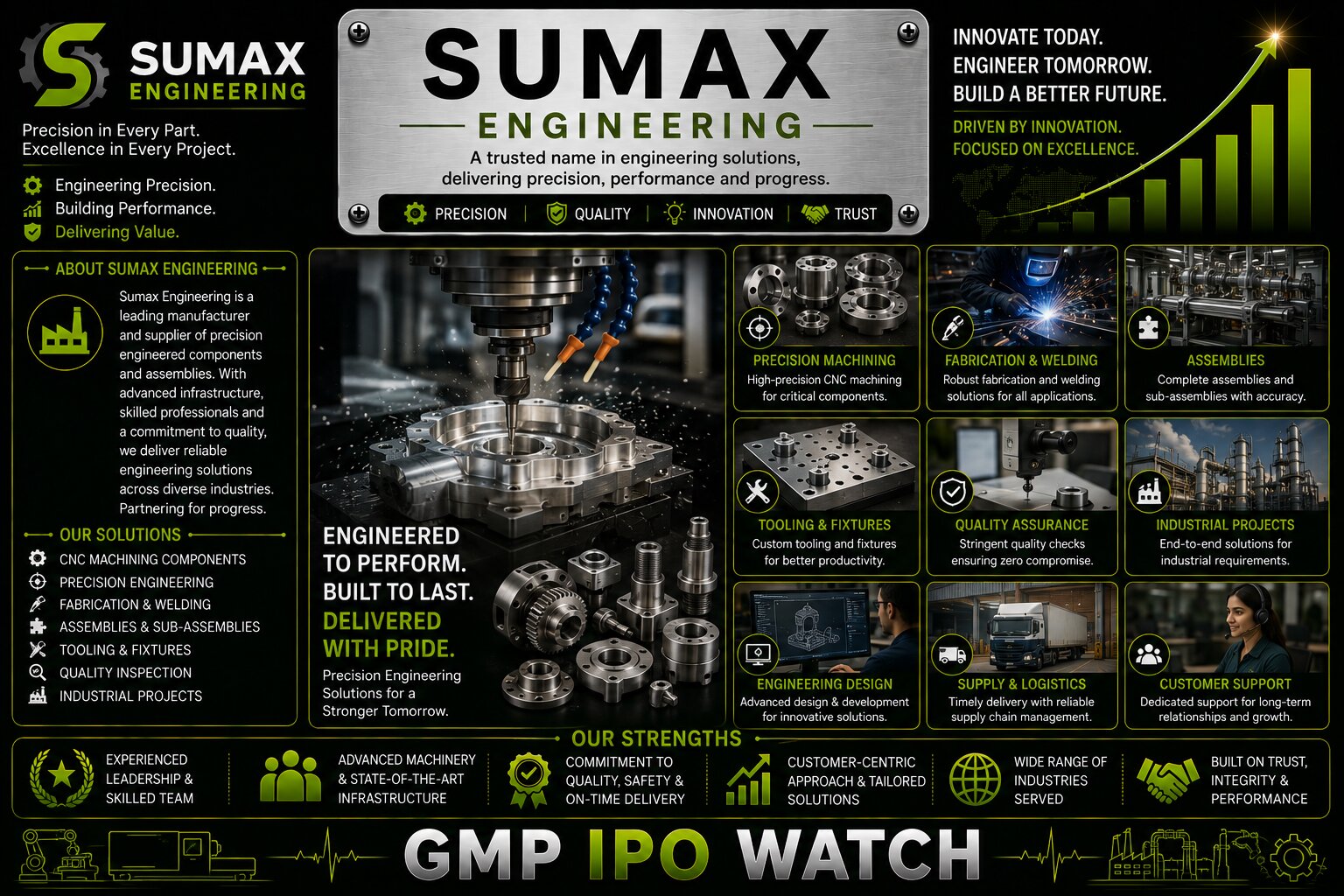
Founded in 1994, Sumax manufactures and supplies specialised products for automotive OEMs and the auto-refinish market. Its portfolio now contains more than 900 products, covering categories such as adhesive tapes, rubbing and polishing compounds, sanding products, tools and other body-shop and vehicle-care solutions.
The company currently operates manufacturing facilities in Manesar and Chennai, with branch offices in Pune, Bengaluru and Jaipur and its head office in Hyderabad.
Its upcoming IPO is important because Sumax is not simply raising working capital.
A large part of the fresh proceeds is intended to establish two new manufacturing units in Rajasthan and Haryana.
That creates the key investment question:
Can Sumax convert new manufacturing capacity into higher-value in-house production, stronger margins and faster earnings growth without allowing working capital and customer dependence to become excessive?
That is the central theme of this IPO.
Sumax Engineering IPO Details
| Particular | Details |
|---|---|
| Company | Sumax Engineering Ltd. |
| IPO Type | Book Built SME IPO |
| Listing Platform | NSE SME |
| Issue Size | ₹53.40 Crore |
| Fresh Issue | ₹43.34 Crore |
| Offer for Sale | ₹10.06 Crore |
| Total Shares | 52.87 Lakh Shares |
| Price Band | ₹95 – ₹101 |
| Face Value | ₹10 Per Share |
| Lot Size | 1,200 Shares |
| Retail Minimum | 2,400 Shares |
| Retail Investment | ₹2,42,400 at ₹101 |
| IPO Open Date | August 25, 2026 |
| IPO Close Date | August 28, 2026 |
| Allotment Date | August 31, 2026 |
| Refund / Demat | September 1, 2026 |
| Listing Date | September 2, 2026 |
| Lead Manager | GYR Capital Advisors |
| Registrar | KFin Technologies |
The issue comprises approximately 42.91 lakh fresh shares worth ₹43.34 crore and 9.96 lakh OFS shares worth ₹10.06 crore, taking the total issue to approximately ₹53.40 crore.
Because this is an SME IPO, retail investors need to bid for at least 2,400 shares, requiring approximately ₹2.42 lakh at the ₹101 upper band.
Sumax Engineering IPO Has Not Opened Yet
As of August 19, 2026, public bidding has not started.
The IPO opens on:
August 25, 2026
and closes on:
August 28, 2026.
Therefore, there is currently no valid:
- QIB subscription
- NII subscription
- Retail subscription
- Overall subscription
to report.
The first public bidding data will become available after the IPO opens.
Sumax Engineering IPO GMP Today
Current grey-market sentiment is positive.
IPO Watch reports a ₹20 GMP as of August 19, 2026.
At the ₹101 upper price band:
₹101 + ₹20 = ₹121
This implies an unofficial premium of approximately:
19.8%.
| Particular | Current Position |
|---|---|
| Upper Price Band | ₹101 |
| Current GMP | ₹20 |
| Indicative Price | ₹121 |
| Indicative Premium | 19.8% |
The tracker shows that GMP moved from essentially no premium on August 18 to ₹20 on August 19, indicating stronger pre-opening sentiment.
GMP is unofficial and can change significantly before listing.
What Does Sumax Engineering Actually Do?
Sumax describes itself as a manufacturer of premium products for automotive OEM and auto-refinish markets.
Its portfolio includes more than 900 products and covers categories such as:
- Adhesive tapes
- Rubbing compounds
- Polishing compounds
- Sanding products
- Polishing tools
- Car-care products
- Body-shop consumables.
This breadth is strategically important.
Rather than depending on one automotive component, Sumax can potentially sell several different products to the same OEM, dealer or body-shop customer.
Sumax Is More Than a Car-Care Brand
The words "car care" can make the company sound like a consumer detailing-products business.
But an important part of Sumax's positioning is the automotive OEM market.
OEM means Original Equipment Manufacturer.
These customers can include companies involved directly in vehicle manufacturing.
Selling to OEMs is different from selling a ₹500 product to an individual car owner.
Automotive manufacturers typically expect:
- Consistent quality
- Product specifications
- Reliable delivery
- Process certification
- Large-volume supply
Sumax's manufacturing processes are reported to be certified under ISO 9001:2015 and IATF 16949:2016, which is particularly relevant to automotive supply chains.
Why OEM Relationships Can Be Valuable
Once a product is approved for use by an automobile manufacturer, replacing the supplier may require:
- Testing
- Validation
- Quality checks
- Procurement approval
This can make established supplier relationships relatively sticky.
A supplier that consistently meets:
quality + price + delivery
can potentially continue receiving orders as customer vehicle production expands.
This creates a different quality of relationship than ordinary retail sales.
Auto Refinish Adds a Different Revenue Pool
Vehicle demand does not end when a new car leaves the factory.
Cars later require:
- Accident repair
- Paint correction
- Body-shop work
- Polishing
- Surface preparation
This creates the auto-refinish market.
Sumax therefore has exposure to both:
new vehicle manufacturing
and:
repair/maintenance of the existing vehicle fleet.
That diversification can be useful because aftermarket demand does not necessarily move exactly in line with new vehicle production.
A 900-Product Portfolio Creates Cross-Selling Potential
Suppose an automotive body shop already buys adhesive tape from Sumax.
The same customer may also require:
- Sanding products
- Polishing compounds
- Tools
- Other finishing materials
Instead of finding another customer, Sumax can increase revenue from the existing relationship.
That creates a straightforward growth strategy:
more customers + more products per customer.
For long-term investors, revenue per customer could therefore be more interesting than merely counting the number of products in the catalogue.
Manufacturing vs Trading Is an Important Part of the Story
Sumax has historically combined manufacturing with trading of automotive-related products.
The strategic opportunity is to manufacture more products internally.
Why?
Because trading often provides less control over:
- Product cost
- Quality
- Availability
- Margin
In-house manufacturing can potentially improve all four.
One current IPO analysis attributes part of the company's recent margin expansion to a shift toward more value-added in-house manufacturing and away from lower-margin trading activity.
That makes the two planned factories particularly important.
Unit I Will Be Built in Rajasthan
According to the IPO objects, Sumax intends to deploy approximately ₹4.88 crore toward constructing a proposed manufacturing Unit I at the RIICO Industrial Area in Karoli, Tapukara, Rajasthan.
Rajasthan is strategically located near a significant automobile manufacturing ecosystem across the NCR and northern India region.
A local manufacturing base can potentially improve:
- Delivery times
- Logistics costs
- Customer responsiveness
for customers in that part of the country.
Unit II Will Be Built in Haryana
The larger capex component is approximately ₹16.62 crore for a proposed second manufacturing facility in the Model Economic Township at Jhajjar, Haryana.
Together, the two proposed facilities represent more than ₹21 crore of planned manufacturing investment.
That means the IPO is fundamentally tied to physical capacity expansion.
The important question after listing will be:
How quickly do these plants begin generating revenue?
New Factories Create Operating Leverage Only After Utilisation Improves
Building a factory creates fixed costs.
Even before full production begins, the company can incur:
- Employee costs
- Utilities
- Maintenance
- Depreciation
If capacity utilisation remains low, returns can suffer.
If orders ramp quickly, fixed manufacturing costs can be spread across larger output.
That creates operating leverage.
Therefore, investors should eventually monitor:
capacity utilisation + revenue generated from new units.
₹12 Crore Will Support Working Capital
The IPO objects also provide approximately ₹12 crore toward working-capital requirements.
This is substantial relative to the company's current operating size.
Automotive suppliers often need money for:
- Raw materials
- Inventory
- Customer credit
- Production expenses
before final collections arrive.
A growing company can therefore be profitable on paper while still consuming cash.
Why OEM Businesses Need Working Capital
Consider a simple supply cycle:
raw-material purchase → manufacturing → product supplied to OEM → invoice → customer payment.
Sumax may need to pay suppliers before receiving money from its automotive customers.
If customers pay after 45, 60 or 90 days, capital remains tied up.
As revenue grows, this requirement can expand.
That explains why Sumax is using a meaningful portion of fresh IPO proceeds for working capital.
FY2026 Total Income Reached ₹148.34 Crore
Sumax reported the following recent financial performance:
| Financial Year | Total Income | EBITDA | PAT |
|---|---|---|---|
| FY2024 | ₹131.54 Cr | ₹11.63 Cr | ₹7.43 Cr |
| FY2025 | ₹147.18 Cr | ₹15.03 Cr | ₹9.98 Cr |
| FY2026 | ₹148.34 Cr | ₹19.08 Cr | ₹12.76 Cr |
The trend is unusual.
Revenue growth between FY2025 and FY2026 was relatively modest.
But EBITDA and PAT increased much faster.
This means the core recent financial story is margin improvement, not rapid top-line expansion.
Revenue Was Almost Flat in FY2026
Total income increased from approximately:
₹147.18 crore in FY2025
to:
₹148.34 crore in FY2026.
That is growth of less than 1%.
For a company entering the IPO market, this is an important point.
Sumax is not coming to investors after a year in which revenue doubled.
Instead, management is raising capital to create additional manufacturing capacity that could support the next phase of top-line growth.
PAT Increased Much Faster Than Revenue
PAT increased from:
₹9.98 crore in FY2025
to approximately:
₹12.76 crore in FY2026.
That is growth of approximately 28%.
Profit therefore expanded much faster than sales.
This suggests better economics within the existing revenue base.
EBITDA Increased to ₹19.08 Crore
EBITDA rose from approximately:
₹11.63 crore in FY2024
to:
₹15.03 crore in FY2025
and:
₹19.08 crore in FY2026.
That represents substantial improvement across two years.
The company's EBITDA margin reached approximately 12.86% in FY2026, according to current IPO analysis.
This is particularly relevant because revenue barely changed in the latest year.
Margin Expansion Is the Strongest Recent Financial Trend
The recent numbers suggest Sumax is extracting more profit from each rupee of sales.
That can happen through:
- Better product mix
- More manufacturing
- Less low-margin trading
- Procurement efficiency
- Higher-value products
If this improvement is sustainable, the new manufacturing units could potentially amplify earnings.
But if FY2026 represented unusually favourable margins, future profitability could normalise.
FY2026 PAT Margin Was Around 8.6%
Using the reported ₹12.76 crore PAT and ₹148.34 crore total income, FY2026 PAT margin is approximately:
8.6%.
That is a meaningful improvement from earlier periods.
For an automotive consumables and engineering-products company, maintaining an 8%+ PAT margin while adding new capacity would be a positive sign.
One-Off Income Needs Attention
One current IPO analysis notes that FY2026 PAT benefited from approximately ₹1 crore of non-recurring exceptional settlement income.
If so, investors should avoid treating the entire reported ₹12.76 crore as perfectly recurring earnings.
A better framework would separate:
normal operating profit
from:
one-time income.
This becomes important when calculating valuation.
Borrowings Increased to ₹13.06 Crore
Total borrowings increased from approximately:
₹6.43 crore in FY2024
to:
₹7.75 crore in FY2025
and:
₹13.06 crore in FY2026.
This is a noticeable rise.
The increase can be understood in the context of:
- Working-capital requirements
- Expansion
- Asset investment
But investors should monitor whether debt continues increasing after the IPO.
Debt-to-Equity Is Still Relatively Low
Despite higher absolute borrowings, one current analysis reports FY2026 debt-to-equity around 0.21×.
This suggests the company is not entering the IPO with a heavily leveraged capital structure.
Fresh equity can provide additional room for expansion without relying only on borrowing.
Assets Increased to ₹84.81 Crore
Total assets increased from approximately:
₹54.00 crore in FY2024
to:
₹66.14 crore in FY2025
and:
₹84.81 crore in FY2026.
The balance sheet is therefore expanding faster than revenue.
This is worth watching.
A larger asset base should eventually produce a larger revenue and earnings base.
If not, return ratios can weaken.
FY2026 RoNW Is Around 20.7%
Current IPO analysis reports Return on Net Worth of approximately:
20.71% in FY2026.
That is an attractive headline return.
However, fresh IPO equity will increase net worth substantially.
Therefore, post-IPO RoNW could initially decline unless the new factories and working capital quickly generate incremental earnings.
The IPO Is Mostly Fresh Capital
At the upper band, the structure is approximately:
Fresh Issue: ₹43.34 crore
OFS: ₹10.06 crore.
This means more than 80% of the total IPO represents fresh capital.
That is useful for the growth story.
Most of the offer is being raised for company-level expansion rather than existing shareholder liquidity.
The OFS Does Not Fund Expansion
The ₹10.06 crore OFS component goes to selling shareholders rather than Sumax itself.
Therefore, the company's actual new capital comes from the fresh-issue portion.
This distinction is important when evaluating:
IPO size vs business expansion capital.
Two New Plants Could Change Geographic Reach
Sumax currently manufactures in Manesar and Chennai.
Adding facilities in:
Rajasthan + Haryana
can create a stronger northern India manufacturing footprint.
That may improve the company's ability to serve automotive manufacturing clusters across the region.
It can also reduce transportation distances for some customers.
Automotive OEMs Prefer Localised Supply Chains
Automobile factories often depend on just-in-time or tightly managed production schedules.
A supplier located closer to the manufacturing ecosystem can potentially provide:
- Faster deliveries
- Lower freight cost
- More reliable replenishment
This can make geographic manufacturing expansion strategically valuable.
But the new plants need sufficient customer orders to justify the additional fixed costs.
Customer Approval Can Create High Switching Costs
Automotive supply chains are quality sensitive.
An OEM may not want to change a tested product merely to save a small amount.
If Sumax's products become embedded within:
- Manufacturing processes
- Body-shop procedures
- Repair systems
the relationship can become sticky.
This can create repeat business.
But it also means Sumax must maintain very consistent product quality.
Product Quality Failures Could Be Expensive
A defective consumer detailing product might create a refund.
A defective product used inside an OEM process can create much larger consequences.
Potential outcomes include:
- Customer complaints
- Rejection of supplied batches
- Production disruption
- Loss of approved-supplier status
Therefore, quality management is a central operational risk.
The company's ISO and automotive quality certifications help support its positioning, but continuous compliance remains essential.
Automotive Cyclicality Is a Major Risk
Sumax's fortunes remain tied to the automotive industry.
When vehicle production expands, OEM demand can grow.
During weaker periods, manufacturers can reduce:
- Production
- Inventory
- Procurement
This can affect supplier revenue.
Auto-refinish demand provides some diversification, but it does not completely remove industry cyclicality.
Aftermarket Demand Can Provide Some Stability
India's existing vehicle fleet continues to require:
- Accident repair
- Paint work
- Polishing
- Detailing
even when new-car sales temporarily slow.
Therefore, Sumax's presence in both OEM and refinish markets can provide a more balanced revenue base than an automotive supplier dependent entirely on new vehicle production.
Raw-Material Prices Can Affect Margins
Products such as:
- Adhesives
- Tapes
- Compounds
- Abrasives
depend on industrial raw materials.
If input prices rise sharply, Sumax needs to either:
- Pass costs to customers
- Improve efficiency
- Absorb margin pressure
OEM customers can have significant bargaining power, so price increases may not always be immediate.
That makes procurement discipline important.
Manufacturing Expansion Can Improve Gross Economics
If Sumax currently purchases some products from external suppliers and resells them, bringing selected products in-house could create better economics.
Potential benefits include:
supplier margin captured internally + better quality control + shorter lead times.
This may explain why management is directing a large part of IPO capital toward new plants rather than simply increasing trading inventory.
Capacity Utilisation Will Determine Whether the Expansion Works
Building two manufacturing units sounds positive.
But factories only generate value when customers use their capacity.
The post-IPO investment thesis therefore depends on:
new plant → orders → production → revenue → profit → cash.
If the factories operate significantly below capacity, return on capital can weaken.
This is one of the most important things investors should monitor after commissioning.
₹12 Crore Working Capital Can Support Higher Sales
The proposed working-capital allocation can help finance:
- More raw materials
- Higher inventory
- Increased customer receivables
as new manufacturing capacity comes online.
That combination makes strategic sense:
new factories create capacity; working capital fills that capacity with production.
One without the other would be less useful.
But Receivable Growth Can Consume IPO Cash
Suppose Sumax increases annual revenue to ₹200 crore.
If OEM customers require long payment terms, a meaningful share of that additional revenue can remain outstanding.
Then the company can show:
revenue growth + PAT growth
while cash generation remains weaker.
Investors should therefore track operating cash flow rather than focusing only on the income statement.
Sumax Engineering IPO Valuation
At the ₹101 upper band, one current analysis calculates FY2026 P/E at approximately 11.66×, based on reported EPS of around ₹8.66.
That is not a particularly demanding headline multiple.
However, the valuation needs to be interpreted carefully because:
- FY2026 revenue was almost flat
- Profit benefited from strong margin expansion
- A one-off income component has been identified in current analysis
- Fresh equity will dilute existing earnings per share
Therefore, investors should focus on post-issue normalised earnings, not simply the most favourable pre-IPO P/E calculation.
There Are No Perfect Listed Comparables
Current IPO analysis notes that the RHP does not identify a directly comparable listed company carrying on exactly the same customised automotive-products business.
That makes peer valuation more difficult.
Sumax combines:
- Automotive OEM supplies
- Refinish products
- Car-care products
- Adhesive and finishing products
rather than fitting neatly into one listed sector.
Investors therefore need to evaluate its own:
growth + margins + return ratios + cash flow
instead of depending entirely on peer P/E comparisons.
SME Liquidity Risk Matters
Sumax will list on NSE SME, with tentative listing scheduled for September 2, 2026.
SME shares can experience:
- Lower trading liquidity
- Larger bid-ask spreads
- Higher volatility
than established mainboard companies.
This matters especially because the minimum retail application is around ₹2.42 lakh.
Investors should therefore consider liquidity and allocation size alongside business fundamentals.
Competitive Strengths
Sumax enters the IPO with several notable strengths.
30+ years of experience: The company traces its operations to 1994.
900+ product portfolio: Broad exposure across automotive body-shop and car-care categories.
OEM and refinish presence: Provides exposure to both new vehicle manufacturing and the existing vehicle fleet.
Existing manufacturing base: Plants in Manesar and Chennai.
Improving profitability: FY2026 EBITDA increased to about ₹19.08 crore and PAT to approximately ₹12.76 crore.
Healthy return profile: FY2026 RoNW is reported around 20.71%.
Expansion capital: New factories are planned in Rajasthan and Haryana.
Fresh-issue-heavy structure: Approximately ₹43.34 crore of the ₹53.40 crore IPO is fresh issue.
Major Risks
Weak Recent Revenue Growth
FY2026 total income of ₹148.34 crore was only slightly above FY2025's ₹147.18 crore.
The company must show that the new manufacturing facilities can restart stronger top-line growth.
Margin Sustainability
PAT and EBITDA grew much faster than revenue.
Investors need to see whether FY2026 margin gains are repeatable.
One-Time Income
One current analysis identifies roughly ₹1 crore of exceptional settlement income within FY2026 profitability.
New Plant Execution
Delays or cost overruns at the Rajasthan and Haryana facilities could affect returns.
Automotive Dependence
Vehicle-production cycles can affect OEM demand.
Working Capital
OEM credit periods can tie up capital in receivables.
Raw-Material Inflation
Input-price increases can pressure margins.
SME Liquidity
NSE SME shares may have lower trading liquidity after listing.
What Could Drive Sumax Engineering's Next Growth Phase?
New Rajasthan Unit
Creates additional capacity and expands northern India manufacturing presence.
New Haryana Unit
The ₹16.62 crore proposed facility is the largest individual capex objective.
More In-House Manufacturing
Can potentially replace lower-margin traded products with higher-value manufactured products.
Cross-Selling
The 900+ product portfolio provides opportunities to increase revenue per OEM and body-shop customer.
Automotive Production Growth
Higher Indian vehicle manufacturing can increase OEM demand.
Existing Vehicle Fleet
Body-shop and refinish requirements provide aftermarket opportunities.
Working-Capital Expansion
₹12 crore can help finance the larger production cycle.
What Investors Should Track After Listing
| Metric | Why It Matters |
|---|---|
| Revenue Growth | New capacity utilisation |
| EBITDA Margin | FY2026 margin sustainability |
| PAT Margin | Earnings quality |
| New Plant Utilisation | Capex productivity |
| Manufacturing Share | Product-mix improvement |
| Working-Capital Days | Cash requirements |
| Receivable Days | OEM collections |
| Operating Cash Flow | Profit-to-cash conversion |
| Debt | Financial discipline |
| RoCE / RoNW | IPO capital efficiency |
The most important post-IPO number may eventually be revenue generated from the new Rajasthan and Haryana facilities, because that will show whether the expansion actually creates shareholder value.
The Most Important Post-IPO Equation
The strongest scenario looks like:
IPO capital → new Rajasthan and Haryana factories → more in-house manufacturing → higher-value product mix → stronger revenue + margins → better operating cash flow.
The weaker scenario looks like:
IPO capital → new factories → low utilisation → higher fixed costs + inventory → weaker return on capital.
Both outcomes create more manufacturing capacity.
Only the first creates a stronger business.
Should Investors Consider Sumax Engineering IPO?
The positive investment case includes:
- More than 30 years of automotive-industry experience
- 900+ product portfolio
- OEM and auto-refinish exposure
- FY2026 EBITDA of approximately ₹19.08 crore
- FY2026 PAT around ₹12.76 crore
- Improving margins
- Relatively low debt-to-equity
- Two new manufacturing facilities
- Fresh-issue-heavy IPO
- Current ₹20 GMP.
The caution case includes:
- Nearly flat FY2026 revenue
- Need to sustain recent margin expansion
- One-off contribution to FY2026 earnings highlighted by current analysis
- Working-capital requirements
- Automotive-industry dependence
- New-plant execution risk
- SME-market liquidity.
Sumax should therefore be evaluated as an established automotive consumables and specialised-products manufacturer entering a capacity-expansion phase, rather than simply as another SME issue with a positive GMP.
Final View on Sumax Engineering IPO 2026
The Sumax Engineering IPO opens on August 25, 2026 and closes on August 28. The ₹53.40 crore NSE SME issue has a price band of ₹95–₹101 per share, with allotment expected on August 31 and listing scheduled for September 2.
The offer comprises approximately ₹43.34 crore of fresh shares and ₹10.06 crore OFS. Retail investors need to apply for at least 2,400 shares, requiring approximately ₹2,42,400 at the upper band.
Financially, Sumax enters the IPO with an interesting combination of slow recent revenue growth and rapidly improving profitability. Total income increased only marginally from ₹147.18 crore in FY2025 to approximately ₹148.34 crore in FY2026, while PAT increased from ₹9.98 crore to approximately ₹12.76 crore and EBITDA reached about ₹19.08 crore.
The IPO's most important feature is where the fresh capital is going.
Sumax plans approximately ₹4.88 crore for a new Rajasthan manufacturing unit, ₹16.62 crore for a Haryana unit and ₹12 crore for working-capital requirements, with the remaining eligible proceeds supporting general corporate purposes.
This creates a clear post-listing thesis:
new manufacturing capacity + more in-house production + broader automotive customer relationships + working-capital support = potential next phase of revenue and earnings growth.
Current pre-opening sentiment is positive, with GMP around ₹20 as of August 19, implying an unofficial price near ₹121 compared with the ₹101 upper band, or roughly 19.8% premium. Public subscription data is not yet available because bidding begins only on August 25.
For long-term investors, however, the important question is not whether the stock lists around ₹121.
It is whether the Rajasthan and Haryana plants can achieve good utilisation while Sumax maintains the margin improvement achieved in FY2026.
Loading comments...