

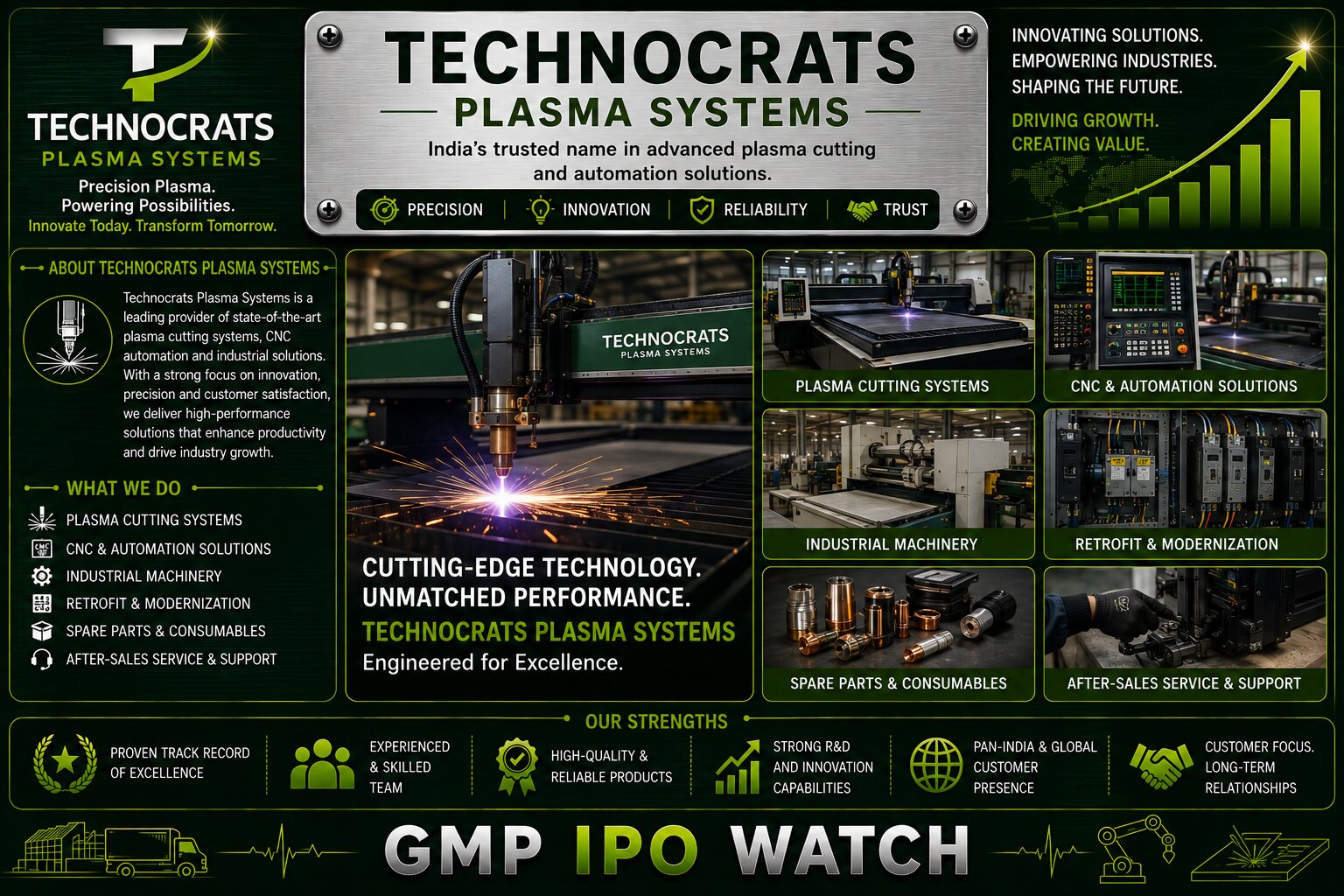
Technocrats Plasma Systems IPO 2026 – The Real Test Starts After the 100× Subscription
A 100-times subscribed IPO attracts attention.
But subscription does not manufacture machines.
It does not collect customer receivables.
And it does not guarantee that new capital will earn attractive returns.
That is why the Technocrats Plasma Systems IPO becomes more interesting after today's final bidding numbers rather than less.
The company designs and manufactures industrial systems used for plasma cutting, welding and automation. Its official positioning describes more than three decades of work in plasma technology supported by R&D and nationwide service.
The IPO has now attracted extraordinary demand, but the central long-term question remains:
Can Technocrats convert roughly ₹40 crore of new working capital into substantially higher profitable revenue without allowing receivables, inventory and project complexity to consume the cash generated by that growth?
That will matter far more than today's GMP.
Final-Day IPO Demand Has Changed Dramatically
Technocrats ended August 17 with approximately 5.38× subscription, according to Economic Times data.
Category-wise, the previous day's subscription stood at:
| Category | August 17 |
|---|---|
| QIB | 0.89× |
| NII | 4.52× |
| Retail | 8.44× |
| Overall | 5.38× |
Today, August 18, InvestorGain's live tracker shows overall subscription around:
102.54×.
That represents a huge final-day acceleration.
This type of late jump is common in SME IPOs because institutional and non-institutional applications often arrive near the closing deadline.
What Does 102× Subscription Actually Mean?
It means demand for shares is many times larger than the quantity available.
But investors should understand what it does not mean.
It does not automatically tell us that:
- Earnings will grow 100 times.
- Listing gains are guaranteed.
- The valuation cannot fall later.
- Management execution risk has disappeared.
Subscription is a demand indicator.
It is not a fundamental valuation metric.
Technocrats Plasma Systems IPO GMP Today
The latest August 18 InvestorGain tracker reports:
GMP: ₹43
Against the ₹132 upper issue price:
₹132 + ₹43 = ₹175
That implies an unofficial premium of approximately:
32.58%.
InvestorGain's seven-day trend shows GMP rising from:
| Date | GMP |
|---|---|
| Aug 12 | ₹12 |
| Aug 13 | ₹22 |
| Aug 14 | ₹30 |
| Aug 15 | ₹32 |
| Aug 16 | ₹32 |
| Aug 17 | ₹30 |
| Aug 18 | ₹43 |
That indicates much stronger final-day sentiment.
But GMP remains unofficial and can change before listing.
What Does Technocrats Plasma Systems Actually Sell?
Technocrats operates across four broad revenue categories:
- Machines without automation
- Machines with automation
- Customisation and retrofit
- Services.
This classification is important.
Not every rupee of revenue has the same economic quality.
A standalone machine sale may be relatively transactional.
An automation project can include:
- Engineering
- Control integration
- Custom design
- Installation
- Commissioning
A retrofit project can monetise an existing customer.
A service contract can produce recurring income.
The strongest long-term business mix would therefore gradually increase:
automation + retrofit + service revenue.
Why Automation Can Increase Revenue Per Customer
Imagine a fabrication company initially buys one cutting machine.
The commercial relationship may end after installation.
Now imagine another customer buys:
plasma cutting + CNC control + welding automation + installation + ongoing maintenance.
The second customer generates far more economic value.
Technocrats does not necessarily need to double its customer count to double revenue.
It can also sell a larger solution to each customer.
This is why average order value can become important after listing.
The Business Has an Installed-Base Advantage
Every machine already installed at a customer's factory can potentially create future demand.
Industrial machinery eventually needs:
- Maintenance
- Spare parts
- Consumables
- Upgrades
- Retrofitting
- Replacement
This creates a valuable concept:
installed-base monetisation.
The initial equipment sale acquires the customer.
The next several years can generate additional service revenue.
Retrofit Revenue Can Be Especially Attractive
Factories do not always want to replace an entire machine.
Sometimes they want to modernise an existing system.
That can involve:
- New CNC controls
- Automation
- Updated electronics
- Better cutting components
- Additional safety features
A retrofit can be cheaper for the customer than buying an entirely new machine.
For Technocrats, it creates revenue without needing to acquire a completely new client.
This can improve customer lifetime value.
Why Service Revenue Can Improve Earnings Quality
Capital-equipment revenue can be cyclical.
Factories may delay purchasing new machines when economic conditions weaken.
But existing machines still need maintenance.
Therefore, increasing the contribution from:
service + retrofit + replacement parts
can make revenue more resilient.
That would improve the quality of the business even if headline growth becomes slower.
FY2026 Revenue Increased 166%
Technocrats reported:
| Financial Year | Total Income | PAT | EBITDA |
|---|---|---|---|
| FY2024 | ₹6.35 Cr | ₹2.21 Cr | ₹1.30 Cr |
| FY2025 | ₹49.44 Cr | ₹8.11 Cr | ₹8.59 Cr |
| FY2026 | ₹131.41 Cr | ₹14.94 Cr | ₹26.29 Cr |
Revenue increased approximately 166% between FY2025 and FY2026, while PAT increased approximately 84%.
This is extremely strong growth.
But revenue grew significantly faster than profit.
That deserves attention.
Revenue Growth Faster Than PAT Is Not Necessarily Negative
Suppose a company enters larger projects.
Those projects may carry:
- Higher component costs
- More working capital
- More subcontracting
- Different margins
Revenue can therefore increase rapidly even when PAT grows more slowly.
The critical question is whether Technocrats can maintain attractive absolute profit growth while operating at a much larger scale.
FY2026 provides some encouraging evidence because EBITDA margin remained strong.
EBITDA Margin Reached 20.02%
Technocrats reported approximately:
EBITDA margin: 20.02%
and:
PAT margin: 11.37%.
Those are healthy operating margins for a small industrial engineering company.
A ₹131 crore revenue business generating more than ₹26 crore of EBITDA is showing meaningful value addition.
The post-IPO test is whether a similar margin can be maintained when the company takes on more simultaneous projects.
FY2026 PAT Was ₹14.94 Crore
PAT increased from:
₹8.11 crore in FY2025
to:
₹14.94 crore in FY2026.
That represents roughly 84% growth.
The absolute earnings base is still relatively small.
This creates both opportunity and risk.
A few successful large orders can increase profit significantly.
But one delayed or low-margin project can also materially affect annual numbers.
Assets Nearly Doubled
Total assets increased from approximately:
₹36.72 crore in FY2025
to:
₹72.06 crore in FY2026.
This shows that recent growth has already required substantial additional capital.
That makes the IPO's heavy emphasis on working capital easier to understand.
Borrowings Have Also Increased
Borrowings increased from:
- ₹6.66 crore in FY2024
- ₹10.24 crore in FY2025
- ₹14.73 crore in FY2026.
At the same time, net worth increased much faster, leaving the debt-to-equity ratio around 0.38×.
That level is manageable.
But the trend demonstrates that rapid growth consumes financing.
The IPO can provide equity funding instead of requiring the company to finance the next stage entirely through additional debt.
₹40 Crore Working Capital Is the Real IPO Story
Technocrats proposes to deploy approximately:
₹40 crore toward long-term working-capital requirements.
Another:
₹8.79 crore
is earmarked for plant and machinery used in manufacturing plasma cutting machines, welding equipment and customised automation systems.
The ₹40 crore working-capital allocation is much larger.
That tells investors something important:
Technocrats appears more constrained by financing project execution than by physical manufacturing capacity alone.
Why Working Capital Matters for Industrial Automation
Suppose Technocrats wins a ₹10 crore customised project.
Before collecting the full customer payment, it may need to spend money on:
- Steel fabrication
- Motors
- Electronics
- CNC systems
- Controllers
- Labour
- Testing
Those costs can occur weeks or months before final collection.
If the company wins several projects simultaneously, the cash requirement multiplies.
That is why working capital can become the limiting factor in growth.
₹40 Crore Could Allow More Projects to Run Simultaneously
Without enough capital, a smaller company may need to complete Project A before aggressively funding Project B.
With more working capital, Technocrats can potentially execute:
Project A + Project B + Project C
at the same time.
That could materially increase annual revenue.
This is the attractive side of the IPO.
But More Working Capital Can Also Create More Receivables
There is a risk.
Suppose Technocrats uses the ₹40 crore to execute more projects.
Revenue rises.
PAT rises.
But customers take longer to pay.
Cash remains stuck in:
- Receivables
- Inventory
- Work in progress
The company can then show strong accounting earnings while still needing more external cash.
This is why operating cash flow should become one of the most important post-listing metrics.
Order-to-Cash Conversion Matters More Than Order Book Alone
Investors often become excited by a large order book.
But an order has limited financial value until it converts into:
revenue → profit → cash.
For example:
₹100 crore order book with fast collections can be very attractive.
₹150 crore order book with 180-day receivables can place significant pressure on cash.
Therefore, investors should monitor:
order book + receivable days + operating cash flow
together.
Customer Advances Can Reduce Working-Capital Risk
Industrial projects can use milestone-based billing.
An attractive structure might be:
20% advance → 40% manufacturing milestone → 30% dispatch → 10% commissioning.
This means the customer helps finance part of the project.
If Technocrats can negotiate favourable payment terms, the ₹40 crore IPO-funded working capital can support significantly more revenue.
If customer credit terms lengthen, the capital will stretch much less.
Plant and Machinery Investment Is Only ₹8.79 Crore
The company plans to deploy ₹8.79 crore toward new plant and machinery.
Compared with the ₹40 crore working-capital allocation, this is relatively modest.
That suggests the company may already have significant manufacturing infrastructure but needs additional:
- Execution capacity
- Financial flexibility
to make better use of it.
New Machinery Can Improve Precision, Not Just Output
For Technocrats, manufacturing quality matters because it sells engineered systems.
Better machinery can support:
- Tighter tolerances
- Faster fabrication
- Lower rejection
- Better reliability
Those benefits can potentially improve margins.
The ideal outcome is not simply producing more machines.
It is producing:
more complex and higher-value machines efficiently.
ROE and ROCE Are Currently Very Strong
Technocrats reports approximately:
ROE: 56.10%
ROCE: 48.55%.
These are very strong headline ratios.
However, investors should be cautious.
The IPO will materially expand the company's equity base.
Return ratios could fall after listing even if the business continues growing.
The IPO Creates Significant Equity Dilution
Pre-IPO EPS is shown at approximately:
₹11.60
while post-IPO EPS falls to:
₹8.53.
That happens because more shares are being issued.
The corresponding P/E changes from approximately:
11.38× pre-IPO
to:
15.47× post-IPO.
This is the valuation investors should focus on.
Using pre-IPO EPS without accounting for dilution would make the issue look artificially cheaper.
Post-Issue Market Capitalisation Is Around ₹231 Crore
InvestorGain estimates the post-issue market capitalisation around:
₹231 crore.
Against FY2026 PAT of ₹14.94 crore, the post-issue valuation is approximately 15.5× earnings on the cited basis.
That is substantially below the P/E ratios shown for several listed peers in the same comparison.
Peer P/E Comparison
Current RHP-based peer figures include:
| Company | P/E |
|---|---|
| Jyoti CNC Automation | 58.51× |
| Patil Automation | 23.21× |
| ESAB India | 41.88× |
| Ador Welding | 31.55× |
| Technocrats Plasma Systems | ~15.47× post-issue |
On headline multiples, Technocrats appears cheaper.
But the comparison requires caution.
The peers differ materially in:
- Scale
- Product mix
- Customer diversification
- Listed-market history
- Liquidity
A smaller SME generally deserves some valuation discount.
Lower P/E Does Not Automatically Mean Undervalued
Suppose Company A trades at 15× earnings.
Company B trades at 30×.
Company A could be cheaper.
But Company B may have:
- Larger recurring revenue
- Better liquidity
- Lower customer concentration
- Longer track record
Therefore, valuation needs to be interpreted alongside business quality.
Technocrats' lower P/E looks interesting, but investors still need to evaluate execution risk.
Promoter Holding Will Fall to Around 64%
InvestorGain reports promoter holding declining from approximately:
86.96% pre-IPO
to:
64.00% post-IPO.
Promoters therefore remain firmly in control after the issue.
The dilution mainly reflects the large fresh share issuance needed for expansion.
No OFS Is a Positive Structural Feature
The IPO consists entirely of new shares rather than a conventional Offer for Sale.
That means existing promoters are not using the IPO mainly to cash out.
Fresh capital is being directed toward:
- Working capital
- Machinery
- General corporate requirements
This makes the issue more closely linked with business expansion.
Anchor Investors Took ₹17.34 Crore
The anchor portion included approximately:
13,14,000 shares
worth around:
₹17.34 crore.
This represents institutional participation before public bidding.
Half of the anchor shares have a 30-day lock-in and the remaining half a 90-day lock-in under the reported schedule.
Retail Allocation Is Around 33%
The total 46.20 lakh-share issue includes approximately:
- QIB: 21.91 lakh shares
- NII: 6.60 lakh shares
- Retail: 15.38 lakh shares
- Market maker: 2.31 lakh shares.
Retail therefore represents approximately 33.29% of the total issue.
Given today's very high overall demand, allotment competition is likely to be significant.
What Could Drive the Next Stage of Growth?
Technocrats has several potential growth levers.
More Automation Revenue
Higher-value automated systems can increase average project size.
More Retrofit Revenue
Existing customers can generate new orders without requiring new customer acquisition.
Services
A larger installed base can generate maintenance revenue.
IPO Working Capital
₹40 crore can support more simultaneous projects.
Manufacturing Expansion
₹8.79 crore machinery investment can improve capacity and precision.
Industrial Capex
Growing manufacturing investment in India can support demand for cutting and welding systems.
Customer Lifetime Value May Become More Important Than Customer Count
Suppose Technocrats adds 100 new customers.
That is positive.
But suppose instead it deepens relationships with 50 existing customers who each buy:
- Additional machines
- Retrofit services
- Automation
- Maintenance
The second route may produce better economics.
That is why future disclosures around:
repeat revenue and service revenue
could be extremely useful.
India Manufacturing Growth Can Support the Business
Technocrats' machinery supports metal fabrication and industrial production.
When industries invest in:
- New factories
- Capacity expansion
- Automation
- Productivity upgrades
demand for industrial equipment can increase.
The company therefore has indirect exposure to India's manufacturing-modernisation cycle.
But this also creates cyclical risk.
Industrial Capex Can Slow
Companies can delay expensive machinery purchases when demand weakens.
That can affect:
- New equipment orders
- Automation projects
Technocrats can reduce this risk somewhat by increasing service, retrofit and installed-base revenue.
These revenue streams can continue even when new-machine demand slows.
Major Strengths
Technocrats enters the final IPO day with several clear positives.
Strong FY2026 growth: Total income increased to ₹131.41 crore from ₹49.44 crore.
Strong profitability: FY2026 PAT reached ₹14.94 crore and EBITDA ₹26.29 crore.
Healthy margins: EBITDA margin is around 20.02% and PAT margin around 11.37%.
Strong return ratios: ROE and ROCE are above 48% on the reported FY2026 numbers.
Fresh issue: No conventional OFS.
Clear growth capital: ₹40 crore working capital and ₹8.79 crore machinery investment.
Strong investor demand: Live overall subscription is around 102.54×.
Positive GMP: Current GMP is around ₹43, or roughly 32.6%.
Major Risks
FY2026 Growth May Be Difficult to Repeat
Revenue increased approximately 166% in one year.
Growth rates usually normalise as the revenue base becomes larger.
Working-Capital Intensity
₹40 crore of IPO proceeds being earmarked for working capital shows that scaling requires substantial cash.
Project Execution Risk
Customised automation projects can experience design, installation or commissioning delays.
Customer Concentration
Large industrial projects can make individual customers more important.
Technology Competition
Domestic and global machinery companies continuously improve cutting, welding and automation technology.
Industrial Cyclicality
Customer capex can slow during weaker economic periods.
SME Liquidity
BSE SME shares can experience much lower liquidity than large mainboard companies after the initial IPO period.
What Investors Should Track After Listing
The most important post-listing metrics will be:
Revenue growth: Does the new ₹131 crore revenue base continue expanding?
EBITDA margin: Can Technocrats stay near 20%?
Working-capital days: Is IPO capital improving execution or becoming trapped in receivables?
Operating cash flow: Does ₹15 crore PAT translate into real cash?
Automation share: Are higher-value systems becoming a larger part of revenue?
Service and retrofit revenue: Is the installed base becoming more valuable?
ROCE: Can the company maintain attractive returns after adding substantial fresh equity?
Debt: Does the company avoid rebuilding borrowings after receiving IPO capital?
The Most Important Post-IPO Equation
The strongest outcome looks like:
₹40 crore working capital + ₹8.79 crore machinery → more automation projects → higher revenue → larger installed base → more service and retrofit revenue → stronger operating cash flow.
The weaker outcome is:
IPO capital → more projects → more receivables → slower cash collection → falling capital efficiency.
Both scenarios can increase reported revenue.
Only the first creates durable shareholder value.
Should Investors Consider Technocrats Plasma Systems IPO?
The positive investment case includes:
- Strong FY2026 revenue growth
- ₹14.94 crore PAT
- 20% EBITDA margin
- High ROE and ROCE
- Entirely fresh issue
- Clear working-capital deployment
- Industrial automation opportunity
- Strong 100×-plus final-day demand
- ₹43 current GMP.
The caution points include:
- Rapid growth from a small base
- Heavy working-capital needs
- Project-driven revenue
- SME liquidity
- Potential margin normalisation
- Need to prove cash conversion after the IPO
Technocrats should therefore be analysed as a fast-scaling industrial automation and engineering SME, rather than simply as a heavily subscribed listing-gain opportunity.
Final View on Technocrats Plasma Systems IPO 2026
The Technocrats Plasma Systems IPO closes today, August 18, 2026, after opening on August 14. The ₹60.98 crore BSE SME issue is priced between ₹125 and ₹132 per share, with allotment expected August 19 and listing scheduled for August 21.
The biggest development today is investor demand.
InvestorGain's live tracker shows the issue subscribed around 102.54× overall, compared with only 5.38× at the end of August 17.
Grey-market sentiment has also strengthened sharply, with the latest reported GMP around ₹43 per share, implying an unofficial price of roughly ₹175 and a premium of approximately 32.6% over the upper band.
Fundamentally, Technocrats enters the IPO after an exceptional year.
FY2026 total income reached approximately ₹131.41 crore, compared with ₹49.44 crore in FY2025, while PAT increased from ₹8.11 crore to ₹14.94 crore. EBITDA rose to ₹26.29 crore, producing a reported EBITDA margin of about 20.02%.
The company also reported strong FY2026 return ratios, including 56.10% ROE and 48.55% ROCE, while debt-to-equity remained around 0.38×.
But today's huge subscription should not distract investors from the real IPO thesis.
Technocrats is raising capital primarily because rapid project growth requires money.
Approximately ₹40 crore is earmarked for long-term working capital, while another ₹8.79 crore will fund new plant and machinery for plasma cutting, welding and customised automation systems.
The company's future therefore depends on one straightforward conversion:
fresh capital → profitable orders → timely collections → sustainable cash flow.
If Technocrats can use the new capital to run more automation projects simultaneously while maintaining approximately 20% EBITDA margins, increasing service and retrofit revenue and keeping receivable days disciplined, the company could emerge from the IPO as a meaningfully larger industrial-automation platform.
If revenue grows but working capital remains locked in customers and projects, the strong pre-IPO return ratios could fall quickly after dilution.






Loading comments...