

Credent Connect N Care IPO 2026 – Strong Profit Growth, But Can Those Profits Turn Into Cash?
A rapidly growing company can report impressive revenue.
It can also report impressive profit.
But there is another question investors sometimes overlook:
Is the company actually collecting enough cash from that growth?
That question is particularly important for Credent Connect N Care Limited.
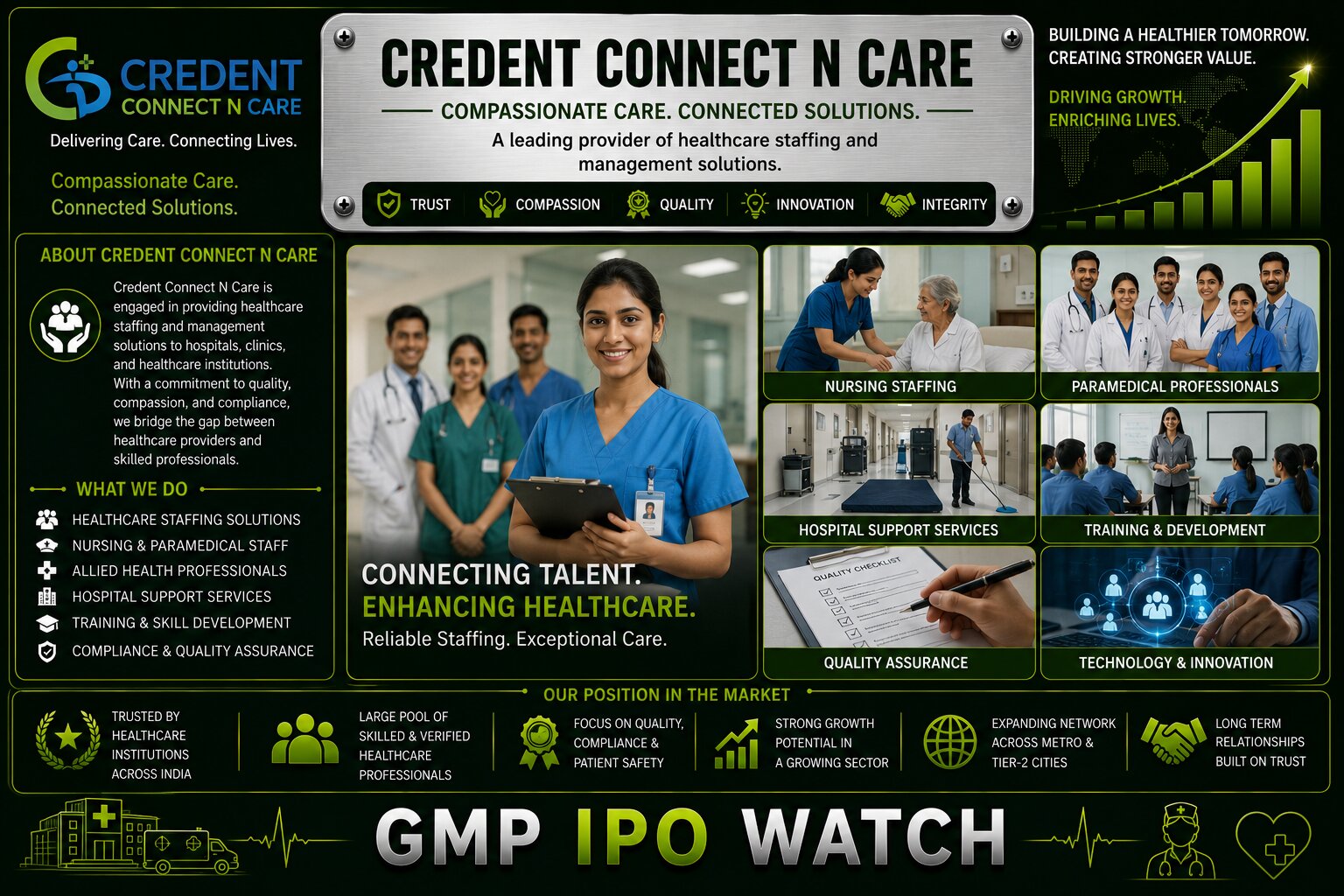
Credent operates across healthcare logistics, diagnostic sample transportation, workforce deployment, phlebotomy and related healthcare-support services. Its business model connects healthcare companies with the physical workforce and logistics infrastructure needed to collect, move and manage diagnostic samples efficiently.
The company's NSE SME IPO opened on August 13, 2026, and remains open until August 17. The price band is ₹179–₹189 per share, the lot size is 600 shares, and the overall issue size is about ₹93.90 crore.
Financially, Credent entered the IPO after a dramatic acceleration.
FY2026 consolidated revenue reached approximately ₹214.16–₹214.43 crore, while reported PAT reached roughly ₹18.45 crore, compared with a much smaller FY2025 business.
Yet one current IPO analysis also highlights negative operating cash flow of approximately ₹6.62 crore and significant customer concentration.
That creates the central investment question:
Can Credent convert its rapid accounting growth into dependable cash generation while reducing dependence on a relatively small group of large healthcare customers?
Credent Connect N Care IPO Details
| Particular | Details |
|---|---|
| Company | Credent Connect N Care Limited |
| IPO Type | Book Built SME IPO |
| Listing Platform | NSE Emerge |
| Issue Size | Approx. ₹93.90 Crore |
| Issue Structure | Fresh Issue |
| Shares Offered | 49,68,000 Shares |
| Price Band | ₹179 – ₹189 Per Share |
| Face Value | ₹10 Per Share |
| Lot Size | 600 Shares |
| Minimum Retail Application | 1,200 Shares |
| Minimum Retail Investment | ₹2,26,800 at ₹189 |
| IPO Opening Date | August 13, 2026 |
| IPO Closing Date | August 17, 2026 |
| Expected Allotment | August 18, 2026 |
| Expected Listing | August 20, 2026 |
| Registrar | KFin Technologies Limited |
| Lead Manager | Hem Securities Limited |
Current IPO data confirms the ₹179–₹189 price band, 600-share lot size, August 17 closing date and August 20 tentative NSE SME listing.
What Does Credent Connect N Care Actually Do?
Credent's roots are in healthcare logistics and operational support.
The business has evolved from healthcare-focused cold-chain and logistics activities into a broader platform covering services required by diagnostic and healthcare companies.
Its value proposition is straightforward.
A diagnostic laboratory may be excellent at processing blood samples.
But someone still needs to:
collect the sample, deploy phlebotomists, move the sample safely, coordinate field workers and deliver it to the laboratory on time.
Credent helps manage this operational layer.
That makes the company more similar to a healthcare infrastructure outsourcing platform than a conventional courier business.
Why Healthcare Outsourcing Can Become a Large Market
Consider a diagnostic chain expanding into 30 new cities.
It could recruit and manage every rider, phlebotomist and local logistics employee internally.
But doing so creates significant complexity.
Outsourcing some of these activities can allow healthcare companies to focus on their core functions while a specialist manages field execution.
For Credent, every expansion by an existing healthcare customer can potentially create additional:
revenue, employees deployed and logistics volume.
That means Credent can grow alongside its customers without needing to own diagnostic laboratories itself.
FY2026 Revenue Was a Major Step Change
Current IPO reporting shows FY2026 revenue at roughly ₹214 crore, compared with approximately ₹78 crore in FY2025.
That implies growth of well over 100% in one year.
For a company of Credent's size, such acceleration is significant.
It suggests the company either won major new contracts, expanded substantially with existing customers, broadened service lines, or benefited from a combination of these factors.
The opportunity is attractive.
The sustainability question is equally important.
PAT Growth Was Even Stronger
Current FY2026 IPO information reports PAT of approximately ₹18.45 crore.
By comparison, the restated FY2025 PAT reported in earlier prospectus-linked financial data was only around ₹2.24–₹2.25 crore.
That represents a very sharp improvement in profitability.
The business therefore appears to have moved into a substantially different scale and margin profile.
But investors should not stop at PAT.
The Cash Flow Question Is More Important Than It Looks
ScanX's current IPO analysis highlights negative operating cash flow of approximately ₹6.62 crore, despite the strong FY2026 revenue and profit profile.
This deserves close attention.
A company can report profit before it actually collects all customer payments.
If receivables rise rapidly, accounting profit can improve while cash flow remains negative.
For a B2B healthcare company, this is particularly relevant because large institutional customers may operate on credit terms.
Why Negative Operating Cash Flow Can Happen During Rapid Growth
Imagine Credent wins several new contracts.
The company immediately needs to pay:
salaries, riders, fuel, vendors and operating expenses.
But the customer may pay invoices after 45, 60 or 90 days.
The company is profitable on paper, but cash leaves before customer collections arrive.
Rapid growth can therefore create more working-capital pressure, not less.
This is why Credent's IPO includes substantial working-capital-related deployment.
Working Capital Is Essentially Growth Fuel
For Credent, more working capital can enable the company to execute larger healthcare contracts.
Suppose a national diagnostic chain awards a new assignment requiring hundreds of field workers.
Credent cannot wait for the first customer payment before hiring and deploying those workers.
It needs liquidity upfront.
Therefore:
working capital → execution capacity → revenue growth.
But investors need to ensure that money eventually returns through customer collections.
Receivable Days Could Become One of the Most Important KPIs
After listing, investors should pay particular attention to how quickly customers pay.
Suppose revenue grows 50%.
If receivables grow 150%, growth quality may be weakening.
The ideal pattern is:
revenue growth + PAT growth + operating cash flow growth.
If only the first two increase, additional investigation is warranted.
Customer Concentration Is Significant
ScanX's IPO analysis states that the top 10 customers contributed approximately 81.76% of revenue.
That is one of the biggest risks in the investment case.
A company can have hundreds of operational relationships while still depending economically on a relatively small group of major clients.
For Credent, losing or renegotiating one major account could materially affect revenue.
Why Large Healthcare Customers Can Be Both Good and Risky
Large diagnostic or healthcare companies provide several advantages.
They can offer:
high volumes, recurring requirements and multi-city expansion opportunities.
But large customers also have negotiating power.
They can demand:
lower pricing, longer payment terms or stricter service-level commitments.
This means Credent's scale can grow quickly through large accounts, but margins and cash flow may depend heavily on contract terms.
The Ideal Future Is Lower Customer Concentration
Suppose the top 10 customer share falls from:
81.76% → 65% → 50%
while overall revenue continues rising.
That would materially improve business resilience.
Credent does not necessarily need to reduce business with existing major clients.
It simply needs other clients to grow faster.
That is an important distinction.
Recurring Healthcare Contracts Can Still Be Attractive
Despite concentration risk, Credent operates in activities that are recurring by nature.
Diagnostic samples need to be collected every day.
Healthcare staff need to be deployed repeatedly.
Logistics routes operate continuously.
This can create stronger revenue visibility than businesses dependent entirely on one-time projects.
The key issue is the duration, renewal profile and profitability of those contracts.
Route Density Can Improve Economics
Healthcare logistics has network economics.
Imagine a rider travels 20 kilometres to collect only one sample.
Cost per sample is high.
Now imagine the same route handles 10 samples.
Transportation cost per sample falls significantly.
As Credent adds more clients in the same geographic areas, route density can improve.
This can create operating leverage.
Workforce Density Can Produce Similar Benefits
Credent's model is also workforce intensive.
More healthcare contracts within the same city can allow supervisory teams and operating infrastructure to support more field workers.
This can potentially reduce overhead per employee.
However, salary inflation remains a risk if customer pricing does not increase at the same rate.
The Company Raised ₹26.53 Crore From Anchor Investors
Before public bidding began, Credent raised approximately ₹26.53 crore from 10 anchor investors, allocating around 14.04 lakh shares at ₹189 per share.
The anchor book included participation from Abakkus Asset Manager, while current reporting also notes existing pre-IPO interest from investors including Ashish Kacholia.
This provides evidence of institutional interest in the business.
However, anchor participation does not remove customer, cash-flow or valuation risk.
The IPO Is Predominantly Growth Capital
Current issue information describes the offer as a fresh issue of 49.68 lakh shares, with no conventional shareholder OFS.
That means capital is being raised primarily to support the company rather than provide a large exit to selling shareholders.
This is constructive for a fast-growing SME because management can direct fresh capital toward:
working capital, subsidiary funding, equipment, debt reduction and general business expansion.
Subsidiary Investment Adds Another Dimension
Credent also intends to support its healthcare subsidiary as part of its broader expansion strategy.
This potentially allows the group to grow beyond logistics into a wider healthcare-services ecosystem.
The strategic opportunity is cross-selling.
A customer using Credent for logistics could potentially also use:
workforce, home-collection or other operational services.
That increases revenue per customer.
Cross-Selling Can Improve Customer Lifetime Value
Imagine one client currently generates ₹1 crore annually from logistics.
If Credent later provides manpower and additional healthcare operations, annual revenue from that same client might increase materially.
That is much more efficient than acquiring a brand-new customer for every rupee of growth.
It can also increase customer stickiness.
Scale Can Become a Competitive Advantage
A small local healthcare logistics provider may serve one city.
Credent's ambition is broader.
Large healthcare organisations operating nationally may prefer one provider capable of supporting several regions.
A larger network can offer:
central reporting, consistent service standards and simplified vendor management.
If Credent succeeds in building that network, scale itself can become an advantage.
But Operational Complexity Also Increases
Managing healthcare logistics across multiple regions means coordinating:
people, vehicles, service quality and customer expectations.
A failure in one major region can damage a national relationship.
Healthcare logistics is particularly sensitive because a delayed or mishandled diagnostic sample can affect the testing process.
Execution quality therefore remains central to customer retention.
FY2025 Shows How Different the Business Looked Before the Growth Surge
Restated financial information for earlier periods showed approximately:
| Period | Revenue | PAT |
|---|---|---|
| FY2023 | ₹59.75 Cr | ₹2.69 Cr |
| FY2024 | ₹75.73 Cr | ₹2.66 Cr |
| FY2025 | ₹77.94 Cr | ₹2.24 Cr |
The interesting pattern is clear.
Revenue increased between FY2023 and FY2025.
PAT did not.
Then the latest FY2026 period produced a dramatic jump in both revenue and profitability.
That makes FY2026 sustainability the single biggest fundamental question surrounding the IPO.
Investors Should Understand What Changed in FY2026
The market needs to determine whether the profitability jump resulted from durable factors such as:
better contract mix, stronger scale economics, greater workforce productivity or higher-value services.
If so, FY2026 may represent a new earnings base.
If profitability benefited heavily from one or two unusual contracts, future results could be more volatile.
Post-listing quarterly results will provide important evidence.
Valuation Should Not Assume FY2026 Growth Continues Forever
Rapid growth creates excitement.
But no company can grow revenue from ₹78 crore to more than ₹214 crore every year indefinitely.
Investors should value Credent using a more normalised future growth assumption.
The investment case is much stronger if the company can:
maintain healthy margins while growing at a sustainable rate and improving operating cash flow.
Day-2 Subscription Is Already Strong
As of 1:40 PM on August 14, Groww reported:
| Category | Subscription |
|---|---|
| QIB | 4.53× |
| NII | 4.18× |
| Retail | 10.54× |
| Overall | 7.22× |
InvestorGain's later live tracker showed the overall issue around 7.95×, illustrating how quickly subscription is moving during Day 2.
Because the issue remains open until August 17, final subscription could be substantially higher.
Retail Demand Is Currently the Strongest
Retail subscription had already crossed 10× by 1:40 PM.
This shows strong individual-investor interest.
QIB and NII categories are also already above 4×.
For an SME IPO with another bidding day remaining after the weekend, this represents substantial early demand.
Credent Connect N Care IPO GMP Today
InvestorGain currently reports GMP of approximately:
₹75 per share.
Against the ₹189 upper price band, this implies an unofficial estimated price around:
₹264
or approximately:
39.68% premium.
The tracker shows GMP moving from roughly ₹0 on August 10 to ₹35 on August 11, ₹50 on August 12 and ₹75 on August 13–14.
This indicates sharply improving short-term sentiment.
GMP Is Strong, but Cash Flow Still Matters More
A ₹75 GMP changes market expectations.
It does not change Credent's operating cash flow.
Long-term shareholders will eventually care much more about:
how much cash the business generates after paying employees, suppliers and working-capital requirements.
That is why the negative FY2026 operating cash-flow observation deserves far more attention than a short-lived grey-market quote.
Competitive Strengths
Credent enters the IPO with several meaningful positives: rapid FY2026 revenue growth, PAT of around ₹18.45 crore, healthcare-specialised logistics capabilities, recurring B2B service requirements, strong anchor participation, an entirely fresh issue structure and strong Day-2 subscription/GMP sentiment.
Major Risks
The largest risks are the 81.76% top-10 customer concentration, negative reported operating cash flow of around ₹6.62 crore, working-capital intensity, dependence on large institutional contracts, workforce-cost inflation, execution risk across a geographically dispersed network and lower liquidity typical of NSE SME shares.
What Investors Should Track After Listing
The most important numbers will be operating cash flow, receivable days, top-10 customer contribution, PAT margin, revenue per employee, customer retention and ROCE on the fresh IPO capital.
If operating cash flow turns sustainably positive while customer concentration falls, the quality of the business could improve significantly even without another year of triple-digit revenue growth.
The Most Important Post-IPO Equation
Credent's attractive growth path looks like:
fresh capital → larger healthcare contracts → higher route and workforce density → stronger revenue → timely customer collections → positive operating cash flow.
The riskier path is:
fresh capital → larger contracts → higher receivables → more working capital → continuing cash-flow pressure.
Both paths can produce impressive revenue.
Only the first produces durable shareholder value.
Should Investors Consider Credent Connect N Care IPO?
The positive case is supported by exceptional FY2026 growth, strong profitability, healthcare outsourcing exposure, recurring service requirements, anchor participation and robust Day-2 demand.
The caution case is equally important.
The company has meaningful customer concentration and reported negative operating cash flow despite strong accounting profitability.
Credent should therefore be evaluated as a fast-growing healthcare infrastructure and outsourcing company whose next challenge is cash-flow quality, rather than simply as a high-GMP SME IPO.
Final View on Credent Connect N Care IPO 2026
The Credent Connect N Care IPO 2026 is on Day 2 today, August 14, and remains open through August 17. The ₹93.90 crore NSE SME issue carries a price band of ₹179–₹189 per share.
Investor demand is already strong.
At 1:40 PM, the issue was subscribed approximately 7.22× overall, including 10.54× retail, 4.18× NII and 4.53× QIB demand. A slightly later InvestorGain update showed overall subscription near 7.95×.
Grey-market sentiment has also strengthened, with the latest reported GMP around ₹75, implying an unofficial price near ₹264 against the ₹189 upper band.
But the more important story is happening inside the financial statements.
Credent's FY2026 revenue surged to roughly ₹214 crore, with PAT around ₹18.45 crore, marking a dramatic improvement over FY2025.
At the same time, current IPO analysis flags negative operating cash flow of approximately ₹6.62 crore and top-10 customer concentration of around 81.76%.
Those two numbers define the real long-term investment question.
Credent has already demonstrated that it can scale.
Now it needs to demonstrate that it can collect cash from that scale and diversify the customers producing it.
If management uses the fresh IPO capital to build a denser healthcare network, win additional customers, improve collection cycles and convert profits into positive cash flow, the company could develop into a substantially stronger healthcare-services platform.
If growth instead keeps absorbing larger amounts of working capital while revenue remains concentrated among a few large customers, the headline PAT numbers may overstate the quality of the underlying economics.
Loading comments...