

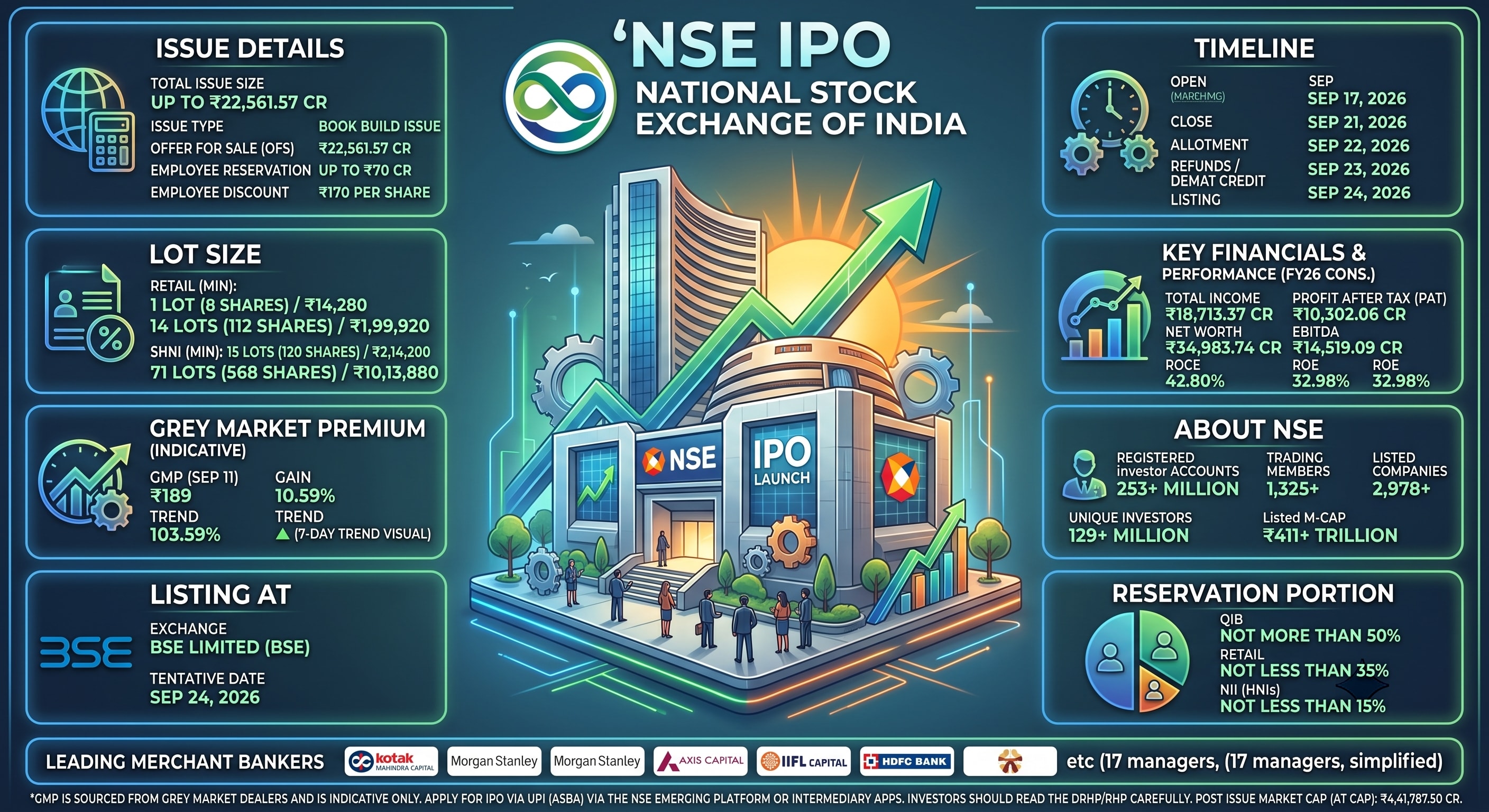
The National Stock Exchange of India (NSE) is finally coming to the public market after years of anticipation. The IPO is an entirely Offer for Sale (OFS), meaning NSE itself will not receive money from the issue. Existing shareholders will sell their shares to public investors, while the IPO will enable NSE's equity shares to become publicly listed.
The IPO opens on September 17, 2026 and closes on September 21, 2026. The shares are expected to list on the BSE on September 24, 2026.
| Particular | Details |
|---|---|
| IPO Name | NSE IPO |
| IPO Date | 17–21 Sep 2026 |
| Allotment | 22 Sep 2026 |
| Listing Date | 24 Sep 2026 |
| IPO Type | Book Built Issue |
| Issue Size | ₹22,561.57 Cr |
| Price Band | ₹1,700–₹1,785 |
| Lot Size | 8 Shares |
| Min. Investment | ₹14,280 |
| Face Value | ₹1 |
| Issue Type | Offer for Sale |
| Listing | BSE |
| Market Cap | ~₹4.41 Lakh Cr |
NSE IPO GMP Today
The latest grey-market tracking indicates that NSE IPO GMP is around ₹210 per share. At the upper price band of ₹1,785, this points to an estimated listing price of approximately ₹1,995.
The implied gain based on this GMP would be around 11.76% over the upper IPO price. However, GMP is unofficial and can change before listing, so it should not be considered a guaranteed listing price. Current market reports have also shown GMP fluctuating in recent sessions.
| Particular | GMP |
|---|---|
| IPO Price | ₹1,785 |
| Current GMP | ₹210 |
| Estimated Listing | ₹1,995 |
| Estimated Gain | ₹210 |
| GMP Return | ~11.76% |
| GMP Status | Positive |
NSE IPO Dates and Timeline
The NSE IPO bidding window will remain open for five days from September 17 through September 21. Anchor investor allocation is scheduled for September 16. The basis of allotment is expected on September 22, followed by demat credit on September 23 and listing on September 24.
| Event | Date |
|---|---|
| Anchor Allocation | 16 Sep 2026 |
| IPO Opens | 17 Sep 2026 |
| IPO Closes | 21 Sep 2026 |
| Allotment | 22 Sep 2026 |
| Demat Credit | 23 Sep 2026 |
| Listing | 24 Sep 2026 |
NSE IPO Lot Size and Investment
The NSE IPO lot size is 8 shares. At the upper price band of ₹1,785, one lot requires an investment of ₹14,280.
Retail investors can bid in multiples of eight shares. The relatively low minimum investment compared with many large IPOs makes the issue accessible to a wider retail investor base.
| Particular | Details |
|---|---|
| Lot Size | 8 Shares |
| Price per Share | ₹1,785 |
| 1 Lot Value | ₹14,280 |
| 2 Lots | ₹28,560 |
| 10 Lots | ₹1,42,800 |
NSE Company Business
The National Stock Exchange of India is one of the country's largest financial market infrastructure institutions. Its businesses include equity trading, equity derivatives, currency derivatives, debt markets, mutual fund platforms and other market infrastructure services.
NSE has a particularly strong position in India's equity derivatives market and benefits from the country's growing participation in capital markets. Its technology-driven trading infrastructure allows millions of investors and institutions to participate in Indian financial markets.
The exchange generates a significant portion of its revenue from transaction charges, with trading activity and market volumes being major drivers of its financial performance.
NSE IPO Issue Structure
Unlike a conventional IPO in which a company raises fresh capital, the NSE IPO consists entirely of an OFS.
Existing shareholders including SBI, Canada Pension Plan Investment Board, Aranda Investments, MS Strategic Mauritius, New India Assurance and other investors are selling their existing holdings.
Because there is no fresh issue, NSE will not receive the IPO proceeds. The money raised will go to the selling shareholders after issue-related expenses.
| Particular | Details |
|---|---|
| Fresh Issue | Nil |
| OFS | Up to 12.64 Cr Shares |
| NSE Fundraising | Nil |
| Proceeds Received By | Selling Shareholders |
| Purpose | Public Listing & Stake Sale |
NSE IPO Financial Performance
NSE has a highly profitable business model supported by trading activity, market data, listing services and other financial-market infrastructure operations.
Recent financial performance has attracted significant investor attention because of the company's strong profitability and high operating margins. Transaction charges remain an important revenue contributor, particularly because of NSE's dominant position in equity derivatives.
The company reported a very strong profit margin in the latest reported period, highlighting the scalability of its exchange business.
| Particular | Key Point |
|---|---|
| Business Model | Exchange & Market Infrastructure |
| Major Revenue Driver | Transaction Charges |
| Profitability | Strong |
| Market Position | Leading Indian Exchange |
| Derivatives Position | Dominant |
NSE IPO Valuation
At the upper price band of ₹1,785, NSE's IPO implies a valuation of approximately ₹22,561.57 crore for the offer, while the implied market capitalisation is around ₹4.41 lakh crore. The reported post-IPO P/E is approximately 35.4x based on the relevant earnings figures.
The valuation is significant, but investors are also paying for NSE's strong market position, scalable exchange model and high profitability. The comparison with BSE should be made carefully because the two exchanges have different market shares, product mixes and business characteristics.
NSE IPO Subscription
The IPO is scheduled to open on September 17, so the final subscription figures are not yet available.
Investor attention is expected to be particularly high because NSE is one of India's most important financial-market institutions and the IPO is among the largest public issues in Indian history.
The issue reserves 50% for QIBs, 35% for retail investors and the remaining portion for NIIs, subject to the applicable allocation rules.
NSE IPO Strengths
NSE has several fundamental advantages that make the IPO particularly important for investors.
The exchange has a leading position in India's capital markets, strong technology infrastructure and a highly scalable business model. Rising retail participation, increasing derivatives activity and growing financialisation of household savings can support long-term market volumes.
Key strengths include:
- Leading position in India's securities market
- Strong equity derivatives franchise
- Highly scalable technology-based business
- Strong profitability
- Large and growing investor base
- High barriers to entry
- Strong financial-market ecosystem
- Significant brand recognition
- Potential long-term benefit from India's financialisation trend
NSE IPO Risks
Despite its strong business position, NSE is not without risks. Exchange revenues are closely linked to market activity and trading volumes. A prolonged period of weak market activity could affect transaction-based revenue.
Regulatory changes are another important risk because exchanges operate in a highly regulated financial environment. Changes in derivatives rules, transaction charges, market structure or investor protection regulations can influence future earnings.
The IPO valuation is also significant. At approximately 35.4x earnings, investors are paying a premium for NSE's market position and profitability.
Other risks include:
- Regulatory changes
- Dependence on trading volumes
- High valuation
- Competition from BSE and other platforms
- Changes in derivatives-market regulations
- Technology and cybersecurity risks
- Market-cycle dependency
NSE IPO Listing and GMP Estimate
Based on the latest GMP of around ₹210, the estimated listing price at the upper band would be approximately ₹1,995.
This is only a grey-market indication. If the GMP remains unchanged, one lot of 8 shares could theoretically generate a listing gain of around ₹1,680.
| Calculation | Amount |
|---|---|
| Upper IPO Price | ₹1,785 |
| Current GMP | ₹210 |
| Estimated Listing | ₹1,995 |
| Gain Per Share | ₹210 |
| Lot Size | 8 |
| Indicative Lot Gain | ₹1,680 |
Actual listing performance can be very different from GMP estimates.
NSE IPO Review
NSE IPO Review: Positive for Long-Term Investors, Valuation Needs Attention
NSE is one of the most important market-infrastructure businesses in India, with a strong competitive position, high barriers to entry and a highly scalable technology-driven model.
The company's dominant position in equity derivatives, strong profitability and India's expanding investor base are major positives. The IPO also gives public investors an opportunity to own a stake in one of India's most important financial institutions.
However, investors should not ignore valuation. The issue is priced at a substantial absolute value and the reported P/E is around 35.4x. Regulatory changes and fluctuations in trading volumes are also important risks.
Overall, NSE IPO looks fundamentally strong, but investors should assess whether the valuation fits their investment horizon and risk appetite rather than relying only on the current GMP.
NSE IPO Key Highlights
- India's highly anticipated NSE IPO
- IPO opens September 17, 2026
- IPO closes September 21, 2026
- Price band ₹1,700–₹1,785
- Lot size 8 shares
- Minimum investment ₹14,280
- ₹22,561.57 crore offer size
- Entirely Offer for Sale
- NSE receives no IPO proceeds
- Expected BSE listing on September 24
- Current GMP around ₹210
- Indicative GMP-based listing around ₹1,995
- Estimated GMP return around 11.76%
- Strong market position and profitability
- Major risks include valuation and regulatory changes
NSE IPO Conclusion
The NSE IPO is a landmark public offering because it brings one of India's most important financial-market institutions into the listed market. Its strong competitive position, dominant derivatives business, scalable technology platform and high profitability make the company fundamentally attractive.
The current GMP of around ₹210 also indicates positive grey-market sentiment, although this can change before listing. The bigger consideration for investors is valuation, with the IPO priced at a substantial earnings multiple.
For investors looking beyond short-term listing gains, NSE's long-term growth will depend on India's expanding capital markets, trading volumes, regulatory environment and its ability to maintain its competitive position.
Disclaimer: GMP is an unofficial and unregulated market indicator and can change at any time. Estimated listing prices based on GMP are not guaranteed. Investors should read the NSE IPO RHP and evaluate the company's valuation, risks and financial performance before investing.
Loading comments...