

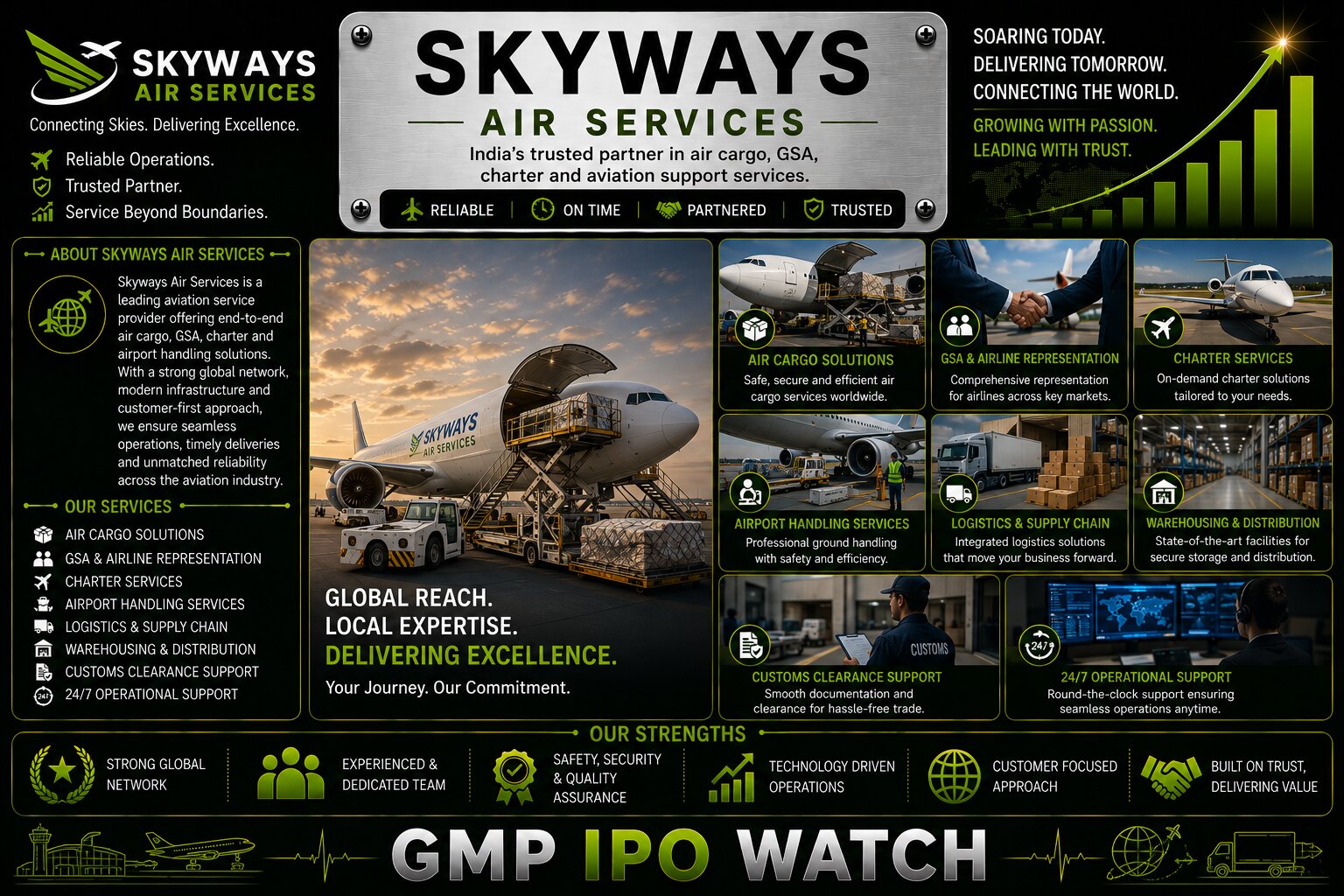
Skyways Air Services IPO 2026 – Day 3 Update
Skyways Air Services Limited's IPO is now in focus as bidding continues ahead of its August 27, 2026 closing date.
The ₹582.80 crore mainboard IPO carries a price band of ₹131 to ₹138 per share, with a minimum lot of 100 shares. The company is expected to list on BSE and NSE on September 1.
Unlike the earlier stages of bidding, investor participation has now strengthened, making the latest subscription trend one of the key developments around the issue.
Skyways Air Services IPO Details
| Particular | Details |
|---|---|
| IPO Type | Mainboard IPO |
| Issue Size | ₹582.80 Crore |
| Fresh Issue | ₹398.80 Crore |
| Offer for Sale | ₹184.00 Crore |
| Total Shares | 4,22,31,600 |
| Price Band | ₹131 – ₹138 |
| Face Value | ₹10 |
| Lot Size | 100 Shares |
| Minimum Investment | ₹13,800 |
| IPO Open Date | August 24, 2026 |
| IPO Close Date | August 27, 2026 |
| Allotment Date | August 28, 2026 |
| Refund / Demat | August 31, 2026 |
| Listing Date | September 1, 2026 |
| Listing Exchange | BSE & NSE |
| Registrar | Bigshare Services |
The issue combines fresh equity with an OFS by existing shareholders. The official RHP was filed with SEBI on August 12.
Skyways Air Services IPO Subscription Today
Investor participation has improved significantly as the IPO moves through its subscription period.
The latest reported figure shows the issue subscribed approximately 2.46 times.
| Subscription Update | Status |
|---|---|
| IPO Stage | Day 3 |
| Overall Subscription | ~2.46x |
| IPO Closing | August 27 |
| Current Demand | Above shares offered |
The figure is live and can change substantially as additional bids are received before the issue closes.
Skyways Air Services IPO GMP Today
Grey-market sentiment also remains positive, although the premium has moderated compared with the opening phase.
The latest reported GMP indicates an estimated 21% premium over the upper issue price.
| GMP Particular | Latest Trend |
|---|---|
| Upper Issue Price | ₹138 |
| Indicative Premium | ~21% |
| Approx. Indicative Price | ~₹167 |
| GMP Sentiment | Positive |
Earlier, around the opening of the IPO, grey-market indications were closer to 23%.
GMP is an unofficial indicator and does not guarantee the actual listing price.
What Does Skyways Air Services Do?
Skyways Air Services is an established integrated logistics and freight-forwarding company.
Despite having "Air" in its name, its business extends beyond air cargo. The company provides services across:
air freight + ocean freight + road transportation + warehousing + customs clearance + supply-chain solutions.
Its presence spans multiple Indian states as well as international markets.
The integrated model allows Skyways to handle multiple parts of a customer's logistics requirement instead of providing only a single transportation service.
Air Freight Remains the Core Business
Air freight is the company's most important business vertical.
More than 75% of Skyways' revenue comes from air-freight services, making the segment central to its financial performance. The company has also held a leading position among Indian air-freight forwarders over recent years.
| Service | Business Role |
|---|---|
| Air Freight | Core revenue driver |
| Ocean Freight | International cargo |
| Road Freight | Domestic movement |
| Warehousing | Storage & distribution |
| Customs Services | Import/export support |
| Supply Chain | Integrated logistics |
Air freight is particularly relevant for customers transporting high-value, urgent or time-sensitive goods.
Why Air Freight Can Be Attractive
Air cargo is substantially faster than sea freight.
Industries dealing with products such as pharmaceuticals, electronics, automotive components and high-value goods may choose air freight when delivery speed is critical.
Skyways benefits by connecting these customers with airlines and international freight networks.
However, dependence on air cargo also means changes in freight rates and international trade volumes can materially influence the business.
IPO Structure Gives Skyways Fresh Growth Capital
The ₹582.80 crore IPO includes a sizeable fresh-issue component.
| IPO Component | Amount | Approx. Share |
|---|---|---|
| Fresh Issue | ₹398.80 Cr | ~68% |
| Offer for Sale | ₹184.00 Cr | ~32% |
| Total IPO | ₹582.80 Cr | 100% |
Approximately two-thirds of the IPO therefore represents fresh capital being raised by the company.
This is important because Skyways can deploy that money toward strengthening its financial position and supporting future operations.
Debt Reduction Is an Important IPO Objective
Skyways operates in a working-capital-intensive industry and has accumulated meaningful borrowings as its operations have expanded.
A major portion of the fresh IPO proceeds is intended to reduce debt. The company is raising approximately ₹399 crore through fresh shares, with proceeds intended partly for repayment of borrowings and working-capital requirements.
The financial benefit could follow this path:
IPO proceeds → debt repayment → lower interest expense → stronger cash flow → improved balance sheet.
Investors should therefore closely watch borrowings and finance costs in the company's first results after listing.
Working Capital Is Equally Important
Freight forwarding can require substantial working capital.
A logistics company may need to pay:
airlines + shipping companies + transport operators + customs-related expenses
before receiving payment from customers.
As shipment volumes increase, more cash can become tied up in day-to-day operations.
IPO-funded working capital can therefore help Skyways support higher business volumes without depending entirely on additional borrowing.
Anchor Book Attracted Institutional Investors
Ahead of public subscription, Skyways Air Services raised approximately ₹174.5 crore from anchor investors.
The anchor book included institutional participation from names such as Citi and Nomura.
| Anchor Particular | Details |
|---|---|
| Anchor Amount | ~₹174.5 Crore |
| Anchor Date | Before IPO Opening |
| Notable Participants | Citi, Nomura |
| Public IPO | ₹582.80 Crore |
Anchor participation does not guarantee listing performance, but it indicates institutional interest before public bidding.
Integrated Logistics Creates Cross-Selling Opportunities
A customer using Skyways for air freight could potentially also require customs clearance, warehousing or domestic transportation.
This creates an opportunity for the company to increase revenue from existing customers.
Instead of providing:
one shipment → one service
Skyways can potentially provide:
international freight → customs clearance → warehousing → road transportation → final delivery.
This integrated approach can also make customer relationships stronger because more parts of the supply chain are managed through one logistics provider.
International Trade Is a Major Growth Driver
Skyways benefits from growth in Indian imports and exports.
Higher international trade can create greater demand for freight forwarding, customs services, warehousing and related logistics activities.
The company's international presence gives it exposure to this trend.
However, this also creates a major business risk.
A slowdown in global trade, geopolitical tensions, tariff changes or economic weakness can reduce cargo volumes. Skyways' dependence on cross-border trade makes these external factors important for investors.
Freight Rates Can Affect Financial Performance
Airline freight prices can fluctuate significantly depending on:
fuel prices + available cargo capacity + global demand + trade routes + geopolitical disruptions.
Skyways operates between customers and transportation providers, meaning its ability to manage these cost changes is important.
Margins can come under pressure if freight costs increase faster than the company can adjust customer pricing.
Scale Can Become an Advantage
A larger freight forwarder can potentially negotiate more effectively with airlines and other logistics partners because it controls larger shipment volumes.
Skyways' established position in air freight can therefore provide advantages involving:
carrier relationships + route access + pricing + capacity availability.
Scale can also help attract larger enterprise customers requiring logistics services across multiple locations.
But Profit Margins Need Attention
Freight forwarding can generate very large revenue numbers while maintaining relatively thin net margins.
A significant portion of customer billing represents freight and transportation costs paid onward to carriers.
Investors should therefore avoid evaluating Skyways purely on revenue.
More meaningful indicators include:
EBITDA margin + PAT margin + operating cash flow + ROCE + working-capital efficiency.
These metrics provide a better picture of whether increasing shipment volumes are actually creating shareholder value.
Promoter Holding Will Decline After IPO
The promoter group's stake is expected to fall from approximately 79.1% before the IPO to around 56.8% afterward.
| Shareholding | Approx. Stake |
|---|---|
| Pre-IPO Promoter Holding | 79.1% |
| Post-IPO Promoter Holding | 56.8% |
Despite the dilution, promoters are expected to retain majority control after listing.
Key Strengths of Skyways Air Services
Skyways has built an established position in India's freight-forwarding industry, particularly in air cargo.
Its key strengths include a long operating history, leadership in air freight forwarding, integrated logistics capabilities, international presence and multiple service verticals.
The IPO structure is another relevant point. Around ₹398.80 crore of the ₹582.80 crore issue is fresh capital, giving the company funds to strengthen its balance sheet and working-capital position.
Investor interest has also improved during bidding, with the issue reaching approximately 2.46 times subscription in the latest reported update.
Major Risks
Skyways remains heavily dependent on air freight, which contributes more than 75% of revenue. That creates concentration around a single logistics vertical.
Other risks include:
- Global trade slowdown
- Air-freight rate volatility
- High working-capital requirements
- Borrowings and finance costs
- Foreign-exchange fluctuations
- Competition from global logistics companies
- Dependence on airlines and transportation partners
- Thin logistics-sector margins
- Customer concentration
- Geopolitical and trade-policy disruptions
Investors should therefore evaluate the underlying logistics business separately from the current positive GMP.
What Investors Should Track After Listing
| Metric | Why It Matters |
|---|---|
| Air Freight Volumes | Core business growth |
| Revenue Growth | Overall expansion |
| EBITDA Margin | Operating efficiency |
| PAT Margin | Earnings quality |
| Borrowings | IPO debt reduction |
| Finance Costs | Deleveraging benefit |
| Working Capital | Funding efficiency |
| Receivable Days | Collection performance |
| Operating Cash Flow | Profit conversion |
| Ocean Freight Growth | Diversification |
| International Revenue | Global exposure |
| ROCE | Capital efficiency |
For Skyways, debt reduction, cash-flow generation and diversification beyond air freight could be particularly important after listing.
Final View on Skyways Air Services IPO
The Skyways Air Services IPO is currently open and closes on August 27, 2026. The ₹582.80 crore mainboard issue has a price band of ₹131–₹138 and a lot size of 100 shares, with listing scheduled for September 1.
Investor demand has strengthened, with the latest reported subscription reaching approximately 2.46 times. At the same time, grey-market indications suggest roughly a 21% potential premium, although GMP remains unofficial and can change before listing.
The bigger long-term story is the company's use of fresh IPO capital. Approximately ₹398.80 crore of the issue consists of fresh shares, while ₹184 crore represents an OFS.


Loading comments...