

Technocrats Plasma Systems IPO 2026 – Can a 35-Year Engineering Business Scale Into Industrial Automation?
A manufacturing company buying a cutting machine is rarely buying just a piece of equipment.
It is buying:
speed, precision, production capacity and lower manufacturing cost.
That distinction is important when analysing Technocrats Plasma Systems Limited.
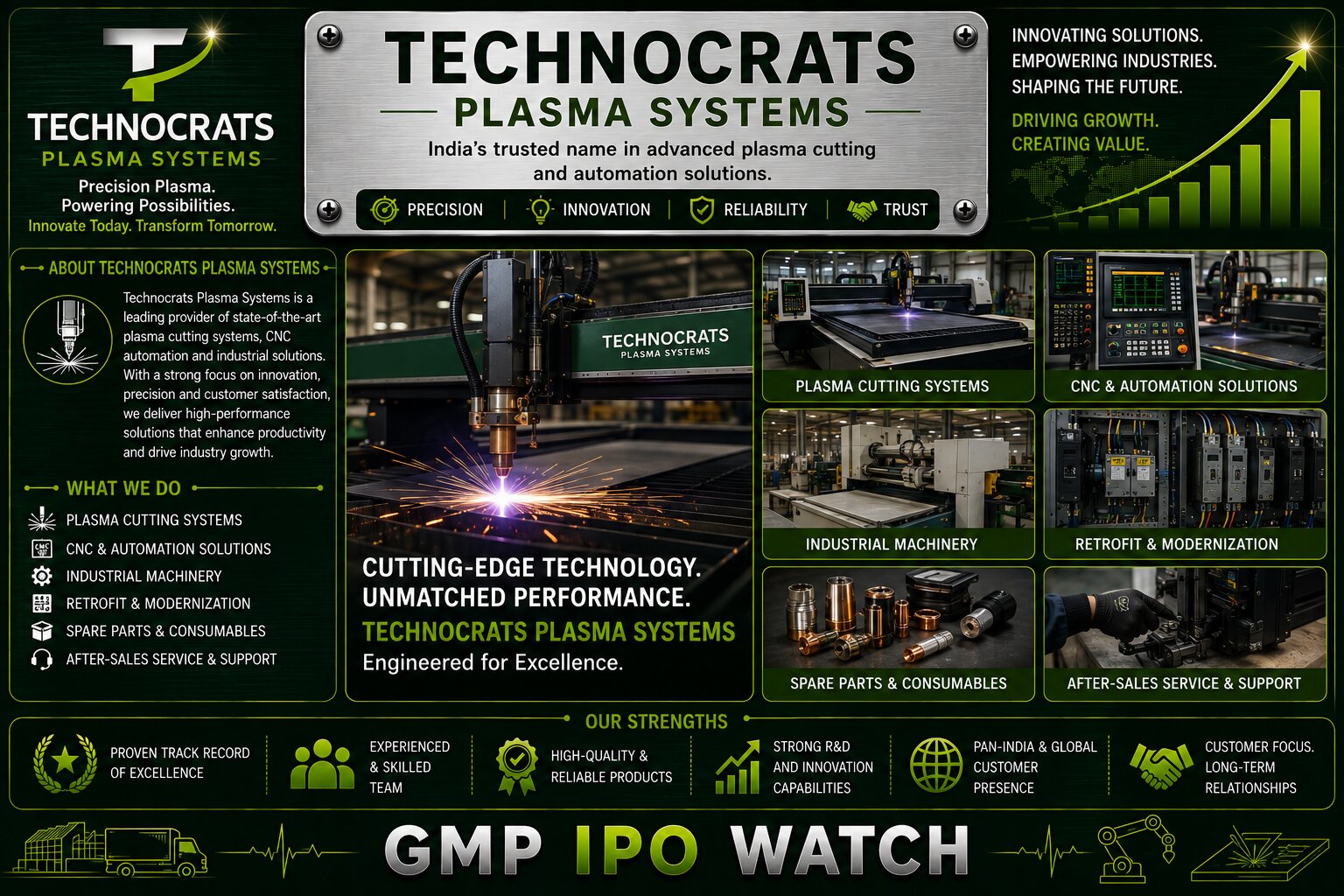
The Maharashtra-based engineering company develops and manufactures plasma cutting systems, welding equipment, CNC machines, laser systems and customised automation solutions used in metal fabrication.
Its official website describes the company as operating in plasma cutting and welding since 1990, with products covering plasma cutting, CNC profile cutting, CNC pipe cutting, arc welding, H-beam fabrication, CNC drilling and laser systems.
Technocrats is therefore not simply selling machines.
Its real product is manufacturing productivity.
That creates a different long-term IPO story.
The central question for investors is:
Can Technocrats use fresh IPO capital to move further from standalone machines toward higher-value automated manufacturing systems?
More Than Three Decades in Plasma Technology
Technocrats traces its operations to 1990, while the corporate entity was incorporated in 1994.
That operating history matters in industrial equipment.
Manufacturers do not normally purchase expensive production machinery based purely on advertising.
They evaluate:
- Reliability
- Cutting quality
- Machine uptime
- Technical support
- Spare-parts availability
- Supplier experience
A long operating history can therefore create credibility that a new entrant cannot immediately reproduce.
What Does Technocrats Plasma Systems Manufacture?
The company's current portfolio covers several industrial manufacturing technologies.
These include:
- Plasma cutting machines
- CNC plasma cutting machines
- CNC gas profile cutting systems
- CNC pipe profile cutting
- Arc welding machines
- Plasma welding systems
- H-beam fabrication systems
- CNC drilling systems
- Laser systems
- Cutting and welding automation.
It also provides customised systems, installation, commissioning, maintenance and retrofit services.
That last part is especially important.
It can create revenue after the original machine sale.
Why Automation Is the Bigger Opportunity
Imagine a factory cutting 500 metal components manually.
The manufacturer depends heavily on:
- Operator skill
- Manual measurement
- Labour availability
- Repeated setup
Now introduce a CNC-controlled automated cutting system.
The machine can potentially produce:
higher consistency + faster throughput + lower rejection + reduced manual intervention.
For customers, automation is therefore not merely a machinery purchase.
It can directly affect manufacturing economics.
This creates an opportunity for Technocrats as Indian factories increase automation.
India's Manufacturing Expansion Can Support Demand
Technocrats supplies equipment used by metal-fabrication and heavy-engineering industries.
Its machines can serve industries including:
- Automotive
- Infrastructure
- Heavy engineering
- Defence
- Shipbuilding
- Steel
- Oil & gas
- General manufacturing.
When these industries expand capacity, demand for fabrication equipment can increase.
The company therefore provides an indirect way of participating in India's broader manufacturing-capex cycle.
Technocrats Does Not Need to Manufacture the Final Product
This is an interesting part of the business model.
Technocrats does not need to manufacture:
a ship, bridge, railway component or industrial plant.
Instead, it sells machines that help other companies manufacture those products.
This means the company can potentially benefit from investment across several industrial sectors simultaneously.
Installed Machines Can Create Future Revenue
The first sale to a customer may be a plasma cutting or CNC system.
But industrial machinery requires ongoing support.
Over its operating life, a machine can require:
- Consumables
- Replacement components
- Maintenance
- Technical service
- Software/control upgrades
- Retrofitting
Technocrats provides maintenance and retrofit capabilities alongside equipment sales.
This creates an important economic opportunity:
machine sale today → service and replacement revenue tomorrow.
The Installed Base Can Become a Competitive Advantage
IPO-related company information indicates Technocrats has historically served more than 2,500 customers, supported by dealers and service locations.
The company's more recent corporate communication refers to 3,000+ customers across industries.
A large installed base matters because every operating machine can potentially create future demand.
That includes:
maintenance + spare parts + consumables + upgrades + replacement machines.
As the installed base grows, aftermarket opportunities can also expand.
Why Aftermarket Revenue Can Be Valuable
Suppose Technocrats sells a machine for ₹20 lakh.
That is one transaction.
But over ten years, the customer may spend additional money on:
- Servicing
- Torches
- Electrodes
- Components
- Retrofits
The lifetime economic value of the customer can therefore be much higher than the original invoice.
This makes aftermarket revenue as a percentage of sales an important metric to watch after listing.
Service Infrastructure Can Create Customer Stickiness
Industrial customers care about downtime.
If a machine stops, production can stop with it.
A customer therefore values a supplier capable of providing quick technical support.
Technocrats has historically developed a dealer and service network to support its installed equipment.
This can create switching costs.
A competing machine may be cheaper.
But a factory may still prefer Technocrats if it trusts the company's:
equipment + service + spare-parts ecosystem.
Customisation Can Improve Pricing Power
Not every factory requires the same machine.
One manufacturer may need to cut large steel plates.
Another may need pipes.
Another may require automated welding.
Another may require a completely customised fabrication cell.
Technocrats' ability to provide customised automation systems means it can compete on engineering capability, not just machine price.
This matters because standardised equipment is easier to compare purely on price.
Custom engineering is harder to commoditise.
R&D Is Central to the Business
The company's official material emphasises its engineering and R&D capability across plasma cutting, welding and automation technologies.
Technology in industrial fabrication continues changing.
Customers increasingly demand:
- Higher precision
- Lower energy use
- Better automation
- Faster production
- Digital controls
A company that stops improving its machines can quickly lose relevance.
For Technocrats, R&D is therefore not an optional expense.
It is part of maintaining competitiveness.
Revenue Growth Has Accelerated Sharply
Historical IPO financial information shows total income of approximately:
| Period | Total Income | PAT |
|---|---|---|
| FY2023 | ₹4.48 Cr | ₹1.51 Cr |
| FY2024 | ₹6.35 Cr | ₹2.21 Cr |
| FY2025 | ₹49.44 Cr | ₹8.11 Cr |
| Jun. 2025 Quarter | ₹30.69 Cr | ₹3.55 Cr |
The jump in FY2025 is substantial.
Revenue increased many times over compared with FY2024.
This shows the company has recently moved into a significantly larger operating scale.
Latest FY2026 Numbers Indicate Further Scale
More recent IPO valuation data reports annualised FY2026 figures of approximately:
Revenue: ₹122.72 crore
EBITDA: ₹19.88 crore
PAT: ₹14.20 crore.
The same source reports:
EBITDA margin: 16.20%
and
PAT margin: 11.57%.
These numbers suggest Technocrats has moved well beyond the revenue scale seen in its earlier historical periods.
Revenue Growth Needs to Be Tested for Sustainability
Rapid growth is attractive.
But capital-equipment businesses can have uneven revenue.
A large automation project can materially increase one year's sales.
Therefore, investors should distinguish between:
repeatable growth
and
project-driven spikes.
The next several reporting periods will help determine whether the latest revenue base represents sustainable scale.
Order Conversion Matters
A machine manufacturer can have strong demand but still face revenue timing differences.
A customised industrial system can involve:
design → manufacturing → testing → installation → commissioning.
Revenue recognition may therefore depend on project completion.
This can create quarterly volatility.
Investors should avoid judging the business based on a single quarter.
The IPO Is Entirely a Fresh Issue
Technocrats' IPO comprises up to 46.20 lakh fresh equity shares, with no Offer for Sale in the original issue structure.
This is a constructive feature.
Existing shareholders are not using the IPO primarily to sell a large stake.
Instead, the company is raising capital for business requirements.
IPO Money Will Support New Machinery
One of the primary IPO objectives is the purchase and installation of plant and machinery at the company's existing premises.
The investment is intended to support manufacturing of:
- Plasma cutting machines
- Welding equipment
- Customised automation systems
This can increase both capacity and technical capability.
New Machinery Can Improve More Than Production Volume
The obvious benefit of new equipment is higher output.
But for Technocrats, the more valuable benefits may include:
- Better precision
- Faster manufacturing
- Lower rejection
- Ability to manufacture more complex systems
That could allow the company to pursue higher-value orders.
The ideal result is therefore not simply:
more machines produced.
It is:
higher engineering value per machine.
Working Capital Is Another IPO Objective
Technocrats also plans to use IPO proceeds for long-term working-capital requirements.
This is important in customised industrial manufacturing.
The company may need to purchase:
- Electronics
- Steel components
- CNC controls
- Motors
- Plasma equipment
- Other specialised parts
well before receiving full payment from customers.
Larger orders therefore require more working capital.
Working Capital Can Determine How Quickly the Company Scales
Imagine Technocrats receives ₹30 crore of new orders.
That sounds positive.
But if manufacturing those systems requires ₹15 crore of components before customers make final payments, the company needs sufficient liquidity.
Without working capital, strong orders cannot necessarily become strong revenue.
Fresh IPO capital can therefore increase the company's ability to execute larger projects.
Two Manufacturing Facilities Support Production
IPO-related information describes two manufacturing facilities in Vasai, Maharashtra, with combined built-up space of approximately 20,000 square feet.
Its official address is in the Gaon Devi Industrial Complex at Sativali, Vasai East.
The IPO-funded machinery investment at the existing premises can help increase productivity without necessarily requiring an entirely new manufacturing location.
Automation Systems Could Improve Revenue Per Customer
Suppose an existing customer originally bought a basic plasma cutter.
Several years later, the factory expands.
Instead of buying another standalone machine, it purchases:
CNC cutting + automation + welding integration.
The second order can be significantly larger.
This gives Technocrats an opportunity to grow not only by adding customers but also by selling more sophisticated systems to existing customers.
Moving Up the Value Chain Is the Bigger Opportunity
The company's evolution can be viewed as:
manual equipment → CNC machines → automated systems → integrated fabrication solutions.
Each step potentially increases:
- Order size
- Engineering complexity
- Customer integration
- Switching costs
This could be more valuable than competing for large volumes of basic equipment.
Laser Systems Expand the Addressable Market
Technocrats' portfolio now also includes laser systems.
Laser cutting provides high precision and is widely used across modern metal fabrication.
The addition gives Technocrats access to customers that may require technologies beyond plasma cutting.
It also allows the company to provide a broader solution portfolio.
Plasma Still Has Important Advantages
Laser does not necessarily replace plasma in every application.
For thicker materials and certain heavy-duty industrial applications, plasma can remain economically attractive.
This means Technocrats can potentially serve different manufacturing requirements through multiple technologies.
The ability to recommend the appropriate system can strengthen its position as a solutions provider rather than a single-product vendor.
Customer Diversification Across Industries Helps
Technocrats' equipment serves industries including automotive, heavy engineering, infrastructure, defence, oil & gas and general manufacturing.
This diversification can reduce dependence on one end-market.
For example, weakness in one industrial segment may be partially offset by capex elsewhere.
However, the overall business remains exposed to the industrial investment cycle.
Industrial Capex Is Still a Major Risk
Factories can postpone machinery purchases during uncertain economic periods.
If industrial capex slows, customers may:
- Delay new machines
- Extend replacement cycles
- Reduce automation investment
This can make equipment revenue cyclical.
Aftermarket services can provide some protection, but they may not completely offset weak capital-equipment demand.
Technocrats Plasma Systems IPO Is on Day 2 Today
The IPO opened on August 14, 2026 and closes on August 18, 2026.
Because August 15 and 16 fell during the Independence Day/weekend break, August 17 is Day 2 of active bidding.
Investors therefore still have the final bidding session on August 18.
Technocrats Plasma Systems IPO GMP Today
Recent grey-market tracking around the weekend indicated a premium of approximately 24% over the ₹132 upper issue price.
At ₹132, a 24% premium would imply an unofficial indicated value around:
₹164 per share.
That corresponds to an indicative gain of roughly:
₹32 per share.
However, GMP is unofficial, unregulated and can change substantially before listing.
GMP Has Been Volatile
Recent community tracking based on InvestorGain data showed Technocrats Plasma Systems GMP moving approximately from:
9% on August 12
to
17% on August 13
to
23% on August 14
and around
24% on August 15–16.
This indicates stronger short-term sentiment as the IPO opened.
But investors should not confuse rising GMP with improving business fundamentals.
What Makes Technocrats Different From a Commodity Manufacturer?
A commodity manufacturer often competes on:
price + volume.
Technocrats can potentially compete on:
engineering + precision + customisation + automation + service.
That distinction is central to the long-term investment case.
If customers choose Technocrats because of engineering capability rather than simply because it offers the cheapest machine, the company may have better pricing power.
Competitive Strengths
Technocrats has several notable strengths.
Its 35+ years of operating experience provides technical credibility.
Its product portfolio spans plasma, CNC, welding, laser and automation technologies.
The company has served thousands of industrial customers, providing a meaningful installed-machine base.
Its customised engineering capabilities allow it to compete beyond standard equipment.
The IPO is entirely fresh capital based on the issue structure, meaning proceeds are focused on company requirements rather than a promoter exit.
Recent financial data also indicates substantial revenue and profit growth.
Major Risks
The investment case also has clear risks.
Industrial cyclicality: Machinery demand depends on customer capex.
Revenue volatility: Large customised orders can make annual growth uneven.
Technology risk: Cutting and welding technologies continue evolving.
Working-capital requirements: Large projects require upfront component purchases.
Customer execution: Delays in complex projects can affect revenue recognition and margins.
Competition: Domestic and international machinery manufacturers compete across plasma, laser and automation.
SME liquidity: BSE SME shares can have lower liquidity and higher volatility than mainboard stocks.
What Investors Should Track After Listing
The most useful post-IPO metrics will be:
Automation revenue share — Is Technocrats moving toward higher-value systems?
Average order value — Are customers purchasing larger solutions?
Order book — Does future revenue visibility remain strong?
Aftermarket revenue — Is the installed base producing recurring income?
EBITDA margin — Can the company maintain roughly mid-teens profitability as it scales?
Working-capital days — Is growth consuming excessive cash?
Operating cash flow — Are accounting profits converting into cash?
ROCE — Is IPO-funded machinery generating adequate returns?
The Most Important Post-IPO Equation
Technocrats' strongest growth path looks like:
IPO capital → better machinery → more complex automation systems → larger orders → bigger installed base → recurring service revenue → stronger cash generation.
The weaker path would be:
IPO capital → more capacity → slower industrial demand → underutilised machinery → lower return on capital.
This is why capacity utilisation and product mix will matter after listing.
Should Investors Consider Technocrats Plasma Systems IPO?
The positive investment case includes:
- More than three decades of engineering experience
- Specialised plasma and welding expertise
- CNC and industrial automation exposure
- Large historical customer base
- Aftermarket/service opportunity
- Strong recent financial growth
- 100% fresh issue structure
- IPO-funded machinery expansion
- Positive recent GMP sentiment
The caution points include:
- SME liquidity
- Industrial-capex cyclicality
- Rapid recent growth that still needs to prove sustainability
- Technology competition
- Working-capital requirements
- Execution risk in customised automation projects
Technocrats should therefore be evaluated as a specialised industrial-automation and fabrication-equipment company, rather than simply a plasma-machine manufacturer.
Final View on Technocrats Plasma Systems IPO 2026
The Technocrats Plasma Systems IPO is on Day 2 today, August 17, 2026, after opening on August 14. Bidding closes tomorrow, August 18, and the shares are proposed for listing on BSE SME.
The issue comprises 46.20 lakh fresh shares, with no OFS in the disclosed structure. Recent grey-market tracking has indicated a premium around 24% over the ₹132 upper issue price, implying an unofficial value near ₹164, although GMP should be treated only as a short-term sentiment indicator.
Fundamentally, the company has an interesting position.
Technocrats has been involved in plasma cutting and welding technology since 1990 and now offers a broader range covering CNC cutting, welding, laser systems and customised industrial automation.
More recent IPO financial analysis reports annualised FY2026 revenue of approximately ₹122.72 crore, EBITDA of ₹19.88 crore and PAT of ₹14.20 crore, with EBITDA margin around 16.2%.
The long-term investment thesis can therefore be summarised as:
industrial automation demand + engineering expertise + large installed customer base + IPO-funded capacity + aftermarket services = potential scalable growth.
But the key word is automation.
If Technocrats uses its IPO capital simply to manufacture more basic equipment, the business remains heavily dependent on machinery volumes and industrial cycles.
If it successfully moves toward larger CNC, laser and customised automation projects while monetising its installed machine base through service, retrofits and consumables, revenue per customer and customer lifetime value could improve considerably.




Loading comments...