

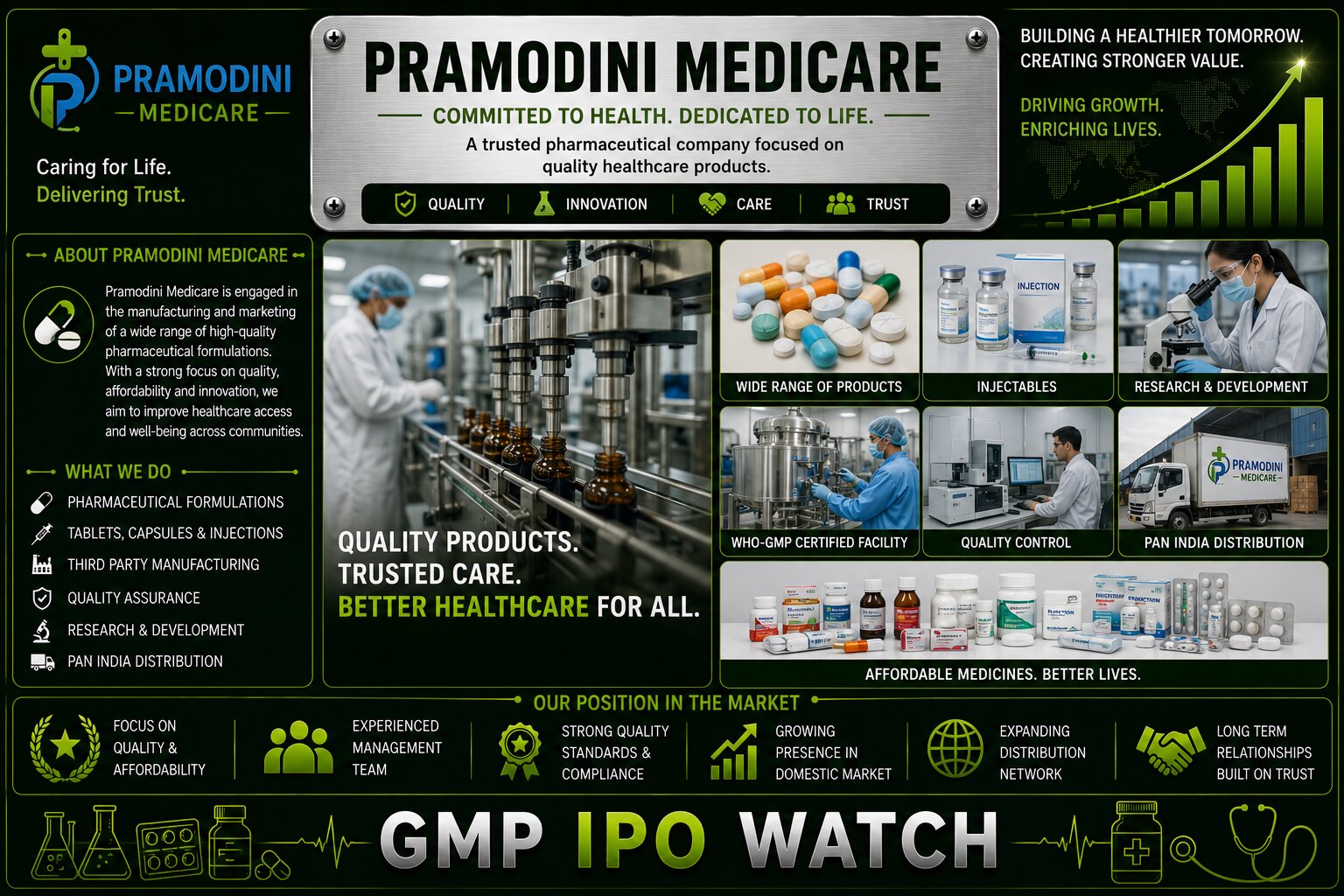
Pramodini Medicare Limited has officially opened its Initial Public Offering for public subscription today, August 12, 2026, bringing another healthcare and diagnostic services company to India's SME primary market.
The IPO will remain open for bidding until August 14, 2026, while the company's shares are proposed to be listed on the NSE Emerge platform on August 19, 2026.
Pramodini Medicare is looking to raise approximately ₹69.04 crore through the public offering.
The company has fixed the IPO price band between ₹110 and ₹118 per equity share, with a face value of ₹10 each.
The offering combines a fresh issue of shares with an Offer for Sale by existing shareholders, meaning the majority of the IPO proceeds will provide fresh growth capital to the company while the OFS component will provide liquidity to selling shareholders.
Pramodini Medicare IPO Opens Today
The opening of the IPO on August 12 places Pramodini Medicare among the notable healthcare-focused SME offerings currently available to investors.
The issue follows the book-building process.
Bidding is available across Qualified Institutional Buyers, Non-Institutional Investors and retail investor categories according to the allocation structure mentioned in the offer documents.
The company's public offering comprises approximately 58.51 lakh equity shares.
At the upper price band, the overall issue size works out to roughly ₹69.04 crore.
IPO Price Band Fixed at ₹110–₹118
Pramodini Medicare has fixed its price band at ₹110 to ₹118 per share.
The underlying lot size is 1,200 equity shares.
However, under the applicable SME IPO bidding structure, a retail application effectively requires 2,400 shares, resulting in an investment of approximately ₹2.83 lakh at the upper price band.
The relatively high minimum application amount is an important factor for investors because SME IPOs generally require significantly larger capital commitments than most mainboard issues.
IPO Closes on August 14
Investors have three bidding days to participate in the issue.
The IPO opens on:
August 12, 2026
It closes on:
August 14, 2026
The basis of allotment is expected to be finalised on August 17.
Shares are expected to be credited to successful investors before the proposed market debut on August 19, 2026.
The stock will list on the NSE SME platform rather than on the mainboard market.
What Does Pramodini Medicare Do?
Pramodini Medicare Limited is a technology-enabled diagnostic and medical imaging services provider.
The company provides diagnostic services through a growing network of centres operating across different regions of India.
Its business combines physical diagnostic infrastructure with technology-enabled reporting and specialised medical interpretation.
The company primarily operates in areas such as:
- Radiology
- Diagnostic imaging
- Pathology-related services
- Teleradiology
- Specialist medical reporting
- Diagnostic centre operations
This places Pramodini Medicare within India's rapidly expanding organised diagnostics and healthcare services industry.
Network of Diagnostic Centres
Pramodini Medicare has expanded its physical presence substantially over recent years.
As of the latest disclosed information, the company operates 16 diagnostic centres across seven states.
Its network provides exposure to multiple regional healthcare markets instead of concentrating operations entirely in one city.
Earlier disclosures showed centres across states and regions including Uttar Pradesh, Andhra Pradesh, Karnataka, West Bengal, Haryana/NCR, Kerala and other locations.
Expanding beyond its original geographic base is an important component of the company's growth strategy.
Centralised Diagnostic Processing Model
One of Pramodini Medicare's operational strengths is its use of centralised processing and technology-enabled reporting.
The company has developed infrastructure that allows diagnostic information and medical images generated at different centres to be reviewed by specialist professionals.
Such a structure can potentially improve utilisation of specialist doctors while allowing smaller diagnostic centres to access higher-quality reporting capabilities.
This technology-led model may become increasingly important as diagnostic networks expand into cities where specialist radiologists and medical professionals remain comparatively scarce.
24×7 Teleradiology Operations
Pramodini Medicare also operates a 24×7 teleradiology unit.
Teleradiology allows medical scans to be transmitted digitally to qualified specialists for interpretation.
The technology is particularly useful for hospitals and diagnostic centres that may not have specialist radiologists available around the clock.
By offering remote interpretation and reporting capabilities, Pramodini Medicare can potentially serve healthcare providers beyond the physical catchment area of its own diagnostic centres.
This creates an additional layer of scalability within its healthcare model.
Why Teleradiology Is Important
Radiology plays a central role in modern medical diagnosis.
CT scans, MRI scans, X-rays and other imaging procedures need interpretation by qualified professionals.
However, specialist radiologists are not evenly distributed across India.
Smaller cities and healthcare facilities may struggle to maintain 24-hour specialist coverage.
Teleradiology addresses this gap by allowing scans to be securely transferred to specialists operating elsewhere.
As healthcare infrastructure spreads into tier-2 and tier-3 cities, the demand for such technology-enabled diagnostic support could continue increasing.
IPO Funds Primarily Target Medical Equipment
The most important objective of Pramodini Medicare's IPO is its planned investment in medical equipment.
The company intends to allocate approximately ₹45.15 crore from the fresh issue proceeds toward purchasing equipment for its existing and proposed diagnostic centres.
Medical imaging equipment represents one of the largest capital requirements in the diagnostic industry.
Advanced systems such as MRI scanners, CT machines and related diagnostic technologies can require substantial upfront investment.
The IPO therefore provides Pramodini Medicare with capital to expand its diagnostic capabilities without relying entirely on additional borrowing.
Expansion of Existing Diagnostic Centres
Part of the capital expenditure will support existing diagnostic centres.
This could include the installation of additional medical equipment, replacement or upgrading of existing systems and enhancement of diagnostic capabilities.
Adding equipment to existing centres can allow the company to increase patient throughput and expand the range of services offered at a location.
Higher utilisation of existing infrastructure can also potentially improve operating leverage.
However, the financial benefit ultimately depends on patient volumes and equipment utilisation.
New Diagnostic Centres Form Part of Growth Strategy
The IPO proceeds are also intended to support equipment purchases for proposed diagnostic centres.
Opening additional centres could expand Pramodini Medicare's geographic presence and increase its overall patient base.
The company appears to be pursuing a network expansion strategy rather than remaining concentrated around a limited number of locations.
Expansion into new markets can increase revenue opportunities but also introduces execution risks.
Each new centre needs suitable locations, qualified employees, doctors, regulatory approvals, equipment installation and sufficient patient volumes.
Inorganic Growth Also Being Considered
Pramodini Medicare has also indicated that part of the IPO proceeds may support unidentified inorganic acquisition opportunities, along with general corporate purposes.
Healthcare diagnostics remains a fragmented industry in India.
Acquiring smaller diagnostic centres or complementary businesses could provide a faster route to geographic expansion than building every new facility from scratch.
An acquisition strategy could potentially help the company gain new customers, infrastructure and local market presence.
However, acquisitions also introduce valuation and integration risks.
Investors may therefore monitor future announcements regarding how management uses the capital allocated toward inorganic opportunities.
FY2026 Revenue Shows Strong Growth
Pramodini Medicare has reported significant growth in its latest financial year.
For FY2026, revenue from operations stood at approximately ₹62.29 crore.
This compares with approximately:
₹38.24 crore in FY2025
and
₹35.23 crore in FY2024.
The sharp FY2026 increase indicates substantial expansion in the company's diagnostic operations.
Growth in centre count, higher patient volumes and greater utilisation of diagnostic infrastructure appear to have contributed to the improvement.
Total Revenue Crosses ₹63 Crore
Including other income, Pramodini Medicare reported total revenue of around ₹63.38 crore in FY2026.
This compares with approximately ₹38.55 crore in FY2025.
The increase demonstrates a meaningful acceleration in the scale of the business.
The key question after the IPO will be whether the company can maintain this momentum while expanding its diagnostic network.
PAT Reaches ₹17.38 Crore
Profitability has also improved significantly.
Pramodini Medicare reported Profit After Tax of approximately ₹17.38 crore in FY2026.
PAT stood at approximately:
₹11.03 crore in FY2025
and
₹6.93 crore in FY2024.
The three-year trend shows substantial growth in earnings.
Importantly, profit growth has outpaced revenue growth over this period, indicating improvement in operating leverage and margins.
Strong PAT Margin
Based on total revenue, Pramodini Medicare reported a FY2026 PAT margin of approximately 27.4%.
When calculated against revenue from operations, the reported margin is close to 27.9%.
These margins are relatively strong for a growing healthcare services company.
However, investors should consider whether such margins can remain sustainable as the company expands into new centres and increases depreciation from additional medical equipment.
EBITDA Margin Near 50%
The company has also reported a FY2026 EBITDA margin close to 49.6%.
A strong EBITDA margin reflects the operating economics of its current diagnostic network and medical services portfolio.
Diagnostic businesses can benefit from operating leverage because a substantial portion of costs relates to fixed infrastructure, specialist personnel and equipment.
Once utilisation crosses certain levels, additional patient volumes can potentially generate higher incremental margins.
However, new centres may initially operate below optimal utilisation, which could affect consolidated margins during rapid expansion.
Healthcare Diagnostics Industry Continues to Grow
India's diagnostics industry is benefiting from several structural trends.
These include:
- Rising healthcare awareness
- Increasing preventive health checks
- Higher incidence of lifestyle diseases
- Expansion of health insurance
- Growing hospital infrastructure
- Rising incomes
- Ageing population
- Increasing demand for advanced medical imaging
- Growth of organised healthcare networks
- Greater adoption of digital health technologies
These factors are gradually increasing demand for professional diagnostic services across India.
Preventive Healthcare Is Becoming More Important
One major change in Indian healthcare consumption is the growing use of diagnostics before serious illness develops.
Preventive health packages are increasingly common among urban consumers, employers and insured patients.
Tests used for monitoring diabetes, heart disease, liver function, kidney health and other conditions are becoming more routine.
This can create recurring demand for diagnostic providers rather than relying entirely on acute medical cases.
Imaging Demand Is Also Expanding
Medical imaging remains another important growth area.
Doctors increasingly rely on MRI, CT, ultrasound, X-ray and other technologies for accurate diagnosis.
As hospital infrastructure expands, demand for quality imaging services also increases.
However, advanced imaging systems require substantial capital expenditure and trained personnel.
This creates relatively higher entry barriers compared with basic pathology services.
Pramodini Medicare's planned investment in additional medical equipment is therefore central to its future growth strategy.
Hub-and-Spoke Models Can Improve Economics
Diagnostic networks often benefit from a hub-and-spoke model.
Large centres can house expensive equipment and specialists while smaller locations provide patient access and sample collection.
Technology enables reporting and medical expertise to be shared across the network.
Pramodini Medicare's central processing and teleradiology capabilities provide elements of this model.
As the network grows, successful integration could improve equipment utilisation and specialist productivity.
Technology Can Improve Turnaround Time
Technology is becoming increasingly important within diagnostic services.
Patients and doctors expect faster reporting and convenient digital access to results.
Centralised reporting, digital image transfer and integrated healthcare software can improve turnaround times.
Pramodini Medicare's technology-enabled model could therefore provide advantages as consumers become more accustomed to digital healthcare services.
Geographic Diversification Is a Strength
Operating across multiple states reduces dependence on one regional healthcare market.
Different states may experience varying economic conditions, competition and healthcare spending trends.
A diversified network can help reduce geographic concentration.
At the same time, managing operations across seven states creates additional complexity in staffing, regulation, logistics and quality control.
Maintaining consistent service standards across the network will remain important as Pramodini Medicare expands.
Quality and Accuracy Are Critical
Diagnostics is fundamentally a trust-based healthcare business.
Incorrect reports can have serious consequences for patient treatment.
The company therefore needs to maintain strict standards across equipment maintenance, medical interpretation, laboratory processes and reporting.
As its centre network expands, quality-control systems will become increasingly important.
Failure to maintain consistent diagnostic accuracy could damage the company's reputation and business relationships.
Dependence on Medical Professionals
Another important factor is the availability of skilled healthcare professionals.
Radiologists, pathologists, technicians and other medical specialists are essential to diagnostic operations.
India continues to face shortages of specialist doctors in many locations.
Pramodini Medicare's teleradiology model can help address some of these shortages, but the company still depends heavily on retaining qualified professionals.
Competition for experienced healthcare talent could increase employee costs over time.
Expensive Medical Equipment Creates Capital Risk
Medical imaging equipment is expensive.
MRI and CT systems can require substantial upfront investment along with ongoing maintenance.
Technology also changes over time.
Older machines may need upgrades or replacement as newer systems provide better imaging quality or improved efficiency.
Pramodini Medicare's decision to allocate more than ₹45 crore toward medical equipment demonstrates the capital-intensive nature of its expansion plan.
The return generated from this investment will depend heavily on patient utilisation.
Equipment Utilisation Will Be Closely Watched
After listing, investors may monitor whether the newly purchased equipment generates sufficient patient volumes.
A high-cost MRI or CT scanner that remains underutilised can reduce returns on capital.
Conversely, strong utilisation can create attractive operating leverage.
Location selection and doctor referral networks will therefore play an important role in the success of the company's expansion strategy.
Referral Relationships Matter
Diagnostic businesses frequently depend on referrals from doctors, hospitals and healthcare institutions.
Strong relationships with medical professionals can help generate patient volumes.
At the same time, regulatory standards and ethical practices around referrals remain important considerations.
Pramodini Medicare will need to expand its network while maintaining transparent healthcare practices and compliance standards.
Competition Remains Intense
India's diagnostics industry includes national chains, regional operators, hospital-owned centres and thousands of independent laboratories.
Pramodini Medicare therefore competes with both organised and unorganised providers.
Larger national diagnostic companies may have greater brand recognition and capital resources.
Regional operators, meanwhile, can compete aggressively on price and local relationships.
The company's ability to differentiate through technology, service quality, specialist expertise and geographic presence will be important.
Healthcare Regulation Is Another Risk
Diagnostic centres must comply with multiple healthcare and operational regulations.
Requirements may relate to equipment, radiation safety, laboratories, medical personnel, patient data, biomedical waste and local healthcare licences.
Any compliance failure could affect operations or reputation.
As Pramodini Medicare enters new states, regulatory complexity may also increase.
Working Capital Needs Could Rise
Healthcare diagnostic businesses also require working capital.
Institutional customers, hospitals and corporate clients may operate on credit terms.
As the company grows, receivables may increase.
At the same time, equipment servicing, employee salaries and facility expenses must continue regardless of payment cycles.
Efficient cash-flow management will therefore remain important.
SME IPO Structure Brings Additional Risk
Investors should remember that Pramodini Medicare is an NSE SME IPO.
SME shares generally have lower liquidity than large mainboard companies.
Trading volumes can be limited after listing, resulting in greater price volatility.
The higher minimum application amount also means investors commit a larger amount of capital to a single IPO application.
These factors should be considered alongside the company's financial performance.
Latest GMP Is Around ₹0
As of August 12, 2026, the latest reported Pramodini Medicare IPO Grey Market Premium is approximately ₹0.
This means the unofficial grey market is currently not indicating a meaningful premium over the upper issue price of ₹118.
The absence of a GMP does not necessarily indicate how the IPO will ultimately perform.
Grey-market activity can change during the subscription period.
It is also unofficial and unregulated.
Investors should therefore avoid making decisions based solely on GMP.
Fundamentals More Important Than GMP
With the grey market currently muted, the company's fundamentals become particularly important.
Key factors investors may evaluate include:
- FY2026 revenue growth
- PAT growth
- Profit margins
- Centre expansion strategy
- Medical equipment utilisation
- Geographic diversification
- Teleradiology capabilities
- IPO valuation
- Management execution
- Regulatory compliance
- Customer and referral relationships
The company's post-IPO performance will ultimately depend on operational execution rather than short-term grey-market sentiment.
Subscription Status Will Be Closely Watched Today
With the IPO opening today, subscription demand now becomes one of the biggest short-term developments to monitor.
Retail bidding will provide an indication of interest among individual investors.
Non-Institutional Investor participation may build closer to the final day.
Qualified Institutional Buyers often submit a significant portion of their bids later in the subscription period.
Consequently, Day 1 subscription figures should not automatically be treated as the final indicator of investor demand.
Allotment Expected August 17
Once the IPO closes on August 14, the company is expected to finalise the basis of allotment on August 17, 2026.
Successful applicants are expected to receive shares before listing.
The proposed market debut is scheduled for August 19, 2026 on NSE Emerge.
The listing will mark an important milestone for Pramodini Medicare as it transitions from a privately held diagnostic company into a publicly traded healthcare business.
What Investors May Watch After Listing
The company's execution following the IPO will be more important than the IPO itself.
Important metrics may include:
- Number of operational diagnostic centres
- Patient volumes
- Revenue per centre
- MRI and CT equipment utilisation
- New centre commissioning
- EBITDA margin
- PAT margin
- Cash flow generation
- Geographic expansion
- Acquisition activity
- Return on capital employed
Strong performance across these areas could indicate effective deployment of the fresh IPO capital.
Pramodini Medicare IPO in Focus Today
The Pramodini Medicare IPO has opened today, August 12, 2026, with a price band of ₹110–₹118 per share and an overall issue size of approximately ₹69.04 crore.
The healthcare company operates a growing technology-enabled diagnostic network and currently has 16 centres spread across seven states, supported by teleradiology and centralised diagnostic capabilities.
Its recent financial performance has been strong, with FY2026 revenue from operations of approximately ₹62.29 crore and Profit After Tax of around ₹17.38 crore.
The largest deployment of fresh IPO funds—approximately ₹45.15 crore—is planned for medical equipment at existing and proposed diagnostic centres.
This capital expenditure could meaningfully expand the company's diagnostic capabilities if the new equipment achieves healthy utilisation.
At the same time, investors should consider risks including healthcare competition, specialist availability, regulatory requirements, capital intensity, geographic execution and SME-share liquidity.
The latest GMP remains around ₹0, meaning there is currently no meaningful unofficial-market premium.
For now, actual subscription demand, company fundamentals and the successful execution of its diagnostic expansion strategy are likely to be more important than short-term listing expectations.
The IPO remains open through August 14, with allotment expected on August 17 and the proposed NSE SME listing scheduled for August 19, 2026.






Loading comments...