

Tempsens Instruments IPO: The Technology Behind Measuring Industrial Heat
Some companies make products everyone sees.
Others manufacture small but essential components hidden inside much larger industrial systems.
Tempsens Instruments (India) Limited belongs to the second category.
Its products help industrial companies answer a seemingly simple question:
How hot is something?
Inside a steel plant, power station, chemical facility, furnace or industrial machine, getting that answer wrong can be expensive—and sometimes dangerous.
Temperature can determine product quality, energy efficiency, equipment life and operational safety.
Tempsens has spent more than three decades building a business around measuring and controlling industrial temperature.
Now the company is preparing to enter India's stock market.
The Tempsens Instruments IPO opens on August 20, 2026 and closes on August 24, while anchor investors can bid on August 19.
Tempsens Instruments IPO Details
| Particular | Details |
|---|---|
| IPO Open Date | August 20, 2026 |
| IPO Close Date | August 24, 2026 |
| Anchor Date | August 19, 2026 |
| Price Band | ₹285 – ₹300 |
| Face Value | ₹4 per share |
| Lot Size | 50 Shares |
| Minimum Retail Investment | ₹15,000 |
| Issue Size | Approx. ₹650 Cr |
| Fresh Issue | Approx. ₹95 Cr |
| OFS | Approx. ₹555 Cr |
| Issue Type | Book Built |
| Listing | BSE & NSE |
| Allotment | August 25, 2026 |
| Listing | Expected August 27/28* |
*Current sources differ by one day on the tentative listing date, with some showing August 27 and others August 28. The final exchange schedule should be followed.
At the upper price band of ₹300, a retail investor needs ₹15,000 for one lot of 50 shares.
Understanding the ₹650 Crore IPO
Tempsens Instruments plans to raise approximately ₹650 crore.
But most of this money will not go to the company.
The IPO consists of approximately:
₹95 crore fresh issue
and
₹555 crore Offer for Sale.
The OFS involves approximately 1.85 crore existing shares being sold by shareholders.
This distinction is important.
Fresh-issue proceeds can be deployed by Tempsens toward expansion, debt repayment and other stated purposes.
OFS proceeds go to the selling shareholders.
Therefore, investors evaluating the IPO should pay particular attention to how the ₹95 crore fresh capital will be deployed.
What Does Tempsens Instruments Actually Do?
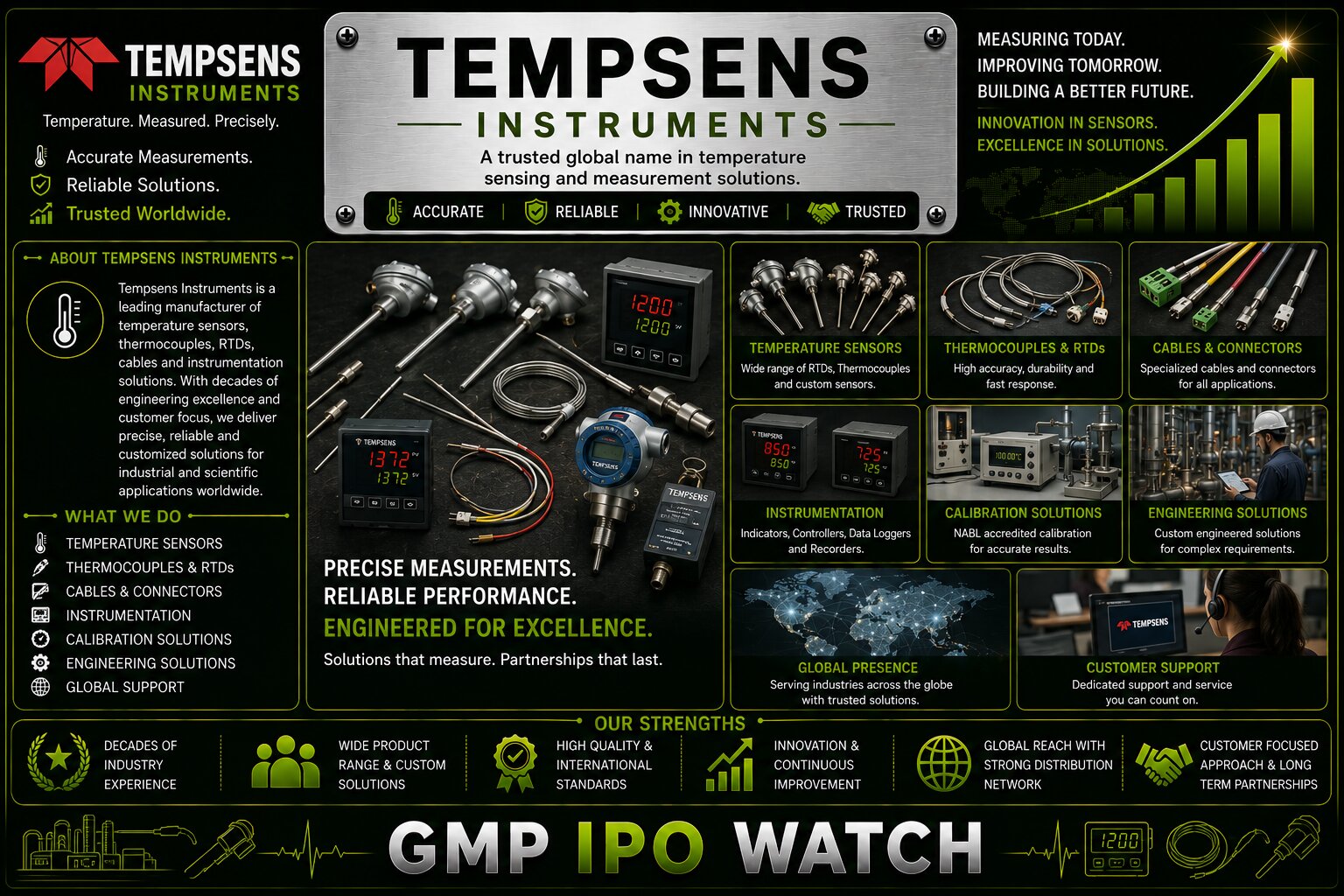
Tempsens is a thermal engineering and specialised cable manufacturer.
Its operations broadly cover three major areas:
- Temperature sensing solutions
- Electrical heating solutions
- Specialised cable solutions
The company designs products according to industrial customer requirements rather than operating purely as a mass-market component supplier.
This custom-engineering capability is an important part of the business.
A temperature sensor used inside a conventional industrial furnace may have very different requirements from one used in aerospace, power generation or a high-temperature metal-processing application.
Temperature Sensors Are the Core Business
Temperature sensing is the company's most recognisable area.
Tempsens manufactures products designed to measure temperature across industrial environments.
These include technologies such as:
- Thermocouples
- Resistance temperature detectors
- Non-contact temperature sensors
- Temperature assemblies
- Industrial pyrometers
- Related instrumentation
Different technologies are suitable for different operating environments.
Some applications require direct physical contact with the object being measured.
Others require non-contact measurement because the material is extremely hot, moving or otherwise difficult to access.
Tempsens Has a Meaningful Indian Market Position
Current IPO reporting describes Tempsens as India's largest manufacturer of contact and non-contact temperature sensors, while recent industry information places its market share in India's temperature-sensor segment at approximately 10.5%.
This is important for the investment story.
Tempsens is not entering the public market as an early-stage company trying to establish whether there is demand for its products.
It already has a meaningful operating position in a specialised engineering category.
The question for investors is whether that position can translate into substantially larger revenue and profits.
Why Temperature Measurement Matters
Imagine a steel furnace operating at an incorrect temperature.
If it is too cold, the manufacturing process may not work correctly.
If it is too hot, energy can be wasted or material quality can deteriorate.
Similar problems exist across many industries.
Accurate temperature information can help companies:
- Maintain product quality
- Reduce energy consumption
- Protect equipment
- Improve safety
- Automate manufacturing
- Monitor processes
- Reduce production waste
That makes temperature sensing an important part of industrial control systems.
Electrical Heating Is the Second Growth Engine
Tempsens is not limited to measuring temperature.
The company also manufactures electrical heating solutions.
Industrial heating equipment is used when manufacturers need controlled heat for production processes.
Applications can range from relatively straightforward heating requirements to complex industrial furnaces.
The ability to both measure temperature and provide heating solutions creates useful technological overlap.
A customer may need not only equipment that generates heat but also systems that accurately monitor and control it.
Specialised Cables Add Another Business Vertical
Tempsens also manufactures specialised cables.
These are not necessarily the same cables used for ordinary residential electricity.
Industrial applications may require cables capable of operating under:
- High temperatures
- Harsh environments
- Mechanical stress
- Special electrical conditions
Such applications can require customised materials and engineering.
Specialised cables therefore broaden Tempsens' addressable market beyond temperature sensors.
Why Customisation Can Be a Competitive Advantage
Industrial customers often cannot simply buy a standard product from a catalogue.
A steel company may have different requirements from a cement manufacturer.
A defence customer may require different specifications from an ordinary factory.
Tempsens designs customised solutions according to customer requirements.
This creates a different relationship than commodity component distribution.
Engineering expertise becomes part of the product.
Once a supplier's component is qualified for an important industrial application, customers may also be less willing to switch purely to save a small amount on price.
More Than Three Decades of Operating Experience
Tempsens was incorporated in 1990.
That gives the business more than three decades of operating history.
Longevity matters in industrial engineering.
Customers may operate expensive equipment for many years.
They need suppliers that can provide reliable products and technical support.
A long track record can also help when bidding for projects where customers evaluate vendor experience before approving components.
FY2026 Revenue Reaches ₹444.88 Crore
Tempsens entered the IPO process after another year of growth.
The company reported approximately:
₹444.88 crore revenue in FY2026
according to current IPO information.
That places Tempsens well above the scale of a typical small industrial SME IPO.
Its operating history and revenue base make this a more established manufacturing story.
FY2026 PAT Reaches ₹71.07 Crore
Profitability is another major part of the IPO story.
Tempsens reported approximately:
₹71.07 crore Profit After Tax in FY2026.
That translates into a net margin of roughly 16% on the reported FY2026 revenue figure.
For a specialised industrial manufacturer, that is a notable level of profitability.
It suggests the company's engineering-intensive product portfolio can support healthier margins than a simple commodity manufacturing business.
Tempsens Instruments Financial Snapshot
| Particular | FY2026 |
|---|---|
| Revenue | ₹444.88 Cr |
| PAT | ₹71.07 Cr |
| PAT Margin | ~16% |
| Fresh IPO Proceeds | ₹95 Cr |
| IPO Size | ₹650 Cr |
The key question is whether Tempsens can maintain these margins while investing in additional capacity and competing for larger orders.
IPO Funds Will Support Manufacturing Expansion
Part of the fresh IPO proceeds is intended for capital expenditure.
Current offer information indicates approximately ₹18.13 crore is proposed for capital expenditure relating to electrical heating and specialised cable solutions.
This is strategically important.
The company is using part of its public-market capital to expand businesses adjacent to its core temperature-sensing operations.
If successful, this can reduce dependence on a single product segment.
Around ₹55 Crore Planned for Debt Repayment
Another significant portion of the fresh issue—approximately ₹55 crore—is intended for repayment or prepayment of outstanding borrowings.
Debt repayment can create several benefits.
Interest expenses may decline.
The balance sheet can become stronger.
Future cash flow can be redirected toward expansion rather than servicing existing debt.
A stronger balance sheet may also provide flexibility if Tempsens later needs capital for another major manufacturing expansion.
Industrial Automation Is a Long-Term Opportunity
Modern factories increasingly depend on sensors.
Automation systems need information before they can make decisions.
Temperature sensors provide one type of that information.
A modern manufacturing system might continuously monitor:
Temperature → Pressure → Flow → Speed → Equipment condition
Software and controllers can then adjust the production process automatically.
As Indian factories become more automated, demand for reliable industrial sensing equipment could increase.
Tempsens operates directly within this trend.
India's Manufacturing Expansion Could Help
India continues to push for greater domestic manufacturing across industries including:
- Electronics
- Steel
- Automotive
- Defence
- Renewable energy
- Chemicals
- Pharmaceuticals
- Heavy engineering
Most of these sectors require process instrumentation and thermal-control technologies.
New manufacturing capacity creates demand for sensors and heating systems.
Existing factories also require replacement equipment and upgrades.
This gives Tempsens exposure to both new industrial projects and recurring replacement demand.
Replacement Demand Is Important
Temperature sensors do not necessarily last forever.
Some operate in extremely harsh conditions.
Exposure to heat, chemicals, vibration and mechanical wear can gradually reduce performance.
Industrial customers therefore need replacement products.
This can create recurring demand after the initial installation.
For Tempsens, a large installed customer base could therefore produce repeat business over time.
Steel Is a Natural Market for Thermal Engineering
Steel manufacturing involves extremely high temperatures.
Accurate thermal measurement is essential at multiple stages of the production process.
Sensors and non-contact temperature-measurement equipment can help monitor:
- Furnaces
- Molten metal
- Rolling operations
- Heat treatment
India is one of the world's major steel producers and continues to add capacity.
This provides a natural domestic market for companies specialising in industrial temperature technology.
Power Generation Also Requires Temperature Monitoring
Power plants contain many systems where temperature needs continuous monitoring.
Equipment operating outside safe temperature ranges can become less efficient or suffer damage.
Temperature sensing can therefore support both performance and safety.
As India's electricity demand grows, investment in conventional and renewable power infrastructure could indirectly support demand for industrial instrumentation.
Aerospace and Defence Can Offer Higher-Value Applications
Specialised industrial products can become particularly valuable in aerospace and defence.
These sectors typically require strict technical specifications, testing and quality controls.
Once approved, suppliers may benefit from higher entry barriers because new vendors cannot always replace qualified components immediately.
Tempsens' ability to address specialised industrial requirements therefore creates opportunities beyond ordinary manufacturing.
Export Markets Could Expand the Opportunity
Industrial temperature measurement is a global requirement.
Factories in Europe, the Middle East, Asia and other regions use many of the same fundamental sensing technologies.
A manufacturer capable of meeting international technical standards can therefore address a much larger market than India alone.
Exports can provide:
- Geographic diversification
- Access to larger markets
- Foreign-currency revenue
- Reduced dependence on Indian capex cycles
However, international expansion also brings competition from established global instrumentation companies.
Competition Is Not Easy
Tempsens operates in a specialised but competitive market.
Industrial customers can source equipment from:
- Indian manufacturers
- Global sensor companies
- International automation suppliers
- Specialised engineering businesses
Global competitors may have stronger brands and significantly larger R&D budgets.
Tempsens therefore needs to compete on engineering capability, quality, customisation, delivery and pricing.
Maintaining technological relevance will be essential.
Raw-Material Prices Can Affect Margins
Manufacturing sensors, heaters and specialised cables requires various metals, alloys, insulation materials and electrical components.
Changes in raw-material prices can influence production costs.
If input prices rise quickly, Tempsens may not always be able to pass the increase immediately to customers.
That could pressure margins.
Procurement discipline therefore remains important despite the company's strong recent profitability.
Customer Concentration Should Be Monitored
Industrial companies can sometimes generate meaningful revenue from large customers.
Large accounts can provide repeat orders and stable relationships.
But excessive dependence on a small customer group creates risk.
If one large customer delays expansion or switches suppliers, revenue can be affected.
Investors should therefore monitor customer diversification as Tempsens grows.
R&D Is Essential
Industrial sensing technology continues to evolve.
Customers increasingly expect:
- Higher accuracy
- Better durability
- Digital connectivity
- Faster response
- Remote monitoring
- Integration with automation systems
Tempsens therefore cannot rely solely on products developed years ago.
Research and product development need to remain continuous.
As Industry 4.0 adoption increases, sensors themselves are becoming part of connected digital manufacturing systems.
Smart Factories Could Create a Bigger Opportunity
The next generation of industrial sensors may do more than simply measure temperature.
Factories increasingly want data to flow automatically into central monitoring platforms.
That allows manufacturers to identify unusual operating conditions before equipment fails.
This supports predictive maintenance.
For example, if a machine begins operating consistently hotter than normal, software may identify that change before a breakdown occurs.
Sensors become the data source enabling this intelligence.
This broader digital-manufacturing trend could expand the long-term market available to companies such as Tempsens.
IPO Valuation Needs Careful Evaluation
At the upper price band of ₹300, investors should compare the company's implied valuation with its earnings, growth rate and listed industrial peers.
Tempsens enters the market with several advantages:
- Established operating history
- Strong market position
- Healthy profitability
- Multiple product segments
- Industrial automation exposure
But IPO valuation still matters.
Even a high-quality company can produce weak shareholder returns if purchased at an excessive valuation.
Investors should therefore evaluate the final earnings multiple rather than relying only on business quality or GMP.
Latest GMP Shows Strong Early Interest
As of August 18, 2026, Tempsens Instruments is seeing significant activity in the unofficial grey market.
Current reports indicate a premium suggesting potential gains of approximately 43–44% over the ₹300 upper issue price.
This shows strong pre-IPO sentiment.
However, investors should remember one important point:
GMP is not an official market price.
It is unregulated and can move sharply before listing.
A strong GMP does not guarantee equivalent listing gains.
Subscription Has Not Started Yet
Public subscription begins on August 20.
Therefore, as of August 18, there are no public retail, NII or QIB subscription numbers to evaluate.
The anchor book opens on August 19.
Anchor participation may provide the first useful indication of institutional interest.
Once public bidding begins, QIB demand will be particularly worth monitoring because Tempsens is a mainboard IPO rather than an SME issue.
What Looks Positive?
Tempsens has several factors working in its favour.
It operates in a specialised engineering niche rather than a commodity business.
The company has more than three decades of experience.
Its position in India's temperature-sensor market provides an established base.
FY2026 revenue and profitability are strong.
The business is exposed to industrial automation and manufacturing expansion.
Fresh IPO capital will also support debt reduction and additional manufacturing capacity.
Together, these create a credible long-term industrial growth story.
What Requires Caution?
Investors should still consider several risks.
Industrial demand can be cyclical.
Capital expenditure slows during weak economic periods.
Raw-material costs can affect margins.
International companies create significant competition.
Technology continues to evolve.
Customer concentration may influence revenue.
And a large majority of the ₹650 crore IPO is an OFS rather than fresh capital.
The strong GMP can also create unrealistic short-term expectations.
What Should Investors Track After Listing?
For Tempsens, the most important post-IPO indicators will include:
- Revenue growth
- PAT growth
- EBITDA margin
- Export growth
- Temperature-sensor market share
- Electrical heating revenue
- Specialised cable revenue
- Capacity utilisation
- Debt reduction
- Operating cash flow
- New industrial customers
- R&D investment
- Return on capital
The performance of the electrical-heating and specialised-cable businesses could be particularly important because fresh IPO money is being deployed toward expanding these segments.
Final View on Tempsens Instruments IPO
The Tempsens Instruments IPO opens on August 20, 2026, with a price band of ₹285–₹300 per share and an issue size of approximately ₹650 crore. Anchor bidding takes place on August 19, while the public issue closes on August 24.
The business itself is compelling because it operates in an area that becomes increasingly important as manufacturing becomes more sophisticated.
Factories need more sensors.
Automation requires more data.
Energy efficiency requires better control.
Industries operating at extreme temperatures require reliable measurement.
Tempsens sits at the intersection of these requirements.
Its FY2026 performance provides additional support to the story, with approximately ₹444.88 crore revenue and ₹71.07 crore PAT. Fresh proceeds are expected to fund around ₹18.13 crore of capex and ₹55 crore of debt repayment.
The latest grey-market premium indicates strong pre-IPO enthusiasm, but the more important long-term question is whether Tempsens can convert its established temperature-sensor position into a broader thermal-engineering platform spanning sensors, heating systems and specialised cables.
If India's manufacturing, automation, defence, energy and industrial infrastructure investments continue expanding, Tempsens has a meaningful addressable market ahead of it.



Loading comments...