

Augmont Enterprises IPO 2026 – Can a Gold Trading Platform Become a Scalable Precious-Metals Ecosystem?
Gold businesses are often associated with jewellery stores.
But Augmont Enterprises Limited operates across a much broader part of the precious-metals value chain.
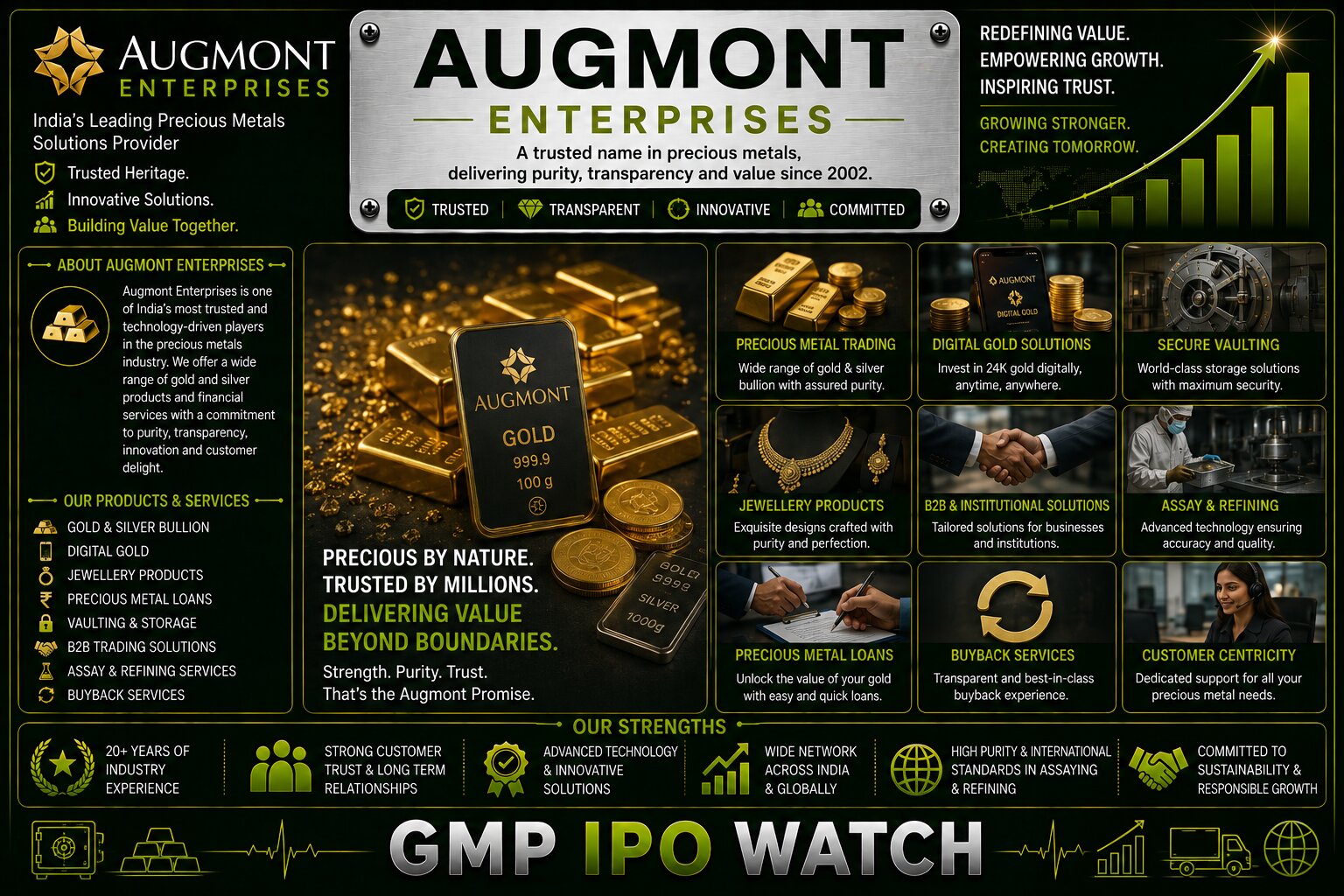
The company combines physical bullion distribution, refining, digital gold and silver, B2B trading infrastructure and consumer-facing precious-metal products through one integrated ecosystem. Augmont's own platform says it has more than 4.2 crore registered users, 4,975 jeweller partners, 180+ enterprise/platform integrations and 4,691 retail touchpoints.
That makes Augmont fundamentally different from a conventional jewellery retailer.
Its business depends more heavily on:
gold and silver volumes + platform activity + inventory management + refining + distribution + digital customer reach.
The IPO opens on August 21, 2026, with anchor bidding scheduled for August 20.
The long-term investment question is:
Can Augmont use its enormous transaction network and ₹620 crore fresh issue to increase precious-metal volumes while preserving capital efficiency in a naturally low-margin business?
That is the central IPO story.
Augmont Enterprises IPO Details
| Particular | Details |
|---|---|
| Company | Augmont Enterprises Ltd. |
| IPO Type | Book Built Mainboard IPO |
| Listing | BSE & NSE |
| Issue Size | ₹825 Crore |
| Fresh Issue | ₹620 Crore |
| Offer for Sale | ₹205 Crore |
| Price Band | ₹750 – ₹788 |
| Face Value | ₹5 Per Share |
| Lot Size | 19 Shares |
| Retail Minimum | 19 Shares |
| Retail Investment | ₹14,972 at ₹788 |
| Anchor Date | August 20, 2026 |
| IPO Open Date | August 21, 2026 |
| IPO Close Date | August 25, 2026 |
| Expected Listing | August 31, 2026 |
| Issue Structure | Fresh Issue + OFS |
The current RHP-stage issue is ₹825 crore, comprising approximately ₹620 crore of fresh shares and ₹205 crore through OFS. The minimum application is 19 shares, requiring ₹14,972 at the upper price band.
Augmont IPO Has Not Opened Yet
As of August 19, 2026, there is no public subscription data for Augmont Enterprises because public bidding begins on August 21.
The sequence is:
August 20: Anchor bidding
August 21: Public IPO opens
August 25: IPO closes.
Therefore, there is currently no valid:
- QIB subscription
- NII subscription
- Retail subscription
- Overall subscription
figure to analyse.
The first public demand data will become available after bidding begins.
Augmont Enterprises IPO GMP Today
Grey-market activity has strengthened substantially ahead of the IPO.
InvestorGain's latest August 19 update reports a GMP of approximately:
₹190 per share.
Against the ₹788 upper issue price:
₹788 + ₹190 = ₹978
which implies an unofficial premium of approximately:
24.1%.
Another current tracker reports GMP around ₹160, or roughly 20%, so live quotations vary across grey-market sources.
| Particular | Current Position |
|---|---|
| Upper Issue Price | ₹788 |
| Reported GMP Range | ₹160 – ₹190 |
| Indicative Price | ₹948 – ₹978 |
| Indicative Premium | Around 20% – 24% |
Because GMP is unofficial and unregulated, it should be treated only as a sentiment indicator rather than a guaranteed listing return.
What Does Augmont Enterprises Actually Do?
Augmont describes itself as an integrated gold and silver ecosystem.
Its operations span several parts of the precious-metals value chain, including:
- Gold and silver trading
- Refining
- Minted coins and bars
- B2B bullion distribution
- Digital gold and silver
- Consumer-facing precious-metal products
- Technology-enabled distribution.
This breadth is strategically important.
A company participating in only one part of the gold ecosystem depends heavily on that one revenue stream.
Augmont can potentially earn business across multiple stages of the same precious-metal lifecycle.
Augmont SPOT Is the Core Revenue Engine
One of the most important parts of the business is Augmont SPOT, its B2B precious-metals platform.
Current IPO analysis states that the SPOT platform contributed approximately 86.8% of FY2026 revenue from operations.
That tells investors where the business is economically concentrated.
The platform facilitates large-volume precious-metal transactions involving jewellers and other market participants.
This produces very large reported revenue because the full value of gold and silver traded flows through the income statement.
Why Augmont's Revenue Is Enormous but Margins Are Tiny
This is the most important accounting concept to understand before analysing the IPO.
Augmont reported revenue exceeding ₹94,000 crore in FY2026.
At first glance, that appears extraordinary.
But gold itself is extremely valuable.
Suppose Augmont buys ₹100 crore of bullion and sells it for ₹100.40 crore.
Reported revenue may be:
₹100.40 crore
while gross value added may be only:
₹0.40 crore.
This is why Augmont's EBITDA and PAT margins are below 1% despite generating hundreds of crores of profit.
The low percentage margin does not necessarily indicate a broken business model; it reflects high-value, low-spread bullion trading economics.
FY2026 Revenue Crossed ₹94,000 Crore
Augmont's recent operating growth has been substantial.
| Financial Year | Revenue from Operations |
|---|---|
| FY2024 | ₹34,921.49 Cr |
| FY2025 | ₹66,230.78 Cr |
| FY2026 | ₹94,186.21 Cr |
Revenue increased approximately 42.2% in FY2026, following an even larger expansion during FY2025.
Over FY2024–FY2026, the company achieved a revenue CAGR above 60%. Zerodha's IPO profile places the CAGR at approximately 64.23%.
This shows the platform is processing dramatically larger precious-metal volumes.
PAT Increased to ₹348.30 Crore
Profit after tax also increased strongly.
Current IPO financial data shows FY2026 PAT at approximately:
₹348.30 crore
compared with:
₹227.19 crore in FY2025.
That represents growth of approximately 53%.
Profit therefore grew slightly faster than revenue.
That is encouraging because it indicates some operating leverage despite the low-margin nature of the business.
Augmont Enterprises Financial Performance
| Financial Year | Revenue | PAT |
|---|---|---|
| FY2024 | ₹34,948.90 Cr | ₹75.97 Cr |
| FY2025 | ₹66,252.05 Cr | ₹227.19 Cr |
| FY2026 | ₹94,282.47 Cr | ₹348.30 Cr |
Current sources use slightly different definitions of revenue versus revenue from operations, but all show the same underlying trend: very strong scale expansion and significant PAT growth.
EBITDA Reached Nearly ₹386 Crore
Augmont's FY2026 EBITDA was approximately:
₹385.95 crore, according to current prospectus-based analysis.
EBITDA has increased substantially from around ₹103.92 crore in FY2024.
That represents strong absolute operating-profit growth.
However, EBITDA margin remains extremely low relative to most ordinary businesses because of the bullion-trading revenue structure.
EBITDA Margin Is Only Around 0.41%
FY2026 EBITDA margin is approximately:
0.41%.
PAT margin is approximately:
0.37%.
These numbers may appear alarming in isolation.
But investors need to remember:
the denominator is ₹94,000+ crore of high-value precious-metal turnover.
A better way to analyse Augmont is through:
- Absolute EBITDA
- PAT growth
- Return on capital
- Inventory efficiency
- Working-capital requirements
rather than margin percentages alone.
A Tiny Margin Change Can Have a Huge Profit Impact
Because turnover is so large, even a small margin movement matters.
Suppose Augmont handles ₹1 lakh crore of annual revenue.
A change of just:
0.10 percentage point
equals approximately:
₹100 crore.
That means improvements or deterioration in:
- Trading spreads
- Refining economics
- Inventory management
- Procurement
can have a major impact on profit.
This is one of the defining characteristics of the investment case.
Augmont Has an Integrated Refining Capability
The company operates in-house precious-metal refining infrastructure.
Zerodha's current IPO profile reports combined annual refining capacity of approximately 284 tonnes.
This is strategically important.
Refining gives Augmont greater control over part of the physical gold value chain rather than operating only as a trading intermediary.
Integration can support:
- Sourcing
- Quality
- Bullion supply
- Minted products
and potentially improve economics across the platform.
Why Refining Creates Strategic Value
Imagine Augmont purchases recycled or raw precious metal.
Instead of depending entirely on third-party refiners, it can process metal internally.
The refined gold or silver can then flow into:
- Bullion
- Coins
- Bars
- Jewellery ecosystem supply
That can improve control over:
quality + supply availability + turnaround time.
It may also help strengthen relationships with jeweller partners.
4,975 Jeweller Partners Create Distribution Scale
Augmont's own website reports approximately 4,975 jeweller partners.
This is one of the company's strongest network assets.
A large jeweller network creates demand for:
- Bullion
- Refining
- Digital integrations
- Precious-metal products
It also makes the platform harder to replicate quickly.
A competitor can build software.
It is much harder to instantly build thousands of active commercial relationships.
Network Effects Could Strengthen Augmont SPOT
A trading platform can benefit from network scale.
If more jewellers participate:
more buyers + more sellers + more transactions + greater liquidity.
Greater activity can make the platform more useful to existing participants.
This potentially creates a reinforcing cycle.
However, investors should not assume a perfect technology-style network effect because gold trading remains highly price-sensitive.
Participants can move between platforms when spreads or service quality become unattractive.
4.2 Crore Registered Users Expand the Consumer Opportunity
Augmont reports more than 4.2 crore registered users across its ecosystem.
That gives the company a large consumer reach.
The opportunity goes beyond physical bullion.
Consumers can interact with gold through:
- Digital gold
- Digital silver
- Coins and bars
- Gold-related savings products
A large user base can potentially reduce customer-acquisition costs when Augmont introduces additional offerings.
Digital Gold Makes Precious Metals More Accessible
Traditionally, consumers might need thousands of rupees to buy a physical gold coin.
Digital gold allows smaller-value purchases.
That can make gold accessible for:
- Small savings
- Recurring purchases
- Digital-first customers
For Augmont, this opens an entirely different customer segment from institutional bullion trading.
The strategic opportunity is to connect:
physical gold infrastructure + digital customer access.
Enterprise Integrations Can Expand Distribution Without New Stores
Augmont says it has more than 180 enterprise and platform integrations.
This matters because Augmont does not need every consumer to visit its own app.
A partner platform can integrate Augmont's gold infrastructure into its own ecosystem.
This can create a B2B2C model.
For example:
partner platform → Augmont infrastructure → end customer.
That can scale distribution without requiring proportionate physical retail expansion.
4,691 Retail Touchpoints Create an Omnichannel Model
Augmont also reports approximately 4,691 retail touchpoints.
This gives the business a combination of:
digital + B2B + physical presence.
That is important because gold remains a trust-sensitive product.
Many consumers may prefer digital convenience but still value physical accessibility.
An omnichannel ecosystem can help bridge those preferences.
Augmont Is Present Across 24 States
As of March 31, 2026, Augmont had a presence across 24 Indian states, according to its IPO profile.
This gives the business broad geographic diversification.
Gold demand is spread across India, but jewellery and purchasing patterns differ considerably by region.
A broad network can therefore increase the addressable market.
Consumer Offerings Are Still a Smaller Revenue Contributor
Current business data indicates approximately:
- Augmont SPOT: 86.80%
- International business: 6.05%
- Consumer-focused offerings: 7.10%
of FY2026 revenue.
This shows that despite Augmont's consumer visibility, B2B bullion activity still dominates reported revenue.
That creates an interesting long-term opportunity.
If higher-margin consumer offerings grow faster than B2B bullion turnover, the overall earnings mix could improve.
Revenue Mix Matters More Than Headline Revenue Growth
Imagine Augmont grows annual revenue from:
₹94,000 crore to ₹1.2 lakh crore.
That sounds exceptional.
But if almost all of the increase comes from very low-margin bullion turnover, PAT may not increase proportionately.
Alternatively, modest growth in:
- Consumer gold
- Minted products
- Refining
- Technology-enabled services
could potentially contribute more profit per rupee of revenue.
Investors should therefore watch the business mix, not just turnover.
₹465 Crore of IPO Proceeds Will Fund Working Capital
The biggest stated use of the fresh issue is approximately:
₹465 crore
for future working-capital requirements relating to procurement, inventory scaling and advance-margin requirements for inventory procurement.
This is the central IPO objective.
Gold is extraordinarily valuable inventory.
Even small increases in physical metal volume require significant additional cash.
Why Gold Trading Requires Huge Working Capital
Suppose Augmont wants to carry an additional:
100 kg of gold.
At high gold prices, that can represent many tens of crores of rupees.
If business volumes increase significantly, the company needs enough capital to:
- Procure bullion
- Maintain inventory
- Meet margin requirements
- Support customer transactions
This makes working capital effectively the fuel that allows the platform to process more volume.
₹465 Crore Could Materially Expand Transaction Capacity
The attractive scenario is:
₹465 crore fresh working capital → larger bullion inventory capacity → greater transaction volumes → more trading income → higher absolute PAT.
This is the main growth logic of the fresh issue.
Unlike a factory company, Augmont does not need most of the IPO money for buildings and machines.
It needs financial inventory capacity.
But Gold Inventory Creates Price Risk
Holding precious metals creates exposure to changing prices.
Gold can move sharply because of:
- Global interest rates
- Currency movements
- Geopolitical events
- Central-bank demand
- Investor sentiment
Companies operating in bullion generally use risk-management and hedging practices to limit exposure.
Investors should nevertheless understand that inventory management is a core operating risk.
Higher Gold Prices Can Increase Working-Capital Needs
Suppose Augmont processes the same physical quantity of gold next year.
If gold prices rise 20%, the rupee value of inventory and transactions can increase significantly.
That means reported revenue can rise even without equivalent volume growth.
It can also mean more working capital is required to handle the same physical metal quantity.
This is why transaction volume and physical metal quantities can be more informative than revenue alone.
Debt Is Extremely Low
One of Augmont's strongest financial characteristics is its low leverage.
FY2026 debt-to-equity is approximately:
0.01×.
That is exceptionally low for a business handling large inventory values.
Debt-to-equity also fell from approximately:
0.29× in FY2024
to:
0.05× in FY2025
and:
0.01× in FY2026.
This indicates a major strengthening of the capital structure.
Low Debt Reduces Financial Risk
A low-debt balance sheet provides several benefits.
Augmont has less exposure to:
- Interest-rate increases
- Debt repayment pressure
- Financing stress
This is particularly valuable in a commodity-linked business where transaction values can fluctuate substantially.
The IPO therefore raises fresh working capital without dramatically increasing leverage.
ROE Is Around 51%
Current FY2026 KPI data reports:
ROE: 51.04%
ROCE: 40.27%
RoNW: 49.52%.
These are very strong return ratios.
They suggest Augmont has historically generated substantial profit relative to the capital invested in the business.
However, the ₹620 crore fresh issue will increase the equity base significantly.
Post-IPO return ratios may decline initially.
Post-IPO Capital Efficiency Is the Real Test
The question after listing will be:
Can ₹465 crore of additional working capital generate enough incremental profit to maintain strong ROCE?
If Augmont simply holds more inventory without producing proportionate earnings, capital efficiency will fall.
If fresh capital significantly increases profitable trading volumes, the IPO could strengthen the business.
This makes ROCE one of the most important future metrics.
Post-Issue P/E Is Around 20.7×
At the ₹788 upper price band, current IPO analysis estimates:
Post-IPO EPS: ₹38.12
and:
Post-IPO P/E: approximately 20.67×.
The estimated market capitalisation is around:
₹7,200 crore.
That valuation is not extremely cheap, but it is not unusually aggressive for a rapidly growing profitable business.
The issue is whether FY2026 profit growth can continue after the larger equity base is added.
Pre-IPO and Post-IPO EPS Differ
Current analysis shows:
| Metric | Pre-IPO | Post-IPO |
|---|---|---|
| EPS | ₹41.71 | ₹38.12 |
| P/E at ₹788 | 18.89× | 20.67× |
This difference is important.
IPO dilution increases the number of shares.
Therefore, investors should use the post-issue valuation rather than relying only on pre-IPO EPS.
Promoter Holding Remains High
Current issue analysis places promoter holding at approximately:
92.75% before the IPO
and:
81.91% after the issue.
Promoters therefore remain firmly in control after listing.
The IPO broadens public ownership without substantially changing control.
₹205 Crore OFS Provides Shareholder Liquidity
The issue includes approximately ₹205 crore of OFS.
OFS money does not enter Augmont itself.
Therefore, investors should distinguish:
₹825 crore headline IPO
from:
₹620 crore fresh capital.
Still, roughly three-quarters of the IPO consists of fresh equity, making the transaction substantially growth-capital oriented.
Gold Demand Provides a Structural Opportunity
India has one of the world's deepest cultural and investment relationships with gold.
Demand comes from:
- Jewellery
- Weddings
- Festivals
- Investment
- Savings
Augmont participates underneath several of these use cases.
Rather than relying only on jewellery retail margins, it provides infrastructure across the precious-metals ecosystem.
This can give it exposure to gold activity regardless of which particular jewellery brand wins the consumer sale.
Gold Financialisation Creates Another Opportunity
Gold ownership is becoming increasingly digital.
Consumers can interact with precious metals through:
- Digital gold
- Apps
- Savings-style purchases
- Platform integrations
This expands the addressable market beyond consumers buying physical jewellery or bullion.
Augmont's technology infrastructure positions it to participate in this shift.
But Regulation Around Digital Gold Matters
Digital precious metals operate in an evolving financial and consumer-protection environment.
Regulatory changes can affect:
- Product structure
- Distribution
- Disclosure requirements
- Partner platforms
Because Augmont has meaningful exposure to technology-enabled gold products, regulatory developments should be monitored carefully.
International Business Can Provide Diversification
Approximately 6.05% of FY2026 revenue came from international sales.
This remains relatively small compared with domestic SPOT activity.
But international expansion can provide another growth route.
It can also expose the company to:
- Currency movements
- International regulation
- Global bullion competition
Therefore, overseas growth should be evaluated together with risk controls.
Competitive Strengths
Augmont enters the IPO with several notable strengths.
Large integrated precious-metals platform: Operations span bullion, refining, digital gold and consumer products.
Large network: More than 4.2 crore registered users, 4,975 jeweller partners and 4,691 retail touchpoints.
Strong revenue growth: FY2026 revenue increased about 42%.
Strong PAT growth: FY2026 profit reached approximately ₹348.30 crore, up about 53%.
Low debt: Debt-to-equity is only around 0.01×.
High return ratios: ROE around 51% and ROCE around 40%.
Large refining capacity: Approximately 284 tonnes annually.
Fresh working capital: ₹465 crore is earmarked for inventory and related requirements.
Major Risks
Extremely Thin Margins
FY2026 EBITDA margin is only around 0.41% and PAT margin around 0.37%.
Small changes in trading economics can materially affect profit.
Gold and Silver Price Volatility
Commodity movements can increase inventory requirements and operational risk.
Working-Capital Intensity
₹465 crore of fresh proceeds being allocated to working capital shows that growth requires substantial inventory funding.
Revenue Concentration
Augmont SPOT contributes approximately 86.8% of revenue.
Regulatory Risk
Digital gold and broader precious-metal products operate within evolving regulatory frameworks.
Transaction-Volume Dependence
Lower bullion activity can reduce revenue and earnings even if long-term gold demand remains strong.
Margin Competition
Bullion customers are highly price sensitive, making spreads competitive.
What Could Drive Augmont's Next Growth Phase?
More SPOT Volume
A larger jeweller network and more active participants can increase transaction value.
Digital Gold
Consumer adoption can broaden the revenue mix.
Enterprise Integrations
More partners can expand distribution without equivalent customer-acquisition spending.
Refining
Greater utilisation of the 284-tonne capacity can strengthen vertical integration.
Consumer Products
Coins, bars and other gold offerings can potentially increase higher-value revenue.
International Expansion
Overseas business can diversify the platform.
IPO Working Capital
₹465 crore can directly support greater bullion inventory and transaction capacity.
What Investors Should Track After Listing
| Metric | Why It Matters |
|---|---|
| Bullion Volume | Real operating scale |
| PAT Growth | Earnings expansion |
| EBITDA Margin | Trading economics |
| PAT Margin | Profit efficiency |
| Working Capital | Inventory requirement |
| Inventory Turnover | Capital efficiency |
| ROCE | IPO capital productivity |
| SPOT Revenue Share | Concentration |
| Consumer Revenue | Business-mix improvement |
| Digital Users | Platform growth |
For Augmont, absolute profit, physical transaction volumes and return on working capital may be far more useful than revenue growth alone.
The Most Important Post-IPO Equation
The strongest scenario looks like:
₹465 crore working capital → more bullion capacity → higher transaction volumes → larger absolute trading profits → growing digital and consumer business → strong ROCE.
The weaker scenario looks like:
more inventory capital → higher reported turnover → margins compress → limited PAT growth → lower return on fresh equity.
Both scenarios could produce enormous revenue numbers.
Only the first creates stronger shareholder value.
Should Investors Consider Augmont Enterprises IPO?
The positive investment case includes:
- ₹94,000 crore-plus FY2026 revenue
- ₹348.30 crore FY2026 PAT
- 42% revenue growth
- 53% PAT growth
- 51% ROE
- 40% ROCE
- 0.01× debt-to-equity
- Integrated refining, bullion and digital-gold ecosystem
- 4.2 crore+ registered users
- 4,975 jeweller partners
- ₹620 crore fresh issue
- Strong current pre-opening GMP.
The caution case includes:
- Sub-1% operating and PAT margins
- Working-capital intensity
- Gold-price volatility
- Heavy dependence on the SPOT platform
- Commodity-market competition
- Digital-gold regulatory risk
- Post-IPO dilution
- Need to generate strong returns on ₹620 crore of new equity.
Augmont should therefore be analysed as an integrated precious-metals infrastructure and technology platform, rather than as a conventional jewellery retailer.
Final View on Augmont Enterprises IPO 2026
The Augmont Enterprises IPO opens on August 21, 2026, after anchor bidding on August 20, and closes August 25. The ₹825 crore mainboard issue is priced at ₹750–₹788 per share, with a minimum lot of 19 shares and an application amount of ₹14,972 at the upper band.
The issue comprises approximately ₹620 crore of fresh shares and ₹205 crore OFS. Of the fresh proceeds, around ₹465 crore will fund working-capital requirements relating to procurement, inventory and advance margins.
Financially, Augmont enters the IPO after another year of significant expansion.
FY2026 revenue from operations reached approximately ₹94,186 crore, compared with ₹66,231 crore in FY2025, while PAT increased to ₹348.30 crore. The company reported FY2026 ROE of around 51.04%, ROCE of 40.27% and debt-to-equity of just 0.01×.
Its scale is already unusual: Augmont reports 4.2 crore+ registered users, 4,975 jeweller partners, 180+ enterprise integrations and 4,691 retail touchpoints, while its refining infrastructure has approximately 284 tonnes of combined annual capacity.
Short-term IPO sentiment is also strong before bidding begins. Current grey-market trackers indicate GMP roughly between ₹160 and ₹190, translating into an unofficial premium of approximately 20%–24% over the ₹788 upper price.
But Augmont's investment case cannot be judged through revenue or GMP alone.
The company generates enormous turnover because it handles high-value gold and silver, while FY2026 EBITDA and PAT margins remain only about 0.41% and 0.37%, respectively.
That means small changes in spreads, inventory efficiency and transaction economics can have a disproportionately large effect on profits.
The long-term thesis can therefore be summarised as:
large jeweller network + high bullion volumes + refining integration + digital gold + ₹465 crore fresh working capital = potential scalable precious-metals earnings.
For investors, the most important post-listing indicators will be transaction volumes, absolute PAT growth, working-capital efficiency, ROCE, business mix and whether higher-margin consumer and digital offerings become more meaningful over time.
Loading comments...