

Madhur Knit Crafts IPO 2026 – Can an Integrated Textile Model Support the Company's Next Growth Phase?
India's textile industry contains a long chain of businesses.
A fabric can pass through several companies before becoming a finished garment:
yarn → knitting → dyeing → printing → finishing → garment manufacturing → distribution.
Madhur Knit Crafts Limited has developed a business model that brings several of these processes under one manufacturing setup.
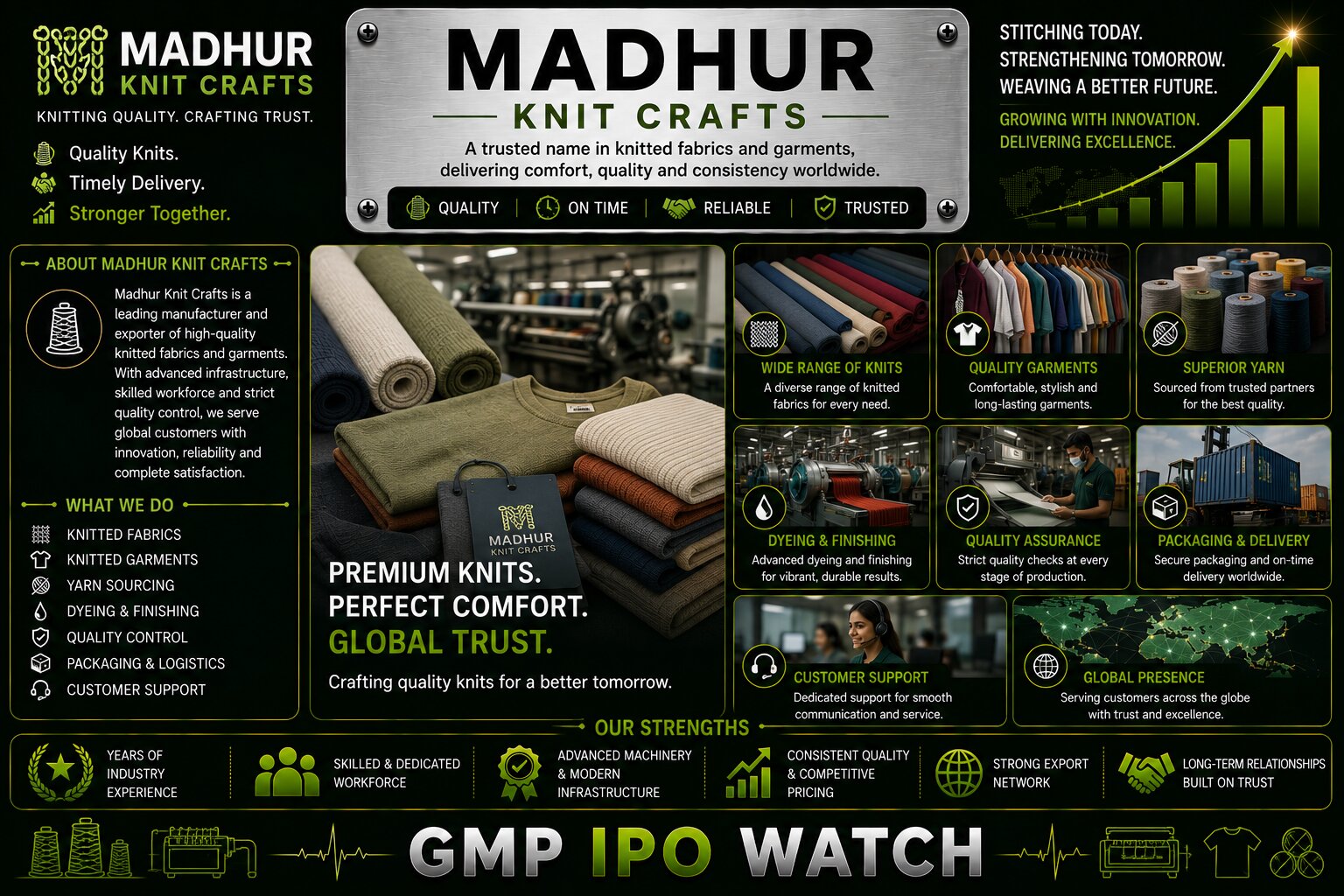
The Ludhiana-based textile company manufactures knitted fabrics, blankets, anti-pilling fabrics, sherpa fabrics and garments. Its facility supports knitting, dyeing, printing, brushing, polishing, sueding and stentering operations.
This integration is the most interesting part of the company's IPO story.
Instead of depending entirely on outside processors, Madhur Knit Crafts can manage several manufacturing stages internally.
But the IPO also comes with significant financial questions.
The company has reported negative operating cash flows for three consecutive financial years, while working-capital requirements are high and more than 90% of recent revenue has come from Punjab.
The key question for investors is therefore:
Can Madhur Knit Crafts convert its integrated textile infrastructure into stronger cash generation while reducing geographic and working-capital concentration?
Madhur Knit Crafts IPO Details
| Particular | Details |
|---|---|
| Company | Madhur Knit Crafts Ltd. |
| IPO Type | Book Built SME IPO |
| Price Band | ₹95 – ₹100 |
| IPO Open Date | August 24, 2026 |
| IPO Close Date | August 27, 2026 |
| Allotment | August 28, 2026 |
| Listing Date | September 1, 2026 |
| Face Value | ₹10 Per Share |
| Business | Textile Manufacturing |
| Location | Ludhiana, Punjab |
| Core Products | Knitted & Specialty Fabrics |
| Business Model | Integrated Manufacturing |
Current IPO tracking shows a price band of ₹95–₹100 per share, while the issue is scheduled from August 24 to August 27, 2026.
The company's earlier DRHP proposed a public issue of up to 56 lakh equity shares.
Madhur Knit Crafts IPO Has Not Opened Yet
As of August 19, 2026, the IPO has not opened for public subscription.
Bidding begins on:
August 24, 2026.
The issue is scheduled to close on August 27, with allotment expected on August 28 and listing currently scheduled for September 1.
Therefore, there is currently no meaningful:
- Retail subscription
- NII subscription
- QIB subscription
- Overall subscription
figure to analyse.
What Does Madhur Knit Crafts Actually Do?
Madhur Knit Crafts is an integrated textile manufacturer based in Ludhiana.
The company's product portfolio includes:
- Knitted fabrics
- Anti-pilling fabrics
- Sherpa fabrics
- Blankets
- Garments
- Other processed textile products.
The business primarily operates in the B2B market.
This means its customers are generally other businesses rather than individual consumers.
The Integrated Manufacturing Model Is Important
One of Madhur Knit Crafts' key characteristics is the number of textile-processing operations it can perform internally.
Its consolidated facility supports:
knitting → dyeing → printing → brushing → polishing → sueding → stentering.
This can create several advantages.
The company can potentially control:
quality + turnaround time + production planning + product development + manufacturing costs.
For customers, working with an integrated supplier can also simplify procurement.
Why Integration Can Improve Textile Economics
Imagine a textile company that only manufactures unfinished fabric.
It may need to send that fabric to separate companies for:
- Dyeing
- Printing
- Finishing
- Brushing
Every additional vendor introduces another:
cost + transportation requirement + quality-control point + production delay.
An integrated manufacturer can potentially retain more of this value internally.
That does not automatically guarantee higher profitability, but it can improve operational control.
Madhur Knit Crafts Has Nearly Three Decades of Experience
The company was incorporated in 1997 and has therefore operated for nearly three decades. Its promoters identified in the DRHP include Arun Gupta, Piyush Gupta and Chirag Gupta.
Long operating history matters in textiles because customer relationships, sourcing networks and manufacturing expertise can take years to develop.
However, operating history alone is not enough.
For IPO investors, the more important question is whether the established manufacturing platform now produces attractive:
returns + cash flow + scalable growth.
Ludhiana Is a Major Textile Manufacturing Hub
Madhur Knit Crafts operates from Ludhiana, Punjab.
Ludhiana has a well-established ecosystem around:
- Hosiery
- Knitted garments
- Woollens
- Textile processing
- Fabric manufacturing
Operating inside a textile cluster can provide easier access to:
labour + suppliers + customers + industry knowledge.
This can reduce some operating friction.
But Madhur Knit Crafts' heavy dependence on Punjab also creates one of its biggest risks.
More Than 90% of Revenue Comes From Punjab
As of February 2026, more than 90% of the company's revenue was generated from Punjab.
That represents significant geographic concentration.
The company may have a strong position within its home market, but dependence on one state makes revenue more vulnerable to regional changes.
These could include:
- Local textile slowdown
- Labour disruption
- Regulatory changes
- Customer migration
- Regional competition
Expanding into other textile markets could therefore become an important long-term opportunity.
Geographic Expansion Could Be a Major Growth Driver
Madhur Knit Crafts does not necessarily need to double its manufacturing capacity immediately to grow.
One potential route is selling more of its existing products outside Punjab.
Large textile and garment markets exist across:
Delhi-NCR + Haryana + Rajasthan + Gujarat + Maharashtra + southern India.
If the company can build a wider customer network, its existing manufacturing capabilities may support a more diversified revenue base.
This would simultaneously create growth and reduce geographic concentration risk.
Top 10 Customers Contribute 34.14% of Revenue
Another important concentration metric is customer dependence.
The company's top 10 customers contributed approximately 34.14% of total revenue as of February 2026.
This is meaningful but less extreme than its geographic concentration.
Large customers can provide repeat orders and manufacturing visibility.
But losing one or more major buyers can affect:
- Capacity utilisation
- Revenue
- Receivables
- Profitability
The ideal post-IPO trend would be rising revenue combined with a declining top-10 customer contribution.
Specialty Fabrics Can Differentiate the Business
Textiles can become highly commoditised.
If two manufacturers produce almost identical basic fabric, customers often choose primarily on price.
Madhur Knit Crafts also produces differentiated categories such as anti-pilling and sherpa fabrics.
Specialised fabrics can potentially provide:
- Better pricing
- Lower direct competition
- More customer stickiness
than basic commodity products.
Increasing the contribution from differentiated fabrics could therefore support margins.
What Is Anti-Pilling Fabric?
Pilling occurs when small fibre balls form on the surface of fabric after repeated use or washing.
Anti-pilling fabrics are designed or processed to reduce this effect.
That can improve:
appearance + durability + product life.
For garments and blankets, these characteristics can be important to customers.
This creates an opportunity for manufacturers that can consistently produce better-performing fabrics.
Sherpa Fabric Creates Exposure to Winter Products
Sherpa is a soft, fleece-like fabric commonly used in products such as:
- Jackets
- Hoodies
- Blankets
- Winter garments
- Linings
Ludhiana's established winter-wear ecosystem can support demand for such fabrics.
But winter-oriented products can also introduce seasonality.
Production planning and inventory management therefore become particularly important.
Manufacturing Machinery Is an Important Competitive Factor
Madhur Knit Crafts has developed its facility using machinery sourced from countries including Korea, Taiwan and China.
Advanced textile machinery can help improve:
- Production speed
- Product consistency
- Finishing quality
- Manufacturing efficiency
However, imported machinery also creates risks involving:
- Maintenance
- Spare parts
- Foreign-exchange movements
- Supplier availability
Keeping equipment productive is critical because the company relies heavily on one consolidated manufacturing location.
Single Manufacturing Facility Is a Major Risk
All production is concentrated at one manufacturing facility in Punjab.
This creates operational concentration.
If the facility experiences:
fire + machinery breakdown + power disruption + labour problems + regulatory closure
production could be materially affected.
A company operating several independent factories has some operational redundancy.
Madhur Knit Crafts currently has less of that protection.
Working Capital Is One of the Biggest IPO Issues
The company's working-capital requirement represented approximately 43.09% of revenue as of February 2026.
That is a very important number.
Textile manufacturing can consume substantial cash because money moves through several stages before returning to the company.
The cycle can look like:
purchase yarn/raw material → manufacture fabric → process fabric → maintain inventory → sell to customer → wait for payment.
Capital remains tied up throughout this process.
Why Textile Growth Can Consume Cash
Suppose Madhur Knit Crafts receives significantly more orders.
The company may need to purchase more:
- Yarn
- Dyes
- Chemicals
- Packaging
- Other inputs
before customers pay for finished goods.
Revenue can therefore increase while cash temporarily decreases.
This means investors should not judge the company's performance only from sales growth.
Cash-flow conversion matters significantly.
Negative Operating Cash Flow Is the Biggest Financial Warning
The company reported negative operating cash flow for three consecutive years:
| Financial Year | Operating Cash Flow |
|---|---|
| FY2023 | -₹4.78 Lakh |
| FY2024 | -₹367.70 Lakh |
| FY2025 | -₹255.82 Lakh |
This deserves serious attention.
A company can report accounting profit while simultaneously consuming cash.
If that happens because the business is growing rapidly and receivables or inventory temporarily increase, the situation may eventually normalise.
But persistent negative cash generation can also indicate structural working-capital pressure.
Why Profit and Cash Flow Can Be Different
Suppose Madhur Knit Crafts sells ₹10 crore of fabric.
Accounting revenue can be recorded when the sale is recognised.
But if customers have not yet paid, the ₹10 crore may partly remain in:
trade receivables.
Therefore:
profit ≠ cash received.
This distinction is especially important for Madhur Knit Crafts because its operating cash flows have historically been negative.
Improving Cash Conversion Should Be a Priority
The most encouraging post-IPO development would not simply be higher revenue.
It would be:
higher revenue + higher PAT + positive operating cash flow.
That would demonstrate that growth is translating into actual cash generation.
If revenue continues increasing while operating cash flow remains negative, investors would need to examine:
- Receivable days
- Inventory days
- Supplier-credit periods
more carefully.
Inventory Management Is Critical in Textiles
Fabric manufacturers often carry:
- Raw materials
- Work in progress
- Finished fabrics
Inventory can become problematic if fashion trends or customer requirements change.
Seasonal fabrics create additional risk.
A winter fabric produced too late may remain unsold until the following season.
Therefore, inventory turnover is an important metric for Madhur Knit Crafts.
Raw-Material Prices Can Affect Margins
Textile profitability can be affected by fluctuations in:
- Yarn prices
- Fibre costs
- Dyes
- Chemicals
- Energy
If input prices rise quickly, manufacturers need to pass those costs to customers.
But customers may resist immediate price increases.
That creates margin pressure.
An integrated manufacturing setup provides greater operational control, but it cannot completely eliminate raw-material volatility.
Energy Costs Matter Because Processing Is Intensive
Processes such as:
dyeing + printing + drying + finishing
can consume substantial energy.
Changes in electricity and fuel prices can therefore affect production costs.
Manufacturers with efficient machinery and high utilisation may be better positioned to absorb these fluctuations.
This makes plant efficiency another important post-IPO consideration.
Environmental Compliance Is Important
Textile dyeing and processing involve water and chemicals.
Companies must therefore manage:
- Effluent treatment
- Wastewater
- Chemical handling
- Environmental permissions
Regulatory compliance is essential.
Any major environmental violation could create:
penalties + production disruption + reputational damage.
For an operator with a single manufacturing facility, this risk becomes even more important.
Capacity Utilisation Can Drive Operating Leverage
Textile manufacturing has meaningful fixed costs.
These include:
- Machinery depreciation
- Factory employees
- Maintenance
- Utilities infrastructure
When capacity utilisation increases, those fixed costs can be spread across more production.
This can improve margins.
But if demand weakens, the opposite happens.
Therefore, investors should eventually monitor the company's utilisation levels alongside revenue.
B2B Business Can Provide Repeat Orders
Madhur Knit Crafts primarily operates as a B2B textile manufacturer.
This can create recurring relationships.
A garment manufacturer that is satisfied with:
quality + pricing + delivery
may continue purchasing similar fabrics season after season.
Repeat customers can reduce selling costs and improve production visibility.
But B2B buyers can also possess substantial negotiating power.
Textile Buyers Can Be Price Sensitive
Textile customers often compare multiple suppliers.
If competing manufacturers offer similar quality at lower prices, customers may switch.
This means Madhur Knit Crafts needs differentiation through:
- Product quality
- Specialised fabrics
- Reliable delivery
- Processing capabilities
- Competitive pricing
Its integrated manufacturing model can help, but competition remains significant.
Export Expansion Could Create a Future Opportunity
Current geographic concentration indicates that the business remains overwhelmingly dependent on Punjab.
That means international markets represent a largely untapped opportunity.
If Madhur Knit Crafts can eventually develop export relationships, benefits could include:
larger market + geographic diversification + potentially better product realisations.
However, exports also introduce:
- Currency risk
- International compliance
- Longer logistics cycles
- Global competition
So expansion needs to be disciplined.
Competitive Strengths
Madhur Knit Crafts has several characteristics that support its IPO story.
Long operating history: The company was incorporated in 1997.
Integrated manufacturing: Knitting, dyeing, printing and several finishing processes operate within the same manufacturing platform.
Specialty products: Anti-pilling and sherpa fabrics provide differentiation beyond basic textile products.
Established textile cluster: The company operates in Ludhiana, an important textile and hosiery manufacturing centre.
B2B relationships: Repeat institutional customers can provide recurring order opportunities.
Advanced machinery: The company uses equipment sourced from major Asian textile-machinery markets.
Major Risks
The most important risk is cash-flow quality. Operating cash flow was negative in FY2023, FY2024 and FY2025.
Working-capital intensity is also high, with requirements equivalent to approximately 43.09% of revenue as of February 2026.
Geographic concentration is significant because more than 90% of recent revenue comes from Punjab.
Customer concentration also deserves attention, with the top 10 customers contributing around 34.14% of revenue as of February 2026.
Single-facility dependence creates operational risk because a disruption at the Punjab plant can affect the entire production operation.
The company is also exposed to raw-material volatility, textile cyclicality, environmental compliance and competitive pricing pressure.
What Could Drive Madhur Knit Crafts' Next Growth Phase?
The first opportunity is geographic diversification.
Moving from a Punjab-heavy customer base toward nationwide sales could expand revenue while simultaneously reducing concentration risk.
The second opportunity is increasing sales of specialised and value-added fabrics such as anti-pilling and sherpa products.
The third is improving utilisation of the integrated manufacturing facility.
The fourth is working-capital efficiency. Faster customer collections and better inventory management could release significant cash.
Finally, developing export markets could provide another long-term growth avenue.
What Investors Should Track After Listing
| Metric | Why It Matters |
|---|---|
| Revenue Growth | Business expansion |
| EBITDA Margin | Manufacturing efficiency |
| PAT Growth | Earnings performance |
| Operating Cash Flow | Earnings quality |
| Receivable Days | Customer collections |
| Inventory Days | Working-capital efficiency |
| Punjab Revenue Share | Geographic diversification |
| Top 10 Customer Share | Concentration risk |
| Capacity Utilisation | Factory productivity |
| Specialty Fabric Share | Product mix |
| ROCE | Capital efficiency |
For this company, operating cash flow should be one of the highest-priority metrics.
The Most Important Post-IPO Equation
The stronger scenario looks like:
IPO capital → better working capital → higher production → wider geographic sales → improved capacity utilisation → higher profit + positive operating cash flow.
The weaker scenario looks like:
higher production → larger inventory + receivables → revenue growth → continued negative operating cash flow.
Both scenarios can produce higher reported sales.
Only the first creates stronger financial quality.
Should Investors Consider Madhur Knit Crafts IPO?
The positive case includes:
nearly three decades of operating history + integrated manufacturing + specialised fabrics + established Ludhiana textile presence + potential geographic expansion.
The caution case is equally important:
three consecutive years of negative operating cash flow + high working-capital intensity + more than 90% Punjab revenue concentration + 34.14% top-10 customer concentration + dependence on a single manufacturing facility.
This means Madhur Knit Crafts should not be evaluated only on IPO demand or GMP.
Cash conversion and working-capital efficiency are fundamental to the long-term investment case.
Final View on Madhur Knit Crafts IPO 2026
The Madhur Knit Crafts IPO is scheduled to open on August 24 and close on August 27, 2026, with allotment expected on August 28 and listing scheduled for September 1. Current IPO tracking reports a ₹95–₹100 price band.
The company's core strength is its integrated textile manufacturing model. From its Ludhiana facility, Madhur Knit Crafts performs multiple processes including knitting, dyeing, printing, brushing, polishing, sueding and stentering, while producing knitted fabrics, blankets, anti-pilling fabrics, sherpa fabrics and garments.
The IPO story, however, has an important financial challenge.
Operating cash flow was negative ₹4.78 lakh in FY2023, negative ₹367.70 lakh in FY2024 and negative ₹255.82 lakh in FY2025. Working-capital requirements were also equivalent to approximately 43.09% of revenue as of February 2026.
Geographic concentration is another key issue. More than 90% of recent revenue came from Punjab, while the company's top 10 customers contributed approximately 34.14%.
The long-term opportunity therefore goes beyond simply increasing textile production.



Loading comments...