

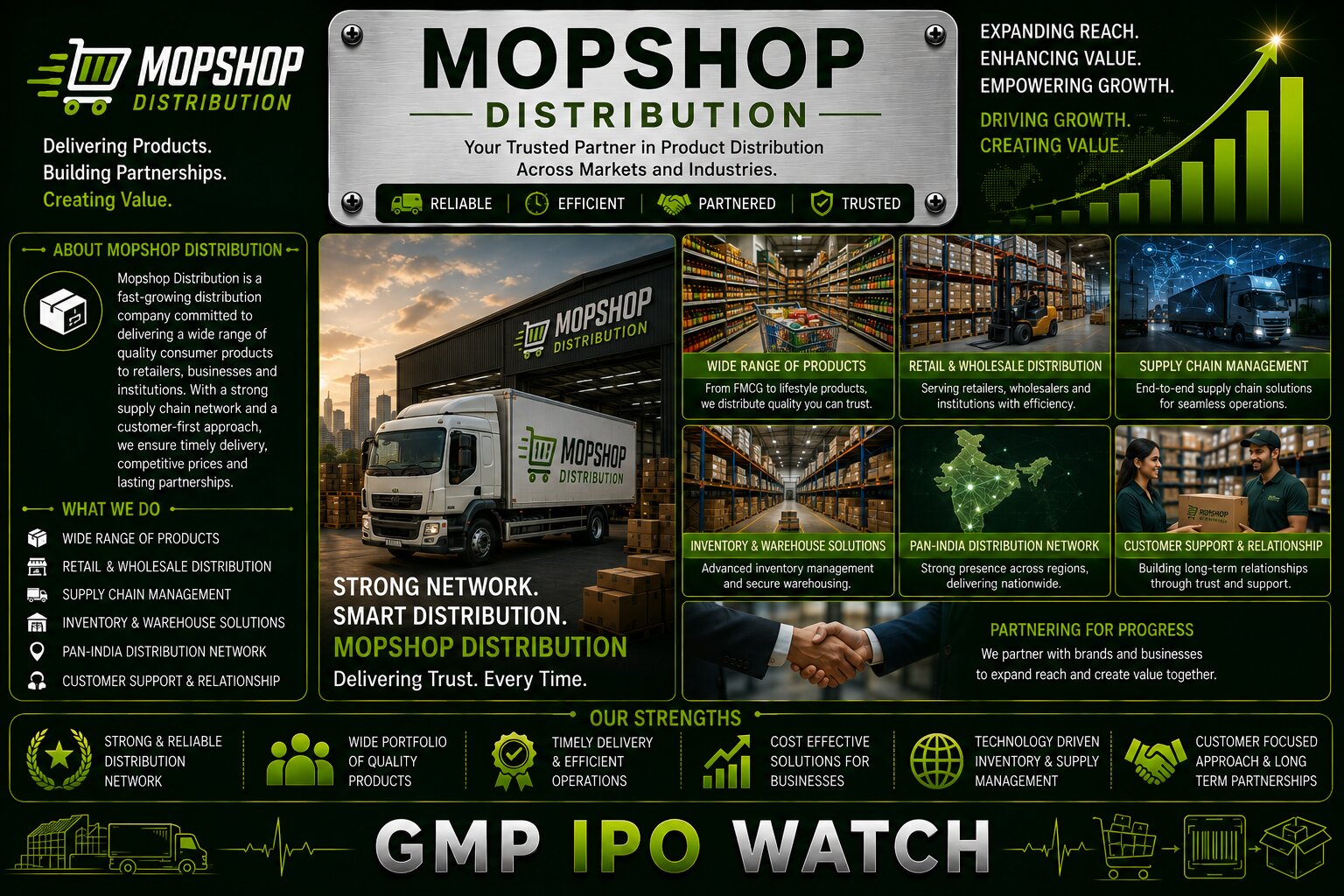
Mopshop Distribution IPO 2026 – Can a Tech-Enabled Facility Supply Business Scale Across India?
Every large office, hospital, hotel, factory, shopping centre and commercial building needs cleaning and facility-management supplies.
Individually, products such as mops, cleaning chemicals, tissues, garbage bags and housekeeping consumables may appear simple.
But for a large organisation operating multiple locations, managing hundreds of such products can become a substantial procurement exercise.
Mopshop Distribution Limited operates in this B2B facility-management supply market.
The company distributes cleaning tools, hygiene products, housekeeping consumables and other facility-management supplies to corporate and institutional customers. It combines physical distribution with a customised digital order-management platform.
The company filed its Draft Prospectus on September 30, 2025, and subsequently received exchange approval for its proposed BSE SME IPO in January 2026.
The central investment question is whether Mopshop can turn its distribution network and digital procurement model into a larger, more profitable nationwide business.
Mopshop Distribution IPO Details
| Particular | Details |
|---|---|
| Company | Mopshop Distribution Ltd. |
| IPO Platform | BSE SME |
| Issue Type | Fixed Price |
| Fresh Issue | Up to 16.00 Lakh Shares |
| Offer for Sale | Up to 3.75 Lakh Shares |
| Total Offer | Up to 19.75 Lakh Shares |
| Face Value | ₹10 Per Share |
| IPO Price | Yet to be announced |
| IPO Dates | Yet to be announced |
| Lead Manager | Khandwala Securities |
| Business | Facility Management Supplies |
| IPO Status | Exchange Approval Received |
The Draft Prospectus describes the offer as a 100% fixed-price offer. Current IPO tracking shows that exchange approval was received on January 16, 2026, but the final IPO dates and pricing are not yet available.
What Does Mopshop Distribution Do?
Mopshop operates primarily as a B2B distributor of facility-management supplies.
Its business revolves around supplying products organisations need to keep commercial premises clean, hygienic and operational.
The product ecosystem includes areas such as:
- Cleaning tools
- Housekeeping products
- Hygiene consumables
- Cleaning chemicals
- Facility-management supplies
- Related commercial-use products
Rather than operating primarily as a consumer-facing retail store, Mopshop focuses on institutional and corporate procurement.
The Business Solves a Procurement Problem
Consider a company operating offices in Mumbai, Bengaluru, Delhi, Hyderabad and Chennai.
Every location may need dozens of products each month.
If each office separately purchases from local vendors, the organisation can face:
multiple vendors + inconsistent prices + different product quality + separate invoices + poor procurement visibility.
A centralised supplier can simplify this process.
That creates the basic value proposition behind Mopshop.
Technology Is an Important Part of the Model
One interesting feature is Mopshop's customised online order-management platform.
Customers can use the system to manage procurement rather than depending entirely on manual ordering.
This can potentially help organisations standardise:
products + quantities + ordering + delivery + procurement visibility.
Technology therefore acts as a support layer around what is fundamentally a physical distribution business.
Digital Procurement Can Increase Customer Stickiness
Imagine a customer has already configured multiple offices, products, ordering processes and users within Mopshop's platform.
Moving to another supplier can require recreating part of that procurement setup.
This can create a degree of customer stickiness.
The relationship becomes more than:
customer buys mop from distributor.
It becomes:
customer manages recurring facility procurement through Mopshop's system.
That distinction could become important as the business scales.
Pan-India Distribution Is a Key Part of the Strategy
Mopshop has developed a multi-city distribution network and has been reported as operating warehouses across seven cities.
A wider distribution footprint matters because large corporate customers may operate facilities in multiple states.
If Mopshop can supply several locations through one relationship, the company can potentially increase revenue per customer.
It can also make itself more useful to national facility-management companies.
The Business Serves More Than 300 Customers
Current IPO-related information indicates that Mopshop serves a diversified base of more than 300 customers across different industries.
This is strategically useful.
A distributor overly dependent on only a handful of customers can face significant revenue risk.
A broader customer base provides some diversification.
However, the contribution of the largest customers should still be monitored.
Top 10 Customers Contribute Around 40% of Revenue
IPO-related information indicates that Mopshop's top 10 customers account for approximately 40% of revenue.
That is meaningful concentration, although the company also has hundreds of customers.
Large corporate relationships can be valuable because they can generate recurring orders.
But losing one major account could still affect revenue and profitability.
After listing, investors should track whether top-customer concentration declines as the overall business grows.
Facility Management Supplies Can Generate Repeat Demand
Many products sold by Mopshop are consumables.
A commercial facility does not purchase garbage bags, cleaning chemicals, tissues or other hygiene supplies only once.
It needs them repeatedly.
This creates an attractive characteristic:
consumption → reorder → consumption → reorder.
Recurring product requirements can provide greater revenue visibility than businesses dependent entirely on one-time capital-equipment purchases.
But Repeat Demand Does Not Automatically Mean Recurring Revenue
There is an important distinction.
Customers may need cleaning supplies every month, but they are not necessarily contractually required to purchase them from Mopshop.
Corporate buyers can change suppliers based on:
- Price
- Product availability
- Service
- Delivery
- Procurement contracts
Therefore, customer retention remains important.
Revenue Reached Around ₹41.99 Crore in FY2025
Mopshop has reported steady revenue growth.
| Financial Year | Revenue | PAT |
|---|---|---|
| FY2023 | ₹30.02 Cr | ₹0.81 Cr |
| FY2024 | ₹37.86 Cr | ₹1.42 Cr |
| FY2025 | ₹41.99 Cr | ₹3.48 Cr |
Revenue increased from approximately ₹30.02 crore in FY2023 to ₹41.99 crore in FY2025.
That represents moderate top-line expansion.
However, the more interesting development is the much faster increase in profitability.
PAT More Than Doubled in FY2025
Profit after tax increased from:
₹1.42 crore in FY2024
to:
₹3.48 crore in FY2025.
That represents approximately 145% year-on-year growth.
Meanwhile, revenue increased by only around 11%.
This means FY2025's earnings improvement was driven by more than simply additional sales.
Profitability improved substantially.
PAT Margin Improved to 8.28%
Current financial data reports FY2025 PAT margin at approximately:
8.28%.
Using the reported numbers:
₹3.48 crore PAT ÷ ₹41.99 crore revenue ≈ 8.3%.
For a distribution-oriented business, maintaining improved margins while scaling will be particularly important.
EBITDA Margin Reached 14.64%
The company's FY2025 EBITDA margin is reported at approximately:
14.64%.
This is worth monitoring after the IPO.
Distribution businesses can face considerable pricing competition because customers can compare suppliers.
Mopshop needs to balance:
competitive pricing + customer retention + supplier costs + operating expenses
without sacrificing profitability.
Net Worth Has Strengthened
Mopshop's reported net worth increased from:
₹1.25 crore in FY2023
to:
₹2.92 crore in FY2024
and then:
₹6.74 crore in FY2025.
This is a significant improvement.
Growing retained profits have helped strengthen the company's capital base before the IPO.
Borrowings Declined in FY2025
Reported total borrowings were:
| Financial Year | Borrowings |
|---|---|
| FY2023 | ₹3.92 Cr |
| FY2024 | ₹6.59 Cr |
| FY2025 | ₹5.14 Cr |
Borrowings declined from ₹6.59 crore in FY2024 to approximately ₹5.14 crore in FY2025.
This is encouraging because profit expanded substantially while borrowings moved lower.
Return Ratios Are Strong
Current IPO financial data reports:
| KPI | FY2025 |
|---|---|
| ROE | 51.56% |
| ROCE | 59.70% |
| RoNW | 51.56% |
| PAT Margin | 8.28% |
| EBITDA Margin | 14.64% |
These return ratios are strong.
However, IPO investors should interpret them carefully.
Mopshop currently operates on a relatively small equity base.
Fresh IPO capital will increase the company's net worth.
The important question is whether management can deploy the new capital productively enough to maintain attractive returns.
IPO Includes Both Fresh Issue and OFS
The proposed offer consists of:
16 lakh fresh shares
and:
3.75 lakh shares through Offer for Sale.
That means most of the proposed issue is fresh capital.
Approximately 81% of the shares offered under the DRHP structure are fresh shares.
This gives the IPO a meaningful capital-raising component rather than being primarily an exit for existing shareholders.
Debt Repayment Is an Important IPO Objective
IPO-related information indicates that approximately ₹11.50 crore of fresh issue proceeds is proposed for repayment or prepayment of borrowings.
Reducing debt can potentially provide several benefits:
lower interest expense + stronger balance sheet + improved cash flow + greater future borrowing flexibility.
But investors should examine the final prospectus because the definitive use of proceeds can change between draft and final offer documents.
Commercial Vehicles Are Another Planned Investment
Mopshop also intends to deploy IPO capital toward commercial vehicles.
This is directly connected to its distribution operations.
Owning or expanding logistics capacity can potentially improve:
- Delivery control
- Service reliability
- Distribution reach
- Customer experience
For a company promising nationwide facility supplies, logistics execution matters significantly.
Rooftop Solar Is Part of the Capex Plan
IPO-related information also identifies investment in a rooftop solar plant among the proposed uses of funds.
For Mopshop, this is not likely to become the central earnings driver.
But lower electricity costs at operating facilities could provide incremental savings over time.
The Asset-Light Model Has Advantages
Mopshop's broader operating model has been described as relatively asset-light, supported by a digital backend and distribution network.
This can allow the company to scale without investing in heavy manufacturing plants.
Instead of producing every cleaning product itself, it can focus on:
sourcing + technology + inventory + distribution + customer relationships.
This potentially reduces manufacturing-related capital requirements.
But Distribution Businesses Need Working Capital
Asset-light does not mean cash-light.
A distributor still needs money to:
purchase inventory → store inventory → deliver products → invoice customers → wait for payment.
If corporate customers receive 30, 60 or 90 days of credit, cash can remain tied up in receivables.
Rapid revenue growth can therefore increase working-capital requirements.
Inventory Management Is Critical
Mopshop needs enough inventory to satisfy customer orders quickly.
Too little inventory creates:
stock-outs + delayed delivery + unhappy customers.
Too much inventory creates:
cash blockage + storage costs + obsolete products.
Finding the right balance becomes more difficult as the number of products, warehouses and customers increases.
Supplier Relationships Matter
As a distributor, Mopshop depends on manufacturers and vendors for products.
Strong supplier relationships can potentially provide:
- Better pricing
- Reliable availability
- Longer credit periods
- Access to new products
But supplier dependence also creates risk.
If an important supplier increases prices or terminates a relationship, Mopshop may need to find alternatives quickly.
Scale Can Improve Purchasing Power
One important opportunity is purchasing leverage.
Imagine Mopshop buys ₹1 crore of products from a manufacturer today.
If future purchases rise to ₹5 crore, the company may be able to negotiate:
better pricing + higher discounts + better payment terms.
That can improve gross margins.
Therefore, scale can potentially create a positive cycle:
more customers → higher purchasing volume → stronger supplier terms → competitive pricing → more customers.
National Customers Can Increase Revenue Per Account
Suppose Mopshop wins a customer operating 50 commercial locations.
Initially it may supply only five.
If service is strong, the relationship can expand to 20, 30 or eventually all 50 locations.
This provides an attractive form of growth:
expansion within existing customers.
It can be cheaper than acquiring entirely new corporate accounts.
Facility Management Outsourcing Supports the Market
Many large organisations outsource housekeeping and facility operations rather than managing everything internally.
This creates demand from:
- Facility-management companies
- Corporate offices
- Hospitals
- Hotels
- Industrial facilities
- Commercial properties
- Educational institutions
A specialised distributor can serve either the end customer directly or the facility-management contractor responsible for the site.
Hygiene Awareness Can Support Long-Term Demand
Commercial hygiene requirements have become increasingly formalised.
Large organisations now often maintain defined standards for:
cleanliness + sanitation + workplace hygiene + washroom supplies.
These requirements support recurring consumption of facility-management products.
However, the market remains competitive because many products are widely available.
The Digital Platform Could Become a Competitive Advantage
The strongest strategic opportunity may not be selling more cleaning products alone.
It could be making Mopshop's platform central to a customer's facility procurement.
The ideal relationship becomes:
customer locations → Mopshop platform → standardised product catalogue → central approvals → recurring orders → nationwide delivery.
If that model becomes embedded within customer operations, switching suppliers becomes less convenient.
Competition Remains a Major Risk
Facility-management supplies are not inherently protected by large technological barriers.
Mopshop can compete with:
- Local distributors
- Regional wholesalers
- National suppliers
- Direct manufacturers
- Online B2B marketplaces
This means execution is critical.
The company needs to differentiate through:
product availability + pricing + delivery + technology + customer service.
Price Competition Can Pressure Margins
Corporate procurement teams typically negotiate aggressively.
A large customer may invite multiple suppliers to quote for the same products.
Even if Mopshop wins the contract, margins can be thin.
This makes FY2025's improved profitability encouraging but also something investors need to test for sustainability.
The key question is whether the higher margin is structural or temporary.
Customer Retention Should Be Closely Monitored
A business with recurring consumable demand becomes significantly more attractive if customers remain for many years.
After listing, useful metrics would include:
repeat customer revenue + customer retention + revenue per customer.
If all three improve, Mopshop's technology-enabled procurement model may be creating genuine customer stickiness.
Warehouse Expansion Must Be Managed Carefully
Operating warehouses across multiple cities helps national distribution.
But every warehouse also creates:
- Rent
- Employees
- Inventory
- Utilities
- Logistics expenses
Opening more warehouses does not automatically create profitable growth.
Each location needs sufficient sales volume.
Investors should therefore watch whether distribution expansion improves revenue without causing operating costs to rise faster.
Commercial Vehicles Can Improve Last-Mile Control
Investment in commercial vehicles could help Mopshop manage deliveries more directly.
This can be useful when customers require:
- Scheduled delivery
- Bulk supply
- Multi-location service
- Fast replenishment
But owning vehicles also introduces fixed costs.
Fuel, maintenance, drivers, insurance and depreciation need to be absorbed through sufficient delivery volume.
SME Listing Adds Liquidity Risk
Mopshop is proposed to list on BSE SME.
SME stocks can have lower trading liquidity than mainboard companies.
This can create:
larger price movements + wider bid-ask spreads + difficulty entering or exiting large positions.
Investors should treat stock-market liquidity as a separate risk from the underlying company's business performance.
GMP Is Not Available Yet
The final IPO dates and issue price have not yet been announced in the latest available IPO tracking information.
Therefore, a meaningful Mopshop Distribution IPO GMP cannot yet be evaluated alongside a confirmed issue price.
Once final terms are announced, investors can compare:
IPO price + GMP + valuation + subscription demand.
Until then, fundamental analysis is more useful.
Valuation Should Be Checked After Final Price Is Announced
Mopshop earned approximately ₹3.48 crore PAT in FY2025.
But without the final IPO price and post-issue share count, investors should avoid making premature conclusions about valuation.
Once pricing is announced, useful calculations will include:
P/E ratio + market capitalisation + price-to-book + post-issue ROE.
A strong business can still become an unattractive IPO if priced too aggressively.
Key Strengths
Mopshop has several characteristics supporting its IPO story.
Growing business: Revenue increased from ₹30.02 crore in FY2023 to approximately ₹41.99 crore in FY2025.
Rapid profit growth: PAT increased from ₹0.81 crore to ₹3.48 crore during the same period.
Improved profitability: FY2025 PAT margin reached approximately 8.28%.
Strong returns: ROE and RoNW were approximately 51.56%, while ROCE was around 59.70%.
Broad customer base: The company serves more than 300 customers.
Digital procurement model: Its customised online order-management platform can improve customer convenience and retention.
Multi-city distribution: The warehouse network supports national customers.
Major Risks
Mopshop also has several risks investors should consider.
Competitive market: Facility-management supplies can be sourced from many distributors.
Margin pressure: Large corporate customers can negotiate aggressively.
Customer concentration: The top 10 customers contribute around 40% of revenue.
Working-capital requirements: Inventory and corporate receivables can absorb cash.
Supplier dependence: Product availability and pricing depend partly on external manufacturers.
Logistics execution: Multi-city distribution requires reliable inventory and delivery management.
SME liquidity: BSE SME stocks can experience relatively low trading volumes.
What Could Drive Mopshop Distribution's Next Growth Phase?
The first opportunity is acquiring more large corporate and institutional customers.
The second is expanding within existing customers by supplying more locations and more product categories.
The third is increasing adoption of the company's digital order-management platform.
The fourth is expanding geographic coverage while maintaining warehouse economics.
The fifth is purchasing scale.
Higher procurement volumes could allow Mopshop to negotiate better supplier terms.
Finally, debt reduction from IPO proceeds could potentially reduce financing costs and strengthen the balance sheet.
What Investors Should Track After Listing
| Metric | Why It Matters |
|---|---|
| Revenue Growth | Business expansion |
| PAT Growth | Earnings scalability |
| EBITDA Margin | Pricing & efficiency |
| PAT Margin | Profit sustainability |
| Operating Cash Flow | Earnings quality |
| Receivable Days | Customer collections |
| Inventory Days | Stock efficiency |
| Customer Count | Market expansion |
| Top 10 Customer Share | Concentration risk |
| Revenue Per Customer | Cross-selling success |
| Warehouse Productivity | Distribution efficiency |
| ROCE | Capital efficiency |
These indicators will help determine whether Mopshop is becoming a scalable technology-enabled distributor or simply a larger traditional wholesaler.
The Most Important Growth Equation
The stronger scenario looks like:
more corporate customers → more recurring orders → higher procurement volume → better supplier pricing → wider distribution → stronger margins and cash flow.
The weaker scenario looks like:
more customers → more warehouses + more inventory + higher receivables → revenue growth but weak cash generation.
For investors, the difference between these outcomes will be crucial.
Should Investors Consider Mopshop Distribution IPO?
The positive case includes:
- ₹41.99 crore FY2025 revenue
- ₹3.48 crore FY2025 PAT
- Strong recent profit growth
- 8.28% PAT margin
- 14.64% EBITDA margin
- 51.56% ROE
- 59.70% ROCE
- More than 300 customers
- Digital order-management platform
- Multi-city distribution presence.
The caution case includes:
- Competitive distribution industry
- Top-customer concentration
- Working-capital requirements
- Supplier dependence
- Corporate pricing pressure
- Execution risk from nationwide logistics
- SME-market liquidity
The final investment decision should also wait for the IPO price and valuation, which are not yet available in current public IPO tracking.
Final View on Mopshop Distribution IPO 2026
Mopshop Distribution offers a different SME IPO story from a conventional manufacturing company.
Its core opportunity is not building a massive factory.
Instead, it is trying to become a technology-enabled B2B procurement and distribution platform for facility-management supplies.
Financial performance has improved significantly.
Revenue increased from ₹30.02 crore in FY2023 to ₹37.86 crore in FY2024 and approximately ₹41.99 crore in FY2025. More importantly, PAT increased from ₹0.81 crore to ₹1.42 crore and then ₹3.48 crore.
The company has also reported strong FY2025 return ratios, including approximately 51.56% ROE and 59.70% ROCE, while net worth increased to ₹6.74 crore.
Its business model benefits from recurring demand because commercial facilities continuously consume cleaning and hygiene supplies. The digital ordering platform and multi-city warehouse network could help Mopshop build deeper relationships with large corporate customers.
However, distribution remains competitive.
The long-term opportunity depends on whether Mopshop can scale without allowing inventory, receivables, logistics costs and customer-acquisition expenses to grow faster than profits.
Loading comments...