

Gold in India is more than a commodity.
For millions of families, it is simultaneously jewellery, savings, investment, financial security and a part of major life events.
That enormous cultural relationship with gold has traditionally supported jewellery stores, bullion dealers and refiners.
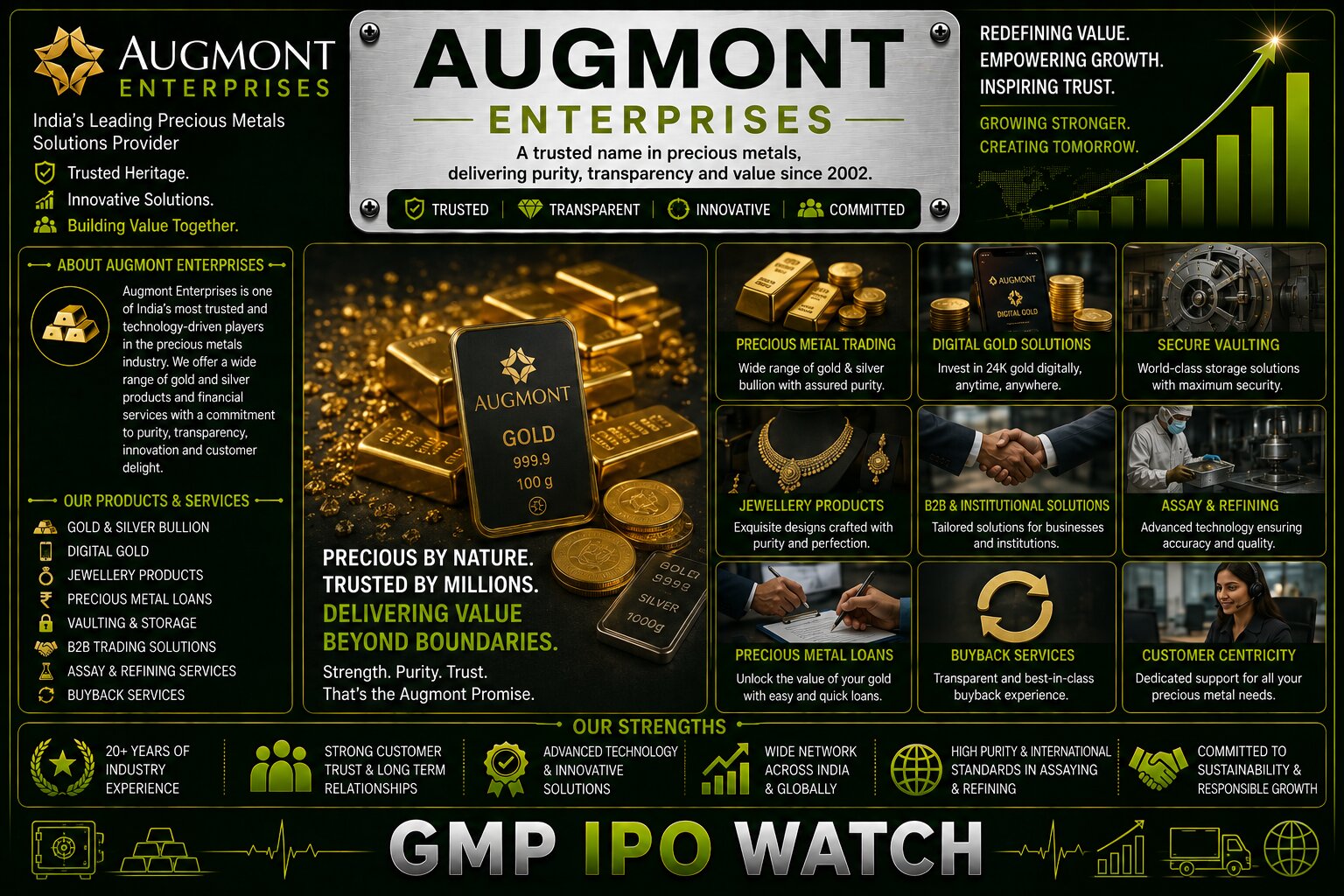
Augmont Enterprises Limited is attempting to bring many of those activities together on one technology-enabled platform.
The company operates across both gold and silver and has built businesses serving jewellers, enterprises and individual consumers.
Now Augmont itself is preparing for the public market.
The Augmont Enterprises IPO opens on August 21, 2026, and closes on August 25.
For investors, this is not simply another jewellery IPO.
Augmont operates much deeper inside India's precious-metals value chain.
Understanding that distinction is essential before looking at the ₹94,000-crore-plus revenue number.
Augmont Enterprises IPO Details
| Particular | Details |
|---|---|
| IPO Open Date | August 21, 2026 |
| IPO Close Date | August 25, 2026 |
| Anchor Investor Date | August 20, 2026 |
| Price Band | ₹750 – ₹788 |
| Face Value | ₹5 per Share |
| Lot Size | 19 Shares |
| Minimum Retail Investment | ₹14,972 |
| Total Issue Size | ₹825 Cr |
| Fresh Issue | ₹620 Cr |
| Offer for Sale | ₹205 Cr |
| Issue Type | Book Built Mainboard IPO |
| Listing Exchange | BSE & NSE |
| Allotment | Expected August 26 |
| Listing | Expected late August 2026 |
At the upper price band of ₹788, one retail lot of 19 shares requires an investment of approximately ₹14,972.
Understanding the ₹825 Crore IPO
The public offering has two components.
The first is a ₹620 crore fresh issue.
This money, after IPO-related expenses, will be available to Augmont for the purposes disclosed in the offer document.
The second is a ₹205 crore Offer for Sale by existing shareholders.
That amount will go to the selling shareholders rather than into the company.
Because the fresh component represents the majority of the IPO, Augmont is raising substantial new capital for its operations.
₹465 Crore Planned for Working Capital
The biggest use of fresh IPO proceeds is working capital.
Augmont plans to deploy approximately ₹465 crore toward procurement, maintaining and scaling inventory and funding advance-margin requirements connected with inventory purchases.
This number tells investors something very important about Augmont's business.
Gold and silver are extremely valuable products.
Even small quantities can require significant capital.
As transaction volumes increase, the amount of money required to hold and procure inventory can increase rapidly.
Working capital is therefore not simply an administrative requirement for Augmont.
It is directly connected with its ability to grow transaction volumes.
Why Augmont Needs So Much Working Capital
Imagine a conventional retailer.
If the price of its inventory increases by 5%, working-capital requirements may rise modestly.
For a precious-metals platform, the situation can be very different.
Gold prices can move substantially while each kilogram already carries extremely high value.
A business processing large quantities of gold therefore needs significant liquidity to purchase and maintain inventory.
Augmont also operates in bullion markets where customers expect execution at prevailing market prices.
Having adequate inventory and financing arrangements is essential for supporting this scale.
The ₹465 crore working-capital allocation is therefore closely linked to future growth.
What Does Augmont Enterprises Actually Do?
Augmont describes itself as an integrated gold and silver platform.
Its operations span several areas of the precious-metals ecosystem, including:
- Gold and silver procurement
- Refining
- Bullion trading
- Digital gold
- Digital silver
- Jewellery-related services
- Gold recycling
- International sales
- Gold-backed financial solutions
- Retail gold products
This broad presence distinguishes Augmont from a conventional jewellery retailer.
The company participates in several stages of the gold lifecycle.
Augmont SPOT Is the Core B2B Engine
One of the most important parts of Augmont's business is Augmont SPOT.
This platform primarily serves enterprise and jewellery-industry customers.
Jewellers and other businesses can use it to access precious-metal products and market-linked pricing.
The platform has become the dominant contributor to Augmont's operating revenue.
In FY2026, Augmont SPOT contributed approximately 86.80% of revenue from operations.
That explains why Augmont's total reported revenue is extraordinarily high.
The company processes huge values of gold and silver through its platform.
Why ₹94,186 Crore Revenue Needs Context
Augmont reported approximately ₹94,186.21 crore of FY2026 revenue from operations.
At first glance, that figure looks enormous.
But investors should not compare it directly with ₹94,000 crore of revenue at a software or consumer-products company.
Gold trading businesses recognise the value of metal transacted through their operations.
Because gold itself is highly valuable, revenue can be extremely high even when percentage margins are very small.
This is why Augmont's PAT margin is less than 1% despite generating hundreds of crores of rupees in profit.
Understanding this revenue model is perhaps the most important part of evaluating the IPO.
FY2026 Revenue Increased 42%
The company's operating scale continued expanding during FY2026.
Revenue from operations increased from approximately:
₹34,921.49 crore in FY2024
to
₹66,230.78 crore in FY2025
and then
₹94,186.21 crore in FY2026.
FY2026 revenue therefore increased by approximately 42.21% year-on-year.
Over the two-year period, the scale of precious-metals transactions handled by the company increased dramatically.
PAT Growth Has Been Even Stronger
Profitability also increased substantially.
Augmont reported PAT of approximately:
₹75.97 crore in FY2024
₹227.19 crore in FY2025
and
₹348.30 crore in FY2026.
FY2026 PAT increased by more than 53% compared with FY2025.
That means profit growth outpaced revenue growth during the year.
This indicates some improvement in operating efficiency and revenue mix.
EBITDA Reaches ₹385.95 Crore
Augmont reported FY2026 EBITDA of approximately ₹385.95 crore.
This compares with around:
₹304.09 crore in FY2025
and
₹103.92 crore in FY2024.
The EBITDA margin remains very thin as a percentage of enormous bullion revenue.
However, the absolute increase in EBITDA is meaningful.
For Augmont, investors should therefore analyse both absolute profit growth and margin movement.
Thin Margins Are Normal—but Still a Risk
Augmont's operating model naturally produces thin margins.
The company handles extremely valuable commodities where price spreads can be small.
This means even a modest change in margins can have a large impact on profits.
For example, small movements in procurement costs, bullion spreads or inventory economics could materially influence earnings.
Investors should therefore avoid assuming that high revenue automatically translates into high earnings visibility.
Digital Gold Adds a Consumer-Facing Business
Augmont is not dependent only on enterprise bullion trading.
The company also has a consumer platform known as Gold For All.
Through digital channels, consumers can access gold and silver products in smaller quantities.
Digital gold allows customers to purchase fractional amounts rather than immediately buying physical jewellery or coins.
This can make gold investing accessible to customers starting with relatively small amounts.
The product also fits naturally with India's growing digital-finance ecosystem.
Why Digital Gold Has Become Popular
Traditional physical gold purchases have several practical issues.
Consumers may need to visit a store.
They need to think about safe storage.
Buying very small quantities can be inconvenient.
Digital gold attempts to reduce some of these barriers.
Customers can purchase gold online and gradually accumulate holdings.
For younger consumers already comfortable using investment and payment applications, this can make gold ownership more convenient.
Augmont's digital infrastructure positions it directly within this trend.
Gold SIPs Could Expand the Addressable Market
One interesting consumer behaviour is systematic gold purchasing.
Instead of purchasing large quantities only during weddings or festivals, consumers can invest smaller amounts periodically.
A gold SIP-style model can convert gold from an occasional purchase into a more regular savings habit.
If adoption increases, platforms capable of providing secure digital ownership and redemption could benefit.
Augmont's consumer ecosystem allows it to participate in this shift.
Physical Gold Still Matters
Digital gold does not eliminate the importance of physical metal.
Many Indian consumers ultimately want:
- Gold coins
- Bars
- Jewellery
- Physical delivery
Augmont's integrated infrastructure can potentially connect digital ownership with physical products.
This is strategically useful because the company is not operating as a purely virtual financial platform.
It has experience across sourcing, refining and physical distribution.
Refining Creates Vertical Integration
Augmont has in-house refining capabilities with combined annual capacity of approximately 284 tonnes.
Refining allows precious metals to be processed to required purity standards.
Vertical integration can provide several benefits.
The company may have greater control over:
- Metal quality
- Processing
- Supply
- Product availability
- Inventory movement
Operating deeper inside the value chain can also reduce reliance on external service providers.
Gold Recycling Could Become Increasingly Important
India already owns enormous quantities of gold inside households.
This creates a large opportunity for recycling.
Consumers may sell old jewellery or exchange it for new products.
That metal can re-enter the formal gold ecosystem rather than requiring equivalent new imports.
Gold recycling can therefore support both commercial activity and resource efficiency.
Augmont's presence in recycling provides another avenue for precious-metal supply.
India's Gold Import Dependence Creates Opportunity and Risk
India is one of the world's largest gold-consuming markets but depends heavily on imports.
This creates both opportunity and risk for Augmont.
The large market supports enormous transaction volumes.
But international gold prices, currency movements and import regulations can directly influence the business.
A stronger US dollar or weaker rupee can make imported gold more expensive.
Changes in customs duties can also influence domestic pricing.
Gold Price Volatility Can Increase Revenue Without Volume Growth
Another point investors should understand is the relationship between gold prices and revenue.
Suppose Augmont sells exactly the same quantity of gold next year, but gold prices rise 20%.
Reported revenue can rise materially even without a similar increase in physical volumes.
Therefore, headline revenue growth should always be analysed alongside:
- Metal volumes
- Transaction activity
- Profit growth
- Margins
- Customer growth
A ₹1 lakh crore revenue figure may look impressive, but the underlying economics matter more.
Augmont Has a Huge Digital Reach
Augmont's broader platform has developed substantial digital reach.
Its ecosystem reports tens of millions of registered users along with thousands of jeweller partners and retail touchpoints.
Digital scale can provide network advantages.
More users can attract additional partners.
A broader partner network can make products more accessible.
Greater transaction volume can also improve platform economics.
But user counts need to be interpreted carefully.
Registered users are not necessarily the same as active or revenue-generating customers.
Jeweller Network Is Strategically Important
Augmont works with thousands of jewellery partners.
Jewellers represent a natural customer segment because they continuously require bullion inventory.
A technology-enabled platform providing transparent pricing and reliable supply can help simplify procurement.
Strong jeweller relationships may also create recurring transactions.
The challenge is maintaining competitive spreads because jewellery businesses are highly sensitive to bullion prices.
Presence Across 24 States
Augmont had operations across 24 states as of March 31, 2026.
This broad distribution footprint provides geographic diversification.
Gold demand is widespread across India, but purchasing behaviour differs significantly between regions.
South India, western India and northern markets can have different jewellery preferences and seasonal patterns.
A national network allows Augmont to participate across multiple consumer and enterprise markets.
Overseas Sales Add Another Revenue Stream
International sales contributed approximately 6.05% of FY2026 operating revenue.
That gives Augmont exposure beyond India.
International precious-metals trade can create additional growth opportunities.
However, it also brings:
- Currency risk
- Global competition
- Regulatory requirements
- International commodity-market exposure
Successful expansion overseas could reduce dependence on domestic demand, but it adds complexity.
Consumer-Focused Businesses Contribute Around 7%
Consumer-focused offerings generated approximately 7.10% of FY2026 operating revenue.
This is still much smaller than Augmont SPOT.
However, consumer businesses could potentially offer different economics from large-volume enterprise bullion trading.
If consumer digital gold, retail products and related services scale successfully, the revenue mix could gradually become more diversified.
That could be important for margins over the long term.
Borrowings Have Fallen Dramatically
Augmont has substantially reduced debt in recent years.
Total borrowing decreased from approximately:
₹54.86 crore in FY2024
to
₹21.54 crore in FY2025
and
₹12.67 crore in FY2026.
This is notable because the company's transaction volume has expanded substantially during the same period.
A lower debt burden can reduce finance costs and strengthen financial flexibility.
Net Worth Has Increased Strongly
Augmont's net worth also expanded sharply.
Reported net worth increased to approximately ₹926.87 crore in FY2026.
That compares with around ₹414.67 crore in FY2025 and approximately ₹187 crore in FY2024.
This provides a significantly stronger equity base.
The fresh IPO issue will increase that capital further.
Working Capital Remains the Main Financial Challenge
Even with low borrowings, Augmont's business remains highly working-capital dependent.
Large precious-metal transaction volumes require constant access to inventory and liquidity.
This explains why ₹465 crore of the ₹620 crore fresh issue is being allocated toward working capital.
For investors, the key post-IPO question will be whether this additional capital produces proportionately higher profits.
If working capital expands rapidly while margins remain stagnant, returns on incremental equity could decline.
Gold Prices Are Currently an Important Tailwind
Gold has experienced strong investor interest globally due to factors such as:
- Economic uncertainty
- Inflation concerns
- Central-bank purchases
- Currency volatility
- Geopolitical risk
Higher interest in gold can support transaction activity.
However, precious-metal markets move in cycles.
If gold prices stabilise or decline, investor behaviour may change.
Augmont therefore should not be valued solely on expectations that gold prices will continuously rise.
Regulatory Risk Matters for Digital Gold
Digital gold is an evolving financial product in India.
Unlike conventional regulated securities, the regulatory framework around certain digital-gold models has historically differed from products such as mutual funds and ETFs.
Any future changes to rules governing:
- Digital gold
- Storage
- Custody
- Consumer protection
- Gold-backed products
could affect Augmont's consumer strategy.
Investors should therefore monitor regulatory developments.
Technology Is an Important Part of the Moat
Augmont is unusual because it combines a traditional commodity with modern technology.
Its platforms support:
- Digital transactions
- Price discovery
- Customer onboarding
- Enterprise trading
- Retail purchasing
- Inventory management
Technology can help the company process large transaction volumes efficiently.
But it also creates cybersecurity and system-reliability risks.
A serious platform outage during volatile gold markets could affect customer trust.
Competition Comes From Several Directions
Augmont does not compete with only one type of company.
Its competitors can include:
- Bullion dealers
- Gold refiners
- Jewellery companies
- Digital gold platforms
- Financial technology companies
- Precious-metals marketplaces
- Banks and financial institutions
This makes competitive positioning complex.
The company needs to maintain trust, pricing, technology and supply-chain reliability simultaneously.
Trust Is Especially Important in Gold
Consumers purchasing digital or physical gold care deeply about trust.
The value involved can represent meaningful household savings.
Customers need confidence regarding:
- Gold purity
- Ownership
- Storage
- Redemption
- Pricing
- Platform reliability
A reputational issue can therefore have an outsized impact.
For Augmont, its long operating history and integrated infrastructure are useful, but maintaining trust remains an ongoing responsibility.
IPO Valuation
At the upper price band of ₹788, Augmont is expected to command a post-issue valuation of roughly ₹7,200 crore.
Based on FY2026 PAT of approximately ₹348.30 crore, the implied earnings multiple is in the region of 20–21 times FY2026 earnings.
That valuation needs to be considered alongside:
- 42% revenue growth
- 53% PAT growth
- Strong return ratios
- Thin bullion margins
- Working-capital requirements
- Gold-market volatility
- Consumer-platform growth potential
The company is growing quickly, but valuation still matters.
Latest GMP Shows Strong Pre-IPO Interest
As of August 19, 2026, Augmont Enterprises has begun attracting significant attention in the unofficial grey market.
The latest reported GMP is around ₹190 per share.
Against the upper issue price of ₹788, this represents roughly a 24% unofficial premium.
This is a strong early indication of market interest.
However, GMP can change very quickly.
It is unofficial and unregulated.
It does not guarantee that the shares will list at the indicated price.
Anchor Investor Bidding Is Tomorrow
The next major event for Augmont is anchor investor bidding on August 20.
Anchor investors can include:
- Mutual funds
- Insurance companies
- Foreign institutional investors
- Other large institutions
The quality and size of the anchor book may provide the first indication of institutional demand.
Public subscription starts one day later.
Public Subscription Begins August 21
Retail, NII and QIB bidding opens on:
August 21, 2026
and remains open through:
August 25, 2026.
The issue reserves approximately:
50% for Qualified Institutional Buyers
15% for Non-Institutional Investors
and
35% for retail investors.
Subscription trends will become an important short-term indicator once bidding begins.
What Looks Positive?
Several aspects of Augmont's business stand out.
The company has a highly integrated precious-metals platform.
It operates across B2B and B2C markets.
Revenue and PAT growth are strong.
Borrowings have fallen sharply.
The company has large digital reach and extensive jeweller relationships.
Fresh IPO capital can significantly expand working-capital capacity.
And India's long-term cultural relationship with gold provides a large underlying market.
What Requires Caution?
There are also significant risks.
The business generates extremely thin percentage margins.
Augmont SPOT contributes the vast majority of revenue.
Gold-price volatility can influence transaction economics.
Working-capital requirements are substantial.
Digital gold remains exposed to regulatory developments.
Commodity prices and currency movements can affect demand.
And the high FY2026 revenue number should not be interpreted like conventional corporate revenue because it includes the value of precious metals traded.
These points need to be understood before evaluating the company.
What Should Investors Track After Listing?
For Augmont, several metrics will matter more than headline revenue alone:
- Gold and silver transaction volumes
- PAT growth
- EBITDA growth
- EBITDA margin
- Consumer-business share
- Digital gold users
- Active jeweller partners
- International revenue
- Working-capital efficiency
- Inventory levels
- Cash flow
- Return on net worth
- Debt levels
The evolution of the revenue mix will be particularly interesting.
If higher-margin consumer offerings become a larger part of business, the company's overall profitability profile could improve.
Final View on Augmont Enterprises IPO
The Augmont Enterprises IPO opens on August 21, 2026, with a ₹750–₹788 price band, 19-share lot size and total issue size of ₹825 crore.
The issue comprises a ₹620 crore fresh issue and ₹205 crore Offer for Sale.
Approximately ₹465 crore of the fresh proceeds will be used for working capital related to precious-metal procurement, inventory and margin requirements.
The company enters the IPO after a powerful FY2026 performance.
Revenue from operations increased to approximately ₹94,186.21 crore, compared with ₹66,230.78 crore in FY2025.
PAT increased to approximately ₹348.30 crore from ₹227.19 crore.
At the same time, Augmont's revenue model needs to be understood carefully.
Most revenue comes from high-volume gold and silver transactions through Augmont SPOT, meaning percentage margins are naturally extremely thin.
The more interesting long-term opportunity may come from the company's ability to connect this massive enterprise bullion infrastructure with digital gold, retail products, recycling, financial solutions and other consumer offerings.
Today's approximately ₹190 GMP shows strong early investor interest, but the IPO should not be evaluated only through listing expectations.
The central investment question is much bigger:
Can Augmont convert its enormous precious-metals transaction scale into steadily higher profits while building a more diversified and higher-margin digital gold ecosystem?
If it can, the company may become one of the more distinctive listed plays on India's gold economy.
If growth remains heavily dependent on thin-margin bullion volumes, investors will need to focus carefully on capital efficiency and sustainable profitability.
That balance between massive transaction scale and thin margins is what makes the Augmont Enterprises IPO particularly interesting.
Loading comments...