

NSE New Rule: New R3 System for Share Lending and Borrowing Starts Monday

The National Stock Exchange (NSE) is introducing a new short-duration contract in the Securities Lending and Borrowing (SLB) segment from Monday, August 17, 2026

NSE New Rule: New R3 System for Share Lending and Borrowing Starts Monday

New Delhi: The National Stock Exchange (NSE) is introducing a new short-duration contract in the Securities Lending and Borrowing (SLB) segment from Monday, August 17, 2026.

The new R3 series contracts are aimed at making short-term share borrowing and lending more flexible for market participants. However, investors should not confuse this change with a new rule for regular buying and selling of shares.

What is the new NSE R3 system?

Securities Lending and Borrowing, commonly known as SLB, allows investors to lend their shares to another market participant for a specific period and earn a lending fee.

On the other side, a trader can borrow shares through the SLB mechanism and sell them in the market. The trader can later buy the shares back and return them to the lender.

The new R3 contracts are designed specifically for short-duration transactions in the SLB segment.

According to reports, the R3 contract will have a three-day settlement period, with features such as rollover and recall not available under this contract.

Will money no longer be blocked when buying shares?

This is where some confusion has been created by headlines around the new rule.

The new R3 facility does not mean that money will no longer be blocked when you buy shares normally.

If you purchase shares through a broker such as Zerodha, Groww, Angel One or another trading platform in the regular cash market, the existing settlement and fund requirements continue to apply.

The R3 change is mainly related to the Securities Lending and Borrowing market, rather than regular equity buying and selling.

How does SLB work?

Let's take a simple example.

Suppose an investor owns 1,000 shares of a company but does not want to sell them. Instead, the investor can lend those shares through the SLB market and earn a lending fee.

A trader who expects the stock price to fall can borrow those shares and sell them in the market.

If the share price subsequently falls, the trader can buy the shares back at a lower price and return them to the original lender.

The difference between the selling price and buying price, after considering the applicable costs and fees, can result in a trading profit.

Why has NSE introduced R3 contracts?

The new short-duration contract is expected to give market participants more flexibility when they need to borrow securities for a shorter period.

It could be useful for traders involved in:

  • Short-selling strategies
  • Arbitrage opportunities
  • Short-term trading positions
  • Securities lending
  • Other market-neutral strategies

The broader objective is to make the SLB market more useful and efficient for participants.

What does this mean for retail investors?

For most retail investors, there is no immediate action required.

If you simply buy shares for delivery or sell shares that you already own, your regular trading process remains largely unchanged.

The new R3 contracts will be more relevant to investors and traders who actively participate in the SLB segment.

So, if you have seen headlines saying that "NSE has changed the rules for buying and selling shares and money will not be blocked from Monday," it is worth looking at the details.

The actual change is focused on short-duration Securities Lending and Borrowing contracts, not on eliminating the normal fund requirements for regular share purchases.

Bottom Line

NSE's new R3 contract is an important development for the SLB market, particularly for participants looking for short-term securities borrowing and lending opportunities.

But for an ordinary investor buying and selling shares through a regular trading account, there is no major change in the normal cash-market trading process because of this R3 launch.

Community discussion

Comments

Share a useful question or insight about NSE New Rule: New R3 System for Share Lending and Borrowing Starts Monday.

Loading comments...

Leave a comment

Your email address will not be published. All comments and replies are reviewed before appearing.

More IPO News

Continue exploring recent IPO market updates and subscription developments.

News
R.K. Fashion Accessories IPO: ₹34.99 Crore Issue Opens October 5; GMP at ₹0
02 Oct 2026 8 min

R.K. Fashion Accessories IPO: ₹34.99 Crore Issue Opens October 5; GMP at ₹0

R.K. Fashion Accessories IPO is set to open for subscription on October 5, 2026, and will close on October 7. The NSE SME IPO has a price band of ₹77 to ₹82 per share and will raise up to ₹34.99 crore through a fresh issue. The latest grey-market update shows GMP at ₹0, while the company has reported strong growth in revenue and profit in FY2026.

Lighthouse Communities Foundation IPO: ₹58.86 Lakh SSE Issue Opens; 1,000 Pune Youth to Benefit
02 Oct 2026 8 min

Lighthouse Communities Foundation IPO: ₹58.86 Lakh SSE Issue Opens; 1,000 Pune Youth to Benefit

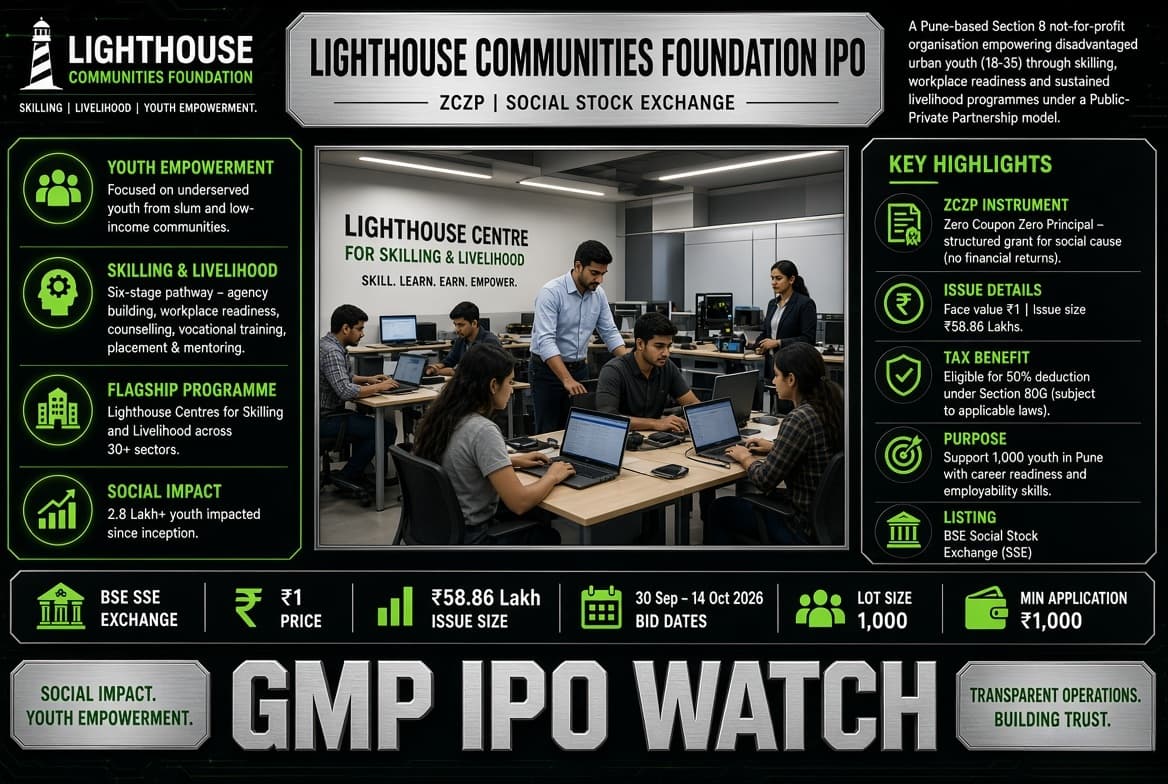
Lighthouse Communities Foundation has opened its Social Stock Exchange issue to raise ₹58.86 lakh through Zero Coupon Zero Principal (ZCZP) instruments. The issue opened on September 30, 2026, and is scheduled to remain open until October 14, 2026. The project aims to support 1,000 underserved youth in Pune with career readiness, workplace skills and livelihood opportunities. The minimum application amount is ₹1,000.

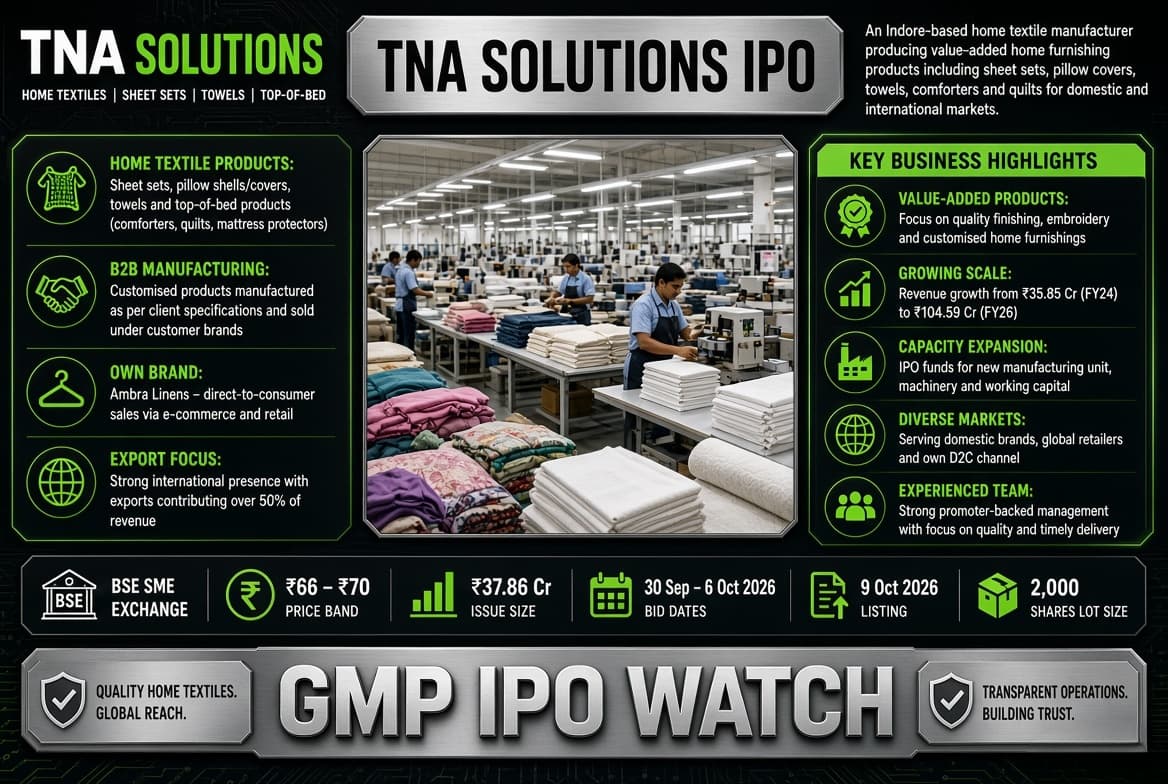
TNA Solutions IPO Day 3: ₹37.86 Crore Issue Subscribed 1.78x; GMP at ₹6
02 Oct 2026 7 min

TNA Solutions IPO Day 3: ₹37.86 Crore Issue Subscribed 1.78x; GMP at ₹6

TNA Solutions IPO is open for subscription from September 30 to October 6, 2026. The BSE SME IPO has a price band of ₹66 to ₹70 per share and an issue size of ₹37.86 crore. The latest Day 3 update shows the issue subscribed 1.78 times, led by QIB demand at 4.77x, while the latest reported GMP stands at ₹6.

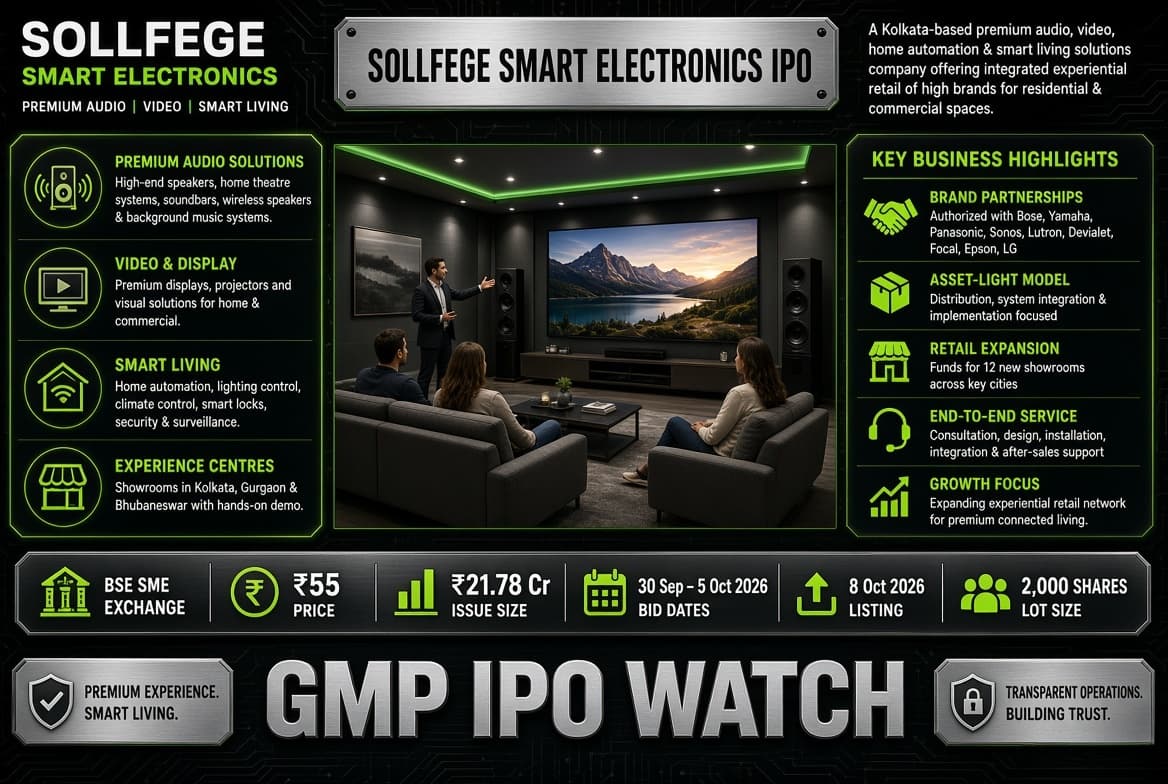
Sollfege Smart Electronics IPO Day 3: ₹21.78 Crore Issue Subscribed 1.86x; GMP Not Quoted
02 Oct 2026 6 min

Sollfege Smart Electronics IPO Day 3: ₹21.78 Crore Issue Subscribed 1.86x; GMP Not Quoted

Sollfege Smart Electronics IPO is open for subscription from September 30 to October 5, 2026. The BSE SME fixed-price issue is priced at ₹55 per share and aims to raise ₹21.78 crore through a fresh issue. The latest October 2 update shows the issue around 1.86 times subscribed, while the grey market has not quoted a reliable GMP.

Eventions IPO Day 3: ₹38.12 Crore Issue Subscribed 1.85x; GMP Not Yet Started
02 Oct 2026 8 min

Eventions IPO Day 3: ₹38.12 Crore Issue Subscribed 1.85x; GMP Not Yet Started

Eventions IPO is open for subscription from September 30 to October 5, 2026. The NSE SME IPO has a price band of ₹112 to ₹118 per share and an issue size of ₹38.12 crore. The issue was subscribed 1.85 times by October 1, with strong QIB participation. The grey market premium has not yet started, according to the latest available update.

Related Topics
NSE New Rule: New R3 System for Share Lending and Borrowing Starts MondayNSE New RuleNSE New Rule newsNSE New Rule ipo newsNSE New Rule gmp newsNSE New Rule ipo gmp newsNSE New Rule subscription newsNSE New Rule price band newsNSE New Rule allotment status newsNSE New Rule allotment date newsNSE New Rule listing date newsNSE New Rule listing gain newsNSE New Rule grey market premium newsNSE New Rule company newsNSE New Rule latest newsNSE New Rule allotment newsNSE New Rule listing newsBusiness IPO newsipo newsipo gmp newsipo update newsgrey market premium newsipo market update newsipo subscription update news