

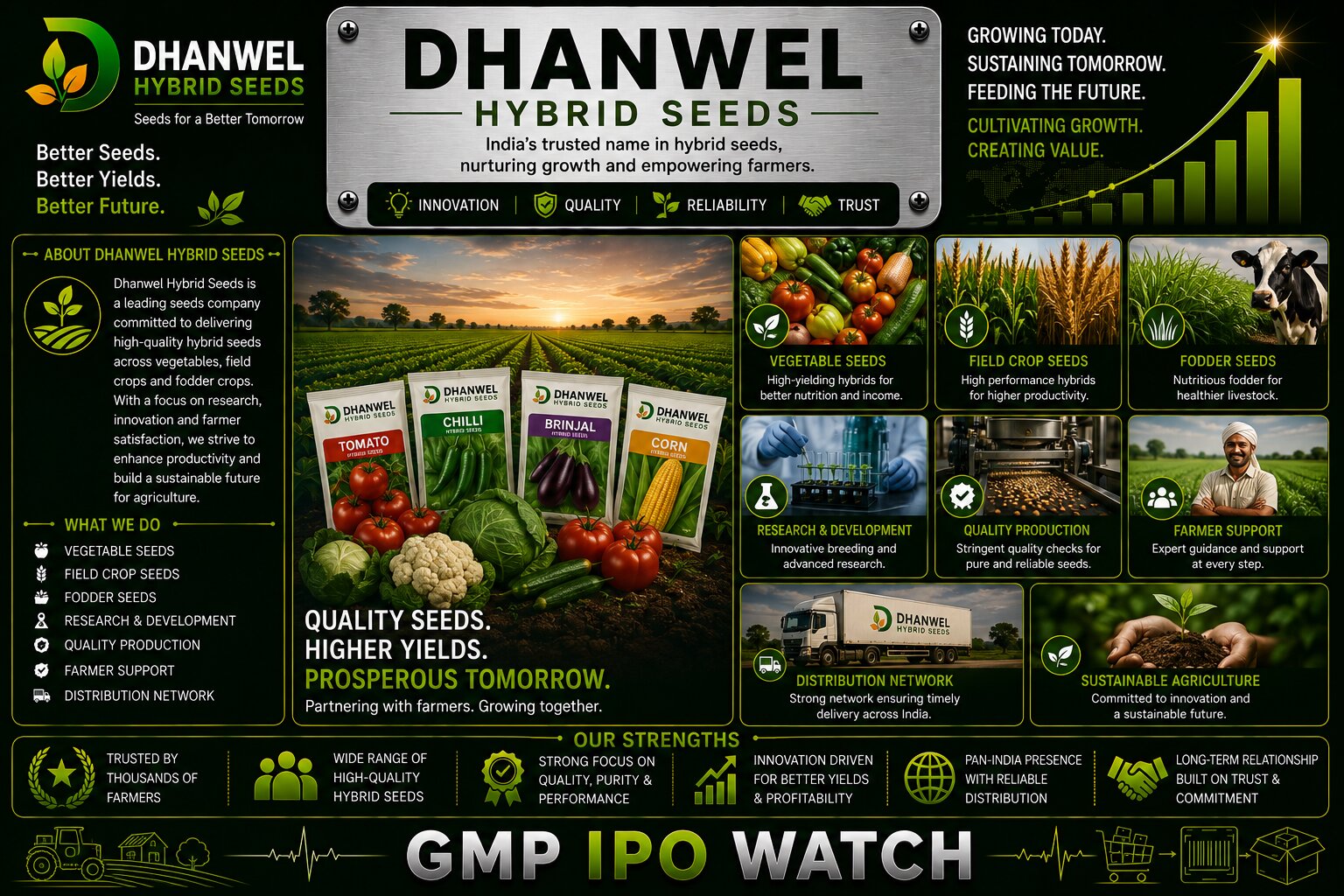
Dhanwel Hybrid Seeds IPO – Can a Wider Product Portfolio Drive the Next Phase of Growth?
Dhanwel Hybrid Seeds operates at one of the most important starting points of the agricultural value chain: seeds.
The company's business involves multiplying, processing, conditioning, packaging and selling seeds used for different field crops and vegetables. It sources seeds through contract farming, direct farmer procurement and market purchases depending on requirements.
What makes the company's latest growth phase interesting is its attempt to move beyond its traditional seed categories. In FY2026, Dhanwel added flowers and fertilisers to its product portfolio and also introduced wheat seed varieties under its Dhanwel-777 and LOK-1 brands.
This means the post-IPO story is increasingly about:
more products + stronger distribution + adequate working capital + lower debt.
Dhanwel Hybrid Seeds IPO Details
| Particular | Details |
|---|---|
| Company | Dhanwel Hybrid Seeds Ltd. |
| IPO Type | SME IPO |
| Issue Type | Book Built Issue |
| Issue Size | ₹26.73 Crore |
| Fresh Issue | ₹26.73 Crore |
| Offer for Sale | Nil |
| Shares Offered | 27 Lakh |
| Price Band | ₹95 – ₹99 |
| Face Value | ₹10 |
| Lot Size | 1,200 Shares |
| Issue Price | ₹99 |
| Exchange | BSE SME |
| Business | Seeds & Agri Products |
| Issue Structure | 100% Fresh Issue |
The issue comprises 27 lakh fresh equity shares, with no OFS component.
Why the 100% Fresh Issue Matters
A complete fresh issue means the IPO proceeds go to the company rather than existing shareholders selling their holdings.
For Dhanwel, that is particularly relevant because the business requires substantial working capital.
The disclosed deployment includes approximately:
| Use of Proceeds | Amount |
|---|---|
| Working Capital | ₹11.60 Cr |
| Debt Repayment | ₹7.60 Cr |
| General Corporate Purposes | Balance |
| Main Objective | Growth + Deleveraging |
The ₹11.60 crore working-capital allocation is the largest specifically identified use, while ₹7.60 crore is intended for repayment or prepayment of borrowings.
Working Capital Is Central to the Business
Seed companies need to prepare inventory before farmers actually need it.
The cycle can look like:
seed sourcing → contract farming → multiplication → processing → quality testing → packaging → inventory → dealer sales → collection.
Cash can remain tied up throughout this cycle.
This makes working capital especially important when the company is expanding.
Dhanwel's IPO allocation reflects this reality: Upstox categorises approximately 43.4% of the proceeds toward working capital and 28.4% toward debt repayment.
Debt Repayment Could Strengthen the Balance Sheet
Dhanwel had borrowings of approximately ₹7.68 crore as of March 31, 2026, while the company proposed using ₹7.60 crore of IPO proceeds for repayment or prepayment.
If deployed as proposed, the IPO could therefore remove a substantial portion of existing borrowings.
The potential benefit is:
lower debt → lower finance costs → stronger cash flow → greater capacity to fund future growth internally.
For a seasonal agricultural business, a stronger balance sheet can be particularly valuable.
Dhanwel Has a Diversified Seed Portfolio
Dhanwel is not dependent on only one crop.
Its product portfolio includes seeds across categories such as:
- Oilseeds
- Pulses
- Spices
- Sesame
- Green gram
- Black gram
- Wheat
- Vegetables
The company expanded its portfolio further in FY2026 by adding flowers and fertilisers.
This diversification can help reduce dependence on the planting cycle of a single crop.
Wheat Seeds Could Become an Interesting Growth Category
Dhanwel has also introduced its own wheat seed varieties under the names:
Dhanwel-777
and
LOK-1.
Developing branded varieties can be strategically important.
A seed company that earns farmer trust can potentially generate repeat purchases across multiple planting seasons.
That creates a different kind of competitive advantage from simply trading agricultural products.
Contract Farming Supports Seed Supply
Dhanwel operates a contract-farming programme under which farmers enter into agreements to grow and supply seed products to the company.
This model helps the company organise seed multiplication without owning enormous areas of agricultural land itself.
The operating model can be simplified as:
source genetic material → contract farmers multiply seeds → company processes and tests → packaged seeds reach market.
However, contract farming also creates dependence on farmers and weather conditions.
Seed Quality Is More Important Than Packaging
For farmers, the real value of a seed becomes visible only after planting.
Important factors include:
germination + genetic purity + crop uniformity + disease tolerance + productivity + yield.
This makes quality control critical.
One poor-performing batch can damage farmer confidence and distributor relationships.
Conversely, seed varieties that consistently perform well can create repeat demand.
Distribution Is Critical for Future Growth
Producing seeds is only one part of the business.
Dhanwel also needs to make its products available where farmers purchase agricultural inputs.
That requires an effective chain involving:
company → distributor → dealer → agricultural retailer → farmer.
A wider dealer network can allow Dhanwel to sell more products without needing a directly owned retail network.
For the company's next growth phase, distribution expansion may therefore be just as important as increasing production.
Adding Fertilisers Creates Cross-Selling Potential
The FY2026 addition of fertilisers is strategically interesting.
A farmer purchasing seeds may also require crop nutrients and other agricultural inputs.
This creates potential for:
same farmer + additional products = higher revenue per customer.
If Dhanwel can use its existing distribution network to sell additional agricultural products, it may improve the economics of that network.
However, expanding into new categories also increases inventory and working-capital requirements.
Agriculture Offers a Large Addressable Market
India has a vast agricultural economy.
Improved seeds can play an important role in helping farmers achieve better productivity and crop quality.
The long-term opportunity for organised seed companies comes from farmers increasingly adopting:
commercial seeds + improved varieties + quality-controlled products + higher-value agricultural inputs.
For a relatively small company such as Dhanwel, even modest increases in market penetration could support meaningful revenue growth.
But Agriculture Is Highly Seasonal
Dhanwel's business does not operate evenly throughout the year.
Seed demand is linked to planting seasons.
This means the company must prepare inventory before demand peaks.
If expected demand does not materialise, excess inventory can create financial pressure.
Historical analysis of the company indicates inventory holding periods ranging from roughly 35 to 82 days across the reported years.
This makes inventory management an important post-IPO metric.
Weather Is One of the Biggest Risks
Dhanwel cannot control the monsoon.
Weather can influence both sides of its business.
On the supply side, adverse weather can affect seed multiplication by contract farmers.
On the demand side, weak rainfall can influence farmers' planting decisions and seed purchases.
The chain can become:
poor weather → lower sowing → weaker seed demand → excess inventory → working-capital pressure.
This is an unavoidable structural risk for agricultural-input companies.
Crop Economics Can Change Farmer Behaviour
Farmers also decide what to plant based partly on expected profitability.
If prices for one crop become attractive, acreage can shift toward that crop.
If another becomes less profitable, demand for its seeds may fall.
Dhanwel's multi-crop portfolio can provide some protection because it allows the company to participate across several agricultural categories.
Smaller Scale Creates Both Opportunity and Risk
Dhanwel remains small compared with India's established seed and agricultural-input companies.
That creates potential for faster percentage growth from a smaller revenue base.
However, larger competitors can have advantages including:
stronger brands + wider distribution + larger R&D budgets + more varieties + greater marketing resources.
Dhanwel therefore needs to scale without sacrificing product quality or financial discipline.
Fresh IPO Capital Can Change the Growth Equation
The combination of debt repayment and working-capital funding is important.
Before the IPO, growth may require additional borrowing to finance inventory.
After deploying the IPO proceeds, the desired equation becomes:
lower debt + more working capital → larger inventory capability → wider distribution → higher sales → stronger cash generation.
If that happens, the IPO can have a direct operating impact.
Key Strengths
Dhanwel Hybrid Seeds has several notable positives.
Its IPO is 100% fresh issue, meaning the capital is being raised for the company rather than through an OFS.
The company operates across multiple seed categories and expanded into flowers and fertilisers during FY2026.
Its own wheat seed varieties provide an opportunity to strengthen branded product sales.
The proposed ₹7.60 crore debt repayment is also substantial relative to the approximately ₹7.68 crore borrowings reported as of March 31, 2026.
Finally, ₹11.60 crore of fresh capital targeted at working capital directly addresses one of the most important requirements of the seed business.
Major Risks
The company's biggest risks come from the nature of agriculture itself.
Weather conditions can influence both production and customer demand.
Other risks include:
- Seasonal sales
- Seed-quality issues
- Inventory build-up
- Working-capital pressure
- Contract-farmer dependence
- Crop-price fluctuations
- Competition from larger seed companies
- Distributor dependence
- New-product execution
- Regulatory requirements
Because Dhanwel is an SME company, investors should also consider the potentially lower liquidity and higher share-price volatility commonly associated with SME-listed shares.
What Investors Should Track
| Metric | Why It Matters |
|---|---|
| Revenue Growth | Business expansion |
| PAT Margin | Profit sustainability |
| Seed Sales Volume | Core demand |
| New Products | Portfolio growth |
| Dealer Network | Market penetration |
| Inventory Days | Working-capital control |
| Receivable Days | Collection efficiency |
| Borrowings | IPO deleveraging |
| Finance Cost | Debt-repayment benefit |
| Operating Cash Flow | Earnings quality |
| Geographic Expansion | Future growth |
| ROCE | Capital efficiency |
The most important combination is:
sales growth + inventory control + operating cash flow.
A seed company can report strong revenue growth while simultaneously consuming significant cash through inventory and receivables.
Final View on Dhanwel Hybrid Seeds
Dhanwel Hybrid Seeds' ₹26.73 crore SME IPO is a 100% fresh issue of 27 lakh shares, priced at ₹95–₹99 per share.
The most interesting aspect of the story is not simply the IPO size.
The company is using the capital to address two important constraints: working capital and debt. Around ₹11.60 crore is earmarked for working capital and ₹7.60 crore for repayment or prepayment of borrowings.
At the same time, Dhanwel is widening its business beyond its existing field-crop and vegetable seed portfolio. FY2026 saw the addition of flowers and fertilisers, alongside its own wheat seed varieties Dhanwel-777 and LOK-1.
The growth opportunity can therefore be summarised as:
more seed varieties + more agricultural products + wider distribution + stronger balance sheet = potential business expansion.
Loading comments...