

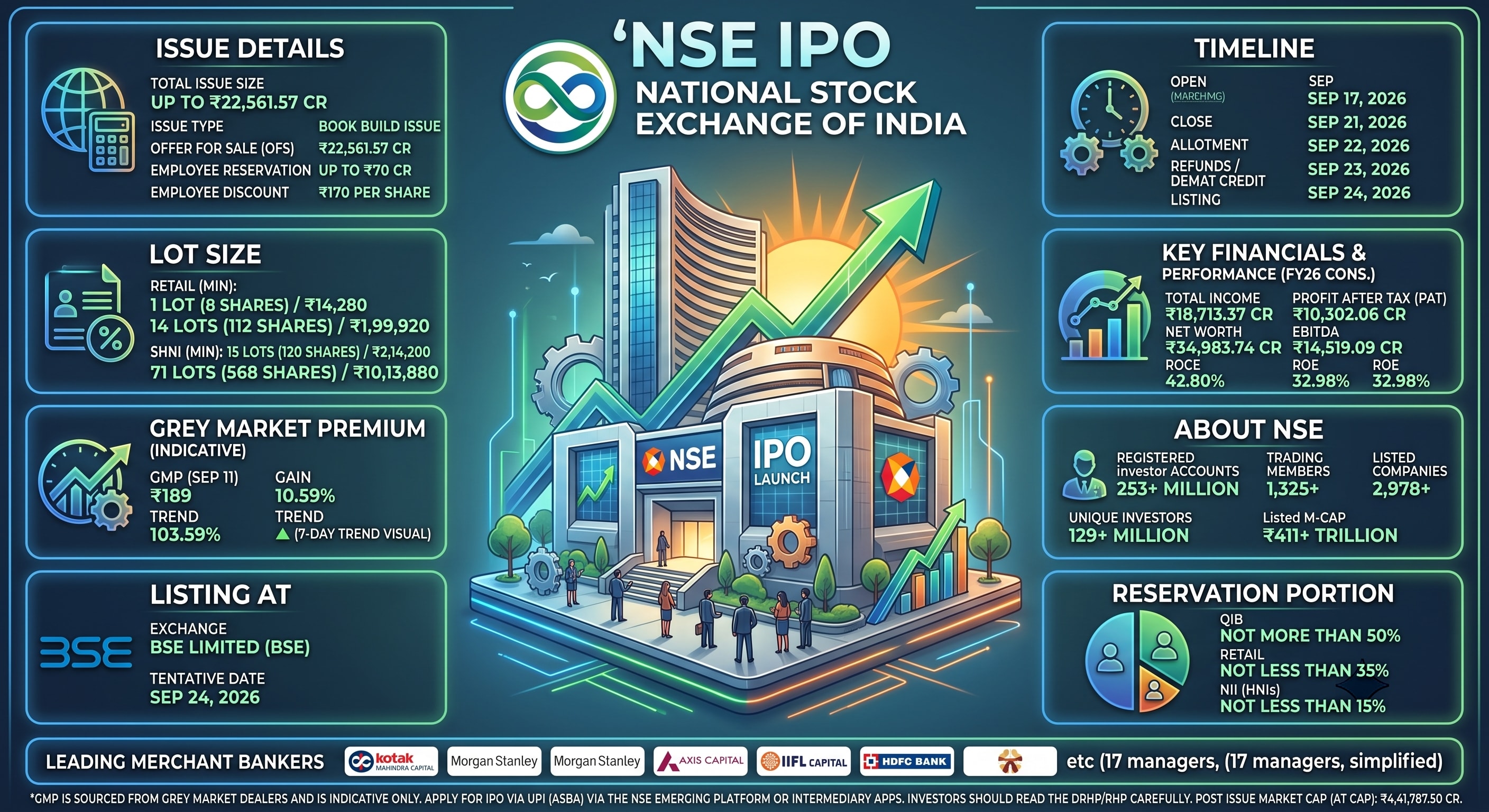
The NSE IPO opened for subscription on September 17, 2026, marking the long-awaited public market debut of the National Stock Exchange of India. The issue will remain open until September 21, 2026.
The NSE IPO is entirely an Offer for Sale (OFS), meaning the National Stock Exchange itself will not receive funds from the public issue. Existing shareholders are selling their shares through the IPO. The issue comprises approximately 12.64 crore shares and is valued at up to ₹22,568.94 crore at the upper price band.
| Particular | Details |
|---|---|
| IPO Name | NSE IPO |
| Company | National Stock Exchange of India |
| IPO Dates | Sep 17–21, 2026 |
| IPO Type | Mainboard |
| Price Band | ₹1,700–₹1,785 |
| Issue Size | ₹22,568.94 Cr |
| Issue Type | 100% OFS |
| Shares Offered | 12.64 Cr |
| Lot Size | 8 Shares |
| Min Investment | ₹14,280 |
| Allotment | Sep 22, 2026 |
| Refund/Demat | Sep 23, 2026 |
| Listing Date | Sep 24, 2026 |
| Listing Exchange | BSE |
| Registrar | MUFG Intime |
NSE IPO GMP Today
The latest NSE IPO GMP was reported around ₹208 per share in the grey market, according to the latest available market update. At the upper price band of ₹1,785, this indicates an unofficial estimated price of approximately ₹1,993 per share.
The reported GMP has moved during the pre-IPO period. Other market trackers had recently reported lower GMP levels, showing that grey-market indications can change quickly. GMP is unofficial and does not guarantee the actual listing price of NSE shares.
NSE IPO Subscription Status
The NSE IPO subscription started on September 17 and the issue is open until September 21. Early bidding data showed demand coming from multiple investor categories soon after the issue opened. Moneycontrol reported that the issue was subscribed around 12% within the first half hour of bidding.
| Category | Reservation |
|---|---|
| QIB | 50% |
| NII | 15% |
| Retail | 35% |
The final NSE IPO subscription status will be available after the issue closes on September 21. Subscription figures can change significantly throughout the bidding period.
NSE IPO Lot Size and Minimum Investment
The NSE IPO lot size is fixed at 8 shares. At the upper price band of ₹1,785 per share, a retail investor needs ₹14,280 for one lot.
Retail investors can apply for up to 112 shares, or 14 lots, subject to the applicable IPO rules. NSE employees are eligible for a ₹170 per-share discount on their bids.
| Particular | Details |
|---|---|
| Lot Size | 8 Shares |
| Price Per Share | ₹1,785 |
| Minimum Application | ₹14,280 |
| Retail Maximum | 112 Shares |
| Employee Discount | ₹170 Per Share |
NSE IPO Company Business
The National Stock Exchange of India is one of India's major market-infrastructure institutions. Its operations cover equity trading, equity derivatives, currency derivatives, commodity derivatives, mutual funds, debt-market products, market data, indices and related capital-market services.
The exchange operates an integrated ecosystem covering trading, clearing, listing, market data and index licensing. Its large trading volumes across cash and derivatives markets form a significant part of its business model.
The NSE's position in India's capital markets also gives the company exposure to the continuing expansion of retail participation, institutional investment and financial-market activity.
NSE IPO Market Position
The NSE IPO is being closely watched because of the exchange's significant share of India's equity and derivatives markets.
According to recent reporting, NSE held approximately 92.99% of India's cash-market turnover in FY26. Its share was also reported at 99.79% in equity futures and 74.71% in equity-options premium turnover.
These figures demonstrate the scale of NSE's existing market operations, although market share and trading volumes can change over time.
NSE IPO Financial Performance
The NSE IPO comes with a large and profitable operating business. For FY26, revenue from operations was reported at approximately ₹16,601 crore, compared with ₹17,141 crore in FY25. Profit after tax stood at around ₹10,302 crore in FY26 versus ₹12,188 crore in FY25.
| Financial Year | Revenue from Operations | PAT |
|---|---|---|
| FY25 | ₹17,141 Cr | ₹12,188 Cr |
| FY26 | ₹16,601 Cr | ₹10,302 Cr |
In the June 2026 quarter, revenue from operations was around ₹4,560 crore and profit after tax was approximately ₹3,120 crore.
NSE IPO Revenue Model
Transaction charges represent an important source of revenue for the National Stock Exchange. According to a September 17 market update, transaction charges accounted for approximately 78.65% of NSE's FY26 revenue. Options and futures activity are particularly important contributors to this revenue stream.
The exchange also generates revenue from other activities, including listing services, market data, indices and related financial-market services.
NSE IPO Valuation
At the upper price band of ₹1,785, the NSE IPO implies a post-issue market capitalisation of approximately ₹4.42 lakh crore. Reports have placed the valuation at around 42.9 times FY26 earnings at the upper price band.
The valuation should be considered alongside NSE's earnings, market position, trading volumes, regulatory environment and dependence on transaction-related revenue.
NSE IPO Objects of the Issue
Unlike a conventional IPO involving a fresh issue, the NSE IPO is entirely an offer for sale. Therefore, NSE itself will not receive the IPO proceeds.
The money raised through the issue will go to the existing selling shareholders rather than being used by NSE for new capital expenditure or debt repayment. This is an important distinction when analysing the purpose of the IPO.
NSE IPO Anchor Investors
The NSE IPO has also attracted significant interest from anchor investors. More than 150 anchor investors participated in the anchor book, with approximately ₹6,746 crore raised from the anchor portion, according to recent reports.
The anchor allocation is separate from the subsequent public subscription process and forms part of the overall institutional participation in the issue.
NSE IPO Strengths
The NSE IPO provides exposure to a major Indian financial-market infrastructure business. Key business factors include its large market share, established trading ecosystem, diversified market products and strong profitability.
The exchange also benefits from the broader development of India's capital markets and increasing participation from retail and institutional investors. Its market-data, index and other non-trading businesses provide additional revenue streams beyond transaction activity.
NSE IPO Risks
The NSE IPO also has risks that investors should examine. A significant portion of NSE's revenue comes from transaction charges, making financial performance sensitive to trading activity and market volumes.
The exchange is particularly exposed to derivatives activity. Changes in regulations, transaction taxes, trading rules, market structure or investor behaviour could affect volumes and revenue. Operational and technology-related disruptions are also relevant risks for an exchange business.
The IPO is also entirely an OFS, so the company will not receive fresh capital from the issue.
NSE IPO Important Dates
The NSE IPO opened on September 17, 2026, and will close on September 21, 2026. The basis of allotment is expected on September 22, refunds and demat credit are scheduled for September 23, and the shares are expected to list on the BSE on September 24.
| Event | Date |
|---|---|
| IPO Opens | Sep 17, 2026 |
| IPO Closes | Sep 21, 2026 |
| Allotment | Sep 22, 2026 |
| Refund | Sep 23, 2026 |
| Demat Credit | Sep 23, 2026 |
| Listing | Sep 24, 2026 |
NSE IPO Key Highlights
- NSE IPO issue size is approximately ₹22,568.94 crore.
- Price band is ₹1,700–₹1,785 per share.
- The issue is entirely an OFS.
- Minimum lot size is 8 shares.
- Minimum retail investment is ₹14,280.
- The issue opened on September 17, 2026.
- NSE shares are scheduled to list on BSE on September 24.
- Latest reported GMP is around ₹208, although grey-market figures vary.
- FY26 revenue from operations was around ₹16,601 crore.
- FY26 PAT was around ₹10,302 crore.
- QIB, NII and retail reservations are 50%, 15% and 35%, respectively.
- Transaction charges remain a major part of NSE's revenue.
NSE IPO Review
The NSE IPO is a large mainboard offer involving one of India's major stock-market infrastructure businesses. Its large market presence, established trading ecosystem and strong profitability are key aspects of the IPO, while dependence on transaction revenue, derivatives activity and regulatory changes are important factors to monitor.
The current GMP provides an unofficial indication of grey-market demand, but it can change before listing. Investors tracking the NSE IPO should consider the issue price, valuation, financial performance, market position, revenue mix and regulatory risks rather than relying on GMP alone.
Disclaimer: NSE IPO GMP is unofficial and unregulated. GMP and subscription figures can change frequently. Investors should verify the latest IPO documents, exchange disclosures and official information before making any investment decision.
Loading comments...