

Technocrats Plasma Systems IPO 2026 – Can Working Capital Unlock the Next Stage of Growth?
Industrial machinery businesses often face an unusual problem.
They may have customers.
They may have technology.
They may even have profitable orders.
But they still need substantial cash before those orders can be completed.
A customised plasma-cutting or welding automation project may require the manufacturer to purchase steel, electrical systems, controllers, drives and other components before the customer pays the entire contract value.
That makes working capital one of the most important parts of the Technocrats Plasma Systems IPO story.
The company's BSE SME IPO opened today, August 14, 2026, and remains open through August 18. The price band is ₹125–₹132 per share, with the overall offer aggregating to approximately ₹60.98 crore.
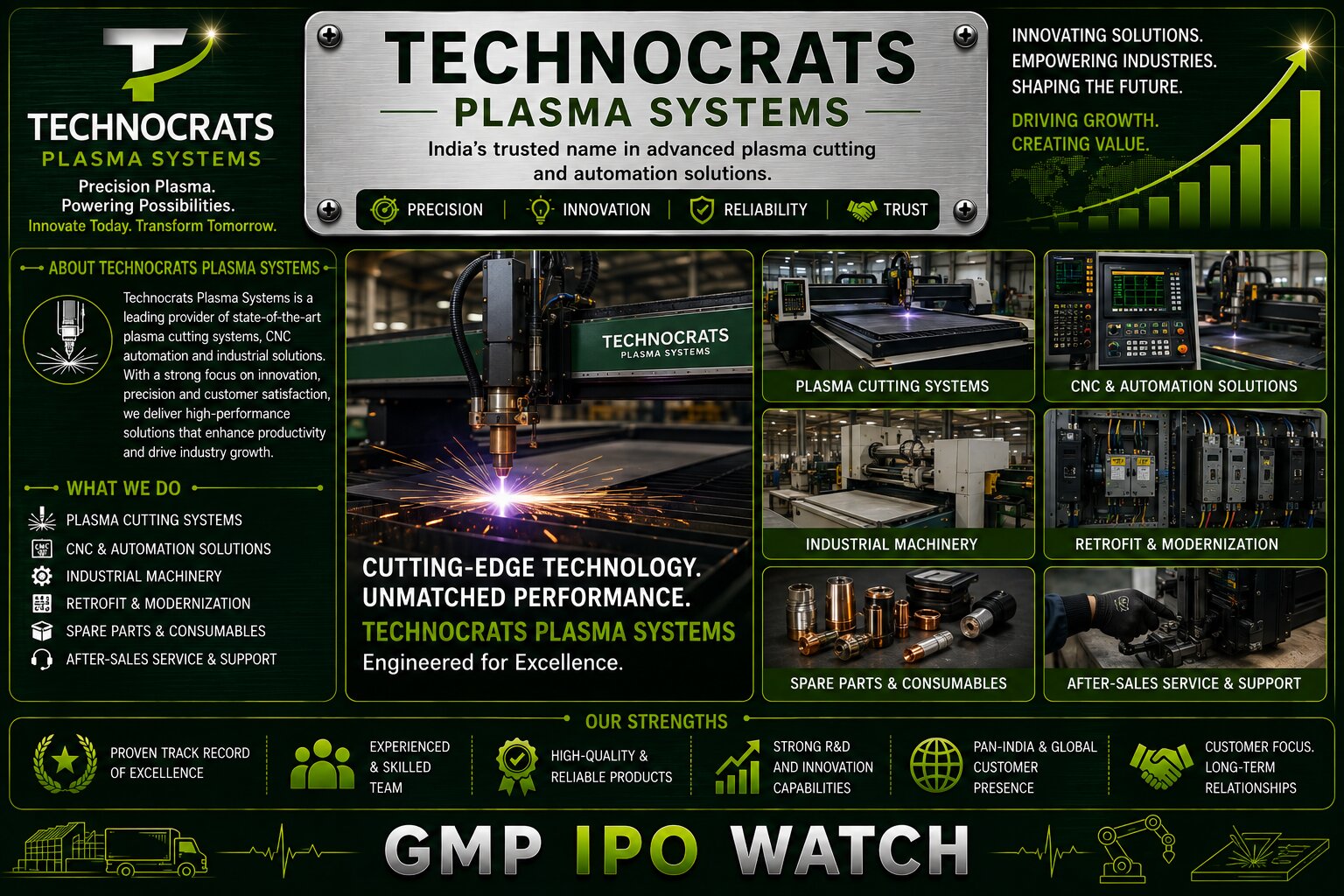
Technocrats has been operating in plasma cutting, plasma welding and industrial automation since 1990. Its current product portfolio spans plasma and gas-profile cutting systems, welding solutions, H-beam fabrication systems, CNC drilling, laser systems and customised automation.
The bigger investment question is therefore not simply whether Indian manufacturers need more cutting machines.
It is:
Can Technocrats use IPO capital to execute larger orders, expand automation revenue and maintain its current profitability as the business scales?
Technocrats Plasma Systems IPO Details
| Particular | Details |
|---|---|
| Company | Technocrats Plasma Systems Limited |
| IPO Type | Book Built SME IPO |
| Listing Platform | BSE SME |
| Total Issue Size | Approx. ₹60.98 Crore |
| Fresh Issue | Approx. ₹57.93 Crore |
| Price Band | ₹125 – ₹132 Per Share |
| Face Value | ₹10 Per Share |
| Total Shares Offered | 46.20 Lakh |
| Market Maker Reservation | 2.31 Lakh Shares |
| Minimum Bid | 2,000 Shares |
| Minimum Retail Investment | ₹2,64,000 at ₹132 |
| IPO Opening Date | August 14, 2026 |
| IPO Closing Date | August 18, 2026 |
| Tentative Allotment | August 19, 2026 |
| Tentative Listing | August 21, 2026 |
| Registrar | Maashitla Securities Pvt. Ltd. |
| Lead Manager | Rarever Financial Advisors Pvt. Ltd. |
The net public offer is about 43.89 lakh shares after the market-maker reservation. Of that, roughly 49.92% is allocated to QIBs, 15.04% to NIIs and 35.04% to retail investors.
What Does Technocrats Plasma Systems Actually Do?
Technocrats is an engineering-led industrial machinery manufacturer.
Its own product catalogue includes:
- CNC plasma and gas-profile cutting machines
- Manual plasma cutting machines
- CNC pipe-profile cutting systems
- Plasma welding systems
- Arc welding equipment
- H-beam fabrication systems
- CNC drilling systems
- Laser cutting and welding systems
- Robotic cutting and welding solutions
- Customised automation
- Retrofit and lifecycle-support services.
This puts the company inside the broader metal-fabrication and industrial automation ecosystem.
Its customers need technology that can improve:
cutting speed + dimensional accuracy + welding consistency + factory productivity.
Standalone Machines and Automation Have Different Economics
Not every Technocrats product carries the same commercial value.
A basic standalone plasma machine can generate a relatively straightforward equipment sale.
A customised automation system can involve:
- Mechanical engineering
- Electrical integration
- Controls
- Programming
- Customer-specific design
- Installation
- Commissioning
The second type of project may create a deeper relationship and a larger contract value.
That means Technocrats can potentially grow through better product mix, not only through higher unit volumes.
Why Automation Is the More Interesting Long-Term Segment
Consider a metal fabricator currently using manual or semi-automatic processes.
It may face:
- Variable product quality
- Higher labour dependence
- Slow throughput
- Material wastage
- Rework
Automation can improve those economics.
A customer might therefore justify purchasing a more expensive system if it lowers manufacturing cost per component over several years.
This gives Technocrats an opportunity to sell based on customer productivity, not just machine price.
That can support stronger pricing power than purely commoditised equipment.
The Installed Base Can Create Repeat Business
Industrial machinery can generate revenue long after the original sale.
Once a customer operates a Technocrats system, it may later need:
- Spare parts
- Consumables
- Preventive maintenance
- Repairs
- Retrofit work
- Additional automation
- New machines
InvestorGain identifies the company's operating verticals as machines without automation, machines with automation, customisation and retrofit, and services.
That creates an important strategic opportunity.
Every machine installed today may become a future service or upgrade customer.
Retrofit Can Be a Particularly Attractive Business
Factories do not always need to replace complete production lines.
Sometimes existing equipment can be modernised.
A retrofit may add:
- CNC control
- Automation
- Updated electrical systems
- Better cutting technology
For customers, this can cost less than purchasing an entirely new system.
For Technocrats, it provides another way to monetise the existing installed base.
This can become valuable during periods when companies are cautious about major greenfield capex but still want productivity improvements.
FY2026 Revenue Accelerated Sharply
Current prospectus-based financial reporting shows Technocrats at a very different scale from FY2025.
| Financial Year | Revenue | EBITDA | PAT |
|---|---|---|---|
| FY2024 | ₹6.06 Cr | ₹1.29 Cr | ₹2.20 Cr |
| FY2025 | ₹49.35 Cr | ₹8.59 Cr | ₹8.10 Cr |
| FY2026* | ₹131.30 Cr | ₹26.29 Cr | ₹14.94 Cr |
*FY2026 figures are presented on an annualised basis in the cited IPO analysis.
Revenue increased by approximately 166% between FY2025 and the FY2026 annualised basis, while PAT rose roughly 84%.
That acceleration is one of the strongest features of the IPO.
Revenue Grew Faster Than PAT
This detail deserves attention.
Revenue increased dramatically.
Profit also increased, but at a slower rate.
That suggests the company may have been taking on:
- Larger orders
- Different product mix
- Greater working-capital requirements
- Higher operating expenses
Investors should therefore avoid assuming the FY2025 PAT margin can be maintained automatically at much larger scale.
The better question is whether absolute profit can keep compounding while margins normalise at sustainable levels.
EBITDA Margin Improved to About 20%
The latest financial data reports an FY2026 annualised EBITDA margin of approximately 20.02%, compared with 17.41% in FY2025.
That is an encouraging sign.
A growing industrial machinery company can struggle to preserve profitability when:
- Hiring employees
- Increasing production
- Expanding working capital
- Taking larger projects
Technocrats' reported operating margin indicates the company has so far maintained meaningful value addition.
PAT Margin Is Around 11.38%
The annualised FY2026 PAT margin is approximately 11.38%.
That is lower than the unusually high FY2025 margin but still healthy for a small engineering manufacturer.
The decline reinforces the importance of separating:
one-time high-margin periods
from:
normalised scalable margins.
A stable 10–12% PAT margin on a much larger revenue base could ultimately be more valuable than a 16% margin on a much smaller business.
Debt-to-Equity Has Improved Substantially
Technocrats' debt-to-equity ratio improved from approximately:
- 2.71× in FY2023
- 1.79× in FY2024
- 0.72× in FY2025
- 0.38× in FY2026 annualised.
This is a significant positive.
The business has scaled while leverage has become more manageable.
A stronger balance sheet can help the company:
- Accept larger orders
- Manage working-capital cycles
- Invest in machinery
- Handle temporary project delays
without becoming excessively dependent on borrowing.
The IPO Is Really a Working-Capital Fundraise
The most interesting use of proceeds is not manufacturing capex.
It is ₹40 crore of long-term working capital.
The company also plans approximately ₹8.79 crore for purchase and installation of plant and machinery for manufacturing plasma cutting machines, welding equipment and customised automation systems.
That means working capital is several times larger than the identified machinery investment.
This tells investors something important about the business model.
Growth may currently be constrained more by the ability to finance customer orders than by factory equipment alone.
Why ₹40 Crore of Working Capital Matters
Imagine Technocrats wins three large automation orders.
Each order requires:
- Materials
- Electronics
- Fabrication
- Engineers
- Testing
before final collection.
Even profitable projects can create a temporary cash gap.
Additional working capital lets the company accept more orders simultaneously rather than waiting for one project to finish before beginning another.
The potential growth cycle becomes:
more working capital → more concurrent projects → higher revenue → better scale.
But Working-Capital Growth Can Also Create Risk
More working capital is useful only if customers eventually pay.
The danger would be:
higher sales → higher receivables → slower collections → cash-flow pressure.
For that reason, investors should pay attention after listing to:
- Receivable days
- Inventory days
- Customer advances
- Operating cash flow
A rapidly growing engineering company can appear profitable on paper while cash remains locked in projects.
Customer Payment Milestones Matter
Custom-engineered machinery is often easier to finance when customers pay in stages.
A favourable structure could look like:
order advance → manufacturing milestone → dispatch payment → commissioning balance.
The more cash Technocrats receives early in the project cycle, the less external working capital it needs.
If customers instead demand long credit periods, growth becomes much more capital intensive.
This is a key area investors should understand from future disclosures.
FY2026 ROCE Is Strong
The latest annualised ROCE is around 48.55%, while ROE is around 38.30%.
These are attractive headline returns.
But the IPO will add substantial fresh capital.
That means the post-listing test is harder.
Technocrats now needs to demonstrate that the new equity can generate similarly productive returns.
Fresh Capital Can Temporarily Reduce ROE
Suppose a company earns ₹15 crore PAT on a relatively small equity base.
ROE can look very high.
If it suddenly adds nearly ₹58 crore of fresh equity but PAT remains ₹15 crore, return on equity falls.
That is not automatically bad.
The new money needs time to be deployed.
What matters is whether earnings subsequently rise enough to justify the expanded capital base.
Post-IPO ROCE May Be the Most Important KPI
For Technocrats, investors should ask:
How much additional EBIT can ₹48.79 crore of specifically identified net-proceeds deployment eventually generate?
If the answer is substantial, the IPO can create real value.
If revenue grows but capital employed rises even faster, return ratios can deteriorate.
This is why ROCE matters more than headline sales growth after listing.
Valuation Is Higher Than a Simple EPS Calculation Suggests
Current IPOPlatform analysis places the post-issue market capitalisation at roughly ₹231 crore, with:
- P/E: 16.26×
- EV/EBITDA: 9.33×
- P/B: 2.31×.
These figures use the relevant post-IPO share structure and therefore provide a more useful reference than simply dividing ₹132 by an EPS figure without adjusting for dilution.
The valuation does not appear extreme relative to several listed engineering peers, but Technocrats is also much smaller and deserves a risk discount for SME-scale execution and liquidity.
Peer Multiples Are Much Higher—but Comparisons Need Care
Current prospectus peer data includes:
- Jyoti CNC Automation: P/E around 58.51×
- Patil Automation: around 23.21×
- ESAB India: around 41.88×
- Ador Welding: around 31.55×.
Technocrats' stated P/E of about 16.26× is lower.
However, that does not automatically mean the IPO is cheap.
Larger listed companies may have:
- More diversified customers
- Deeper management teams
- Better liquidity
- Larger installed bases
- Longer public track records
A small SME deserves to be valued with those differences in mind.
India’s Manufacturing Automation Cycle Is a Structural Tailwind
Technocrats operates in an industry that can benefit from ongoing manufacturing modernisation.
Factories increasingly need:
- Higher precision
- Lower rejection
- Faster production
- Automated workflows
- Better export quality
This supports demand for industrial cutting, welding and automation systems.
The company's own product range now extends beyond traditional plasma systems into laser systems, H-beam fabrication, CNC drilling and robotic cutting and welding solutions.
That provides multiple avenues for future growth.
Laser Systems Broaden the Addressable Market
Technocrats' portfolio includes both plasma and laser cutting/welding solutions.
This matters because different manufacturing jobs require different technologies.
Laser systems may be preferred for applications demanding:
- High precision
- Fine edges
- Thin materials
Plasma can be highly effective for thicker conductive metals and heavy fabrication.
Offering multiple technologies allows Technocrats to solve more customer problems rather than depending on one cutting method.
H-Beam Fabrication Expands Into Infrastructure Manufacturing
The company also offers H-beam fabrication systems.
H-beams are widely used in:
- Industrial buildings
- Warehouses
- Infrastructure
- Heavy structures
Automation in H-beam fabrication can help structural steel manufacturers improve productivity.
This gives Technocrats exposure to infrastructure and industrial construction in addition to general engineering.
CNC Drilling Adds Another Complementary Product
CNC drilling systems extend the company's portfolio further into fabrication automation.
A customer that already needs automated cutting may also require:
- Drilling
- Welding
- Structural fabrication
The broader the product portfolio becomes, the more Technocrats can potentially increase revenue per industrial customer.
Cross-Selling Could Be a Major Growth Lever
The ideal sales relationship looks like this:
A customer first purchases a plasma cutting system.
Later it buys:
- Welding automation
- CNC drilling
- H-beam equipment
- Laser systems
- Retrofit services
This can increase customer lifetime value dramatically.
Technocrats therefore has two routes to growth:
- Acquire more customers.
- Sell more solutions to existing customers.
The second can often be more efficient because trust and service relationships already exist.
Nationwide Support Can Help Customer Retention
Technocrats describes itself as providing nationwide support alongside its cutting, welding and automation solutions.
That can be important in industrial machinery.
A manufacturer buying a machine is also buying confidence that someone can repair it when needed.
Fast after-sales support can influence:
- Repeat purchases
- Referrals
- Customer retention
This service capability becomes more valuable as the installed base grows.
Downtime Is Expensive for Customers
Imagine a fabrication company depends on one CNC cutting system.
If it stops operating for several days, the customer may face:
- Production delays
- Missed deliveries
- Labour idle time
- Revenue loss
A machinery supplier capable of solving problems quickly can therefore create substantial customer value.
This gives service quality strategic importance beyond the direct revenue it generates.
R&D Needs to Continue
Technocrats has a long history in plasma cutting and welding, dating back to 1990.
But industrial technology continues changing.
The company must keep improving:
- Automation
- Controls
- Precision
- Software
- Energy efficiency
- Laser integration
Past expertise does not guarantee future competitiveness.
The business needs continuous engineering investment.
Imported Equipment Remains a Competitive Threat
Industrial buyers can choose domestic or international machinery suppliers.
Overseas competitors may offer:
- Global brands
- Advanced technologies
- Larger installed bases
Technocrats' potential advantages include:
- Local support
- Faster customisation
- Lower logistics cost
- India-specific engineering
The company needs to maintain the right balance between affordability and technical performance.
Customised Engineering Can Protect Pricing
Standard equipment is easier for customers to compare.
Customised systems are harder to commoditise.
A customer may need automation built specifically around:
- Factory layout
- Component dimensions
- Production sequence
- Existing machinery
That reduces direct price comparison.
If Technocrats increases custom automation revenue, it may maintain stronger margins than through pure standard-machine volume.
Day-1 IPO Subscription
As of the latest August 14 morning update, the IPO was subscribed around:
0.23× overall.
Because this is only the opening day and the issue remains open through August 18, the current figure has limited predictive value.
SME issues can see substantial bidding closer to the final day.
Investors should therefore focus more on the eventual category-wise closing subscription.
Technocrats Plasma Systems IPO GMP Today
The latest reported GMP on August 14 is approximately:
₹24 per share.
Against the ₹132 upper band, this represents roughly:
18.18% premium
and an unofficial indicated price near:
₹156.
Recent GMP readings have moved from:
- ₹29 on August 11
- ₹12 on August 12
- ₹22 on August 13
- ₹24 on August 14.
That volatility is a reminder that GMP is an unofficial sentiment measure rather than a reliable valuation tool.
Current GMP Is Positive, but Fundamentals Matter More
A ₹24 GMP does not improve Technocrats' factory output.
It does not reduce receivables.
It does not increase ROCE.
For long-term investors, more important variables include:
- Order growth
- Working-capital turnover
- EBITDA margin
- Cash conversion
- Automation revenue
GMP is useful mainly for understanding short-term demand expectations.
Competitive Strengths
Technocrats Plasma Systems enters the IPO with several meaningful strengths:
- Operating history dating to 1990
- Broad plasma, welding, laser and automation portfolio
- Strong FY2026 annualised revenue growth
- Approximately 20% EBITDA margin
- Improving debt-to-equity ratio
- High reported ROCE
- Significant working-capital funding for expansion
- Lifecycle services and retrofit opportunity
- Positive opening-day GMP.
Major Risks Investors Should Understand
Rapid Growth Sustainability
Revenue increased from ₹49.35 crore in FY2025 to an annualised ₹131.30 crore FY2026 level.
That pace may be difficult to repeat.
Working-Capital Intensity
₹40 crore of IPO proceeds is earmarked for working capital, highlighting how important cash availability is to the model.
Customer Concentration
Large customised orders can make annual revenue dependent on relatively few projects.
Project Execution
Automation work can face engineering, installation and commissioning delays.
Technology Competition
Domestic and international machinery suppliers continue evolving.
Margin Normalisation
PAT margin has already changed meaningfully as revenue scaled.
SME Liquidity
BSE SME stocks can have lower liquidity and higher volatility than established mainboard shares.
What Could Drive the Next Growth Phase?
Working-Capital Expansion
Allows the company to execute more projects simultaneously.
Automation Revenue
Higher-value automated systems can increase revenue per order.
Retrofit Business
Provides monetisation of older installed machinery.
Laser Systems
Broaden the addressable market beyond plasma.
H-Beam and CNC Solutions
Provide exposure to broader fabrication demand.
Manufacturing Localisation
Can support demand for domestically manufactured machinery.
Services and Spares
Can create more recurring revenue from the installed base.
What Investors Should Track After Listing
Order Book and New Orders
Is demand keeping pace with additional working capital?
Receivable Days
Are customers paying within reasonable periods?
Operating Cash Flow
Is rapid revenue growth translating into cash?
EBITDA Margin
Can Technocrats maintain around 20%?
Automation Mix
Is customised automation becoming a larger revenue contributor?
ROCE
Does the larger post-IPO capital base continue generating strong returns?
Service Revenue
Is the installed machine base producing recurring aftermarket income?
The Most Important Post-IPO Equation
Technocrats is not raising most of its money merely to build a bigger factory.
It is raising capital primarily to finance growth already requiring more working capital.
That creates the ideal cycle:
₹40 crore working capital → more simultaneous projects → higher revenue → stronger installed base → repeat service and automation sales → higher cash generation.
But there is also a weaker outcome:
₹40 crore working capital → higher receivables → slow customer collections → weak cash conversion.
The difference will be visible in the company's operating cash flow and receivable cycle after listing.
Should Investors Consider Technocrats Plasma Systems IPO?
The positive case includes:
- Specialised industrial technology
- Strong recent growth
- Healthy EBITDA margin
- Improving leverage
- High reported capital efficiency
- Entirely growth-oriented fresh capital
- Automation and retrofit opportunity
- Positive GMP
The caution points include:
- Small-company execution risk
- High dependence on working capital
- Need to sustain FY2026 growth
- Project concentration
- SME-market liquidity
- Technology competition
Technocrats should therefore be analysed as a specialised industrial automation and capital-goods SME, rather than simply as a plasma-machine manufacturer.
Final View on Technocrats Plasma Systems IPO 2026
The Technocrats Plasma Systems IPO 2026 opened today, August 14, at a price band of ₹125–₹132 per share, with listing planned on BSE SME on August 21. The current opening-day subscription is around 0.23×, while reported GMP is approximately ₹24, implying about an 18% unofficial premium.
The more compelling part of the story is the company's operational growth.
Technocrats' latest annualised FY2026 financials show approximately ₹131.30 crore revenue, ₹26.29 crore EBITDA and ₹14.94 crore PAT, versus ₹49.35 crore revenue and ₹8.10 crore PAT in FY2025.
The balance sheet has also improved, with debt-to-equity falling to roughly 0.38× on the FY2026 annualised basis.
Most importantly, the IPO gives investors a clear picture of what is currently constraining growth.
Technocrats intends to deploy around ₹40 crore toward long-term working capital and another ₹8.79 crore toward plant and machinery.
That means management is effectively betting that the company has enough market opportunity and project demand to put significantly more capital to work.
The long-term investment thesis can therefore be summarised as:
strong engineering capability + more working capital + broader automation portfolio + installed-base monetisation = potential scale and earnings growth.
The main risk is that rapid revenue expansion may require increasingly large amounts of cash.
For long-term investors, the critical post-listing evidence will therefore be operating cash flow, receivable days, automation revenue mix, EBITDA margin and post-IPO ROCE.
Overall, Technocrats Plasma Systems represents a fast-growing industrial automation SME with specialised technology, improving leverage and healthy current operating margins. The ₹40 crore working-capital deployment could unlock a larger project pipeline, but the quality of that growth will depend on whether the company converts additional orders into cash rather than merely larger receivables.






Loading comments...