

Acme India Industries IPO Subscription Update
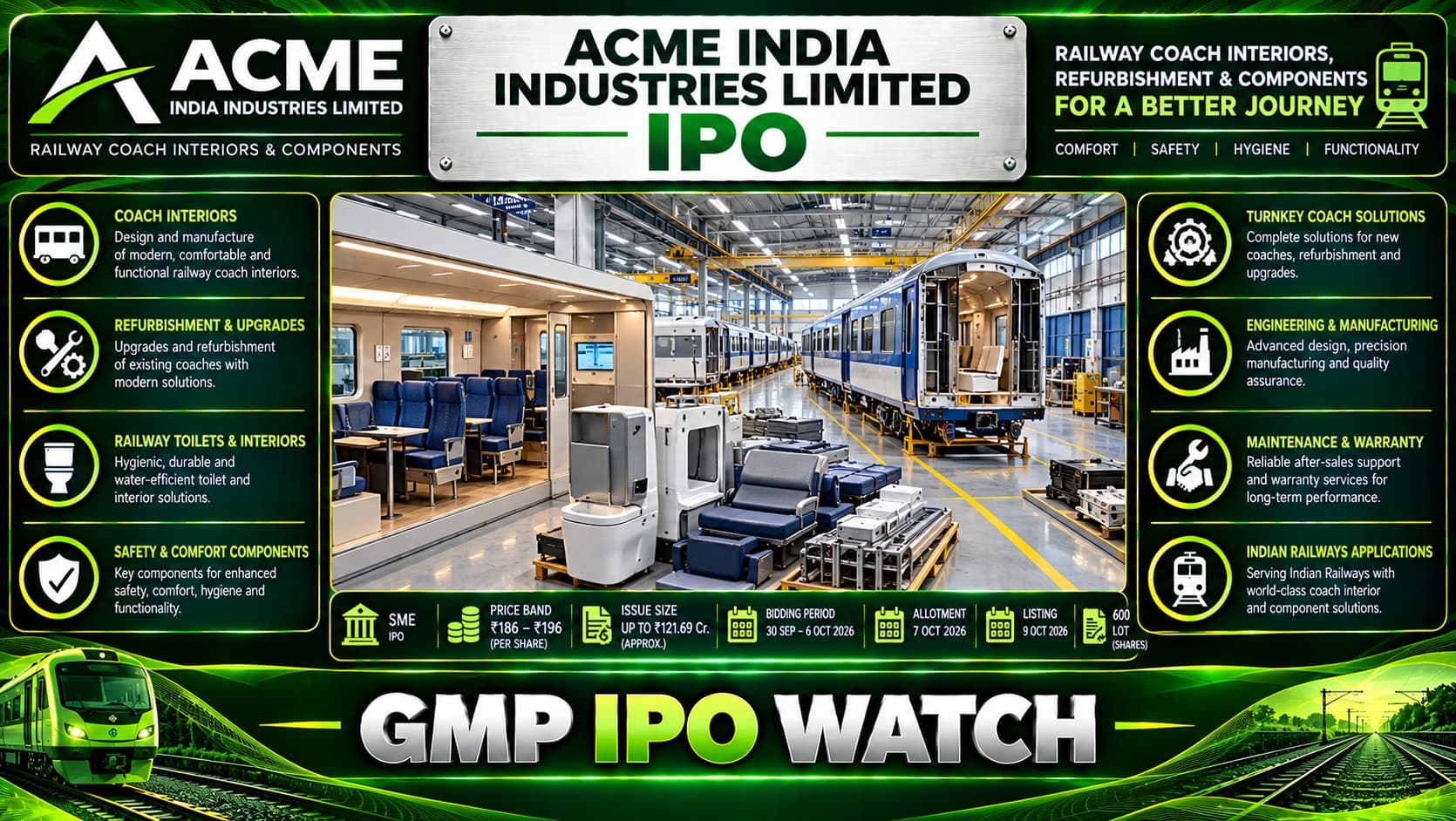
Acme India Industries IPO continued its subscription on October 2, 2026, with the issue receiving steady demand from institutional investors. The IPO opened on September 30 and will remain open until October 6.
The company has fixed the price band at ₹186 to ₹196 per share and is raising approximately ₹121.69 crore through a combination of a fresh issue and an offer for sale. The shares are proposed to be listed on the BSE SME platform on October 9, 2026.
Acme India Industries IPO Details
| Particular | Details |
|---|---|
| IPO Open Date | September 30, 2026 |
| IPO Close Date | October 6, 2026 |
| Price Band | ₹186 – ₹196 |
| Issue Size | ₹121.69 Cr |
| Fresh Issue | ₹105.98 Cr |
| Offer for Sale | ₹15.71 Cr |
| Face Value | ₹10 |
| Lot Size | 600 Shares |
| Retail Minimum | 1,200 Shares |
| Retail Investment | ₹2,35,200 |
| Allotment | October 7, 2026 |
| Refund/Demat | October 8, 2026 |
| Listing Date | October 9, 2026 |
| Listing Platform | BSE SME |
| Registrar | Bigshare Services |
| Lead Manager | Hem Securities |
The IPO comprises around 54.07 lakh fresh shares and approximately 8.02 lakh shares through the offer for sale. Retail investors need to bid for a minimum of two lots, or 1,200 shares, at the upper price band.
Acme India Industries IPO GMP Today
The latest available grey market data on October 2 indicates a GMP of around ₹25 per share. Against the upper price band of ₹196, this represents an unofficial premium of approximately 12.76%.
Based on the current GMP, the indicative price would be around ₹221 per share. The grey market premium has eased from around ₹30 in the days around the IPO opening to ₹25 currently. GMP is unofficial and can change before listing.
| Particular | Latest Update |
|---|---|
| Upper IPO Price | ₹196 |
| Current GMP | ₹25 |
| Indicative Price | ₹221 |
| GMP Percentage | ~12.76% |
| GMP Trend | Lower than ₹30 |
Acme India Industries IPO Subscription Status
By October 2, the IPO had received an overall subscription of around 2.05 times. The QIB category remained the strongest with 5.70 times subscription, while retail participation stood at 0.48 times.
| Investor Category | Subscription |
|---|---|
| QIB | 5.70x |
| NII – bHNI | 0.39x |
| NII – sHNI | 1.07x |
| Retail | 0.48x |
| Overall | 2.05x |
The subscription pattern shows a significant difference between institutional and retail participation, with QIB bids accounting for a large part of the demand recorded so far.
What Does Acme India Industries Do?
Acme India Industries operates in the Indian railway rolling stock sector, focusing on the design, manufacturing, installation and maintenance of railway coach interiors and related components.
Its services include turnkey furnishing of new railway coaches, refurbishment and upgrading of existing coaches, and modernization of toilet facilities. The company also manufactures and supplies components used in railway projects.
As of June 30, 2026, the company had completed 1,610 turnkey coaches, refurbished 1,888 coaches and carried out 10,948 toilet upgrades. It operates across all 16 railway zones through three production units and two mid-life rehabilitation units.
Large Railway Order Book
Acme India Industries reported an order book of approximately ₹737.97 crore as of June 30, 2026. The order book includes railway coach furnishing, toilet upgrades and other infrastructure-related work, providing visibility for future revenue.
The company has also worked on projects involving Vande Bharat coaches and has tie-ups for specialised railway products.
Acme India Industries Financial Performance
The company reported strong growth in FY2026. Revenue from operations increased to ₹263.71 crore, compared with ₹210 crore in FY2025, while profit after tax rose to ₹24.36 crore from ₹16.46 crore.
| Particular | FY2024 | FY2025 | FY2026 |
|---|---|---|---|
| Revenue from Operations | ₹213.43 Cr | ₹210.00 Cr | ₹263.71 Cr |
| Total Revenue | ₹215.02 Cr | ₹213.45 Cr | ₹267.89 Cr |
| PBT | ₹25.94 Cr | ₹24.14 Cr | ₹33.22 Cr |
| PAT | ₹19.21 Cr | ₹16.46 Cr | ₹24.36 Cr |
However, the company's operating cash flow was negative at around ₹11.50 crore in FY2026, while its working-capital requirements increased significantly. This makes working-capital management an important area to monitor after the IPO.
Where Will Acme India Industries IPO Funds Be Used?
The fresh issue proceeds are planned for working capital, repayment or prepayment of borrowings, capital expenditure and general corporate purposes.
| Particular | Amount |
|---|---|
| Working Capital | ₹38.00 Cr |
| Debt Repayment / Prepayment | ₹41.00 Cr |
| Plant & Machinery | ₹6.27 Cr |
| General Corporate Purposes | Balance Amount |
The proposed machinery investment includes additional equipment to support the company's manufacturing and project capabilities. The debt repayment component is also significant, with borrowings of around ₹85.18 crore reported as of March 2026.
Key Factors to Track
Acme India Industries' IPO story is closely linked to railway infrastructure spending and its ability to execute its existing order book. The company has a substantial order book and has expanded its railway-related product and service offerings.
At the same time, the company has considerable dependence on Indian Railways, which accounted for a significant share of revenue, while working-capital requirements, negative operating cash flow and contingent liabilities remain important factors to monitor.
Acme India Industries IPO Timeline
The IPO opened on September 30 and will close on October 6, 2026. The basis of allotment is expected on October 7, refunds and demat credit are scheduled for October 8, and the shares are expected to list on October 9.
With the IPO currently subscribed around 2.05 times and the GMP at approximately ₹25, the final subscription response and grey-market movement during the remaining bidding period will be the next important updates.
Note: GMP is an unofficial market indicator and can change at any time. It should not be treated as a guaranteed listing price. Investors should also consider the company's financials, order book, debt, working-capital requirements, valuation and risk factors.

Loading comments...