

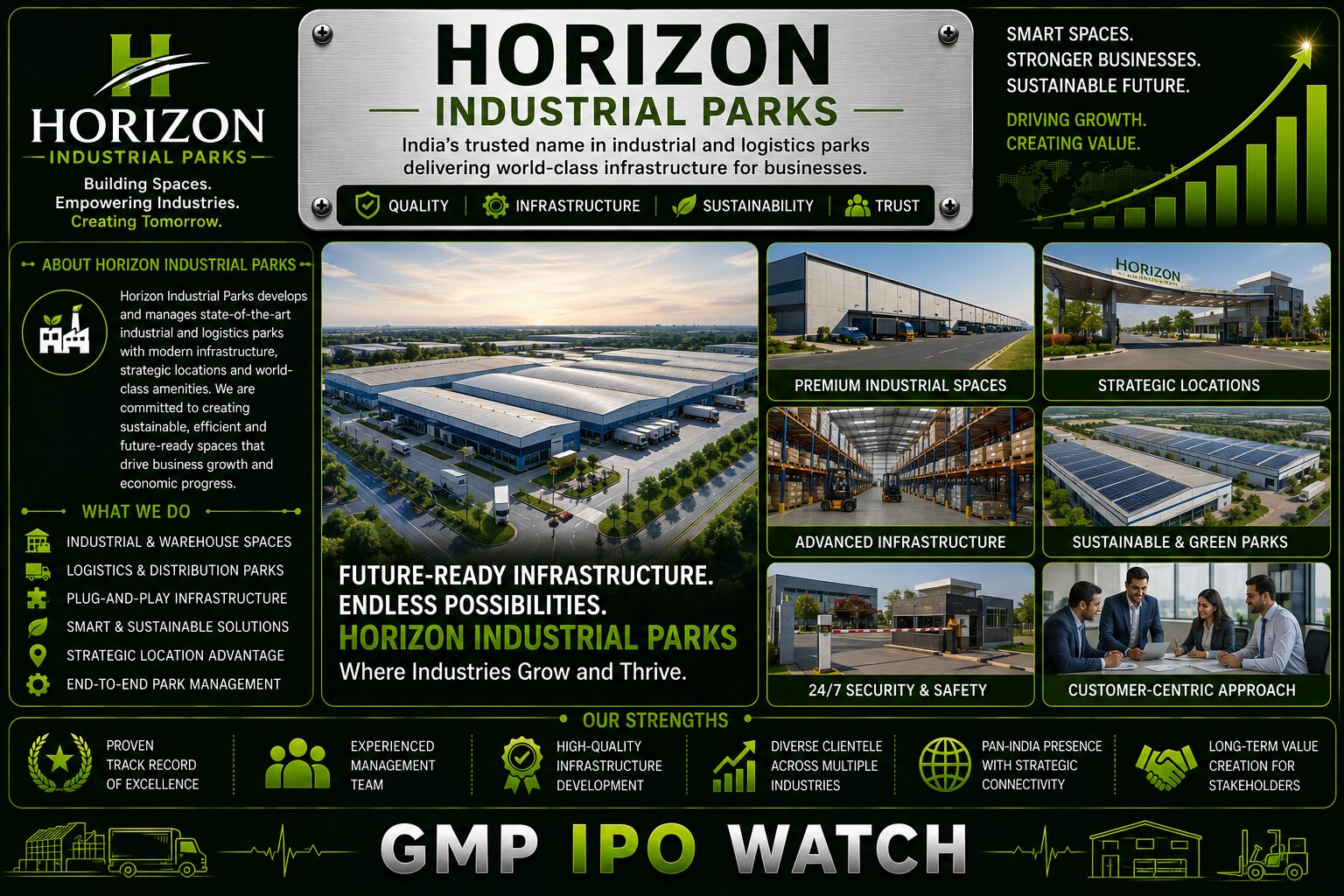
Horizon Industrial Parks Limited is preparing to open its Initial Public Offering for public subscription on August 17, 2026, bringing one of India's largest industrial and logistics infrastructure platforms to the mainboard market.
The IPO will remain open for bidding until August 19, 2026, while the anchor investor portion is scheduled to open on August 14.
The company has fixed a price band of ₹57 to ₹60 per equity share, with a face value of ₹10 per share.
At the upper end of the price band, Horizon Industrial Parks aims to raise approximately ₹2,600 crore.
The public offering is significant because it consists entirely of a fresh issue of equity shares.
There is no Offer for Sale component.
This means the IPO is primarily being used to bring new capital into the company and strengthen its financial position rather than providing an exit to existing shareholders.
Horizon Industrial Parks IPO Opens August 17
Public subscription begins on Monday, August 17, 2026.
The issue closes on:
August 19, 2026
The basis of allotment is expected to be finalised on:
August 20, 2026
Refunds and credit of shares are expected on:
August 21, 2026
The company's shares are proposed to list on both the:
BSE
and
NSE
on August 24, 2026.
The listing would make Horizon Industrial Parks one of the few publicly traded companies in India focused specifically on institutional-grade industrial and logistics infrastructure.
Price Band Fixed at ₹57–₹60
Horizon Industrial Parks has fixed the IPO price band between ₹57 and ₹60 per share.
The minimum lot size is 250 shares.
At the upper price band of ₹60, the minimum retail investment works out to:
₹15,000
Investors can apply in multiples of 250 shares thereafter.
The comparatively affordable retail application size makes the mainboard issue accessible to a broad investor base.
₹2,600 Crore Entirely Fresh Issue
The IPO consists entirely of new shares aggregating up to approximately ₹2,600 crore.
There is no Offer for Sale.
This structure is important because the company itself will receive the capital raised through the issue.
The funds will mainly be used to reduce outstanding debt and improve the company's balance sheet.
A stronger financial position could support Horizon Industrial Parks as it enters its next phase of expansion across India's industrial and warehousing markets.
₹2,250 Crore Planned for Debt Repayment
The largest portion of the IPO proceeds—approximately ₹2,250 crore—is planned for the repayment or prepayment of certain borrowings of the company and its subsidiaries.
Debt reduction is therefore the central objective of the IPO.
As of March 31, 2026, Horizon Industrial Parks had total borrowings of approximately ₹6,884.34 crore.
This is a substantial level of leverage.
Using IPO proceeds to repay part of the debt could reduce finance costs and improve cash flows over time.
It could also provide the company with greater flexibility for future development projects.
Debt Is a Key Investment Consideration
Industrial and logistics real estate is a capital-intensive business.
Developing large warehouses and industrial parks requires significant expenditure on land, construction and infrastructure.
Companies in this sector therefore often rely heavily on debt.
High borrowing levels can increase financial risk, especially during periods of higher interest rates.
For Horizon Industrial Parks, reducing leverage is one of the most important potential benefits of the IPO.
Investors will likely monitor how much the company's interest burden falls after the funds are deployed.
Blackstone-Backed Business
Horizon Industrial Parks is backed by global alternative asset manager Blackstone.
Blackstone currently holds approximately 89% of the company before the IPO.
The global investment firm has built a significant presence across Indian office, retail and logistics real estate over the years.
Its involvement provides Horizon Industrial Parks with access to institutional real-estate expertise, capital and international operating experience.
The IPO also represents another important public-market transaction for Blackstone's Indian real-estate portfolio.
Pre-IPO Fundraise of ₹1,650 Crore
Before the public issue, Horizon Industrial Parks completed a major ₹1,650 crore pre-IPO primary fundraise.
The round attracted institutional and high-net-worth investors.
This capital was raised before filing the final public issue.
The combination of the pre-IPO fundraise and the ₹2,600 crore IPO significantly strengthens the company's capital base.
The additional funds can support debt reduction and prepare Horizon Industrial Parks for further expansion.
What Does Horizon Industrial Parks Do?
Horizon Industrial Parks develops, owns and operates Grade-A industrial and logistics infrastructure.
Its portfolio includes:
- Warehouses
- Fulfilment centres
- Industrial facilities
- In-city logistics centres
- Built-to-suit facilities
- Plug-and-play industrial spaces
- Cold-storage solutions
- Energy infrastructure
- Material-handling infrastructure
- Staff accommodation and support services
The company leases these facilities to businesses across multiple sectors.
Its customers typically require large, professionally managed spaces close to manufacturing hubs, highways and major consumption markets.
Large Pan-India Logistics Network
Horizon Industrial Parks has built one of India's largest institutional logistics and industrial real-estate networks.
The company has approximately 45 directly owned or controlled assets across 10 cities, spanning around 58.58 million square feet.
Including its stake in an additional facility, the total network expands to approximately:
46 assets
covering about:
61.13 million square feet
This scale gives Horizon a significant presence across India's institutional warehousing market.
28.55 Million Sq Ft Operational
Not all of the company's total network has been fully developed yet.
As of May 31, 2026, Horizon Industrial Parks had an operational network of approximately:
28.55 million square feet
This represents the portion already available for customer occupancy and revenue generation.
The remaining portfolio includes assets under development or future development opportunities.
As more projects become operational, Horizon could potentially increase rental income and portfolio scale.
Committed Occupancy Above 93%
One of the important operating metrics for warehouse and logistics real-estate companies is occupancy.
Horizon Industrial Parks reported committed occupancy of approximately 93.56% across its operational portfolio as of May 31, 2026.
A high occupancy rate indicates strong tenant demand for existing facilities.
High occupancy also improves the revenue-generating efficiency of completed assets.
However, the company will need to maintain similar occupancy levels as it adds millions of square feet of new supply.
61 Million Sq Ft Portfolio Shows Scale
The company's existing and future network gives it significant operating scale.
A large portfolio can create multiple advantages.
Large customers may prefer logistics providers capable of supporting operations across several cities.
A national network can also help Horizon build relationships with major e-commerce, retail and manufacturing companies.
Scale may additionally improve procurement, development and property-management efficiency.
However, managing a large multi-city portfolio also increases operational complexity.
Presence Across Major Industrial Markets
Horizon Industrial Parks operates across major Indian logistics and industrial locations.
Its portfolio is concentrated around key manufacturing, consumption and transportation hubs.
These locations are strategically important because modern logistics companies increasingly need warehouses close to both factories and consumers.
Shorter delivery distances can reduce transportation costs and improve delivery speed.
This has become particularly important with the growth of e-commerce and quick commerce.
E-Commerce Is a Major Demand Driver
India's e-commerce industry continues to expand rapidly.
Online retailers require large fulfilment centres to store products and process orders.
These facilities need strong transport connectivity, large floor plates and modern warehousing infrastructure.
Institutional-grade logistics parks are therefore becoming increasingly important.
Horizon Industrial Parks provides infrastructure specifically designed for these operations.
Continued e-commerce growth could support long-term demand for the company's facilities.
Quick Commerce Creates New Logistics Requirements
Quick commerce has added another layer of demand.
Consumers increasingly expect grocery and everyday products to be delivered within minutes or hours.
This requires distribution infrastructure located closer to urban customers.
Traditional large warehouses located far from cities are not sufficient for every part of this model.
Horizon also operates in-city logistics centres, providing exposure to this rapidly evolving segment.
The growing importance of urban fulfilment could become a meaningful opportunity for the company.
Manufacturing Expansion Supports Industrial Parks
India is also investing heavily in domestic manufacturing.
Government initiatives promoting electronics, automobiles, renewable energy, defence and industrial production are encouraging companies to establish and expand factories.
These manufacturers need industrial buildings and nearby logistics infrastructure.
Horizon Industrial Parks provides facilities that can support manufacturing operations as well as warehousing.
This gives the company exposure to both logistics demand and industrial expansion.
Built-to-Suit Facilities Add Differentiation
One of Horizon's important offerings is built-to-suit infrastructure.
Instead of providing only standard warehouses, the company can develop facilities designed specifically for individual customers.
Large companies may require customised floor layouts, power infrastructure, loading systems or production configurations.
A built-to-suit model allows Horizon to address these requirements.
Customised assets can potentially lead to longer tenant relationships because the facilities are specifically designed around customer operations.
Plug-and-Play Infrastructure
The company also offers fully fitted plug-and-play facilities.
These allow tenants to begin operations faster without making large upfront investments in infrastructure.
For expanding manufacturers and logistics companies, speed can be important.
Reducing the time between lease signing and operational launch can improve customer convenience.
Plug-and-play offerings could therefore help Horizon differentiate itself from traditional warehouse landlords.
Cold Storage Provides Additional Opportunity
Cold-chain logistics is another potential growth segment.
Food, pharmaceuticals and other temperature-sensitive products require specialised warehousing.
Cold-storage infrastructure generally carries higher technical requirements than traditional warehouses.
As organised food distribution and healthcare logistics expand, demand for modern cold-storage facilities could increase.
Horizon includes cold-storage solutions among its infrastructure offerings.
This provides another avenue for product diversification.
Renewable Energy and Energy Solutions
Industrial tenants increasingly focus on energy efficiency and sustainability.
Large warehouses and factories consume substantial amounts of electricity.
Horizon Industrial Parks provides energy-related infrastructure as part of its broader service offering.
Solar power and other renewable-energy solutions can help tenants lower operating costs and meet environmental targets.
Green infrastructure may become increasingly important when competing for multinational customers with strict sustainability requirements.
Customers Across Multiple Industries
The company's tenant base spans several industries.
These include:
- E-commerce
- Retail
- FMCG
- Renewable energy
- Automotive components
- Manufacturing
- Third-party logistics
- Consumer businesses
A diversified customer base reduces dependence on any single industry.
For example, slower growth in e-commerce could potentially be offset by stronger demand from manufacturing or automotive companies.
Maintaining this diversification will remain important as the company expands.
Long-Term Leasing Model
Horizon primarily generates revenue by leasing its industrial and logistics facilities to customers.
Lease agreements can extend over multiple years.
Longer leases can provide better revenue visibility compared with businesses dependent on short-term transactions.
They may also help stabilise cash flows.
However, the company's performance can still be affected by rent negotiations, lease expiries, occupancy levels and tenant financial health.
Horizon 2.0 Growth Strategy
Management has described the company's next phase as Horizon 2.0.
The strategy focuses on expanding both geographically and across different infrastructure products.
Management has indicated plans to:
- Increase presence in existing cities
- Enter additional Tier-2 markets
- Broaden the customer base
- Expand product offerings
- Explore inorganic acquisitions
- Grow market share
The IPO is expected to give the company a stronger balance sheet to pursue this strategy.
Tier-2 Cities Are a Major Expansion Target
Horizon Industrial Parks has identified several Tier-2 cities as potential future markets.
Management has discussed opportunities in locations such as:
- Lucknow
- Visakhapatnam
- Coimbatore
- Indore
- Aurangabad
These markets are seeing increasing manufacturing activity and consumption growth.
As supply chains become more distributed across India, logistics facilities outside the largest metropolitan cities may become increasingly important.
Entering these markets early could provide Horizon with opportunities to secure strategically located land.
Eastern India Could Become Another Growth Market
The company has also indicated interest in expanding into eastern India, where its current presence remains limited.
The region has major industrial centres, ports and growing consumer markets.
Expansion into eastern India could further diversify Horizon's geographic portfolio.
However, entering new markets requires careful land selection and demand assessment.
Industrial real-estate projects can take years to develop, so poor location decisions can affect returns for long periods.
33 Million Sq Ft Development Pipeline
Horizon Industrial Parks has a substantial development pipeline of roughly 33 million square feet.
This pipeline represents one of the company's biggest long-term growth opportunities.
As projects move from planning and construction into operational status, the revenue-generating portfolio can expand significantly.
The challenge will be ensuring that demand grows alongside new supply.
Maintaining high occupancy across a much larger portfolio will be critical.
Industrial Warehousing Is Becoming More Institutional
India's warehousing industry was historically fragmented.
Many facilities were operated by smaller local owners and often lacked modern infrastructure.
This is changing.
Large corporations increasingly demand Grade-A warehouses with:
- Better safety standards
- Large loading areas
- Higher ceilings
- Modern fire systems
- Digital infrastructure
- Sustainability features
- Reliable property management
Institutional investors have therefore entered the sector aggressively.
Horizon Industrial Parks is positioned directly within this shift.
Supply-Chain Diversification Supports Demand
Global companies are increasingly diversifying supply chains.
Recent disruptions have highlighted the risks of relying too heavily on one manufacturing region.
India has become an important alternative destination for global production.
As multinational companies increase manufacturing and sourcing from India, they require industrial and logistics infrastructure.
This nearshoring and supply-chain diversification trend could support demand for Horizon's facilities over the long term.
National Logistics Policy Provides Supportive Backdrop
Government policy is also supporting improvements in India's logistics infrastructure.
The National Logistics Policy aims to improve supply-chain efficiency and reduce logistics costs.
Investments in highways, freight corridors and multimodal transportation infrastructure can make industrial and logistics parks more valuable.
Better connectivity reduces transportation time and increases the number of locations that can support large distribution operations.
FY2025 Revenue Crossed ₹600 Crore
Horizon Industrial Parks reported FY2025 revenue from operations of approximately ₹608.20 crore.
This represented growth of more than 34% compared with the previous financial year.
FY2024 revenue from operations stood at approximately:
₹452.97 crore
The increase demonstrates significant growth in the company's operating portfolio and leasing activity.
Revenue could continue to expand as additional assets become operational.
EBITDA Reaches ₹501.7 Crore in FY2025
The company's FY2025 EBITDA was approximately ₹501.7 crore.
This compares with around:
₹326 crore in FY2024
The increase reflects expansion of the income-generating portfolio.
Real-estate leasing businesses often report relatively high EBITDA margins because a large portion of rental income flows through after property-level operating expenses.
However, interest and depreciation costs remain substantial.
Company Remains Loss-Making
Despite strong revenue and EBITDA, Horizon Industrial Parks has historically reported net losses.
For FY2025, the company's net loss was approximately:
₹233 crore
compared with around:
₹254.54 crore in FY2024.
One major reason is the high financing burden associated with its debt-heavy expansion model.
This explains why debt repayment is such a significant part of the IPO strategy.
Reducing borrowing costs could potentially improve bottom-line profitability over time.
High Debt Is the Biggest Financial Risk
Horizon Industrial Parks had total borrowings of approximately ₹6,884.34 crore as of March 31, 2026.
This remains one of the most important investment risks.
Although ₹2,250 crore from the IPO is planned for debt repayment, the company will still remain a capital-intensive real-estate platform.
Future expansion may require additional financing.
Investors should therefore monitor leverage, interest costs and operating cash flows after listing.
Interest Rates Can Affect Profitability
High debt makes the company sensitive to interest rates.
When borrowing costs rise, finance expenses increase.
This can reduce net profitability even if rental income remains strong.
The planned debt repayment should help reduce this risk.
However, interest-rate movements will continue to matter because logistics real estate requires ongoing capital investment.
Development Risk Needs Attention
Horizon has a large development pipeline.
Development creates growth potential but also carries risks.
Projects may face:
- Construction delays
- Cost overruns
- Regulatory approvals
- Land-title issues
- Infrastructure delays
- Slower tenant leasing
- Changes in local demand
If projects take longer than expected to become operational, returns can be delayed.
Execution discipline will therefore be critical.
Occupancy Must Remain High
The company's current committed occupancy of more than 93% is encouraging.
However, occupancy needs to remain high as the portfolio expands.
Adding millions of square feet of new supply creates leasing risk.
If tenants are not secured quickly, completed buildings may remain vacant while still generating maintenance and financing costs.
Investors may therefore closely track occupancy across newly commissioned parks.
Customer Concentration Is Another Consideration
Large logistics parks often depend on a smaller number of major tenants.
Major e-commerce and manufacturing clients can occupy substantial areas.
Large customers provide stable rental income but can also create concentration risk.
If a major tenant vacates or reduces space, occupancy can fall quickly.
Horizon will need to maintain a diversified tenant base across multiple sectors and regions.
Real Estate Is Cyclical
Industrial and logistics real estate benefits from structural growth, but it remains sensitive to economic cycles.
A slowdown in manufacturing, retail or e-commerce can reduce demand for warehouse space.
Companies may delay expansions during weaker economic periods.
Land and construction costs can also fluctuate.
Investors should therefore evaluate Horizon as a long-term infrastructure and real-estate business rather than purely as a short-term IPO opportunity.
Latest GMP Remains Around ₹0
As of August 13, 2026, current IPO trackers indicate that the Horizon Industrial Parks IPO does not yet have a meaningful Grey Market Premium, with GMP around ₹0 or not actively quoted.
This is not unusual several days before the public issue opens.
Grey-market activity can develop closer to the subscription period.
Investors should also remember that GMP is unofficial and unregulated.
It should not be treated as a guarantee of listing performance.
Anchor Bidding Opens Tomorrow
The next major IPO event is scheduled for August 14, 2026.
That is when anchor investors will be allocated shares ahead of the public issue.
Institutional participation in the anchor book will be closely monitored.
Strong participation could provide an early signal of institutional demand.
However, the broader subscription picture will only become clear once public bidding begins on August 17.
Public Subscription Begins Monday
Retail, NII and QIB bidding officially begins on August 17.
The company has reserved:
Up to 75% of the offer for Qualified Institutional Buyers
At least 15% for Non-Institutional Investors
and
At least 10% for retail investors
This allocation differs from many conventional IPOs that reserve 35% for retail investors.
Institutional demand will therefore play a particularly important role in the final subscription numbers.
What Investors May Watch After Listing
After the IPO, several metrics will be important for assessing Horizon Industrial Parks' progress:
- Debt reduction
- Interest costs
- Occupancy levels
- Rental income
- New asset commissioning
- Leasing of development pipeline
- Cash flow from operations
- New city expansion
- Customer diversification
- Development costs
- Debt-to-equity ratio
- Portfolio size
Improvement in leverage while maintaining strong portfolio growth would be particularly important.
Horizon Industrial Parks IPO in Focus Ahead of Opening
The Horizon Industrial Parks IPO is scheduled to open on August 17, 2026, with a ₹57–₹60 price band, a 250-share lot size and a total issue size of approximately ₹2,600 crore.
The IPO is entirely a fresh issue, with approximately ₹2,250 crore earmarked for debt repayment.
The Blackstone-backed company operates one of India's largest institutional industrial and logistics real-estate networks, with 46 assets covering approximately 61.13 million square feet and operational space of roughly 28.55 million square feet.
Its committed occupancy of approximately 93.56% indicates healthy demand across the existing operational portfolio.
The company also has a substantial development pipeline and plans to expand into additional Tier-2 cities and new regional markets.
Long-term demand drivers include e-commerce, manufacturing expansion, quick commerce, supply-chain diversification and increasing institutionalisation of India's warehouse sector.
However, the company's high debt, historical net losses, development risk and capital-intensive business model remain important considerations.
With anchor bidding beginning August 14, the next key development will be institutional participation ahead of the public subscription opening on August 17.
The latest unofficial GMP remains around ₹0, meaning investors are currently likely to focus more on fundamentals, leverage reduction and long-term warehouse-sector growth than on immediate listing expectations.
The issue closes on August 19, allotment is expected on August 20, and Horizon Industrial Parks shares are tentatively scheduled to list on the BSE and NSE on August 24, 2026.

Loading comments...