

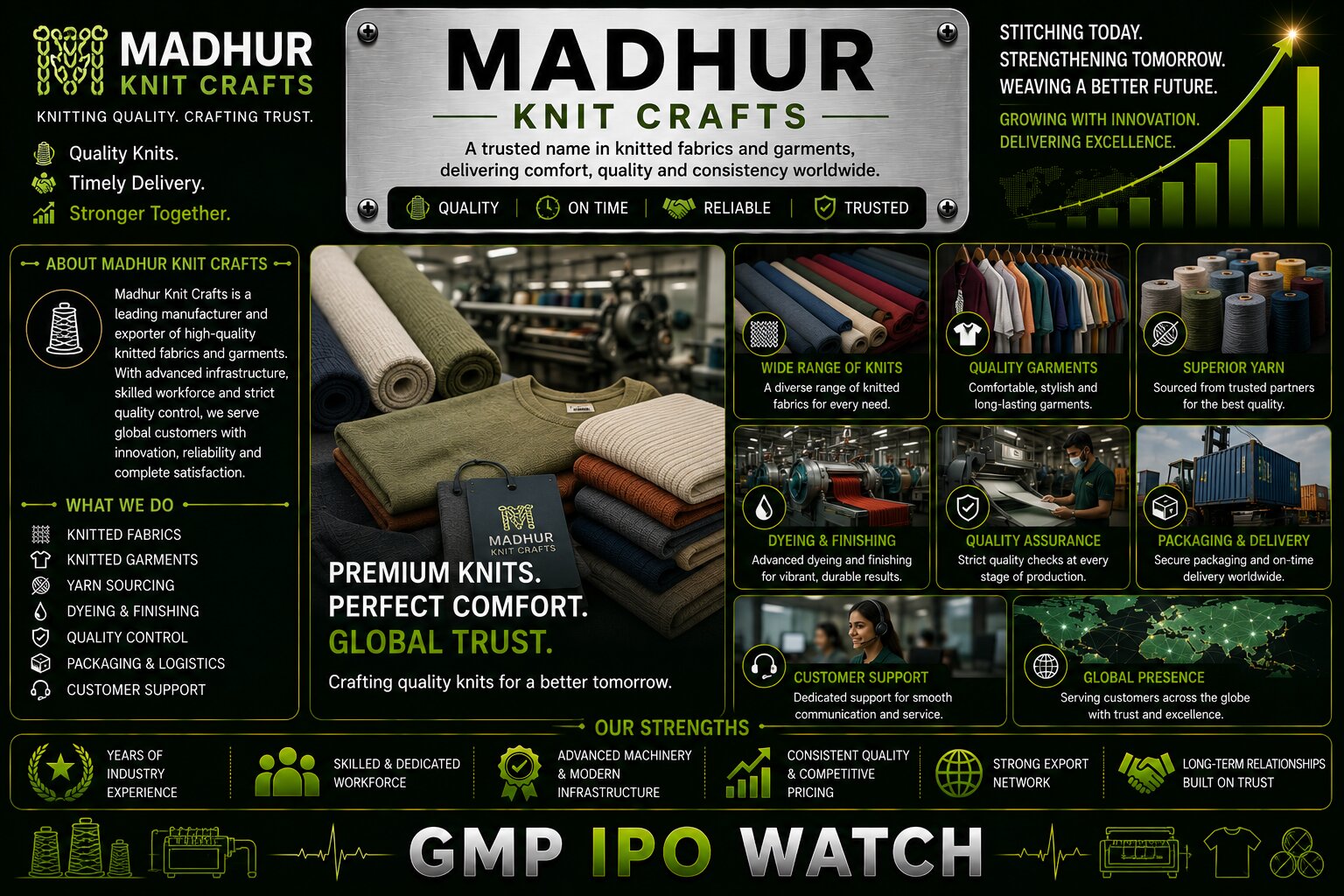
Madhur Knit Crafts IPO 2026 – Issue Remains Open for Subscription
Madhur Knit Crafts Limited's IPO is currently open for subscription after bidding began on August 24, 2026. The issue will close on August 27, with the company's shares expected to list on the NSE SME platform on September 1.
The company operates in the textile manufacturing industry from Ludhiana, Punjab. Unlike many IPOs that include an Offer for Sale, Madhur Knit Crafts is raising the entire amount through fresh equity, meaning the capital is intended to go into the business.
Madhur Knit Crafts IPO Details
| Particular | Details |
|---|---|
| Company | Madhur Knit Crafts Limited |
| IPO Type | SME IPO |
| Listing Platform | NSE SME / NSE Emerge |
| Issue Type | Book Built Issue |
| Issue Size | ₹53.27 Crore |
| Fresh Issue | ₹53.27 Crore |
| Offer for Sale | Nil |
| Shares Offered | 53,26,800 Shares |
| Price Band | ₹95 – ₹100 |
| Face Value | ₹10 |
| Lot Size | 1,200 Shares |
| Retail Minimum Application | 2,400 Shares |
| Minimum Investment at ₹100 | ₹2,40,000 |
| IPO Open Date | August 24, 2026 |
| IPO Close Date | August 27, 2026 |
| Allotment Date | August 28, 2026 |
| Refund / Share Credit | August 31, 2026 |
| Expected Listing | September 1, 2026 |
The 53,26,800-share issue size reflects the corrected IPO particulars, including a market-maker reservation of 2,66,400 shares. Some IPO portals continue to display the earlier ₹27 crore/27 lakh-share figures, so investors should be careful when comparing older data.
What Does Madhur Knit Crafts Do?
Madhur Knit Crafts is a Ludhiana-based textile manufacturer established in 1997.
Its operations include the production of textile products such as:
knitted fabrics + blankets + winter-related textile products + garments + job-work services.
The company operates in one of India's major textile manufacturing clusters, giving it access to suppliers, skilled labour and an established textile ecosystem.
Its business broadly follows:
raw material → knitting/manufacturing → processing → finished textile products → customer sales.
Production Capacity Has Expanded
Madhur Knit Crafts has already invested in expanding its manufacturing capabilities.
According to current IPO information, installed capacity increased from approximately 37.50 lakh kg per annum in FY2024 to 75 lakh kg per annum in FY2025.
This represents a significant capacity increase.
The important question now is whether the company can keep that expanded manufacturing infrastructure sufficiently utilised.
Higher capacity becomes valuable when it produces:
more orders → higher production → stronger sales → better fixed-cost absorption.
FY2026 Total Income Reached ₹194.79 Crore
The company's latest restated financials show substantial growth compared with FY2024.
| Particular | FY2024 | FY2025 | Feb. 2026 |
|---|---|---|---|
| Total Income | ₹108.41 Cr | ₹171.76 Cr | ₹194.79 Cr |
| EBITDA | ₹8.04 Cr | ₹23.28 Cr | ₹25.67 Cr |
| PAT | ₹1.70 Cr | ₹11.03 Cr | ₹12.35 Cr |
| Net Worth | ₹16.24 Cr | ₹29.49 Cr | ₹43.61 Cr |
| Borrowings | ₹57.79 Cr | ₹67.20 Cr | ₹73.54 Cr |
| Total Assets | ₹90.60 Cr | ₹122.59 Cr | ₹159.97 Cr |
The improvement from FY2024 is notable.
Total income rose from ₹108.41 crore to ₹194.79 crore, while PAT increased from only ₹1.70 crore to ₹12.35 crore in the latest reported period.
Profitability Has Improved Significantly
The earnings trend is arguably more interesting than the revenue growth.
PAT moved from:
₹1.70 crore → ₹11.03 crore → ₹12.35 crore.
EBITDA increased from ₹8.04 crore in FY2024 to ₹25.67 crore for the latest reported period.
Current IPO data places the company's EBITDA margin at approximately 13.19% and PAT margin at 6.34%.
The key question for investors is whether this stronger profitability can be maintained after listing.
Debt Has Also Increased
While revenue and profits have improved, borrowings have moved higher.
| Period | Borrowings |
|---|---|
| FY2024 | ₹57.79 Cr |
| FY2025 | ₹67.20 Cr |
| Feb. 2026 | ₹73.54 Cr |
This makes debt reduction one of the more important aspects of the IPO.
The company plans to use approximately ₹20.85 crore from the proceeds for repayment or prepayment of borrowings.
If completed as planned, the repayment could reduce finance costs and strengthen the balance sheet.
How Madhur Knit Crafts Plans to Use IPO Money
The IPO proceeds have three major identified uses.
| Object of the Issue | Amount |
|---|---|
| Debt Repayment / Prepayment | ₹20.85 Cr |
| Working Capital | ₹15.92 Cr |
| Solar Panel Capex | ₹3.68 Cr |
| Total Identified Uses | ₹40.44 Cr |
| Remaining Amount | General Corporate / Issue Purposes |
This gives the IPO a mix of deleveraging, operational funding and energy-related capex.
Debt Repayment Is the Largest Identified Use
At approximately ₹20.85 crore, debt repayment represents the largest specified use of IPO proceeds.
The potential benefit is straightforward:
IPO proceeds → lower borrowings → reduced finance costs → stronger cash generation → improved balance sheet.
Given the company's latest reported borrowings of ₹73.54 crore, investors should monitor how much debt actually declines after the IPO.
₹15.92 Crore Will Strengthen Working Capital
Textile manufacturing can be working-capital intensive.
A manufacturer needs funds for:
raw materials + inventory + labour + processing + customer credit + transportation.
Cash may therefore remain tied up for a considerable period between purchasing raw materials and collecting payment from customers.
Madhur Knit Crafts plans to allocate ₹15.92 crore toward working-capital requirements.
This funding could help support higher production volumes without relying entirely on additional short-term borrowings.
Solar Investment Could Lower Energy Dependence
Another interesting IPO objective is approximately ₹3.68 crore of capex for solar panels.
Energy is an important cost for textile manufacturing because machinery can operate for extended periods.
The investment logic is:
solar installation → captive renewable power → lower grid-power dependence → potential energy-cost savings.
The actual benefit will depend on generation, utilisation and the company's overall electricity requirements.
Madhur Knit Crafts IPO Valuation
At the upper issue price of ₹100, current IPO data provides the following valuation indicators:
| KPI | Value |
|---|---|
| Market Capitalisation | ₹187.37 Cr |
| EPS | ₹8.23 |
| P/E Ratio | 12.15× |
| ROE | 28.33% |
| ROCE | 31.11% |
| RoNW | 28.33% |
| Debt / Equity | 1.69 |
| EBITDA Margin | 13.19% |
| PAT Margin | 6.34% |
| NAV | ₹32.47 |
| Price / Book Value | 3.08× |
The debt-to-equity ratio of 1.69 stands out. It reinforces why debt repayment is an important part of the IPO strategy.
At the same time, reported ROE and ROCE are relatively strong at 28.33% and 31.11%, respectively.
Textile Manufacturing Provides a Large Addressable Market
Madhur Knit Crafts operates in an established but highly competitive industry.
Demand for textile products is supported by:
domestic apparel consumption + winter wear + home textiles + garment manufacturing + exports + institutional buyers.
Ludhiana itself is an important textile and hosiery manufacturing hub, which can provide access to an established supplier and labour ecosystem.
However, textile manufacturers also face significant competition on price, quality and delivery timelines.
Raw-Material Prices Can Affect Margins
Textile profitability can be sensitive to fluctuations in yarn and other raw-material prices.
If raw-material costs increase rapidly but the company cannot immediately pass the increase to customers, margins can come under pressure.
The operating equation can quickly become:
higher input costs + fixed selling price → lower gross margin.
Procurement efficiency and pricing power will therefore remain important after listing.
Capacity Utilisation Will Be Important
Madhur Knit Crafts has already expanded its installed capacity significantly.
The next challenge is utilisation.
A larger manufacturing plant with low utilisation can carry:
higher depreciation + labour costs + maintenance + electricity costs
without producing enough additional revenue.
Investors should therefore track production volumes alongside revenue rather than focusing only on installed capacity.
100% Fresh Issue Is Worth Noting
The corrected ₹53.27 crore IPO is entirely a fresh issue.
| Component | Amount |
|---|---|
| Fresh Issue | ₹53.27 Cr |
| Offer for Sale | Nil |
| Total IPO | ₹53.27 Cr |
This means there is no promoter or existing-shareholder exit through an OFS.
The capital raised is intended to strengthen and expand the company itself.
Promoters Retain Majority Ownership
The promoters of Madhur Knit Crafts include Arun Gupta, Piyush Gupta and Chirag Gupta.
Current IPO data indicates promoter ownership will remain substantial after the issue.
| Shareholding | Stake |
|---|---|
| Pre-Issue Promoter Holding | 100%* |
| Post-Issue Promoter Holding | 71.57% |
*Based on the latest IPO shareholding data cited by the tracker following the pre-IPO allotment structure.
Promoters will therefore continue to retain clear control of the company after listing.
Key Strengths of Madhur Knit Crafts
The company's strongest point is its recent financial improvement. Total income increased from ₹108.41 crore in FY2024 to ₹194.79 crore in the latest reported period, while PAT increased from ₹1.70 crore to ₹12.35 crore.
The IPO also has clearly defined uses. Around ₹20.85 crore is earmarked for debt repayment, ₹15.92 crore for working capital and ₹3.68 crore for solar-panel capex.
Its other strengths include an established operating history, expanded manufacturing capacity and location in Ludhiana's textile ecosystem.
Major Risks
The biggest areas investors should watch are borrowings, raw-material price volatility, working-capital requirements and the sustainability of recent profit growth.
Debt has increased from ₹57.79 crore in FY2024 to ₹73.54 crore in the latest period, although part of the IPO proceeds will be used to reduce it.
Other risks include textile-sector competition, capacity underutilisation, customer concentration, fluctuations in demand and the lower liquidity generally associated with SME-listed shares.
What Investors Should Track After Listing
| Metric | Why It Matters |
|---|---|
| Revenue Growth | Demand momentum |
| Production Volume | Manufacturing growth |
| Capacity Utilisation | Efficiency of expanded capacity |
| EBITDA Margin | Operating profitability |
| PAT Margin | Earnings sustainability |
| Borrowings | IPO deleveraging |
| Finance Costs | Benefit from debt repayment |
| Working Capital | Cash efficiency |
| Receivable Days | Collection cycle |
| Raw-Material Costs | Margin pressure |
| Solar Power Generation | Capex benefit |
| Operating Cash Flow | Quality of earnings |
For Madhur Knit Crafts, the combination of debt reduction and operating cash flow may be particularly important during the first few reporting periods after listing.
Final View on Madhur Knit Crafts IPO
The Madhur Knit Crafts IPO is currently open and will close on August 27, 2026. Based on the corrected issue particulars, the company is raising approximately ₹53.27 crore through 53,26,800 fresh shares at a price band of ₹95–₹100. The shares are expected to list on NSE SME on September 1.
The business has shown a considerable financial improvement, with total income reaching ₹194.79 crore and PAT ₹12.35 crore in the latest reported period. However, borrowings have also increased to ₹73.54 crore.
That makes the IPO's fund deployment particularly relevant. Around ₹20.85 crore is planned for debt repayment, ₹15.92 crore for working capital and ₹3.68 crore for solar-panel investment.





Loading comments...