

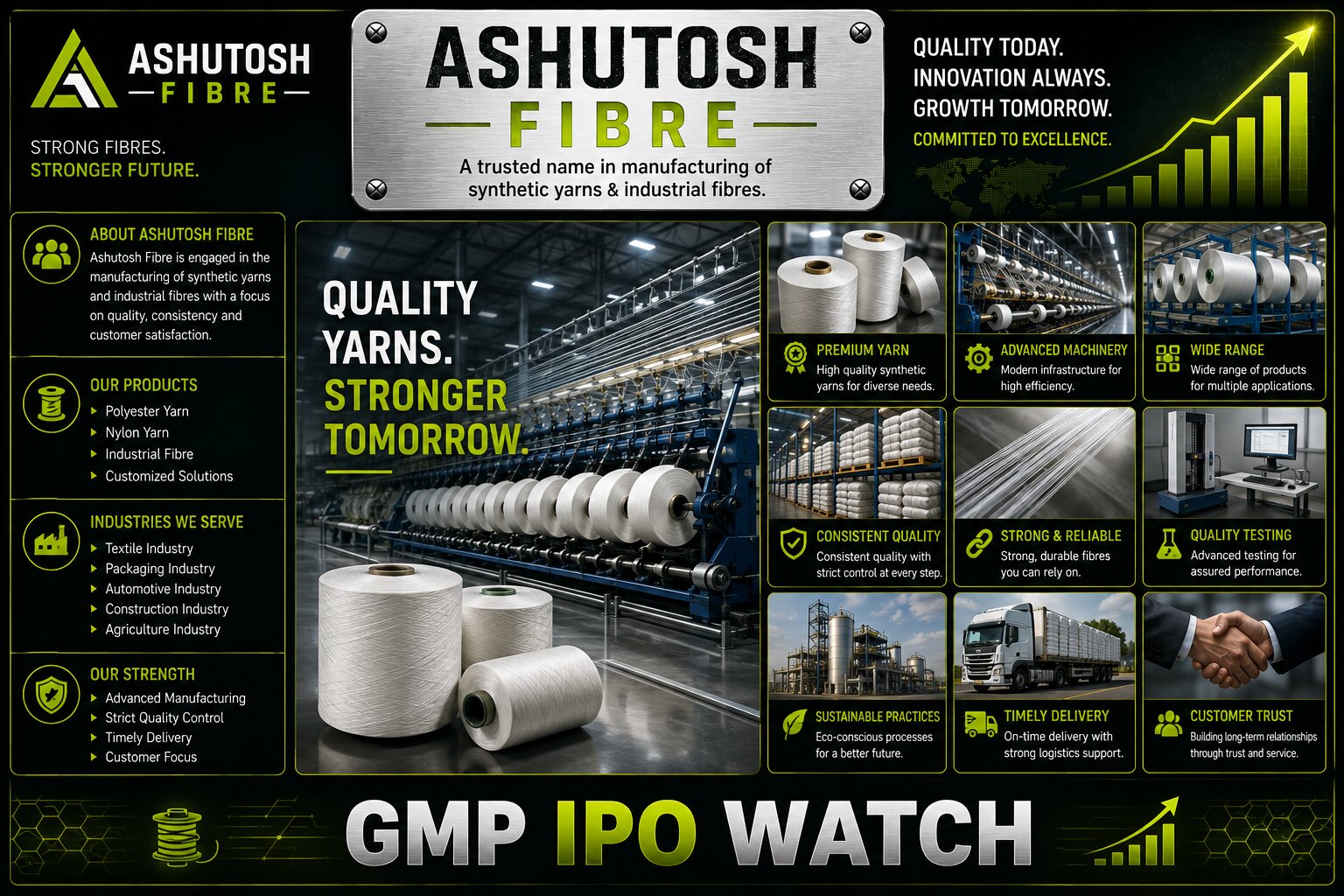
Ashutosh Fibre IPO 2026 – NSE SME Issue Opens Next Week
Ashutosh Fibre Limited is preparing to enter the primary market with its IPO opening on August 31, 2026.
The issue will remain open until September 2 and the shares are scheduled to list on the NSE SME platform on September 7. The company has fixed its IPO price band at ₹87 to ₹92 per share.
An important feature of this IPO is that it consists entirely of fresh equity. There is no Offer for Sale, meaning the funds raised are intended for the company's requirements rather than an exit by existing shareholders.
Ashutosh Fibre IPO Details
| Particular | Details |
|---|---|
| IPO Type | NSE SME IPO |
| Issue Type | Book Built Issue |
| Issue Size | ₹53.52 Crore |
| Fresh Issue | ₹53.52 Crore |
| Offer for Sale | Nil |
| Shares Offered | 58,17,600 |
| Price Band | ₹87 – ₹92 |
| Face Value | ₹10 |
| Market Lot | 1,200 Shares |
| Retail Minimum | 2,400 Shares |
| Minimum Investment | ₹2,20,800 |
| IPO Open Date | August 31, 2026 |
| IPO Close Date | September 2, 2026 |
| Expected Listing | September 7, 2026 |
| Listing Platform | NSE SME |
The IPO comprises 58,17,600 shares, and the minimum retail application is two lots or 2,400 shares, requiring ₹2,20,800 at the upper price band.
What Does Ashutosh Fibre Do?
Ashutosh Fibre Limited is an established textile-sector company whose corporate history dates back to 1985. Its registered office is in Ahmedabad, Gujarat.
The company operates in the fibre and textile-material segment, with a focus on recycled polyester staple fibre and related textile products.
Its business effectively connects:
recycled/raw materials → fibre processing → finished fibre products → textile & industrial customers.
The recycling angle is particularly relevant as textile manufacturers increasingly look for alternative raw materials and more sustainable production processes.
FY2026 PAT Nearly Doubled
Ashutosh Fibre's recent financial performance shows relatively modest revenue growth but a sharp improvement in profitability.
| Particular | FY2024 | FY2025 | FY2026 |
|---|---|---|---|
| Revenue | ₹109.89 Cr | ₹114.97 Cr | ₹117.43 Cr |
| EBITDA | ₹16.14 Cr | ₹17.84 Cr | ₹31.07 Cr |
| PAT | ₹7.05 Cr | ₹8.51 Cr | ₹16.04 Cr |
| Net Worth | ₹27.55 Cr | ₹35.85 Cr | ₹51.90 Cr |
| Borrowings | ₹34.86 Cr | ₹57.44 Cr | ₹47.92 Cr |
PAT increased from ₹8.51 crore in FY2025 to ₹16.04 crore in FY2026, an increase of roughly 88%. EBITDA also jumped from ₹17.84 crore to ₹31.07 crore.
This is considerably faster than revenue growth, making margin sustainability an important part of the IPO story.
Profitability Improved Sharply in FY2026
Current IPO financial data indicates an EBITDA margin of approximately 26.47% and PAT margin of around 13.67% for FY2026.
| KPI | Value |
|---|---|
| EPS | ₹10.19 |
| Pre-Issue P/E | 9.03× |
| Post-Issue P/E | 12.55× |
| RoNW | 30.91% |
| ROCE | 26.29% |
| Debt / Equity | 0.92 |
| EBITDA Margin | 26.47% |
| PAT Margin | 13.67% |
| NAV | ₹32.95 |
| Market Cap | ₹201.25 Cr |
At the upper issue price of ₹92, the pre-issue P/E works out to approximately 9.03 times, while the post-issue P/E is estimated at 12.55 times.
₹25.51 Crore Planned for New Machinery
Capacity expansion is one of the main reasons behind the IPO.
Ashutosh Fibre intends to allocate approximately ₹25.51 crore toward capital expenditure for new equipment and machinery.
Use of IPO Proceeds
| Purpose | Amount |
|---|---|
| New Equipment & Machinery | ₹25.51 Cr |
| Debt Repayment / Prepayment | ₹20.00 Cr |
| General Corporate Purposes | Balance |
| Total Issue | ₹53.52 Cr |
The machinery investment represents almost half of the overall IPO size.
The growth strategy can therefore be viewed as:
new machinery → higher/efficient production → larger sales opportunity → potential earnings growth.
The actual benefit will depend on how quickly the company can utilise the additional manufacturing capabilities.
₹20 Crore Will Be Used to Reduce Debt
Debt reduction is the second major IPO objective.
Ashutosh Fibre reported borrowings of ₹47.92 crore in FY2026, down from ₹57.44 crore in FY2025 but still considerably above the ₹34.86 crore reported in FY2024.
Using ₹20 crore from IPO proceeds toward repayment or prepayment could materially reduce leverage.
| Period | Borrowings |
|---|---|
| FY2024 | ₹34.86 Cr |
| FY2025 | ₹57.44 Cr |
| FY2026 | ₹47.92 Cr |
| IPO Debt Repayment Planned | ₹20.00 Cr |
If implemented as planned, lower debt could reduce interest expenses and provide greater financial flexibility for the expanded manufacturing business.
IPO Is Entirely a Fresh Issue
There is no OFS component in the Ashutosh Fibre IPO.
| IPO Component | Amount |
|---|---|
| Fresh Issue | ₹53.52 Cr |
| Offer for Sale | Nil |
| Total Issue | ₹53.52 Cr |
This means the capital raised through the public offering will strengthen Ashutosh Fibre itself.
For investors, this makes utilisation of IPO proceeds particularly important.
The company needs to demonstrate that the money spent on machinery and debt reduction generates better operating performance after listing.
Recycled Fibre Provides a Distinct Business Position
Recycled polyester fibres can be produced by processing recycled PET and other suitable polyester materials.
These fibres can then be used across textile and industrial applications.
The broader production cycle can involve:
recycled polyester material → cleaning & processing → fibre production → textile/industrial application.
This gives companies such as Ashutosh Fibre exposure to the broader trend toward recycled materials and resource efficiency.
However, sustainability positioning alone does not guarantee profitability. Product quality, raw-material availability, pricing and production efficiency remain equally important.
Raw-Material Costs Can Affect Margins
Fibre manufacturers operate in an industry where input costs can fluctuate.
Changes in prices and availability of raw materials can affect gross margins, especially if selling prices cannot be adjusted immediately.
The risk can be represented simply as:
input prices rise → selling-price adjustment lags → margins decline.
This becomes particularly important for Ashutosh Fibre because FY2026 showed a significant improvement in margins.
Investors will want to see whether those margins can remain near current levels through different raw-material cycles.
Capacity Expansion Needs Matching Demand
Installing additional equipment is only the first part of expansion.
The company must also generate enough orders to utilise the new capacity.
Otherwise:
new machinery + low utilisation = higher depreciation and fixed costs without sufficient additional revenue.
Therefore, after listing, investors should compare capex progress with revenue and production-volume growth.
A successful expansion would ideally produce:
higher production + higher sales + stable margins + stronger operating cash flow.
Revenue Growth Has Been Moderate
One point investors should not overlook is the difference between revenue and profit growth.
Revenue increased from:
₹109.89 crore in FY2024 → ₹114.97 crore in FY2025 → ₹117.43 crore in FY2026.
That represents fairly modest topline growth.
PAT, however, increased from ₹7.05 crore to ₹16.04 crore over the same period.
This means recent earnings growth has been driven significantly by improved profitability rather than rapid revenue expansion.
The IPO-funded machinery investment could therefore become important if management wants to create the next phase of growth through higher sales volumes.
Ashutosh Fibre IPO GMP Today
As of the latest available update, Ashutosh Fibre IPO GMP is ₹0.
| GMP Particular | Latest Update |
|---|---|
| Upper Issue Price | ₹92 |
| Current GMP | ₹0 |
| Indicative Listing Price | ₹92 |
| Indicative Premium | 0% |
| IPO Status | Upcoming |
The latest tracker update was recorded on August 25, ahead of the IPO's August 31 opening.
There is therefore currently no meaningful unofficial premium.
However, the IPO has not yet opened, and GMP can change once subscription activity begins. GMP is unofficial and should not be considered a guaranteed listing-price forecast.
Promoters Will Retain a Significant Stake
The company's promoters include Siddharth Prakash Patel, Abhishek Rajendrakumar Agarwal and Prabhas Fin-Stock Private Limited.
Current IPO data indicates that promoter holding will decline following the fresh issue.
| Shareholding | Stake |
|---|---|
| Promoter Holding Pre-Issue | 59.79% |
| Promoter Holding Post-Issue | 43.05% |
The dilution results from the issuance of fresh equity rather than an OFS by promoters.
SME Listing Brings Liquidity Risk
Ashutosh Fibre will list on NSE SME rather than the mainboard.
SME stocks can experience lower trading liquidity, wider bid-ask spreads and higher price volatility.
The retail minimum investment is also considerably larger than in most mainboard IPOs.
At the upper band:
2,400 shares × ₹92 = ₹2,20,800.
Investors should therefore consider both business fundamentals and SME-market liquidity before evaluating the issue.
Key Strengths of Ashutosh Fibre
Ashutosh Fibre enters the IPO with a long operating history and sharply improved recent profitability.
FY2026 PAT reached ₹16.04 crore compared with ₹8.51 crore in FY2025, while EBITDA increased to ₹31.07 crore. ROCE stood at approximately 26.29% and RoNW at 30.91%.
Another positive is the 100% fresh-issue structure.
The company is deploying most of the capital toward two identifiable areas that can directly influence future performance: ₹25.51 crore for machinery and ₹20 crore for debt reduction.
Major Risks
The main question is whether the sharp FY2026 improvement in profitability is sustainable.
Revenue increased only modestly to ₹117.43 crore while PAT nearly doubled, meaning future results will need to demonstrate that the higher margins are durable.
Other risks include raw-material price fluctuations, manufacturing disruptions, customer concentration, competition, execution of new capex, capacity underutilisation and SME-market liquidity.
The current ₹0 GMP also indicates limited unofficial listing-price enthusiasm at this early stage.
What Investors Should Track After Listing
| Metric | Why It Matters |
|---|---|
| Revenue Growth | Expansion in sales |
| Production Volume | Manufacturing growth |
| Capacity Utilisation | New machinery performance |
| EBITDA Margin | Margin sustainability |
| PAT Margin | Earnings quality |
| Raw-Material Costs | Margin pressure |
| Borrowings | IPO deleveraging |
| Finance Cost | Debt repayment benefit |
| Operating Cash Flow | Profit-to-cash conversion |
| Working Capital | Funding efficiency |
| Asset Turnover | Capex productivity |
| ROCE | Return on new investment |
For Ashutosh Fibre, revenue growth after the new machinery becomes operational and sustainability of FY2026 margins could be the two most important post-IPO indicators.
Final View on Ashutosh Fibre IPO
The Ashutosh Fibre IPO opens on August 31, 2026 and closes on September 2, with a price band of ₹87–₹92 per share. The company plans to raise approximately ₹53.52 crore entirely through fresh equity and list on NSE SME on September 7.
Financially, FY2026 was a strong year for profitability. Revenue reached ₹117.43 crore, EBITDA ₹31.07 crore and PAT ₹16.04 crore, compared with FY2025 PAT of ₹8.51 crore.
The IPO capital also has clearly defined uses, with ₹25.51 crore planned for new machinery and ₹20 crore for debt repayment.
Loading comments...