

Skyways Air Services IPO 2026 – Air Freight Leader Enters the Public Market
Skyways Air Services Limited opened its mainboard IPO for subscription today, August 24, 2026, after previously postponing its planned March offering amid volatile market conditions. The current issue will remain open until August 27.
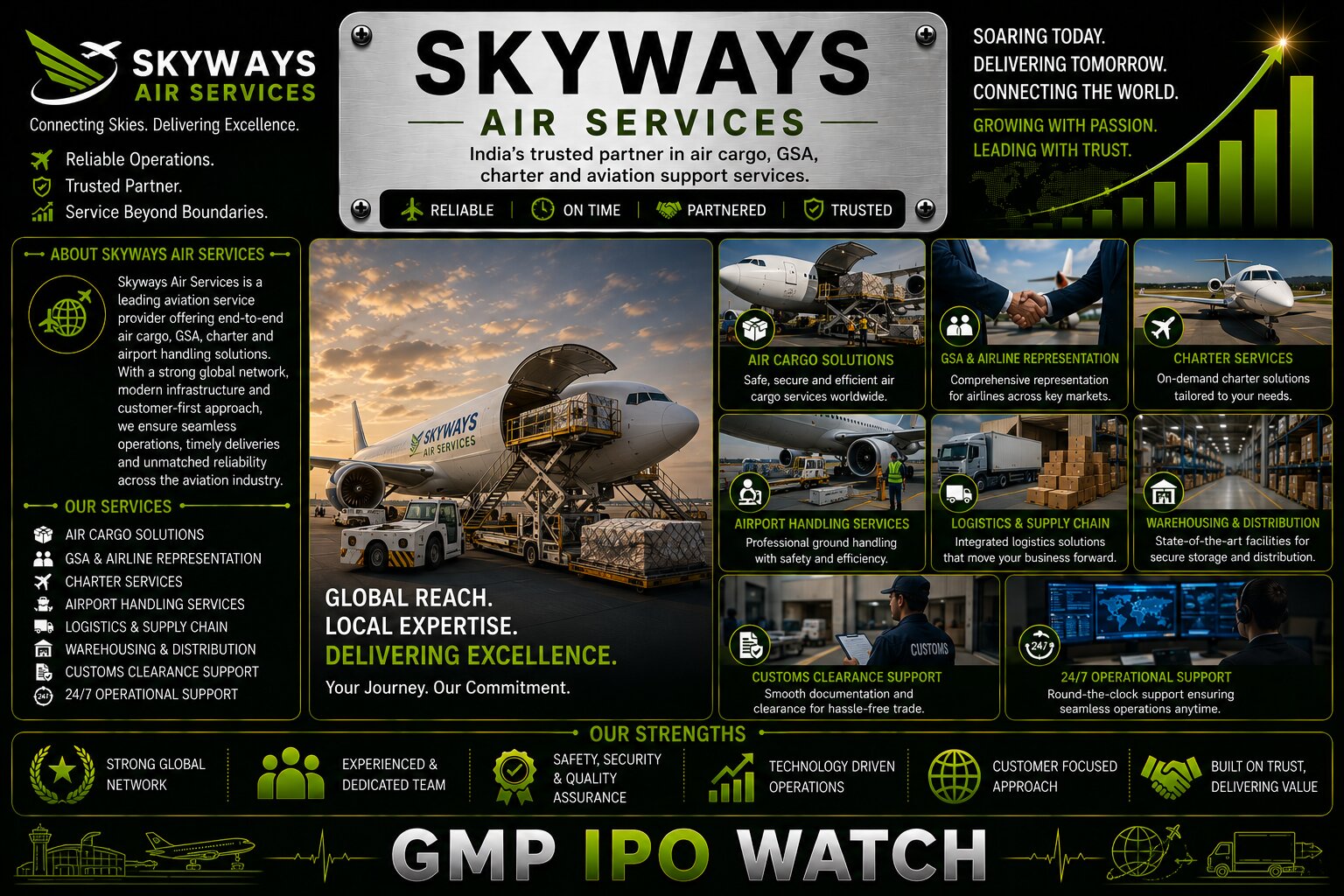
The company operates in the logistics and freight-forwarding industry, providing multimodal supply-chain services across air freight, ocean freight, express cargo, road transportation, warehousing and other logistics services.
Air freight remains by far its largest business.
The company has also held the No. 1 position among India's air-freight forwarders by number of airway bills for four consecutive years, giving the IPO a differentiated position within the logistics sector.
Skyways Air Services IPO Details
| Particular | Details |
|---|---|
| Company | Skyways Air Services Limited |
| IPO Type | Mainboard IPO |
| Issue Type | Book Built Issue |
| Total Issue Size | ₹582.80 Crore |
| Fresh Issue | ₹398.80 Crore |
| Offer for Sale | ₹184.00 Crore |
| Price Band | ₹131 – ₹138 |
| Face Value | ₹10 |
| Lot Size | 100 Shares |
| Minimum Retail Investment | ₹13,800 |
| IPO Open Date | August 24, 2026 |
| IPO Close Date | August 27, 2026 |
| Allotment Date | August 28, 2026 |
| Refund / Demat | August 31, 2026 |
| Listing Date | September 1, 2026 |
| Listing | BSE & NSE |
| Total Shares Offered | 4.22 Crore |
The IPO structure and dates are confirmed in current offer information, while SEBI records show that the company's updated RHP was filed on August 12, 2026.
Fresh Issue Makes Up Most of the IPO
The ₹582.80 crore IPO contains both fresh shares and an Offer for Sale.
| IPO Component | Amount | Share of Issue |
|---|---|---|
| Fresh Issue | ₹398.80 Cr | ~68.4% |
| Offer for Sale | ₹184.00 Cr | ~31.6% |
| Total Issue | ₹582.80 Cr | 100% |
This means more than two-thirds of the IPO amount will go directly into the company rather than entirely to selling shareholders.
That is important because Skyways intends to use fresh capital to strengthen its balance sheet and support its working-capital requirements.
Skyways Air Services IPO GMP Today
Grey-market sentiment is currently positive.
On the opening day, August 24, the IPO was reported trading at an unofficial GMP indicating approximately a 23% premium over the issue price.
| GMP Particular | Current Position |
|---|---|
| Upper Issue Price | ₹138 |
| Reported GMP Premium | ~23% |
| IPO Status | Open |
| Subscription Day | Day 1 |
| Listing Date | September 1 |
GMP is unofficial and can change quickly during the subscription period. It should not be considered a guaranteed listing return.
₹174.5 Crore Raised From Anchor Investors
Before opening the public issue, Skyways Air Services raised approximately ₹174.5 crore from anchor investors.
The anchor book attracted institutional names including Citi and Nomura.
Anchor participation indicates institutional interest before public bidding, although it does not guarantee the IPO's listing or long-term performance.
What Does Skyways Air Services Do?
Skyways Air Services is essentially a freight-forwarding and integrated logistics company.
Importantly, the company does not need to own a large fleet of aircraft to provide air-freight services.
Instead, it connects customers requiring cargo transportation with airlines and other logistics infrastructure.
The model can broadly be understood as:
customer shipment → Skyways logistics planning → airline/ocean/road capacity → freight movement → destination delivery.
This allows the company to provide logistics solutions across multiple transportation modes.
Air Freight Generates More Than 77% of Revenue
Air freight is the foundation of Skyways' business.
FY2026 revenue composition shows how significant this segment has become.
| Revenue Stream | FY2026 Revenue | Contribution |
|---|---|---|
| Air Freight | ₹2,166.40 Cr | 77.02% |
| Ocean Freight | ₹422.60 Cr | 15.02% |
| Express Cargo & Parcel | ₹162.78 Cr | 5.79% |
| Trucking | ₹38.68 Cr | 1.38% |
| Support & Value-Added Services | ₹17.26 Cr | 0.61% |
| Warehousing | ₹3.68 Cr | 0.13% |
| E-commerce & Retail | ₹1.49 Cr | 0.05% |
This clearly demonstrates that Skyways remains predominantly an air-freight business, even though it has expanded into other logistics categories.
Why Air Freight Is Important
Air freight is considerably faster than ocean transportation.
It is particularly useful for goods where:
delivery speed + product value + supply-chain reliability matter more than obtaining the lowest possible transportation cost.
Typical air-freight categories can include electronics, pharmaceuticals, automotive components, fashion products, machinery parts and time-sensitive industrial shipments.
As Indian manufacturing and exports grow, the country's demand for reliable international logistics can expand alongside them.
Ocean Freight Is the Second-Largest Business
Ocean freight contributed approximately 15% of FY2026 revenue, making it the company's second-largest segment.
This provides useful diversification.
Customers do not always require air transportation.
For larger or less time-sensitive shipments, ocean freight can be significantly more economical.
Offering both modes means Skyways can provide customers with:
fast air freight + lower-cost ocean freight + road connectivity + additional logistics support.
This creates a more complete supply-chain proposition.
Express Cargo Adds Another Growth Vertical
Express cargo and parcel services contributed around 5.8% of FY2026 revenue.
Although currently much smaller than air freight, express logistics can provide another growth opportunity.
Demand can be supported by:
e-commerce + SMEs + time-sensitive business shipments + direct-to-consumer deliveries.
If this segment grows faster than the core freight business, Skyways could gradually create a more diversified revenue profile.
Skyways Has Held the No. 1 Air Freight Position
One of the strongest parts of the company's business profile is its position in India's air-freight forwarding market.
Current IPO analysis notes that Skyways has been the No. 1 air-freight forwarder in India by airway bills for four consecutive years.
Scale can be important in freight forwarding.
Higher shipment volumes can help a logistics company develop:
stronger airline relationships + wider networks + better capacity access + customer relationships + operating experience.
This can create advantages when competing for larger corporate customers.
The Business Is Asset-Light Compared With Airlines
Skyways' business should not be confused with an airline.
It does not need to own the aircraft used for most cargo transportation.
Instead, it purchases freight capacity and coordinates shipments through transportation partners.
That creates a relatively asset-light model compared with owning and operating aircraft.
However, asset-light does not mean risk-free.
Skyways still requires significant working capital because there can be a timing difference between paying transportation providers and collecting money from customers.
Working Capital Is Central to the Business
Freight forwarding can consume substantial working capital.
The operating cycle may look like:
book cargo capacity → pay airline/shipping partner → move shipment → invoice customer → collect payment.
If customers receive longer payment terms than those offered by airlines or other logistics providers, Skyways must finance the difference.
That is one reason working capital is an important part of the IPO funding plan.
IPO Capital Will Also Help Reduce Debt
The fresh issue will also be used to strengthen the balance sheet and reduce borrowings.
This is particularly relevant for a working-capital-intensive logistics business.
Lower borrowings can potentially create:
lower finance costs → stronger cash flow → greater capacity to support freight volumes.
Investors should therefore monitor whether post-IPO debt and finance expenses decline meaningfully.
Global Trade Is the Biggest Long-Term Opportunity
Skyways' freight-forwarding business is closely connected with India's international trade.
As Indian businesses increase imports and exports, they require logistics partners capable of moving products between global markets.
Several structural trends can support demand:
Make in India + manufacturing growth + electronics exports + pharmaceutical exports + automotive components + e-commerce + global supply-chain diversification.
If India's share of global manufacturing increases, freight-forwarding volumes could expand alongside it.
But Global Trade Is Also a Major Risk
The same international exposure creates risk.
Skyways' business can be affected by:
- Global economic slowdown
- Trade restrictions
- Tariffs
- Geopolitical conflicts
- Currency volatility
- Airport disruption
- Shipping disruption
- Airline capacity shortages
- Fuel-price changes
Current IPO analysis specifically highlights the company's exposure to cross-border trade and the resulting sensitivity to global economic conditions, trade policies and currency movements.
Middle East Disruption Was Already a Real Test
Skyways originally planned an IPO earlier in 2026 but deferred the launch amid volatile conditions.
At that time, management discussed disruption related to Middle East tensions while noting that its diversified network and ability to develop alternate logistics routes helped limit the impact.
This is a useful example of a real operating risk for an international freight-forwarding business.
Geopolitical events can suddenly change:
routes + freight rates + available capacity + transit times.
A broad logistics network can therefore become an important competitive advantage.
Promoter Holding Will Decline After IPO
Current IPO analysis indicates that the promoter group's ownership is expected to decline from approximately 79.1% before the IPO to around 56.8% after the issue.
The promoters identified in the company's offer documents are Yashpal Sharma and Tarun Sharma.
Even after the public issue, promoters are therefore expected to retain majority ownership.
Valuation Is an Important Consideration
At the upper price of ₹138, Skyways is seeking a post-IPO market capitalisation of approximately ₹2,006 crore.
Current IPO analysis calculates the valuation at roughly 48.94× earnings at the upper price band.
| Valuation Metric | Approx. Value |
|---|---|
| Upper IPO Price | ₹138 |
| Post-Issue Market Cap | ~₹2,006 Cr |
| Indicative P/E | ~48.94× |
| Current GMP Premium | ~23% |
This means investors are not entering at an obviously low headline earnings multiple.
Future growth and profitability will therefore matter significantly after listing.
Revenue Scale Is Already Substantial
Adding the FY2026 segment figures shows that Skyways operates at a considerable revenue scale, with air freight alone generating more than ₹2,166 crore.
But freight forwarding can be a high-revenue, relatively lower-margin business.
That means headline sales numbers should not be evaluated in isolation.
Investors should focus equally on:
gross profit + EBITDA + PAT + freight volumes + operating cash flow + working-capital days.
Air Freight Concentration Is Both Strength and Risk
Generating 77% of revenue from air freight gives Skyways a clear specialisation.
It has helped the company establish a leading position in the Indian market.
But concentration also creates vulnerability.
If air-freight demand or margins weaken significantly, smaller businesses such as ocean freight, trucking and warehousing may not yet be large enough to offset the impact.
Growing non-air logistics operations could therefore improve the company's long-term resilience.
Key Strengths of Skyways Air Services
Skyways enters the IPO with several attractive characteristics. Its leadership in air-freight forwarding, large FY2026 revenue base and multimodal logistics capabilities provide an established operating platform.
The IPO itself is also predominantly fresh capital, with approximately 68.4% of the ₹582.80 crore issue going into the company.
Other positives include its exposure to India's growing international trade, diversification into ocean freight and express cargo, an asset-light freight-forwarding model and institutional participation through the ₹174.5 crore anchor book.
Major Risks
The most important risks investors should monitor are:
- More than 77% revenue dependence on air freight
- Global trade slowdown
- Geopolitical disruption
- Airline freight-capacity availability
- Freight-rate volatility
- Foreign-exchange movements
- Working-capital requirements
- Customer receivable delays
- Competitive logistics market
- Dependence on third-party transportation providers
- Margin pressure
- Relatively demanding IPO valuation
The company's exposure to cross-border trade means events outside India can materially influence operations even when domestic demand remains healthy.
What Investors Should Track After Listing
| Metric | Why It Matters |
|---|---|
| Air Freight Volumes | Core business growth |
| Air Freight Revenue | Main revenue engine |
| Ocean Freight Revenue | Diversification |
| Express Cargo Growth | New growth vertical |
| EBITDA Margin | Operating efficiency |
| PAT Growth | Earnings performance |
| Operating Cash Flow | Earnings quality |
| Receivable Days | Collection efficiency |
| Working-Capital Cycle | Capital requirements |
| Borrowings | IPO deleveraging |
| International Revenue | Global trade exposure |
| ROCE | Capital efficiency |
For Skyways, one of the most important post-listing indicators will be whether it can grow freight volumes while improving cash conversion and reducing dependence on borrowed working capital.
Final View on Skyways Air Services IPO 2026
The Skyways Air Services IPO opened today, August 24, and closes on August 27, 2026. The ₹582.80 crore mainboard issue is priced at ₹131–₹138 per share, with a minimum lot of 100 shares and listing scheduled for September 1 on BSE and NSE.
The IPO comprises a ₹398.80 crore fresh issue and ₹184 crore OFS, meaning fresh capital accounts for approximately 68% of the total offer.
The underlying business has considerable scale. Air freight generated ₹2,166.40 crore and 77.02% of FY2026 revenue, while ocean freight contributed ₹422.60 crore or around 15%. Skyways has also maintained the No. 1 position among Indian air-freight forwarders by airway bills for four consecutive years.



Loading comments...