

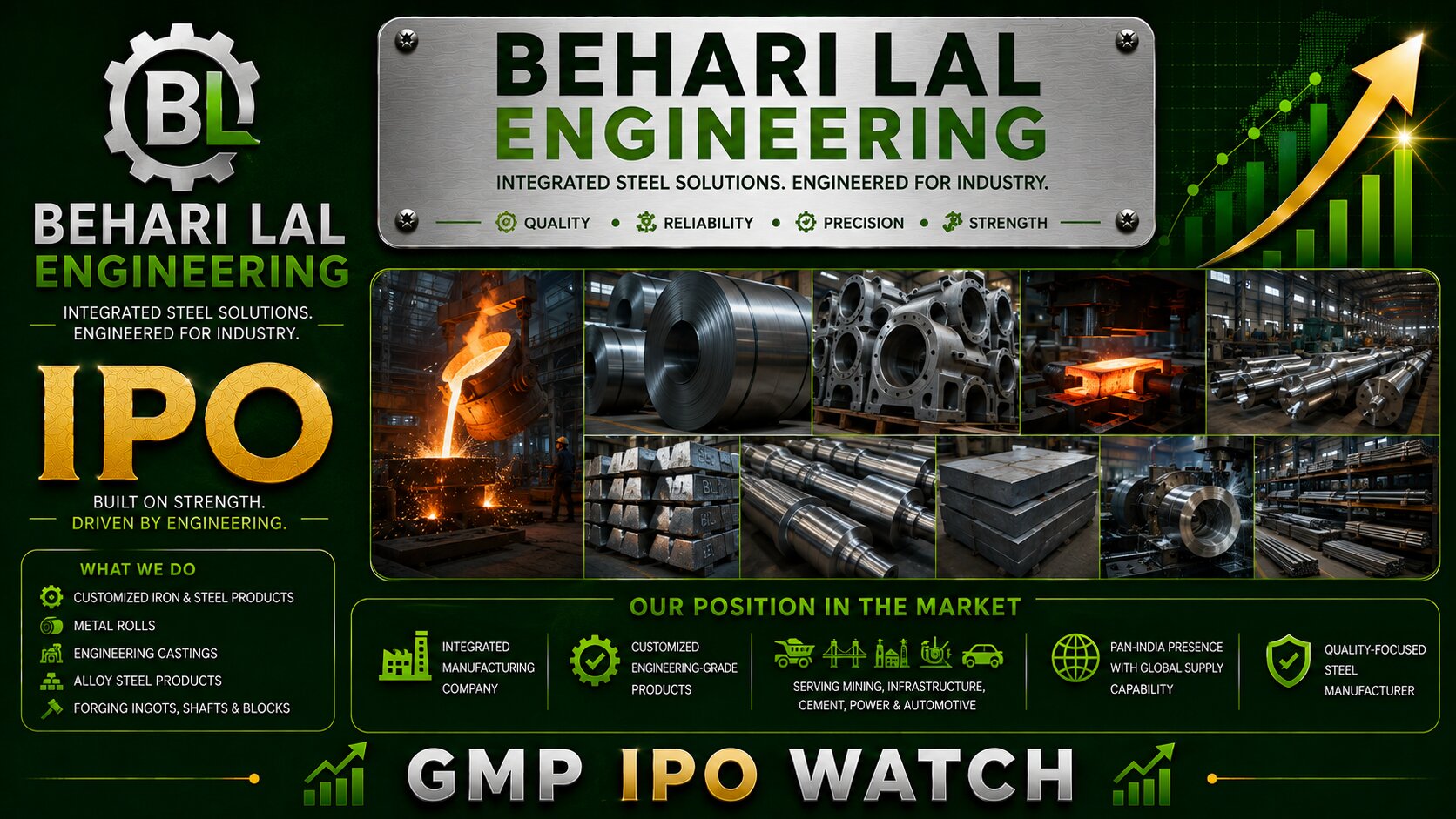
Behari Lal Engineering IPO 2026 – The Opportunity Is in Engineering Value, Not Just More Steel
Behari Lal Engineering Limited reaches the final day of its IPO today, August 14, 2026, with investor demand accelerating sharply.
The approximately ₹301.62 crore mainboard IPO opened on August 12 and closes today. The price band is ₹271 to ₹285 per share, with a lot size of 52 shares. The issue consists of approximately ₹93 crore of fresh equity and ₹208.62 crore through an Offer for Sale.
But Behari Lal Engineering is not interesting merely because its IPO is heavily subscribed.
The deeper investment story lies in where the company sits within the steel industry.
It does not simply manufacture basic steel products.
It produces specialised items such as:
- Metal rolls
- Engineering castings
- Alloy steel products
- Forging ingots
- Forged shafts
- Customised industrial components
These products are used inside factories where failure can be expensive.
That changes the nature of competition.
A commodity supplier typically competes heavily on price per tonne.
An engineering supplier can compete on:
product life + metallurgy + reliability + precision + customer-specific performance.
That distinction may ultimately determine whether Behari Lal can sustain its recent margins after the IPO.
Behari Lal Engineering IPO Details
| Particular | Details |
|---|---|
| Company | Behari Lal Engineering Limited |
| IPO Type | Mainboard Book Built IPO |
| Total Issue Size | ₹301.62 Crore |
| Fresh Issue | ₹93 Crore |
| Offer for Sale | ₹208.62 Crore |
| Price Band | ₹271 – ₹285 Per Share |
| Face Value | ₹10 Per Share |
| Lot Size | 52 Shares |
| Minimum Retail Investment | ₹14,820 at ₹285 |
| IPO Opening Date | August 12, 2026 |
| IPO Closing Date | August 14, 2026 |
| Expected Allotment | August 17, 2026 |
| Expected Listing | August 19, 2026 |
| Listing | BSE & NSE |
| Lead Managers | Emkay Global Financial Services and Systematix Corporate Services |
The final issue terms and August 19 tentative listing are confirmed in current IPO materials.
What Does Behari Lal Engineering Actually Do?
Behari Lal Engineering is an integrated engineering and steel-products manufacturer.
Its operations include the manufacture of customised products used by industries such as:
- Steel
- Mining
- Cement
- Heavy engineering
- Infrastructure
- Industrial machinery
The company has operated for decades and built expertise around specialised metal products rather than limiting itself to ordinary steel output.
That is important because specialised industrial products can create better economics when customers care about technical performance.
Metal Rolls Are One of the Most Important Products
One of Behari Lal Engineering's strongest businesses is metal rolls.
These rolls are used inside rolling mills to shape metal into products such as:
- Bars
- Sections
- Sheets
- Plates
The roll must withstand:
- Extreme pressure
- Heat
- Repeated mechanical stress
- Abrasion
If the roll fails prematurely, the customer's mill can face:
- Production stoppage
- Replacement expense
- Lower product quality
- Lost manufacturing time
This is why roll performance can matter far more than the initial purchase price.
Behari Lal Has a Meaningful Market Position
One recent industry analysis based on the IPO documents estimates Behari Lal Engineering's share of India's metal-roll market at roughly 10%–11.5%.
That is significant.
It means the company is not entering the public market as an unknown niche manufacturer.
It already has a relevant position in one of its core product categories.
A meaningful installed customer base can support:
- Repeat orders
- Technical reputation
- Customer references
- Replacement demand
This creates a stronger starting point for expansion.
Replacement Demand Can Make Metal Rolls Attractive
Some industrial products are sold once.
Metal rolls are different.
They wear down through use and eventually need replacement.
That creates potential recurring demand.
Suppose a steel mill operates continuously.
Its rolls experience:
- Heat
- Friction
- Pressure
Even a high-quality roll will eventually need to be replaced.
Therefore, Behari Lal can potentially benefit from two demand streams:
new industrial capacity + replacement of existing rolls.
Replacement demand can make revenue more resilient than businesses dependent only on new factory construction.
A Larger Installed Customer Base Can Become a Moat
If Behari Lal supplies rolls to hundreds of operating plants, each customer can potentially generate repeat orders.
This means historical product installations matter.
A competitor wanting to displace Behari Lal may need to prove:
- Equivalent quality
- Equivalent roll life
- Equivalent technical reliability
Industrial customers often hesitate to take unnecessary operating risk.
That can create customer stickiness.
Customer Qualification Can Take Time
A steel mill cannot simply install an untested critical component without considering the consequences.
Customers may evaluate:
- Alloy composition
- Hardness
- Surface quality
- Product life
- Dimensional tolerance
before approving a supplier.
Once Behari Lal qualifies successfully, future purchasing can become easier.
This creates a potentially valuable competitive barrier.
Metallurgy Is the Real Technology
Behari Lal's products may look like pieces of steel.
But the real intellectual value lies inside the metal.
Different applications require specific combinations of:
- Carbon
- Chromium
- Nickel
- Molybdenum
- Other alloying elements
along with carefully controlled:
- Melting
- Cooling
- Heat treatment
A small difference in composition can significantly change:
- Hardness
- Strength
- Wear resistance
That makes metallurgy a core competency.
Higher-Value Products Can Improve Revenue Per Tonne
Consider two manufacturers.
Manufacturer A
Produces basic steel worth ₹60,000 per tonne.
Manufacturer B
Uses specialised alloys and engineering to create components worth significantly more per tonne.
The second company can potentially generate higher revenue and margin from the same quantity of metal.
For Behari Lal, this means the ideal growth strategy is not simply:
produce more tonnes.
It is:
produce more value per tonne.
Product Mix May Be More Important Than Capacity Growth
Suppose Behari Lal increases production by 20%.
That is positive.
But if most of the extra production is low-margin basic steel, earnings may not increase significantly.
Now consider another scenario:
Production increases 10%, but customised metal rolls and engineered components become a larger part of sales.
Profit growth could be stronger.
Investors should therefore monitor:
product-mix improvement, not just output growth.
FY2025 Financial Performance Was Already Strong
Behari Lal's FY2025 numbers showed:
- Revenue: approximately ₹516.30 crore
- EBITDA: approximately ₹81.31 crore
- PAT: approximately ₹52.95 crore.
Compared with FY2024, revenue increased from about ₹449.96 crore, while PAT rose from around ₹35.79 crore.
That means PAT grew substantially faster than revenue.
Profit Growth Has Been Stronger Than Sales Growth
FY2024 to FY2025:
Revenue: ₹449.96 crore → ₹516.30 crore
PAT: ₹35.79 crore → ₹52.95 crore.
Revenue increased by around 15%.
PAT increased by roughly 48%.
That indicates substantial improvement in profit conversion.
For investors, this is more meaningful than headline sales growth alone.
FY2026 Maintained Strong Capital Efficiency
Recent RHP-related analysis indicates FY2026 RoNW around 21.12% and an extremely low debt-to-equity ratio of roughly 0.06×.
Another prospectus analysis reports ROE around 21.91% and EBITDA margin around 16.01%.
These metrics suggest Behari Lal enters the IPO with a relatively healthy balance sheet.
Low Debt Is an Important Competitive Strength
Heavy manufacturing companies can easily become overleveraged.
They require capital for:
- Machinery
- Raw material
- Inventory
- Working capital
Behari Lal's debt-to-equity near 0.06× is therefore notable.
Low leverage can provide several advantages:
- Lower finance cost
- Stronger downside protection
- Greater borrowing capacity if required later
- Better ability to survive industrial slowdowns
This makes the company's capital structure different from highly indebted manufacturing businesses.
Why Low Debt Matters During a Downturn
Imagine industrial demand temporarily weakens.
Highly leveraged company
Still needs to pay substantial interest even when factory utilisation falls.
Low-debt company
Has greater flexibility.
This can protect:
- Profit
- Cash flow
- Balance-sheet strength
Industrial cycles are unavoidable.
Financial resilience can therefore become a meaningful competitive advantage.
The IPO Will Still Repay Some Borrowings
Even with relatively modest leverage, IPO proceeds include repayment or prepayment of certain borrowings, alongside investment in machinery and other business requirements.
Reducing remaining borrowings can further strengthen cash flow.
But the more strategically important use of fresh capital is productive expansion.
New Machinery Can Increase Precision, Not Just Volume
Behari Lal plans to use part of IPO proceeds for manufacturing expansion and machinery.
Modern manufacturing equipment can improve:
- Accuracy
- Production speed
- Energy efficiency
- Rejection rates
- Product consistency
For specialised engineering products, quality improvements can be even more valuable than pure capacity expansion.
A customer may pay more for a component that lasts longer.
Reject Rate Can Materially Affect Profit
Suppose the company manufactures ₹100 crore worth of products.
If 5% fails inspection:
₹5 crore of production value is affected.
If better process control reduces rejection to 2%, the company saves substantial material and labour.
This can improve margins without raising selling prices.
That is why manufacturing quality metrics can be as important as revenue growth.
Capacity Utilisation Will Determine Post-IPO ROCE
Buying machinery does not create returns.
Using it does.
Consider a ₹20 crore machine installation.
Scenario A
It generates ₹40 crore of additional annual sales.
Scenario B
It generates ₹10 crore.
Both increase capacity.
Only the first is likely to produce attractive capital efficiency.
Therefore, investors should monitor post-IPO ROCE and capacity utilisation carefully.
Existing Order Visibility Helps Reduce Expansion Risk
Behari Lal entered the IPO with a meaningful order pipeline, providing some visibility for manufacturing utilisation.
But investors should separate:
order-book quantity
from:
order-book quality.
A ₹100 crore order book with strong margins can be more valuable than ₹150 crore of low-margin business.
Order Mix Is More Important Than Order Size
A customised forged component may require:
- Technical design
- Special alloy
- Heat treatment
- Machining
This can justify stronger pricing.
By comparison, generic metal products may compete more directly on cost.
If the company gradually increases higher-value engineering orders, earnings may grow faster than revenue.
Customer Diversification Reduces Risk
Behari Lal serves customers across several industrial sectors.
This means demand is not entirely dependent on one market.
Potential exposure includes:
- Steel
- Mining
- Cement
- Infrastructure
- Heavy engineering
A slowdown in one sector may be partly offset by another.
Diversification is especially valuable for cyclical manufacturers.
India's Steel Capacity Expansion Can Support Demand
India continues adding manufacturing and infrastructure capacity.
More steel capacity means:
- More rolling mills
- More industrial equipment
- More replacement components
That can support long-term demand for products such as metal rolls.
Behari Lal can potentially benefit without needing to own the steel mills itself.
It supplies the components required to keep them running.
Replacement Demand May Be Less Cyclical Than New Capex
New factory construction can slow sharply during weak economic periods.
Replacement parts are different.
A functioning steel plant cannot permanently postpone replacement of worn industrial components.
This means replacement demand may provide some revenue support even when new industrial capex slows.
For Behari Lal, this can improve business resilience.
Energy Efficiency Is Another Margin Lever
Casting and forging consume substantial energy.
Expenses can include:
- Electricity
- Fuel
- Furnace operations
- Heat treatment
Reducing energy usage per tonne can directly improve operating margins.
The company has also identified energy-related investments such as rooftop solar as part of its expansion strategy.
Over several years, such savings can compound.
Raw-Material Risk Remains Important
Behari Lal still operates within the steel value chain.
Its input costs can be influenced by:
- Scrap
- Alloy metals
- Energy
- Steel prices
If input prices rise rapidly and selling prices cannot be adjusted immediately, margins can compress.
Specialised products can offer more pricing flexibility than commodities, but they do not eliminate raw-material risk.
Working Capital Still Requires Discipline
The company's production cycle can involve:
raw material → melting → casting/forging → machining → inspection → dispatch → customer payment.
Cash can remain tied up throughout that cycle.
If revenue grows quickly, working capital may also expand.
Investors should therefore compare:
PAT growth
with:
operating cash-flow growth.
A profitable company can still face cash pressure if receivables rise too quickly.
Export Opportunity Can Diversify the Business Further
Engineering products can be supplied internationally.
Export expansion could provide:
- Larger addressable market
- Customer diversification
- Foreign-currency revenue
But international business also introduces:
- Logistics costs
- Currency fluctuations
- Certification requirements
The opportunity is attractive when export margins compensate for the additional complexity.
Final-Day IPO Subscription Has Accelerated Sharply
The biggest change today is subscription demand.
At around 1:50 PM on August 14, Groww reported:
| Category | Subscription |
|---|---|
| QIB | 7.93× |
| NII | 100.96× |
| Retail | 33.87× |
| Overall | 41.34× |
This is a major jump from approximately 7.78× overall at the end of Day 2.
NII Demand Is Exceptionally Strong
The NII category is currently above 100× subscription.
That is significantly higher than retail and QIB demand.
NII applications can be influenced strongly by:
- Listing expectations
- GMP
- Leverage-funded bidding
Therefore, high NII demand should be viewed as evidence of strong IPO interest, not necessarily as proof of long-term valuation comfort.
Retail Demand Is Also Strong
Retail subscription has reached approximately 33.87× as of the same update.
This means retail allotment probability will be relatively low if final demand remains near these levels.
The figures can still rise further before the issue closes.
QIB Demand Has Improved Materially
QIB subscription reached approximately 7.93× by 1:50 PM.
This is particularly relevant because institutional bids often arrive late in the subscription period.
The increase suggests stronger professional-investor participation on the final day.
Behari Lal Engineering IPO GMP Today
As of approximately 12:30 PM on August 14, NDTV Profit reported GMP around:
₹80 per share.
Against the ₹285 upper price band, this implies an unofficial estimated price of approximately:
₹365
or:
28.07% premium.
Economic Times also reported the issue trading around a 28% grey-market premium today.
GMP remains unofficial and can change before listing.
GMP Has Increased Recently
NDTV Profit notes that GMP has risen from around ₹53 to ₹80 in recent days.
That indicates stronger short-term sentiment as the issue reaches its closing day.
But investors should remember:
GMP affects expectations, not business performance.
It does not change Behari Lal's:
- Market share
- Debt
- Margins
- Customer relationships
- Cash flow
Valuation Should Focus on Capital Efficiency
The right valuation question is not simply whether Behari Lal trades below some listed peer P/E.
Investors should ask what they are paying for:
- Market position
- ROE
- ROCE
- Low leverage
- Growth prospects
- Cash conversion
A specialised manufacturer deserves a premium over commodity businesses only when engineering advantages produce durable financial returns.
Competitive Strengths
Behari Lal Engineering enters the IPO with several clear positives.
Strong Position in Metal Rolls
Industry analysis places its share at roughly 10%–11.5% of the Indian metal-roll market.
Specialised Engineering Products
Metal rolls, castings and forged products provide higher-value manufacturing exposure.
Strong Profit Growth
FY2025 PAT increased to approximately ₹52.95 crore.
Low Leverage
FY2026 debt-to-equity is reported around 0.06×.
Healthy Return Ratios
Prospectus analysis reports ROE above 21%.
Replacement Demand
Metal rolls and industrial components create recurring replacement requirements.
Strong Final-Day Subscription
Overall demand has crossed 41× as of early afternoon.
Major Risks
Raw-Material Volatility
Steel and alloy prices can compress margins.
Industrial Cyclicality
Customer capex may slow during weak economic periods.
Capacity Expansion
New machinery needs sufficient utilisation.
Customer Concentration
Large industrial customers can have bargaining power.
Working Capital
Receivables and inventory can absorb cash.
Large OFS Component
Approximately ₹208.62 crore of the ₹301.62 crore issue is an Offer for Sale rather than fresh company capital.
Margin Sustainability
Recent profit growth needs to remain sustainable as scale increases.
What Could Drive Behari Lal's Next Growth Phase?
Higher Metal-Roll Market Share
Even modest share gains can materially increase revenue.
Replacement Demand
Existing customers can generate repeat orders.
Higher-Value Product Mix
Custom-engineered components can improve margins.
New Machinery
Can increase precision and output.
Industrial Capex
New steel and manufacturing capacity can increase demand.
Export Expansion
Can broaden the customer base.
Energy Efficiency
Lower power cost can support margins.
What Investors Should Track After Listing
Metal Rolls Market Share
Can Behari Lal move beyond its existing estimated 10%–11.5% position?
Product Mix
Are higher-value engineered products becoming more important?
EBITDA Margin
Can profitability remain strong as production grows?
Capacity Utilisation
Are IPO-funded machines being used effectively?
Operating Cash Flow
Is PAT converting into real cash?
Working-Capital Days
Are inventory and receivables under control?
ROCE
Is fresh capital generating attractive returns?
The Most Important Post-IPO Equation
Behari Lal already has scale, customers and technical capability.
The IPO does not need to prove those things again.
The real test is whether management can convert additional capital into higher-value earnings.
The ideal cycle is:
fresh capital → better machinery → higher-value products → stronger customer relationships → greater market share → higher cash flow and ROCE.
The weaker outcome is:
fresh capital → more tonnage → commodity products → lower margins → weaker returns.
The difference comes down to how successfully Behari Lal moves up the engineering value chain.
Should Investors Consider Behari Lal Engineering IPO?
The positive investment case includes:
- Established manufacturing history
- Strong metal-roll market position
- Specialised metallurgy
- Replacement-led demand
- Strong recent PAT growth
- Very low leverage
- Healthy return ratios
- Strong final-day QIB, NII and retail demand
- Positive GMP
The caution points include:
- Industrial cyclicality
- Raw-material prices
- Working-capital requirements
- OFS-heavy issue structure
- Need to preserve margins during expansion
Behari Lal should therefore be evaluated as a specialised industrial-engineering and metallurgy company, rather than simply as another steel manufacturer.
Final View on Behari Lal Engineering IPO 2026
The Behari Lal Engineering IPO 2026 closes today, August 14, and investor demand has accelerated dramatically.
As of approximately 1:50 PM, the issue was subscribed around 41.34× overall, including roughly 100.96× NII, 33.87× retail and 7.93× QIB demand.
Grey-market sentiment is also strong. The latest reported GMP is approximately ₹80, implying an unofficial price near ₹365 against the ₹285 upper band, or around a 28% premium.
But the more important investment story lies in the business itself.
Behari Lal operates in specialised industrial products where metallurgy, precision and product life matter more than simple steel tonnage.
Recent industry analysis estimates the company holds around 10%–11.5% of India's metal-roll market, providing an established platform for future growth.
Financially, the company has also improved substantially. FY2025 revenue reached approximately ₹516.30 crore, EBITDA about ₹81.31 crore, and PAT roughly ₹52.95 crore, while recent FY2026 analysis indicates a very low debt-to-equity ratio near 0.06× and healthy return ratios.
The long-term investment thesis can therefore be summarised as:
metal-roll leadership + recurring replacement demand + specialised engineering + low debt + new manufacturing capacity = potential sustainable earnings growth.
The central risk is that Behari Lal could use expansion capital simply to produce more low-value tonnage rather than increasing the contribution of higher-margin engineered products.
For long-term investors, the most important post-listing metrics will therefore be:
metal-roll market share, product mix, EBITDA margin, capacity utilisation, operating cash flow and ROCE.
Overall, Behari Lal Engineering represents a profitable, low-leverage and increasingly specialised industrial manufacturing company entering the market with exceptionally strong final-day demand. The strongest long-term outcome would come not from producing more steel, but from using its engineering expertise and new capacity to generate more value from every tonne of metal processed.
Loading comments...