

Kwick Forensic Solutions IPO 2026 – Can India's Growing Digital and Criminal Investigation Needs Drive Its Next Phase?
Forensic investigation has changed dramatically.
Crime investigation is no longer limited to fingerprints, photographs and physical evidence collected from a crime scene.
Modern investigations can involve:
smartphones + computers + CCTV footage + social media + digital documents + fingerprints + data analytics + physical evidence.
This creates demand for specialised technology capable of collecting, analysing and managing increasingly complex evidence.
Kwick Forensic Solutions Limited operates in this specialised market.
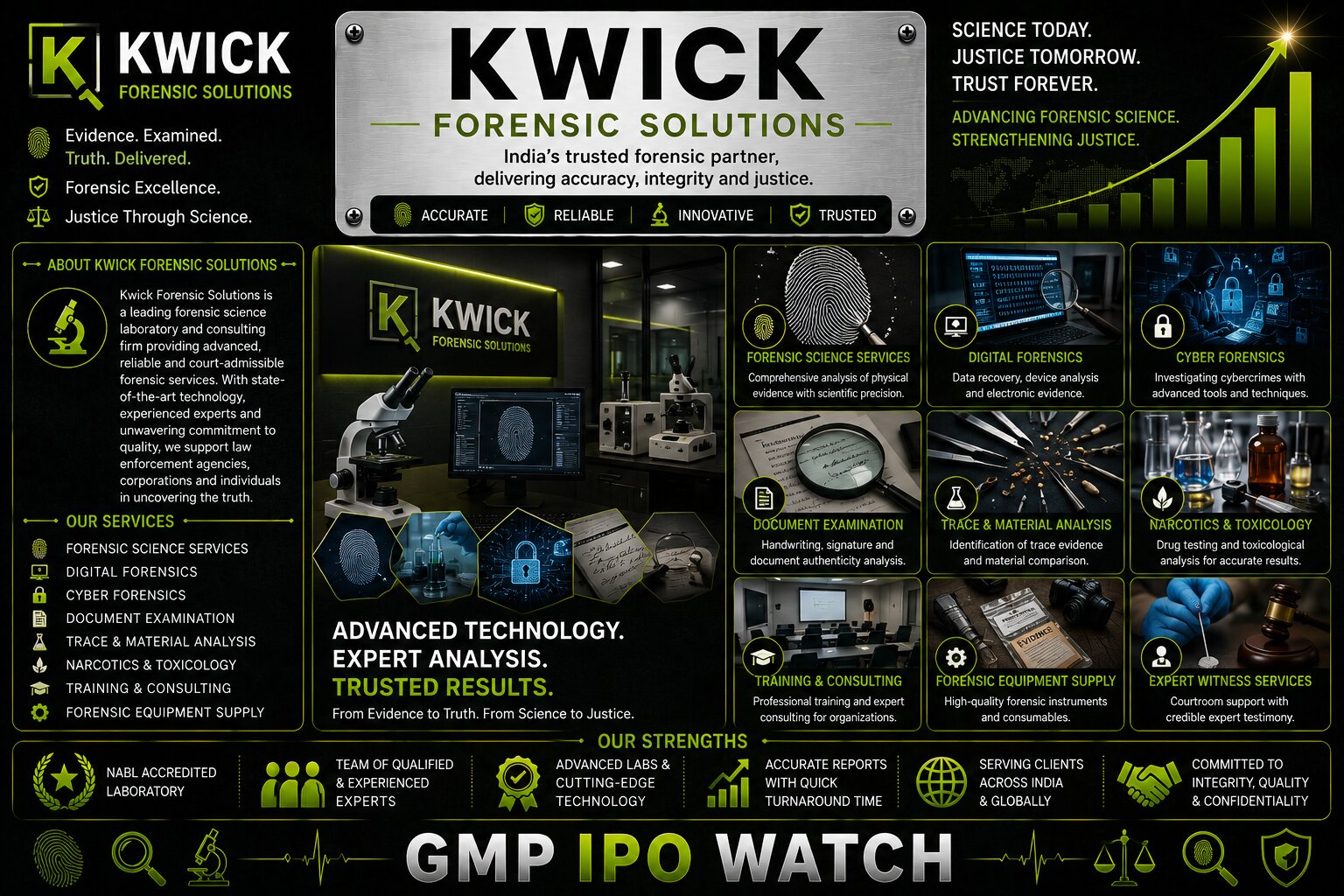
The Chennai-based company provides products, tools and technology across forensic science, fingerprint science, cyber and digital forensics, social-media analytics and big-data analytics, with government and law-enforcement organisations forming an important part of its customer base.
The company has now filed for an SME IPO, making its rapid recent financial growth particularly important for prospective investors.
Kwick Forensic Solutions IPO Details
| Particular | Details |
|---|---|
| Company | Kwick Forensic Solutions Ltd. |
| IPO Type | Book Built SME IPO |
| Listing Platform | BSE SME |
| Face Value | ₹10 Per Share |
| Total Offer | 56.40 Lakh Shares |
| Fresh Issue | 45.60 Lakh Shares |
| Offer for Sale | 10.80 Lakh Shares |
| IPO Open Date | August 27, 2026 |
| Price Band | To Be Announced |
| Lot Size | To Be Announced |
| Main Objective | Working Capital |
| Business | Forensic & Investigation Technology |
The current offer document provides for a total offer of 56.40 lakh shares, comprising 45.60 lakh fresh shares and up to 10.80 lakh shares through OFS.
The issue is proposed for listing on the BSE SME platform.
Kwick Forensic Solutions IPO Date
Current IPO tracking information indicates that the Kwick Forensic Solutions IPO is scheduled to open on:
August 27, 2026.
As of August 19, 2026, the issue has not opened for public bidding.
Therefore, there is currently no valid:
- Retail subscription
- NII subscription
- QIB subscription
- Overall subscription
data to analyse.
What Does Kwick Forensic Solutions Actually Do?
Kwick's business is unusual compared with most SME IPOs.
The company began operations in 2005 and, from FY2015 onward, expanded into end-to-end forensic products, solutions, tools and technologies.
Its offerings cover areas including:
- Forensic sciences
- Fingerprint science
- Cyber forensics
- Digital forensics
- Social-media analytics
- Big-data analytics
- Crime-scene investigation products
- Evidence-management solutions
- Law-enforcement technologies.
This gives Kwick exposure to both traditional forensic investigation and the rapidly expanding field of digital evidence.
Why Digital Forensics Is Becoming More Important
Twenty years ago, an investigation might have focused heavily on physical evidence.
Today, a single case can involve:
mobile phones + laptops + cloud data + messaging applications + social networks + CCTV + location information + digital transactions.
Investigators therefore need tools capable of extracting and analysing large quantities of digital information.
This structural shift can expand the addressable market for specialised forensic-technology providers.
Government Customers Are Central to the Business
Kwick primarily serves government entities across India, including organisations associated with:
- Police departments
- Forensic laboratories
- Investigation agencies
- Training institutes.
This creates an interesting business profile.
Government customers can provide large institutional contracts and repeat requirements.
But government-focused businesses can also face:
tender dependence + long procurement cycles + payment delays + intense bidding competition.
Investors need to consider both sides.
Kwick's Revenue Has Grown Rapidly
The company's recent financial expansion is one of the strongest parts of its IPO story.
| Financial Year | Revenue from Operations | PAT | PAT Margin |
|---|---|---|---|
| FY2024 | ₹30.18 Cr | ₹2.83 Cr | 9.35% |
| FY2025 | ₹65.03 Cr | ₹8.56 Cr | 13.15% |
| FY2026 | ₹105.71 Cr | ₹13.51 Cr | 12.78% |
Kwick's revenue increased from approximately ₹30.18 crore in FY2024 to ₹105.71 crore in FY2026, while PAT expanded from ₹2.83 crore to ₹13.51 crore.
That represents substantial scaling over only two years.
FY2026 Revenue Crossed ₹100 Crore
Revenue from operations reached approximately:
₹105.71 crore in FY2026
compared with:
₹65.03 crore in FY2025.
That represents growth of approximately:
62.6%.
The company has therefore maintained strong top-line momentum after more than doubling revenue between FY2024 and FY2025.
PAT Reached ₹13.51 Crore
Profit after tax increased to approximately:
₹13.51 crore in FY2026
from:
₹8.56 crore in FY2025
and:
₹2.83 crore in FY2024.
This is an important trend because profit has expanded alongside revenue rather than being sacrificed purely for growth.
PAT Margin Remains Healthy
Kwick reported FY2026 PAT margin of approximately:
12.78%.
That compares with:
13.15% in FY2025
and:
9.35% in FY2024.
The small decline from FY2025 does not eliminate the broader improvement compared with FY2024.
The next question is whether Kwick can maintain double-digit profitability as it continues scaling.
Operating Cash Flow Has Improved
Profit is important.
But cash generation is particularly important for a government-focused supplier.
Kwick's operating cash flow reportedly moved from:
negative ₹2.61 crore in FY2024
to:
positive ₹4.65 crore in FY2025
and then:
positive ₹7.62 crore in FY2026.
This is a constructive trend.
The business is not only reporting higher accounting profits; operating cash flow has also improved.
But Profit Is Still Higher Than Operating Cash Flow
Compare FY2026:
PAT: ₹13.51 crore
with:
Operating Cash Flow: ₹7.62 crore.
Operating cash generation is positive but remains below reported PAT.
That makes working-capital management particularly important.
Investors should monitor whether future profit increasingly converts into cash.
₹48 Crore Is Planned for Working Capital
One of the most important IPO objectives is funding the company's working-capital requirement.
Current IPO information identifies approximately:
₹48 crore
for working capital.
This is a significant amount relative to the current size of the business.
It tells investors something important about Kwick's operating model:
growth requires substantial capital before customer payments are collected.
Why Kwick Needs Working Capital
Suppose Kwick wins a large forensic-technology contract.
It may need to:
purchase equipment → import or procure specialised technology → customise the solution → deliver it → install it → receive customer approval → wait for payment.
Cash can therefore remain tied up for months.
If Kwick wins more contracts, working-capital requirements can increase even while the business becomes more profitable.
Government Contracts Can Create Long Cash Cycles
Government procurement often involves multiple stages.
These may include:
- Tender
- Technical qualification
- Commercial bidding
- Purchase order
- Delivery
- Installation
- Inspection
- Acceptance
- Payment
The time between purchasing equipment and receiving payment can therefore be significant.
That explains why IPO-funded working capital can directly support revenue growth.
Working Capital Can Increase Kwick's Bidding Capacity
Imagine Kwick has opportunities to execute ₹150 crore of projects.
If it only has enough working capital to execute ₹80 crore, some opportunities may have to be delayed or rejected.
Additional IPO capital can potentially change that.
The growth cycle becomes:
IPO working capital → ability to execute larger orders → higher revenue → larger profit.
This is one of the clearest potential uses of the fresh issue.
But More Working Capital Does Not Guarantee Better Returns
The opposite scenario is also possible.
If Kwick deploys additional cash into:
- Inventory
- Receivables
- Slow-moving projects
without generating proportionate profit, return on capital could decline.
Therefore, post-IPO investors should track both:
revenue growth
and:
working-capital efficiency.
Digital Forensics Creates a Structural Growth Opportunity
Digital evidence is increasing because society itself is becoming more digital.
More activities now happen through:
- Smartphones
- Computers
- Digital payments
- Social media
- Online communication
This creates more electronic evidence.
Law-enforcement agencies consequently require tools capable of:
acquiring + preserving + analysing + presenting digital evidence.
Kwick's cyber and digital-forensics exposure places it directly within this trend.
Fingerprint Science Remains Relevant
Digital evidence does not replace traditional forensic science.
Physical investigations still require:
- Fingerprint collection
- Crime-scene documentation
- Evidence preservation
- Laboratory analysis
Kwick's portfolio spans both traditional and digital forensic technologies.
This diversification is useful because it allows the company to address a wider portion of an investigation agency's technology requirements.
Total Evidence Management Can Deepen Customer Relationships
Kwick's positioning includes Total Evidence Management and law-enforcement solutions.
That concept is strategically interesting.
Rather than supplying only one forensic device, the company can potentially participate across multiple stages of evidence management.
A broader solution can increase:
contract value + customer dependence + cross-selling opportunities.
Training Is Important in Forensic Technology
Selling sophisticated forensic tools is different from selling ordinary hardware.
Users need to understand:
- How evidence should be collected
- How equipment should be operated
- How results should be interpreted
- How digital evidence should be preserved
Kwick conducts product demonstrations and awareness programmes around evidence-management practices.
Training can help deepen relationships with institutional customers.
Cybercrime Can Expand the Addressable Market
Cybercrime is increasingly relevant to:
- Banks
- Corporates
- Government agencies
- Police departments
- Investigation organisations
Digital investigations can involve everything from compromised computers to mobile devices and online activity.
As digital systems expand, demand for specialised investigation tools can increase.
Kwick therefore operates in a market with potential structural rather than purely cyclical growth.
Big-Data Analytics Broadens the Business
Kwick also provides solutions related to big-data analytics.
Modern investigations can produce enormous datasets.
The challenge is no longer only obtaining data.
It is finding useful patterns within that data.
Analytics technology can potentially help investigators identify:
connections + patterns + anomalies + relationships.
This moves Kwick further beyond being simply an equipment supplier.
Customer Concentration Is a Key Risk
Current IPO reporting identifies high customer concentration as one of the company's important risks.
This matters because a small number of large contracts can materially influence annual revenue.
Suppose a major customer represents a significant portion of sales.
If that customer:
- Reduces orders
- Delays procurement
- Changes suppliers
Kwick's revenue can be affected quickly.
Investors should therefore monitor customer diversification after listing.
Geographic Concentration Is Another Risk
Current IPO reporting also identifies geographic concentration as a material risk.
A business dependent heavily on certain regions can be affected by changes in:
- Government budgets
- Procurement cycles
- Tender activity
within those markets.
Expanding customer relationships across more states and agencies could reduce this risk.
Tender Competition Can Be Intense
Government procurement is often price competitive.
Even technically capable companies need to qualify under tender requirements.
And qualification does not guarantee winning the contract.
For example, State Bank of India's published tender information for forensic tools shows Kwick participated in a procurement process but did not qualify after technical evaluation, while another vendor ultimately won the contract.
This is a useful real-world reminder of procurement risk.
Kwick can invest resources into bidding without necessarily securing every opportunity.
Technology Obsolescence Is an Important Risk
Forensic technology changes quickly.
A digital-forensics tool useful today can become less effective as:
- Operating systems change
- Encryption improves
- Devices evolve
- Data formats change
Kwick therefore needs to continually maintain access to updated products and technologies.
Unlike a traditional manufacturing business, technological relevance can be as important as physical infrastructure.
Supplier Relationships Can Matter
If specialised forensic tools or technologies come from external manufacturers, Kwick can depend on those suppliers for:
- Availability
- Product updates
- Pricing
- Technical support
Any disruption can affect Kwick's ability to fulfil contracts.
Supplier diversification is therefore worth monitoring.
Data Security Is Critical
A forensic-technology provider operates in an unusually sensitive environment.
Customers can deal with:
- Criminal investigations
- Confidential information
- Digital evidence
- Government data
Security failures can therefore create severe reputational consequences.
Trust is a major intangible asset in this industry.
RoNW Is Around 30.7%
Current IPO data reports Return on Net Worth of approximately:
30.68%.
That is a strong return ratio.
It indicates the company has historically generated substantial earnings relative to shareholder capital.
However, fresh IPO equity will increase the company's net worth.
Therefore, post-IPO RoNW could initially decline unless the additional working capital produces meaningful incremental profit.
ROCE Is Around 38.15%
Current IPO data also reports:
ROCE: 38.15%
and:
Debt-to-equity: 0.12×.
These are encouraging indicators.
The company currently appears to generate strong returns without relying heavily on debt.
The important post-IPO question is whether those returns can remain healthy after a significant infusion of new equity.
Low Debt Gives Kwick Financial Flexibility
A debt-to-equity ratio around 0.12× indicates relatively modest leverage.
That can be advantageous for a working-capital-intensive business.
Instead of using IPO proceeds mainly to repair an overleveraged balance sheet, Kwick intends to deploy significant fresh capital toward supporting operations and growth.
Fresh Issue Dominates the Offer
The IPO consists of:
45.60 lakh fresh shares
plus:
10.80 lakh OFS shares.
This means roughly 81% of the offered shares are fresh issue.
That gives the IPO a meaningful growth-capital component.
OFS Provides Existing Shareholder Liquidity
The 10.80 lakh-share OFS is being offered by promoter selling shareholders identified in the offer document.
Money from the OFS does not go to Kwick.
Therefore, investors should distinguish between:
total IPO size
and:
fresh capital actually entering the company.
Competitive Strengths
Kwick enters the IPO with several notable strengths.
Specialised business: It operates in forensic science and investigation technology rather than a highly commoditised general market.
Rapid growth: Revenue increased from ₹30.18 crore in FY2024 to ₹105.71 crore in FY2026.
Strong profitability growth: PAT increased from ₹2.83 crore to ₹13.51 crore during the same period.
Healthy margins: FY2026 PAT margin remained around 12.78%.
Positive operating cash flow: Cash flow from operations improved to ₹7.62 crore in FY2026.
Strong return ratios: Current IPO data reports RoNW around 30.68% and ROCE around 38.15%.
Low leverage: Debt-to-equity is approximately 0.12×.
Digital-forensics exposure: The company participates in cyber, digital and data-driven investigation technologies.
Major Risks
Government Customer Dependence
Government procurement cycles can be unpredictable and lengthy.
Customer Concentration
Current IPO reporting identifies concentration among customers as a material risk.
Geographic Concentration
Business concentration across certain regions increases dependence on local procurement activity.
Working-Capital Intensity
Approximately ₹48 crore is intended for working-capital requirements.
Tender Risk
Participating in a government or institutional tender does not guarantee qualification or contract award.
Technology Obsolescence
Forensic and cyber-investigation technologies can evolve rapidly.
Supplier Dependence
Specialised products may rely on third-party technology providers.
SME Liquidity
BSE SME shares can experience lower liquidity and higher volatility than established mainboard stocks.
What Could Drive Kwick's Next Growth Phase?
Digital Forensics
Increasing volumes of electronic evidence can create demand for investigation technology.
Cybercrime Investigation
More digital crime can increase requirements for specialised forensic tools.
Government Modernisation
Police and forensic laboratories upgrading investigation infrastructure can create new opportunities.
Working-Capital Expansion
The proposed ₹48 crore allocation can allow Kwick to execute a larger order pipeline.
Cross-Selling
Existing institutional customers can potentially purchase multiple forensic products and solutions.
Big-Data Analytics
Data-intensive investigations create additional technology requirements.
Geographic Diversification
Expansion across more states and customers could reduce concentration risk.
What Investors Should Track After Listing
| Metric | Why It Matters |
|---|---|
| Revenue Growth | Order execution |
| PAT Growth | Earnings scalability |
| PAT Margin | Profit sustainability |
| Order Book | Future revenue visibility |
| Operating Cash Flow | Earnings quality |
| Receivable Days | Government payment cycle |
| Working Capital | Capital efficiency |
| Top Customer Share | Concentration risk |
| ROCE | IPO capital productivity |
| Debt-to-Equity | Financial strength |
| Digital Forensics Share | Technology-led growth |
For Kwick, operating cash flow and receivable days will be particularly important because rapid government-led revenue growth can consume substantial working capital.
The Most Important Post-IPO Equation
The stronger scenario looks like:
IPO working capital → larger project-execution capacity → more government and forensic contracts → higher revenue → strong PAT → better cash generation.
The weaker scenario looks like:
IPO working capital → larger inventory and receivables → delayed government collections → weaker cash conversion → declining return on capital.
Both scenarios can produce revenue growth.
Only the first represents high-quality growth.
Should Investors Consider Kwick Forensic Solutions IPO?
The positive investment case includes:
- ₹105.71 crore FY2026 revenue
- ₹13.51 crore FY2026 PAT
- Rapid three-year business expansion
- Double-digit PAT margin
- Positive and improving operating cash flow
- Around 30.68% RoNW
- Around 38.15% ROCE
- Low 0.12× debt-to-equity
- Exposure to forensic and cyber-investigation technologies
- Fresh capital primarily supporting working capital.
The caution case includes:
- Customer concentration
- Geographic concentration
- Government procurement dependence
- Working-capital intensity
- Tender uncertainty
- Technology obsolescence
- SME-market liquidity risk.
Kwick should therefore be evaluated as a specialised forensic and investigation-technology company with strong recent financial growth but meaningful government-contract and working-capital exposure.
Final View on Kwick Forensic Solutions IPO 2026
Kwick Forensic Solutions is preparing for a BSE SME IPO, with current IPO tracking indicating an opening date of August 27, 2026.
The proposed offer comprises 56.40 lakh shares, including a 45.60 lakh-share fresh issue and 10.80 lakh-share OFS. The major objective of the fresh issue is funding working-capital requirements, with current IPO information identifying approximately ₹48 crore for this purpose.
Financial performance is the strongest part of the current story.
Revenue from operations increased from ₹30.18 crore in FY2024 to ₹65.03 crore in FY2025 and ₹105.71 crore in FY2026. PAT expanded from ₹2.83 crore to ₹8.56 crore and then ₹13.51 crore over the same period. FY2026 PAT margin remained healthy at approximately 12.78%.
Cash generation has also improved. Operating cash flow moved from negative ₹2.61 crore in FY2024 to positive ₹7.62 crore in FY2026, although it remains below reported PAT.
The long-term opportunity comes from Kwick's exposure to forensic science, fingerprints, cyber and digital forensics, social-media analytics and big-data investigation solutions as law-enforcement agencies increasingly need technology to handle both physical and electronic evidence.
The key risk is that rapid growth comes with substantial working-capital requirements and concentration among government customers and geographic markets.






Loading comments...