

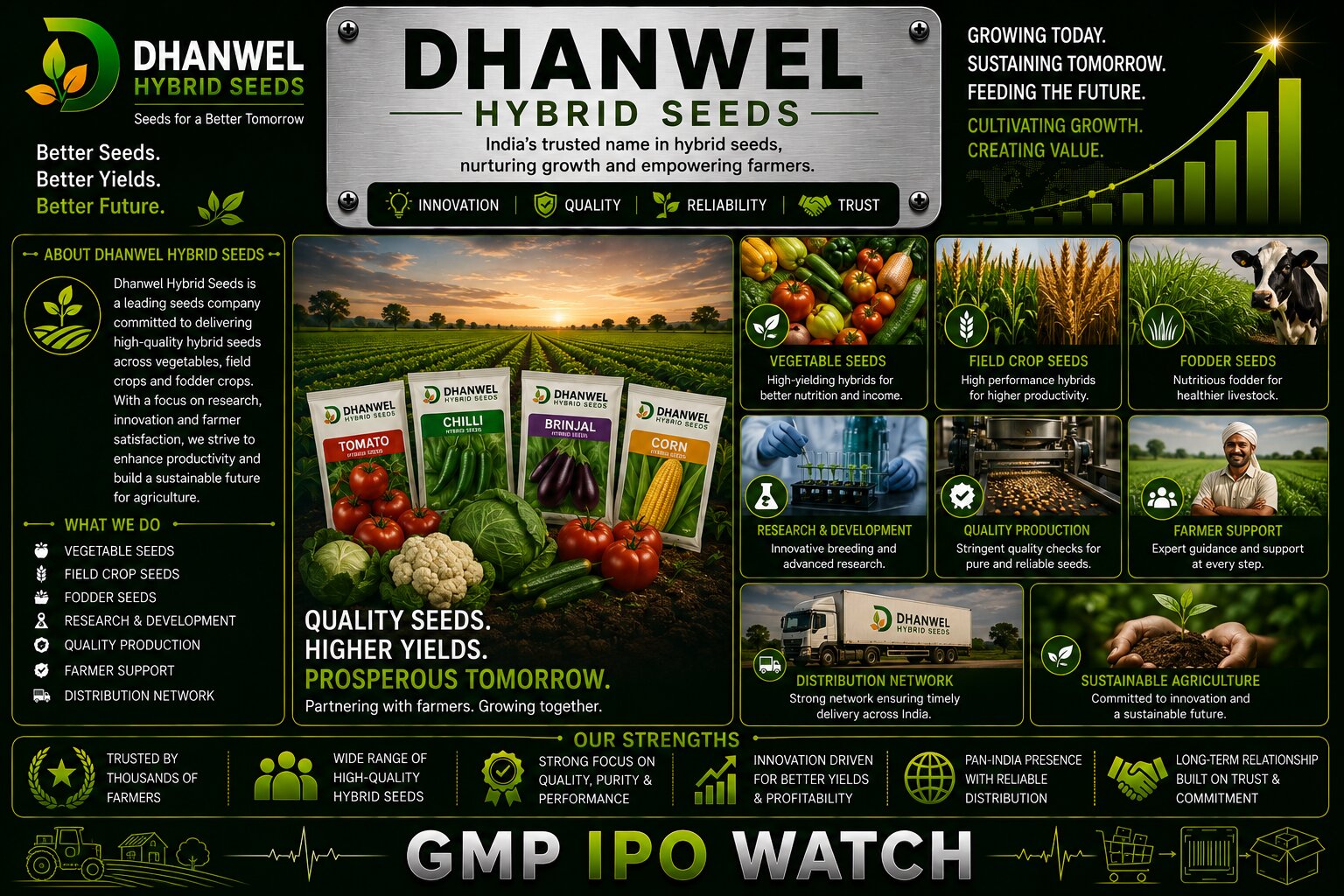
Dhanwel Hybrid Seeds IPO Blog
Agriculture businesses often look simple from the outside.
A farmer buys seeds, plants a crop and sells the harvest.
But the seed industry sitting behind that process involves research material, crop planning, contract farming, processing, testing, storage, packaging and distribution.
Dhanwel Hybrid Seeds Limited operates within this important part of India's agricultural value chain.
The Gujarat-based seed company is now preparing to enter the stock market through its SME IPO.
The Dhanwel Hybrid Seeds IPO opens on August 19, 2026 and closes on August 21, with shares being offered between ₹95 and ₹99 apiece.
For investors, the company presents an interesting combination: strong recent financial growth and exposure to India's large agricultural market, but also the seasonality, customer concentration and liquidity risks normally associated with smaller agri-focused SME businesses.
Dhanwel Hybrid Seeds IPO Details
| Particular | Details |
|---|---|
| IPO Open Date | August 19, 2026 |
| IPO Close Date | August 21, 2026 |
| Price Band | ₹95 – ₹99 |
| Face Value | ₹10 per share |
| Lot Size | 1,200 Shares |
| Retail Minimum | 2,400 Shares |
| Minimum Investment | ₹2,37,600 |
| Issue Size | Approx. ₹26.73 Cr |
| Issue Type | Book Built SME IPO |
| Listing Exchange | BSE SME |
| Allotment Date | August 24, 2026 |
| Refund / Demat Credit | August 25, 2026 |
| Listing Date | August 26, 2026 |
The minimum retail application is significantly larger than a typical mainboard IPO because investors need to bid for 2,400 shares, requiring ₹2.37 lakh at the upper price band.
That higher investment amount makes fundamental evaluation particularly important.
What Does Dhanwel Hybrid Seeds Actually Do?
Dhanwel Hybrid Seeds operates in the production, processing and distribution of agricultural seeds.
The business sources improved genetic seed material and then works with farmers for multiplication and production.
After harvesting, the seeds are brought to the company's processing infrastructure.
They go through several stages before reaching customers.
These can include:
- Cleaning
- Grading
- Processing
- Seed treatment
- Quality checks
- Packing
- Labelling
- Distribution
The objective is to provide farmers with seeds capable of producing reliable agricultural output.
The Business Has Roots Going Back to 2018
The business originally operated through a partnership firm under the name Super Vegetable Seeds, which began operations in 2018.
The business was subsequently converted into Dhanwel Hybrid Seeds Limited in 2024.
This distinction is worth understanding.
The listed corporate entity is relatively new, but the underlying seed operations have existed for several years before the conversion.
For investors, operating history matters because agriculture is heavily influenced by crop seasons and weather cycles.
A business tested across multiple agricultural seasons can provide more useful information than one with only a single year of operations.
Dhanwel Has a Diversified Crop Portfolio
The company's seed portfolio covers several crops rather than depending entirely on one agricultural category.
Products include seeds for crops such as:
- Groundnut
- Soybean
- Gram / Chickpea
- Sesame
- Wheat
- Green Gram
- Black Gram
- Fenugreek
- Cumin
This diversification is important.
Different crops have different seasons, geographic markets and demand patterns.
A broader portfolio can reduce dependence on the performance of one crop category.
However, agriculture remains seasonal overall, so diversification does not completely eliminate volatility.
How Does the Seed Production Model Work?
Dhanwel does not simply manufacture seeds inside a conventional factory.
Seed production begins in the field.
The company procures genetic seed material and provides breeder or foundation seeds to selected contract farmers.
Farmers cultivate the crop under defined production guidelines.
During cultivation, field teams can monitor crop development.
Once the crop reaches maturity and seeds are harvested, the material moves to Dhanwel's processing facility.
The company then converts harvested seed into commercially marketable agricultural seed through cleaning, grading and treatment.
This model means agricultural execution is just as important as factory processing.
Contract Farmers Are Important to the Business
Contract farming allows seed companies to increase production without owning all the farmland themselves.
Instead, the company works with farmers who produce seeds according to specified standards.
This can make the business comparatively asset-light from a land-ownership perspective.
But it creates another dependency.
The quality and quantity of seed production depend on how successfully farmers execute the crop.
Weather, disease, irrigation and farming practices can all affect output.
Strong farmer relationships and field monitoring therefore become important competitive capabilities.
Why Seed Quality Matters So Much
For a farmer, seed quality can directly influence an entire agricultural season.
If a seed has poor germination or weak genetic characteristics, the farmer may lose much more than the purchase price of the seed.
Costs have already been spent on:
- Land preparation
- Fertiliser
- Labour
- Irrigation
- Pesticides
- Equipment
That makes trust extremely important in the seed industry.
Farmers may repeatedly buy from a company when previous crop performance has been satisfactory.
For Dhanwel, building a reliable brand among farmers could therefore become one of its most valuable long-term assets.
FY2026 Was a Breakout Growth Year
The company's latest financial performance is one of the biggest reasons the IPO has attracted attention.
Dhanwel Hybrid Seeds reported the following total income:
| Financial Year | Total Income |
| FY2024 | ₹35.49 Cr |
| FY2025 | ₹44.13 Cr |
| FY2026 | ₹74.59 Cr |
Revenue increased sharply from ₹44.13 crore in FY2025 to ₹74.59 crore in FY2026.
That represents growth of roughly 69% in a single year.
For a company of Dhanwel's size, this is substantial expansion.
Profit Growth Was Even Stronger
Profit After Tax improved faster than revenue.
| Financial Year | PAT |
| FY2024 | ₹1.91 Cr |
| FY2025 | ₹2.16 Cr |
| FY2026 | ₹6.12 Cr |
PAT increased from approximately ₹2.16 crore to ₹6.12 crore in FY2026.
That represents growth of more than 180% year-on-year.
The improvement indicates that the company benefited not only from higher sales but also from better operating leverage and profitability.
The key question is whether this performance can be repeated across future agricultural seasons.
EBITDA Also Improved
Dhanwel's EBITDA increased substantially.
Reported EBITDA was approximately:
₹2.79 crore in FY2024
₹3.66 crore in FY2025
and
₹9.24 crore in FY2026.
The FY2026 EBITDA margin stood at approximately 12.38%.
The PAT margin was around 8.2%.
The improvement in profitability is encouraging, but agriculture-linked margins can vary because seed pricing, crop yields and inventory availability change from season to season.
Return Ratios Look Strong
Based on FY2026 financials, Dhanwel reported strong return metrics.
| KPI | FY2026 |
| ROE | 31.11% |
| ROCE | 49.36% |
| EBITDA Margin | 12.38% |
| PAT Margin | ~8.2% |
| EPS | ₹9.56 |
| RoNW | 31.11% |
| NAV | ₹30.70 |
These figures indicate efficient historical use of capital.
A 31.11% return on net worth is particularly noteworthy.
However, investors should remember that return ratios can change following an IPO because fresh equity increases the company's net worth.
The future test will be whether Dhanwel can generate similar returns from the new capital.
IPO Valuation Looks Moderate on FY2026 Earnings
At the upper price band of ₹99, the IPO's implied P/E ratio based on reported FY2026 EPS of approximately ₹9.56 is around 10.36 times earnings.
That provides one reference point for valuation.
For comparison, listed seed-sector peers can trade at substantially different multiples depending on scale, profitability, brand strength and growth expectations.
A lower P/E does not automatically mean an IPO is cheap.
Investors still need to consider company size, SME liquidity, financial history and business risks.
Peer Comparison
| Company | EPS | P/E Ratio | RoNW |
| Dhanwel Hybrid Seeds | ₹9.56 | 10.36 | 31.11% |
| Bombay Super Hybrid Seeds | ₹2.54 | 39.09 | 20.35% |
| Upsurge Seeds of Agriculture | ₹7.43 | 14.00 | 12.06% |
On reported numbers, Dhanwel shows stronger return on net worth than these cited peers while entering the IPO at a lower earnings multiple.
However, the peer companies differ considerably in operating scale and history, so valuation comparison should not be used in isolation.
Where Will IPO Money Be Used?
The IPO is being raised primarily to strengthen the company's financial capacity.
Two important objectives are:
Working Capital
A significant portion of the IPO proceeds is intended for working-capital requirements.
Debt Repayment
Another portion will be used toward the repayment or prepayment of borrowings.
The remaining amount will be available for general corporate purposes subject to regulatory limits.
These objectives are closely connected with the economics of a seed business.
Why Dhanwel Needs More Working Capital
Seed businesses can consume substantial working capital.
The company needs money months before the final product is sold.
Capital can become tied up in:
- Genetic seed material
- Contract farming
- Seed procurement
- Processing
- Packaging
- Inventory
- Receivables
Agricultural demand is also seasonal.
A company may need to build large seed inventories before the main sowing season.
That means cash is invested before revenue is generated.
Additional IPO working capital could therefore allow Dhanwel to handle greater production and sales volumes.
₹12 Crore-Plus Working Capital Can Support Scale
Current offer information indicates that roughly ₹12 crore or more of the issue proceeds is intended to strengthen working capital.
For a company that generated approximately ₹74.59 crore of FY2026 revenue, this is a meaningful capital injection.
If management uses it efficiently, Dhanwel could expand its production cycle without depending as heavily on short-term borrowing.
But investors should monitor inventory and receivable growth carefully.
Working capital creates value only when it eventually converts into profitable sales and cash.
Debt Reduction Can Lower Finance Costs
Dhanwel reported total borrowings of approximately:
₹1.94 crore in FY2024
₹5.97 crore in FY2025
and
₹7.68 crore in FY2026.
Borrowing increased as the business expanded.
Using IPO proceeds to reduce some of that debt could lower finance costs and improve balance-sheet flexibility.
A lower debt burden can also make it easier for the company to fund future seasonal requirements.
India's Huge Agricultural Market Is the Long-Term Opportunity
Agriculture remains one of India's most important economic sectors.
Millions of farmers require seed every agricultural season.
Improved seeds can play an important role in:
- Increasing crop yield
- Improving disease resistance
- Improving crop quality
- Managing climatic stress
- Reducing crop duration
As farmers become more focused on productivity, demand for reliable branded seed products can increase.
For organised seed companies, this creates a substantial long-term opportunity.
Hybrid and Improved Seeds Can Increase Farm Productivity
The economics of agriculture are increasingly focused on output per acre.
Farmers have limited land.
One way to improve economics is therefore to generate more output from the same acreage.
Seed genetics can contribute to this objective.
Better seed varieties may offer:
- Higher yield
- Better germination
- Improved resistance
- Greater uniformity
This is why seed quality can command meaningful value even though seed itself represents only one part of the farmer's overall crop cost.
India's Seed Market Is Still Fragmented
India's agricultural seed market includes both organised and informal supply.
Many farmers still rely on farm-saved seed or smaller local suppliers.
Organised seed companies can potentially gain share by offering:
- Consistent quality
- Tested germination
- Better packaging
- Reliable genetics
- Distribution support
- Farmer education
This shift toward organised seed supply represents a potential growth opportunity for companies such as Dhanwel.
Distribution Will Determine How Big Dhanwel Can Become
Producing good seeds is only half the challenge.
Farmers need access to them at the right time.
Agricultural purchasing windows can be short.
If seed is not available in a local market before sowing begins, the sale may effectively be lost for the entire season.
Distribution therefore becomes critical.
Dhanwel will need strong relationships with dealers, distributors and agricultural markets as it expands.
Geographic diversification could eventually become just as important as product diversification.
Gujarat Provides a Strong Agricultural Base
Dhanwel operates from Gujarat, an important agricultural state with significant production across oilseeds, pulses, cereals and spices.
Its location provides access to agricultural regions relevant to several products in the company's seed portfolio.
The company's familiarity with crops such as groundnut, sesame and cumin also fits naturally with western India's agricultural ecosystem.
Over time, expansion into additional states could create a significantly larger market.
Weather Is the Biggest External Risk
No seed company can completely escape weather risk.
Rainfall patterns can directly influence:
- Seed production
- Farmer sowing decisions
- Crop acreage
- Seed demand
A weak monsoon or delayed rainfall may cause farmers to change crops or reduce sowing.
Excessive rainfall can also damage production.
Climate volatility therefore creates uncertainty in both Dhanwel's supply chain and customer demand.
Crop Failure Can Affect Seed Availability
Remember that Dhanwel's final product begins as an agricultural crop.
If contract-farming production performs poorly, the company may have less seed available to process and sell.
This could create supply shortages.
The company may also need to procure seed from alternative sources at higher prices.
Weather conditions therefore influence more than end-customer demand—they can also influence production costs and availability.
Agriculture Is Highly Seasonal
Dhanwel should not be evaluated like a software company with smooth monthly revenue.
Seed demand can be concentrated around sowing seasons.
Different crops have kharif and rabi cycles.
Sales can therefore fluctuate significantly between quarters.
Working-capital requirements can also peak before major agricultural seasons.
Investors should evaluate full-year performance rather than interpreting a single quarter in isolation.
Customer Concentration Needs Attention
Smaller agricultural businesses can depend significantly on a limited number of distributors or major customers.
High customer concentration creates risk.
If an important distributor reduces purchases or switches suppliers, revenue can be affected.
As Dhanwel scales, broadening its distribution and customer network would reduce this dependence.
Investor attention after listing should therefore include customer diversification alongside revenue growth.
Supplier and Farmer Relationships Matter
Dhanwel also depends on external agricultural production.
Reliable relationships with farmers and seed-material suppliers are essential.
The company needs:
- Suitable production acreage
- Farmers willing to follow protocols
- Timely agricultural inputs
- Correct harvesting
- Consistent seed quality
Any disruption can influence final production.
Building a larger and more diversified production network could help reduce this risk over time.
Quality Failure Can Damage the Brand Quickly
Seed is a trust-driven product.
A farmer may judge a brand based on germination and crop performance.
If a batch performs poorly, the reputational impact can be serious.
Quality-control procedures are therefore essential.
As Dhanwel increases volumes after the IPO, maintaining quality across larger production batches will become a major operational challenge.
Growth should not come at the expense of germination quality or genetic purity.
Regulatory Compliance Is Important
Agricultural seeds operate within a regulated environment.
Companies need to comply with rules covering areas such as:
- Seed quality
- Labelling
- Certification
- Packaging
- Variety approvals
- Agricultural regulations
Regulatory changes can affect which products can be sold and how they are marketed.
Dhanwel will need to maintain strong compliance systems as it expands across different regions.
SME IPO Risk Is Higher
Dhanwel Hybrid Seeds will list on BSE SME, not on the mainboard.
This creates additional considerations.
SME stocks can have:
- Lower trading volumes
- Lower liquidity
- Wider bid-ask spreads
- Greater price volatility
The retail investment is also relatively large at approximately ₹2.37 lakh.
Investors need to be comfortable holding the shares if post-listing liquidity is limited.
Latest GMP Is ₹0
As of August 18, 2026, Dhanwel Hybrid Seeds' latest reported Grey Market Premium is approximately ₹0.
This means the unofficial market currently indicates no meaningful premium above the upper issue price of ₹99.
A ₹0 GMP does not automatically mean the IPO will list flat.
Nor does it mean the business has no long-term potential.
GMP is unofficial, unregulated and can change quickly.
For Dhanwel, investors may find financial growth, valuation and business execution more useful than short-term grey-market sentiment.
Public Subscription Starts Tomorrow
As of today, August 18, the IPO has not yet opened for public bidding.
Therefore, there is no retail, NII or institutional subscription figure available yet.
Bidding begins tomorrow.
Subscription demand across the three-day window will give investors another indication of market interest.
Final-day numbers will matter more than early Day 1 subscriptions because SME issues can receive significant bids near closing.
What Looks Positive in Dhanwel Hybrid Seeds IPO?
Several aspects of the story are encouraging.
The company recorded strong FY2026 revenue growth.
Profit grew much faster than sales.
ROE and ROCE are healthy.
The IPO is being used primarily to strengthen the business rather than create a large promoter exit.
The valuation based on FY2026 earnings is not excessive compared with cited listed peers.
India's agricultural seed market also provides substantial long-term opportunity.
What Requires Caution?
The risks are equally important.
Dhanwel remains a relatively small company.
FY2026 was exceptionally strong, and investors do not yet know whether this growth rate is sustainable.
Agriculture depends heavily on weather and crop cycles.
Working capital can be significant.
Customer and supplier concentration can create volatility.
Seed quality is critical.
And BSE SME liquidity may be lower after listing.
Investors should therefore avoid treating one strong financial year as a guaranteed long-term growth trajectory.
What Should Investors Track After Listing?
Several indicators could provide a clearer picture of whether the IPO capital is creating value:
- Revenue growth
- PAT growth
- EBITDA margin
- Working-capital cycle
- Inventory levels
- Operating cash flow
- Debt reduction
- New crop varieties
- Distributor additions
- Geographic expansion
- Customer concentration
- Seed-processing volumes
- Return on capital
Operating cash flow will be particularly important.
Strong reported profits become much more valuable when they consistently convert into cash.
Final View on Dhanwel Hybrid Seeds IPO
The Dhanwel Hybrid Seeds IPO opens on August 19, 2026, with a price band of ₹95–₹99 per share and closes on August 21.
Retail investors need to apply for a minimum 2,400 shares, requiring approximately ₹2,37,600 at the upper price band.
The company is expected to list on BSE SME on August 26, 2026.
From a business perspective, Dhanwel offers exposure to a fundamental part of India's agricultural economy: the seed that begins the entire crop cycle.
The company's FY2026 numbers are attractive.
Revenue increased from approximately ₹44.13 crore to ₹74.59 crore, while PAT jumped from around ₹2.16 crore to ₹6.12 crore.
Reported ROE of 31.11%, ROCE of 49.36% and FY2026 EPS of approximately ₹9.56 also show strong recent operating performance.
But this is not a predictable consumer or technology business.
Dhanwel remains exposed to weather, crop cycles, working-capital requirements, farmer production, distribution and seed-quality risks.
The latest GMP of approximately ₹0 also means there is currently little visible grey-market excitement ahead of the opening.
That may actually make the IPO easier to evaluate on fundamentals.
For investors studying Dhanwel Hybrid Seeds, the most important question is not whether the stock receives an immediate listing premium.
It is whether the company can use fresh IPO capital to convert one exceptional FY2026 growth year into a durable seed business across multiple agricultural seasons and geographies.




Loading comments...