

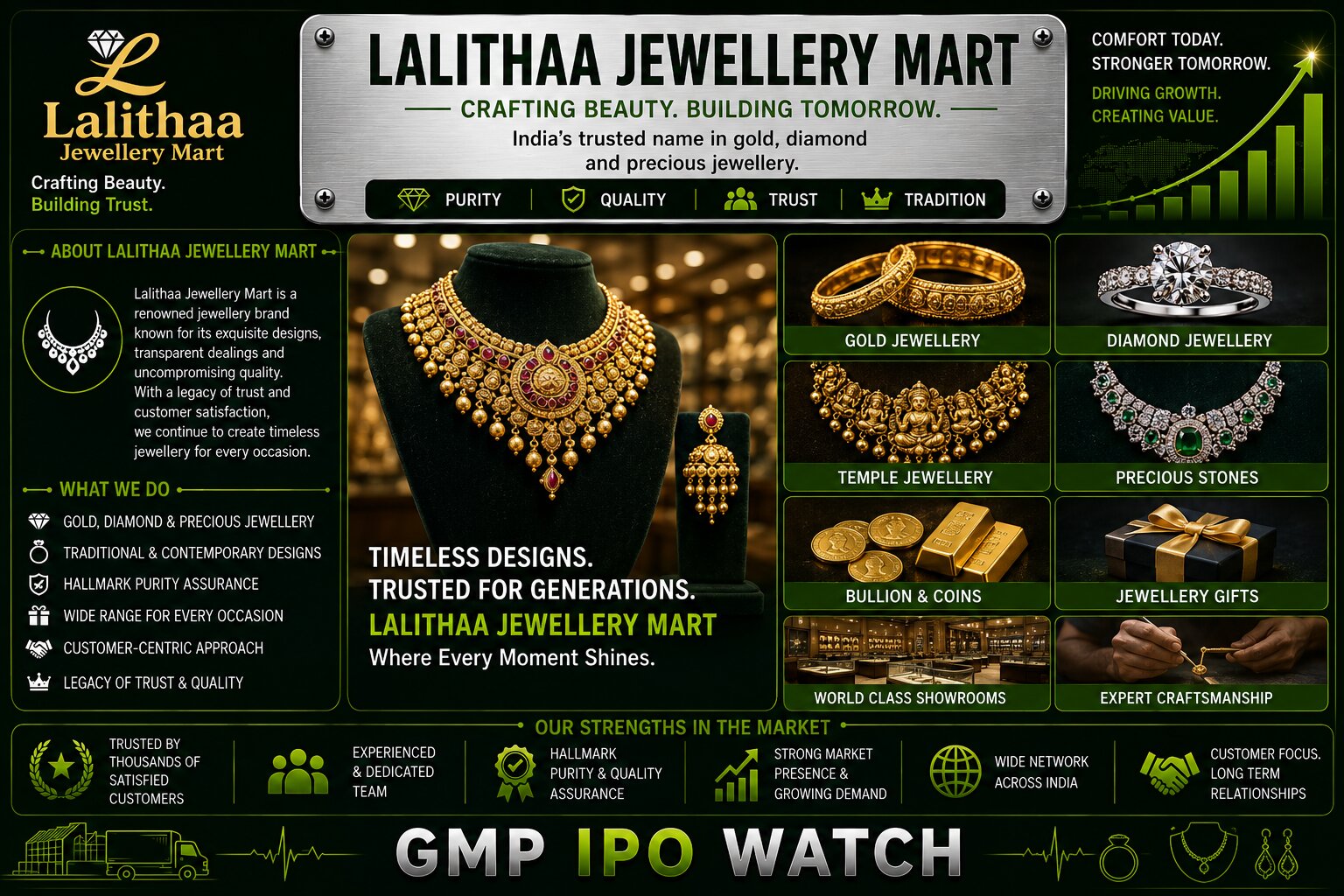
Lalithaa Jewellery Mart Limited is preparing to open its Initial Public Offering for subscription on August 17, 2026, bringing one of South India's largest organised jewellery retailers to India's mainboard primary market.
The company is looking to raise a total of ₹1,700 crore through the public offering.
Lalithaa Jewellery Mart has fixed the IPO price band between ₹190 and ₹201 per equity share, with a face value of ₹5 per share.
The issue will remain open for public subscription until August 19, 2026.
Before the public bidding begins, the company's anchor investor book is scheduled to open on August 14, making institutional participation the next important development for the IPO.
₹1,700 Crore Lalithaa Jewellery Mart IPO
The public offering comprises two components.
The first is a fresh issue worth ₹1,200 crore.
The second is an Offer for Sale worth ₹500 crore.
Promoter Kiran Kumar Jain will sell shares through the OFS.
The structure is important because more than 70% of the overall IPO consists of fresh capital going into the company.
The ₹500 crore generated through the OFS will go to the selling shareholder rather than Lalithaa Jewellery Mart.
Lalithaa Jewellery Mart IPO Important Dates
The IPO opens on:
August 17, 2026
It closes on:
August 19, 2026
Anchor bidding is scheduled for:
August 14, 2026
The basis of allotment is expected on:
August 20, 2026
Refunds and credit of shares are expected around:
August 21, 2026
The shares are proposed to list on both the BSE and NSE on August 24, 2026.
Price Band Fixed at ₹190–₹201
The company has fixed the IPO price band at:
₹190 to ₹201 per share
The lot size is 74 equity shares.
At the upper price band of ₹201, the minimum retail investment for one lot works out to approximately:
₹14,874
A retail investor can apply for additional lots subject to applicable IPO investment limits.
Eligible employees have also been provided a ₹19 per share discount under the employee reservation portion.
What Does Lalithaa Jewellery Mart Do?
Lalithaa Jewellery Mart is a Chennai-headquartered jewellery retailer with a strong presence across South India.
The company's history dates back to 1985.
Over the following decades, Lalithaa Jewellery developed from a regional jewellery business into a large organised retailer with stores across multiple southern states.
The company sells a broad range of:
- Gold jewellery
- Diamond jewellery
- Silver jewellery
- Precious-stone jewellery
- Semi-precious jewellery
- Gold coins and related products
Its jewellery collections are designed around regional consumer preferences and different price points.
61-Store Jewellery Network
Lalithaa Jewellery Mart currently operates approximately 61 stores across South India.
Its presence spans:
Tamil Nadu
Andhra Pradesh
Telangana
Karnataka
and
Puducherry
This provides the company with one of the larger retail footprints among regional organised jewellery companies.
Its physical network is particularly important because jewellery remains a category where customers often prefer to inspect products in person before making high-value purchases.
Tier-II and Tier-III Cities Are a Major Strength
One of the most distinctive aspects of Lalithaa Jewellery's network is its exposure to smaller cities.
Of the company's 61 stores, approximately 45 are located in Tier-II and Tier-III cities.
These locations contributed approximately 60.25% of FY2026 revenue.
This demonstrates that Lalithaa Jewellery's growth is not dependent only on Chennai, Hyderabad, Bengaluru and other large metropolitan markets.
Smaller cities have become increasingly important for organised jewellery retailers as income levels rise and consumers shift from local unorganised jewellers toward branded stores.
Mass and Value-Conscious Customers
Lalithaa Jewellery Mart primarily positions itself toward mass-market and value-conscious jewellery buyers.
Pricing is particularly important in the jewellery industry.
For customers purchasing large quantities of gold for weddings or festivals, even a relatively small difference in making charges can significantly affect the final bill.
The company's focus on value-oriented jewellery has therefore played an important role in developing its customer base.
IPO Funds to Open 10 New Stores
The central growth objective behind the fresh issue is retail expansion.
Lalithaa Jewellery Mart plans to use IPO proceeds to establish 10 new stores.
Opening 10 additional stores represents a meaningful expansion of its existing network.
If all proposed outlets become operational, the company could increase its retail presence substantially.
New stores can provide access to additional customers and markets, but jewellery outlets require significant upfront capital.
That is particularly because stores need to hold large quantities of valuable gold inventory from the day they open.
Nearly ₹999 Crore Planned for Inventory
The largest IPO expenditure is therefore not construction—it is jewellery inventory.
Approximately ₹998.68 crore of IPO proceeds is planned for inventory required for the proposed new stores.
This represents the majority of the fresh capital being raised.
The number highlights how capital-intensive jewellery retail can be.
A new jewellery showroom cannot operate with empty display counters.
It needs significant inventory across different designs, weights, price ranges and jewellery categories.
Because gold itself is extremely valuable, building inventory for 10 stores requires substantial capital.
₹34.55 Crore for Store Fit-Outs
The company also proposes to use approximately ₹34.55 crore toward capital expenditure associated with the new stores.
This includes spending on areas such as:
- Furniture
- Fixtures
- Equipment
- IT hardware
- Software
- Store infrastructure
Jewellery stores require specialised security, display and operational infrastructure.
The remaining fresh issue proceeds will be used toward general corporate purposes according to the IPO structure.
Why Inventory Is So Important
Jewellery retail works differently from many conventional retail businesses.
Customers expect substantial product choice when visiting a showroom.
A consumer buying jewellery for a wedding may want to compare dozens of necklaces, bangles, earrings and other products before selecting one.
This means retailers need to maintain broad inventory.
Insufficient inventory can reduce conversion because customers may simply visit another jeweller offering greater choice.
Lalithaa Jewellery's decision to allocate nearly ₹1,000 crore toward inventory therefore directly supports its store-expansion strategy.
FY2026 Revenue Crosses ₹25,000 Crore
The company enters the IPO with substantial operating scale.
Lalithaa Jewellery Mart reported FY2026 revenue from operations of approximately ₹25,023.9 crore.
This compares with approximately:
₹16,897.3 crore in FY2025
and
₹16,788.1 crore in FY2024.
FY2026 therefore represented a major acceleration in the company's business.
Revenue increased approximately 48% year-on-year.
This makes Lalithaa Jewellery one of the largest jewellery retailers approaching India's public markets by revenue.
Profit Surges in FY2026
Profitability showed an even sharper improvement.
Lalithaa Jewellery Mart reported approximately ₹1,009.8 crore Profit After Tax in FY2026.
This compares with approximately:
₹364.7 crore in FY2025
and
₹359.8 crore in FY2024.
FY2026 PAT therefore increased by roughly 177% compared with FY2025.
The sharp increase in earnings is one of the most important financial developments investors are likely to evaluate during the IPO.
FY2026 EBITDA Margin Improves
Operating profitability also strengthened.
The company's EBITDA margin increased to approximately 6.7% in FY2026, compared with about 4.4% in FY2025 and 4.1% in FY2024.
For a jewellery retailer processing extremely high-value gold sales, relatively small improvements in percentage margins can have a major impact on absolute earnings.
The sustainability of FY2026's stronger profitability will therefore be closely watched after listing.
Revenue Per Store Is an Important Strength
Lalithaa Jewellery has also highlighted its strong store productivity.
The company claims to have among the highest operating revenue per store among major organised jewellery players considered in its industry comparison.
Strong revenue per store can indicate high customer traffic, large transaction values or efficient utilisation of retail infrastructure.
Store productivity becomes particularly important as the company prepares to add another 10 locations.
Investors will eventually evaluate whether new stores can achieve similar economics.
Gold Remains Deeply Embedded in Indian Consumption
The long-term backdrop for jewellery demand remains substantial.
India is one of the world's largest consumers of gold.
Gold jewellery has a unique role because it serves multiple purposes simultaneously.
It is purchased as:
- Jewellery
- Wedding expenditure
- Festival spending
- Gifting
- Family wealth
- Long-term savings
- A store of value
This cultural and financial role creates structural demand that is difficult to replicate in most other consumer categories.
Weddings Remain a Major Demand Driver
India's wedding industry represents one of the largest sources of gold jewellery demand.
Families can spend substantial amounts on jewellery during weddings.
Demand therefore extends across necklaces, bangles, earrings, chains, rings and other traditional products.
South India has particularly strong cultural demand for gold jewellery during marriages and family occasions.
Lalithaa Jewellery's established southern presence provides direct exposure to this market.
Festivals Generate Seasonal Jewellery Sales
Festivals are another major driver.
Akshaya Tritiya, Dhanteras, Diwali and regional festivals can produce significant jewellery purchases.
Retailers prepare inventory in advance of these periods.
Successful festival sales can materially influence quarterly financial performance.
However, seasonality also means jewellery companies need careful inventory planning.
Too little inventory can lead to lost sales, while excessive inventory ties up substantial capital.
South India Is a Major Gold Market
South India has historically represented a significant share of India's jewellery consumption.
Gold is deeply embedded in wedding, festival and savings traditions across Tamil Nadu, Andhra Pradesh, Telangana and Karnataka.
This provides Lalithaa Jewellery with a large underlying market.
The company's decades-long presence also provides significant regional brand recognition.
However, South India is simultaneously one of India's most competitive jewellery markets.
Competition Is Extremely Strong
Lalithaa Jewellery competes against both national and regional companies.
Large organised jewellery players have expanded aggressively across South India.
Competition exists across areas such as:
- Gold pricing
- Making charges
- Designs
- Store locations
- Customer service
- Jewellery schemes
- Advertising
- Brand reputation
Independent local jewellers also remain important competitors because many have longstanding relationships with local families.
Maintaining differentiation will therefore be critical.
Organised Jewellery Continues Gaining Share
Despite competition, a structural shift toward organised jewellery retail provides a favourable industry backdrop.
Consumers increasingly prefer organised retailers because of greater transparency around:
- Gold purity
- Hallmarking
- Billing
- Pricing
- Product exchange
- Buyback policies
- Brand trust
Government formalisation measures have also encouraged consumers to move toward established businesses.
Large regional retailers such as Lalithaa Jewellery could potentially benefit from this transition.
Hallmarking Supports Organised Players
Mandatory hallmarking has increased transparency across India's gold jewellery market.
Customers increasingly expect clear purity standards.
Organised retailers with formal procurement and quality-control processes may benefit from this environment.
Trust is especially important because jewellery purchases often represent substantial household savings.
Any quality or purity issue can significantly damage a jewellery brand.
In-House Manufacturing Provides Greater Control
Lalithaa Jewellery also has in-house manufacturing capabilities.
Vertical integration can provide greater control over product quality, design development and inventory.
It can also potentially reduce dependence on third-party manufacturers.
Manufacturing capabilities may allow the company to respond faster to changes in consumer preferences.
However, manufacturing also introduces operational complexity and requires skilled artisans.
Jewellery Designs Are Highly Regional
Indian jewellery is not a uniform market.
Consumer preferences differ significantly between regions.
Tamil Nadu customers may favour designs different from those preferred in Telangana or Karnataka.
Wedding traditions also influence jewellery styles.
A successful regional retailer therefore needs a broad product portfolio adapted to local tastes.
Lalithaa Jewellery's long operating history provides experience in understanding these regional preferences.
Jewellery Savings Schemes Support Customer Retention
The company also offers jewellery purchase schemes designed to encourage customers to save periodically toward future purchases.
Such programmes can improve customer retention.
They can also create repeat store visits and provide visibility into future demand.
However, jewellery schemes require strong financial controls and regulatory compliance because companies receive customer money before the final jewellery purchase.
Gold Price Volatility Remains a Major Risk
One of the largest risks facing Lalithaa Jewellery is gold-price volatility.
Gold prices can move significantly because of global factors including:
- Interest rates
- Inflation
- Geopolitical uncertainty
- Currency movements
- Central-bank purchases
- Investment demand
Higher gold prices can increase reported revenue even when physical sales volumes do not increase proportionately.
Investors should therefore examine volume growth alongside headline revenue.
Higher Gold Prices Increase Working Capital
Gold-price increases also make expansion more expensive.
Suppose a store needs a fixed quantity of gold jewellery inventory.
If gold prices increase by 20%, the retailer may need approximately 20% more capital simply to hold a similar quantity of gold.
This explains why almost ₹999 crore is being allocated toward inventory for only 10 proposed stores.
The jewellery business can consume significant capital as it expands.
FY2026 Operating Cash Flow Is a Key Risk
Despite reporting strong accounting profits, Lalithaa Jewellery recorded approximately ₹397.8 crore of negative operating cash flow in FY2026.
This deserves investor attention.
A company can report strong profits while simultaneously consuming cash if inventory and receivables increase substantially.
For a rapidly growing jewellery retailer, expansion can create precisely this situation.
Investors should therefore monitor whether future earnings translate into sustainable operating cash flow.
Free Cash Flow Was Also Negative
FY2026 free cash flow was approximately negative ₹464.6 crore.
This contrasts with positive operating cash flow of around ₹288.7 crore in FY2025.
The deterioration reflects the capital and working-capital requirements associated with rapid expansion.
It does not automatically indicate financial distress, but it highlights the importance of cash-flow analysis when evaluating a jewellery retailer.
New Stores Need Time to Mature
The proposed 10-store expansion creates significant growth potential, but new stores may not immediately achieve the productivity of established outlets.
A new location requires:
- Brand awareness
- Local customer relationships
- Staff recruitment
- Inventory optimisation
- Marketing
- Customer acquisition
Revenue can therefore take time to reach mature levels.
Meanwhile, inventory worth crores of rupees is already deployed.
The speed at which new stores achieve healthy sales will be important for return on capital.
Tier-II and Tier-III Expansion Provides Opportunity
Smaller cities represent an important opportunity.
Rising incomes, urbanisation and greater exposure to organised retail are changing consumer behaviour outside India's largest metros.
Customers in Tier-II and Tier-III cities increasingly seek branded jewellery while maintaining strong cultural demand for gold.
Lalithaa Jewellery already generates a majority of revenue from these markets, giving it experience that could support future expansion.
But Smaller Markets Also Bring Risks
Smaller cities can have different competitive dynamics.
Local jewellers may have customer relationships extending across generations.
Real-estate economics, consumer purchasing power and jewellery preferences also vary significantly.
Selecting the right location is therefore critical.
A poorly performing jewellery showroom can lock up substantial inventory while generating insufficient revenue.
Promoter OFS Worth ₹500 Crore
The IPO includes a ₹500 crore Offer for Sale by promoter Kiran Kumar Jain.
The OFS provides partial liquidity to the promoter.
Investors should distinguish this from the ₹1,200 crore fresh issue.
The company receives no proceeds from the OFS.
However, the fact that the fresh issue represents the majority of the IPO means most of the overall fundraising remains directed toward business expansion.
Corporate Governance Will Remain in Focus
Lalithaa Jewellery's IPO journey previously faced investor scrutiny around issues including promoter remuneration, governance and structural financial metrics.
The company subsequently returned to the market with its IPO plans.
As a listed company, governance standards, related-party transactions, board oversight, disclosures and promoter compensation are likely to receive greater investor attention.
Public-market scrutiny can ultimately encourage stronger institutional processes, but governance remains an area investors should evaluate carefully.
Strong FY2026 Numbers Need Context
The sharp FY2026 increase in revenue and profit is encouraging, but investors should consider the full financial trend.
FY2025 revenue growth was comparatively modest before the significant acceleration in FY2026.
Gold-price movements can also influence jewellery revenue considerably.
Investors may therefore want to evaluate:
- Same-store sales growth
- Gold volume growth
- New store contribution
- Revenue per store
- Inventory turnover
- Making-charge income
- Operating cash flow
These indicators can provide more context than headline revenue alone.
Mainboard IPO Allocation
The IPO follows the conventional mainboard allocation structure.
Approximately:
50% of the net offer is available for Qualified Institutional Buyers
15% for Non-Institutional Investors
and
35% for retail investors
Institutional demand during the issue will be an important indicator of how professional investors evaluate the company's valuation and growth strategy.
Anchor Book Opens August 14
The immediate development to watch is the anchor book opening tomorrow, August 14.
Anchor investors typically include mutual funds, insurance companies, foreign institutional investors and other large investors.
The anchor allocation can provide an early indication of institutional demand before public bidding begins.
However, anchor participation does not guarantee post-listing performance.
Public Subscription Starts Monday
Retail and other public bidding begins on Monday, August 17.
The subscription period runs for three days through August 19.
Investors will closely monitor demand from QIBs, NIIs and retail bidders.
Final-day institutional bidding can substantially change subscription figures, so early subscription data should not be interpreted as the complete demand picture.
What Investors Should Watch After Listing
For Lalithaa Jewellery Mart, the most important post-IPO indicators are likely to include:
- New store openings
- Revenue growth
- Same-store sales growth
- PAT growth
- EBITDA margin
- Revenue per store
- Inventory turnover
- Operating cash flow
- Gold volume growth
- Store-level profitability
- Return on capital
- Working-capital requirements
The performance of the 10 proposed stores will be particularly important because more than ₹1,000 crore of IPO capital is connected with their inventory and infrastructure.
Lalithaa Jewellery Mart IPO in Focus Today
As of August 13, 2026, Lalithaa Jewellery Mart is just days away from launching one of the year's larger consumer-sector IPOs.
The ₹1,700 crore mainboard issue opens August 17, with a ₹190–₹201 price band and 74-share lot size.
The issue comprises a ₹1,200 crore fresh issue and ₹500 crore OFS, while the company's shares are scheduled to list on the BSE and NSE on August 24, 2026.
The biggest growth story behind the IPO is the proposed opening of 10 new jewellery stores. Approximately ₹998.68 crore is earmarked for their inventory, while about ₹34.55 crore will fund furniture, fixtures, equipment, IT hardware and software.
Lalithaa enters the IPO with an established 61-store South Indian network, including 45 outlets in Tier-II and Tier-III cities. FY2026 revenue reached approximately ₹25,023.9 crore, while PAT increased sharply to approximately ₹1,009.8 crore.
The company's scale, strong regional brand, rapid FY2026 growth and exposure to India's shift toward organised jewellery retail provide important positives. At the same time, investors need to consider gold-price volatility, large inventory requirements, negative FY2026 operating cash flow, competition, store-expansion execution and governance considerations.

Loading comments...