

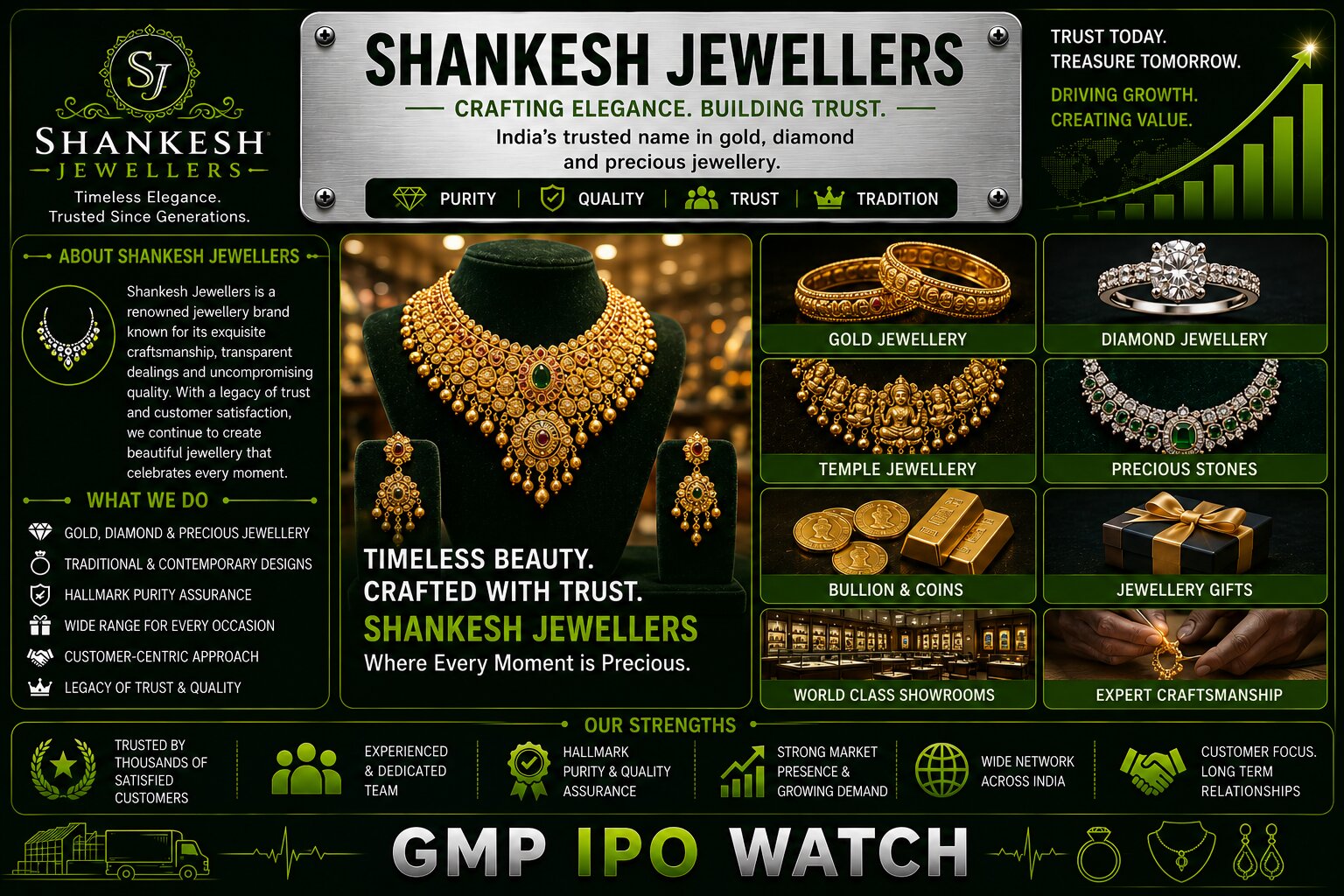
Shankesh Jewellers Limited is preparing to launch its Initial Public Offering on August 18, 2026, bringing another established jewellery company to India's mainboard primary market.
The IPO will remain open for public subscription until August 20, 2026, while the anchor investor bidding is scheduled to take place on August 17.
The company has fixed its IPO price band at ₹88 to ₹93 per equity share, with a face value of ₹5 each.
At the upper end of the price band, Shankesh Jewellers is looking to raise approximately ₹367.18 crore through the public offering.
The IPO combines a fresh issue with an Offer for Sale, giving the company new growth capital while also allowing existing shareholders to sell part of their holdings.
₹367.18 Crore Shankesh Jewellers IPO
The overall public offering is valued at approximately ₹367.18 crore at the upper price band.
The issue comprises a fresh issue aggregating up to ₹274.18 crore and an Offer for Sale worth approximately ₹93 crore.
This distinction is important for investors.
Money raised through the fresh issue will flow to Shankesh Jewellers and can be deployed toward the objectives disclosed by the company.
The proceeds generated through the OFS, however, will go to the selling shareholders and will not be available to the company for business expansion.
Shankesh Jewellers IPO Opens August 18
The IPO is scheduled to open on:
August 18, 2026
The issue closes on:
August 20, 2026
Anchor investor bidding is scheduled for:
August 17, 2026
The basis of allotment is expected on:
August 21, 2026
The company's shares are tentatively scheduled to list on the:
BSE and NSE on August 25, 2026
The proposed listing will mark Shankesh Jewellers' transition into a publicly traded jewellery company.
Price Band Fixed at ₹88–₹93
Shankesh Jewellers has fixed the IPO price band at ₹88 to ₹93 per share.
The minimum application lot contains 160 equity shares.
At the upper price of ₹93, one retail lot requires an investment of:
₹14,880
Investors can submit applications in multiples of 160 shares thereafter, subject to the applicable retail investment limits.
The relatively conventional mainboard application size makes the IPO accessible to a broad base of retail investors.
What Does Shankesh Jewellers Do?
Shankesh Jewellers operates in India's gold jewellery manufacturing and wholesale market.
The company is primarily engaged in designing and supplying gold jewellery products across multiple categories.
Its business is strongly oriented toward the B2B jewellery market, where products are supplied to jewellery retailers and other industry participants.
Rather than depending primarily on a large company-owned retail-store network, the business has developed around manufacturing, customisation and distribution.
This creates a relatively different operating model from major consumer-facing jewellery chains.
Strong Presence in Gold Jewellery
Gold jewellery remains the core of Shankesh Jewellers' business.
The company offers jewellery across multiple designs, styles and price points.
Its products are developed for different customer preferences and regional markets.
India's jewellery market is highly diverse.
Jewellery styles popular in Maharashtra can differ considerably from those preferred in Gujarat, Rajasthan, South India or eastern states.
A manufacturer supplying retailers across several markets therefore needs significant design flexibility.
Shankesh Jewellers has built its model around this requirement.
Customisation Is an Important Strength
One important aspect of the company's business is customised jewellery manufacturing.
Retail jewellers frequently need products designed according to regional trends, customer preferences and changing fashion.
This makes flexibility particularly important for B2B jewellery suppliers.
Customisation can also help manufacturers build longer relationships with retail customers because designs can be tailored around specific market requirements.
However, this model requires skilled craftsmanship and strong inventory management.
Pan-India Customer Presence
Shankesh Jewellers has developed a broad geographic footprint.
Its business reaches customers across more than 20 Indian states and union territories, providing the company with exposure to multiple jewellery markets.
Geographic diversification can be beneficial because jewellery demand varies across regions and festivals.
A wider customer network also reduces dependence on a single city or state.
However, managing customers across a large geographic area increases logistics, inventory and receivable-management requirements.
Mumbai Provides a Strategic Base
The company's presence in Mumbai's Zaveri Bazaar jewellery ecosystem provides an important strategic advantage.
Mumbai is one of India's largest jewellery trading and manufacturing centres.
The Zaveri Bazaar ecosystem provides access to bullion traders, jewellery wholesalers, manufacturers, artisans and retailers.
Operating within such a cluster can support procurement, customer relationships and product development.
It also exposes the company to changing market trends across India's jewellery sector.
Fresh Issue to Support Working Capital
One of the most important objectives of the Shankesh Jewellers IPO is working capital funding.
Jewellery is an unusually working-capital-intensive industry.
Gold represents a high-value raw material.
A jewellery manufacturer needs substantial capital to purchase gold, manufacture products, maintain inventory and extend credit to customers.
As revenue increases, the amount of capital locked into inventory and receivables can rise significantly.
The IPO is therefore expected to strengthen the company's ability to support a larger business scale.
Why Working Capital Matters So Much
Consider the economics of a jewellery manufacturer.
Even relatively small quantities of gold can represent crores of rupees in inventory.
Before a finished jewellery product can be sold, the manufacturer needs to purchase raw material and incur labour and manufacturing costs.
Products may then remain in inventory before being sold to retailers.
Retail customers may also receive credit periods.
This creates a significant gap between the time money is spent and the time cash is collected.
Additional working capital can therefore allow Shankesh Jewellers to process larger orders and serve more customers.
Debt Repayment Is Another IPO Objective
The company also proposes to use part of the fresh issue proceeds for repayment or prepayment of certain borrowings.
Reducing debt can lower finance costs.
This is particularly relevant in a working-capital-intensive business.
Jewellery companies often use borrowing facilities to finance inventory.
Lower interest expenses can potentially improve profitability and cash flows.
The post-IPO balance sheet will therefore be an important area for investors to monitor.
FY2026 Revenue Reaches ₹1,630.79 Crore
Shankesh Jewellers enters the IPO with substantial operating scale.
For FY2026, the company reported revenue of approximately:
₹1,630.79 crore
This demonstrates the scale already achieved by the business before its public-market debut.
Revenue growth has been supported by higher jewellery sales and expansion of the company's customer network.
Maintaining this growth after listing will depend partly on how efficiently the company deploys its new working capital.
PAT Crosses ₹106 Crore
Profitability also improved strongly.
For FY2026, Shankesh Jewellers reported Profit After Tax of approximately ₹106.68 crore.
The earnings performance represents an important factor in the IPO investment discussion.
Strong profit growth alongside increasing revenue suggests improving operating performance.
However, jewellery-company profitability can be affected by gold-price volatility, inventory management, finance costs and competitive pricing.
Investors will therefore need to assess whether recent margins can be sustained.
Return on Equity Is Strong
Shankesh Jewellers has also reported strong return ratios.
Its reported Return on Equity is approximately 50.94%.
Such a high ROE indicates that the company generated substantial earnings relative to its existing shareholder equity base.
However, investors should understand that ROE can change significantly following an IPO.
The fresh issue will substantially increase the company's net worth.
Future ROE will therefore depend on how quickly management can deploy the new equity capital and generate additional earnings.
ROCE Also Remains Healthy
The company's reported Return on Capital Employed stands at approximately 41.57%.
ROCE measures how efficiently a company generates operating profits from the capital employed in the business.
A strong ROCE is generally encouraging.
However, as with ROE, future performance will depend on how effectively the IPO capital is deployed.
The post-listing trend in return ratios could therefore be more important than the pre-IPO number alone.
PAT Margin Around 6.5%
Shankesh Jewellers reported a PAT margin of approximately 6.54%.
Jewellery businesses typically operate on lower percentage margins than many technology or service companies because of the high value of gold passing through revenue.
A 6%-plus PAT margin can therefore translate into substantial absolute profits when revenue exceeds ₹1,600 crore.
The company's ability to maintain margins while expanding sales will remain important.
Gold Prices Can Affect the Business
Gold prices represent one of the biggest external variables affecting jewellery companies.
Gold prices can fluctuate because of:
- Global interest rates
- Currency movements
- Central-bank purchases
- Geopolitical uncertainty
- Inflation expectations
- Investor demand
- International bullion markets
Rapid increases in gold prices can raise working-capital requirements.
They can also temporarily affect consumer demand because jewellery becomes more expensive.
Shankesh Jewellers needs to manage these fluctuations carefully.
Rising Gold Prices Increase Capital Requirements
For a B2B jewellery manufacturer, higher gold prices have a particularly important consequence.
The same physical quantity of inventory requires more money to finance.
For example, if gold prices rise substantially while sales volumes remain unchanged, the company may still require additional working capital simply to maintain its existing inventory.
This helps explain why working-capital funding is a major objective of the IPO.
Jewellery Demand Remains Culturally Strong
India remains one of the world's largest jewellery markets.
Gold has deep cultural and financial importance across the country.
Jewellery purchases are strongly associated with:
- Weddings
- Festivals
- Religious occasions
- Family celebrations
- Gifting
- Long-term savings
These structural factors provide a large underlying market for jewellery manufacturers.
Even as consumer preferences evolve, gold remains an important part of Indian household spending.
Wedding Demand Is a Major Driver
India's wedding industry represents one of the largest sources of jewellery demand.
Families often purchase substantial quantities of jewellery ahead of weddings.
This creates seasonal demand across the jewellery supply chain.
Manufacturers supplying retailers can benefit when jewellery stores increase inventory ahead of wedding seasons.
However, demand can fluctuate depending on gold prices, economic conditions and consumer sentiment.
Festivals Create Seasonal Demand
Festivals such as Dhanteras, Diwali and Akshaya Tritiya are important jewellery-buying occasions.
Retail jewellers generally prepare inventory before these periods.
This creates demand for manufacturers and wholesalers several weeks or months before the actual festival.
Efficient production and inventory planning are therefore important for B2B suppliers such as Shankesh Jewellers.
Organised Jewellery Market Is Expanding
India's jewellery industry has historically included a large number of small, independent businesses.
The market is gradually becoming more organised.
Consumers increasingly value:
- Hallmarked jewellery
- Transparent pricing
- Product certification
- Reliable purity
- Established brands
- Professional service
Greater formalisation can also benefit organised B2B manufacturers supplying compliant products to jewellery retailers.
Hallmarking Has Changed the Industry
Mandatory hallmarking requirements have increased the importance of purity and compliance.
Jewellery manufacturers need to maintain strict standards.
This creates additional operating requirements but can also benefit organised businesses with established quality-control systems.
Retailers increasingly prefer suppliers capable of consistently delivering compliant jewellery.
Quality and reliability could therefore become more important competitive factors over time.
B2B Model Reduces Retail Expansion Costs
Shankesh Jewellers' B2B-oriented model differs from large jewellery chains that need to invest heavily in stores.
Retail stores require expensive locations, interiors, employees, security and local marketing.
A wholesale manufacturing model can potentially expand across regions without requiring the same level of physical retail investment.
However, it creates other risks.
The company becomes more dependent on retailer relationships and wholesale pricing.
It also needs to carefully manage customer credit.
Customer Relationships Are Important
Jewellery is a trust-based industry.
Retailers need confidence in their suppliers' product purity, design quality, delivery reliability and pricing.
Long-term relationships can therefore create repeat business.
A manufacturer that consistently fulfils orders can become an important supplier to retailers.
Maintaining these relationships will remain critical as Shankesh Jewellers expands.
Design Capability Can Create Differentiation
Jewellery trends change continuously.
Consumers increasingly discover designs through social media, influencers and online jewellery platforms.
Manufacturers therefore need to respond quickly to changing preferences.
Companies with strong design capabilities can potentially launch new collections faster.
Shankesh Jewellers' customisation model could provide an advantage if it continues adapting effectively to changing trends.
Skilled Artisans Remain Essential
Despite advances in manufacturing technology, jewellery production continues to rely heavily on skilled craftsmanship.
Artisans play an important role in creating intricate designs and finishing products.
Availability and retention of skilled workers can therefore influence manufacturing quality and capacity.
Competition for experienced artisans represents an operational consideration for jewellery companies.
Digital Jewellery Discovery Is Growing
Consumers increasingly research jewellery online before visiting physical stores.
Social media and digital catalogues have made jewellery trends spread faster across regions.
This influences B2B manufacturers as well.
Retailers need access to new designs more frequently to keep their collections relevant.
Manufacturers capable of rapidly converting design trends into production may benefit from this change.
Export Opportunity Could Provide Future Growth
India has a well-established jewellery export industry.
Indian manufacturers supply jewellery to customers across several international markets.
While Shankesh Jewellers' current business is strongly focused on domestic distribution, broader international opportunities could provide an additional avenue for long-term expansion.
Export growth, however, would introduce additional requirements around compliance, currency risk and international customer relationships.
Competition Remains Intense
India's jewellery industry is highly competitive.
Shankesh Jewellers competes with:
- Large organised jewellery manufacturers
- Regional wholesalers
- Independent manufacturers
- Branded jewellery companies
- Local artisans
Competition can influence both selling prices and margins.
The company therefore needs to differentiate through design, quality, customer service and reliable delivery.
Peer Companies Provide a Valuation Reference
Listed jewellery companies provide investors with benchmarks for evaluating Shankesh Jewellers.
However, direct comparisons need care.
Some listed peers operate large retail-store networks, while Shankesh Jewellers has a more B2B-focused model.
Differences in inventory turnover, margins, branding expenditure and working-capital requirements can therefore affect valuation.
Investors should compare business models rather than relying only on P/E ratios.
IPO Valuation Around 12–13 Times Earnings
At the upper price band, current IPO data indicates a price-to-earnings multiple of approximately 12.8 times, based on reported FY2026 earnings.
Reported EPS is approximately ₹7.26.
This provides investors with one benchmark for assessing the offer price.
However, valuation should also be evaluated alongside earnings sustainability, working-capital requirements, return ratios and industry risks.
Latest GMP Shows Moderate Premium
As of the afternoon of August 13, 2026, Shankesh Jewellers shares are showing a modest premium in the unofficial grey market.
Different trackers are reporting approximately ₹6 to ₹7 GMP per share.
Against the upper issue price of ₹93, this indicates only a moderate unofficial premium at present.
Grey Market Premium can change considerably before the IPO opens on August 18.
It is also unofficial and unregulated.
Investors should therefore not interpret the current GMP as a guaranteed listing return.
GMP Has Improved From Earlier Levels
The grey-market trend has nevertheless improved compared with earlier indications.
Initial tracking showed little or no premium, while current indications have moved into positive territory.
This suggests some early interest ahead of the public offering.
However, several days remain before bidding opens.
Institutional participation, overall market conditions and competing IPOs could all influence sentiment before listing.
Anchor Investors Bid on August 17
The next major event for the IPO will be anchor investor bidding on August 17.
Anchor investors typically include institutional investors participating before public bidding begins.
The size and quality of the anchor book can provide an early indication of institutional interest.
The broader demand picture will become clearer once retail, NII and QIB bidding starts the following day.
Subscription Begins August 18
Public subscription opens on August 18.
Investors will then be able to track demand across:
- Qualified Institutional Buyers
- Non-Institutional Investors
- Retail investors
Subscription levels can change dramatically on the final day.
Therefore, Day 1 figures should not automatically be interpreted as final investor sentiment.
The issue closes on August 20.
Fresh Capital Could Support Faster Growth
The ₹274.18 crore fresh issue provides Shankesh Jewellers with substantial additional capital.
Working-capital funding could allow the company to purchase more raw material and process larger customer orders.
Debt reduction could simultaneously lower finance costs.
If both objectives are executed successfully, the company could potentially grow revenue while strengthening its financial structure.
This will be one of the most important post-IPO developments to monitor.
Working-Capital Efficiency Will Be Critical
Simply increasing working capital does not guarantee higher returns.
The company must manage inventory efficiently.
Jewellery that remains unsold for long periods locks up expensive gold inventory.
Receivables also need to be collected on time.
Investors may therefore watch inventory days, receivable days and overall cash conversion after listing.
Cash Flow Is More Important Than Accounting Profit Alone
Strong PAT is encouraging, but jewellery businesses require significant cash to finance growth.
Investors should therefore monitor operating cash flow alongside reported earnings.
Rapid revenue growth can actually increase cash requirements if inventory and receivables expand faster than supplier credit.
The IPO temporarily provides substantial capital, but sustainable long-term growth ultimately requires efficient cash generation.
Key Risks Investors Should Consider
Several risks deserve attention before evaluating the IPO.
These include:
- Gold-price volatility
- High working-capital requirements
- Inventory risk
- Customer credit risk
- Competitive pricing
- Dependence on skilled artisans
- Jewellery-design changes
- Regulatory compliance
- Product purity requirements
- Economic slowdown
- Seasonal demand fluctuations
Investors should evaluate these factors alongside the company's recent financial growth.
What Investors May Watch After Listing
After the IPO, several metrics could become particularly important:
- Revenue growth
- PAT growth
- EBITDA margin
- PAT margin
- Inventory turnover
- Working-capital cycle
- Operating cash flow
- Debt reduction
- Finance costs
- Customer additions
- Geographic expansion
- Return on capital
- Gold-price impact
Successful deployment of the IPO proceeds should eventually become visible across these operating and financial indicators.
Shankesh Jewellers IPO in Focus Ahead of Opening
The Shankesh Jewellers IPO is scheduled to open on August 18, 2026, with a ₹88–₹93 price band, 160-share lot size and total issue size of approximately ₹367.18 crore.
The offering consists of a ₹274.18 crore fresh issue and ₹93 crore Offer for Sale.
The Mumbai-based jewellery company enters the public market with substantial operating scale, having reported approximately ₹1,630.79 crore in FY2026 revenue and ₹106.68 crore in Profit After Tax.
Its strong ROE, healthy profitability, broad geographic customer presence and exposure to India's large gold jewellery market provide important points for investors to evaluate.
At the same time, gold-price volatility, significant working-capital requirements, inventory management, competition and customer-credit risks should not be overlooked.
As of August 13, the unofficial grey market indicates a relatively modest ₹6–₹7 premium, but this can change significantly before the IPO opens.
The next important event will be anchor bidding on August 17, followed by public subscription from August 18 to August 20. Allotment is tentatively expected on August 21, with Shankesh Jewellers shares scheduled to list on the BSE and NSE on August 25, 2026.

Loading comments...