

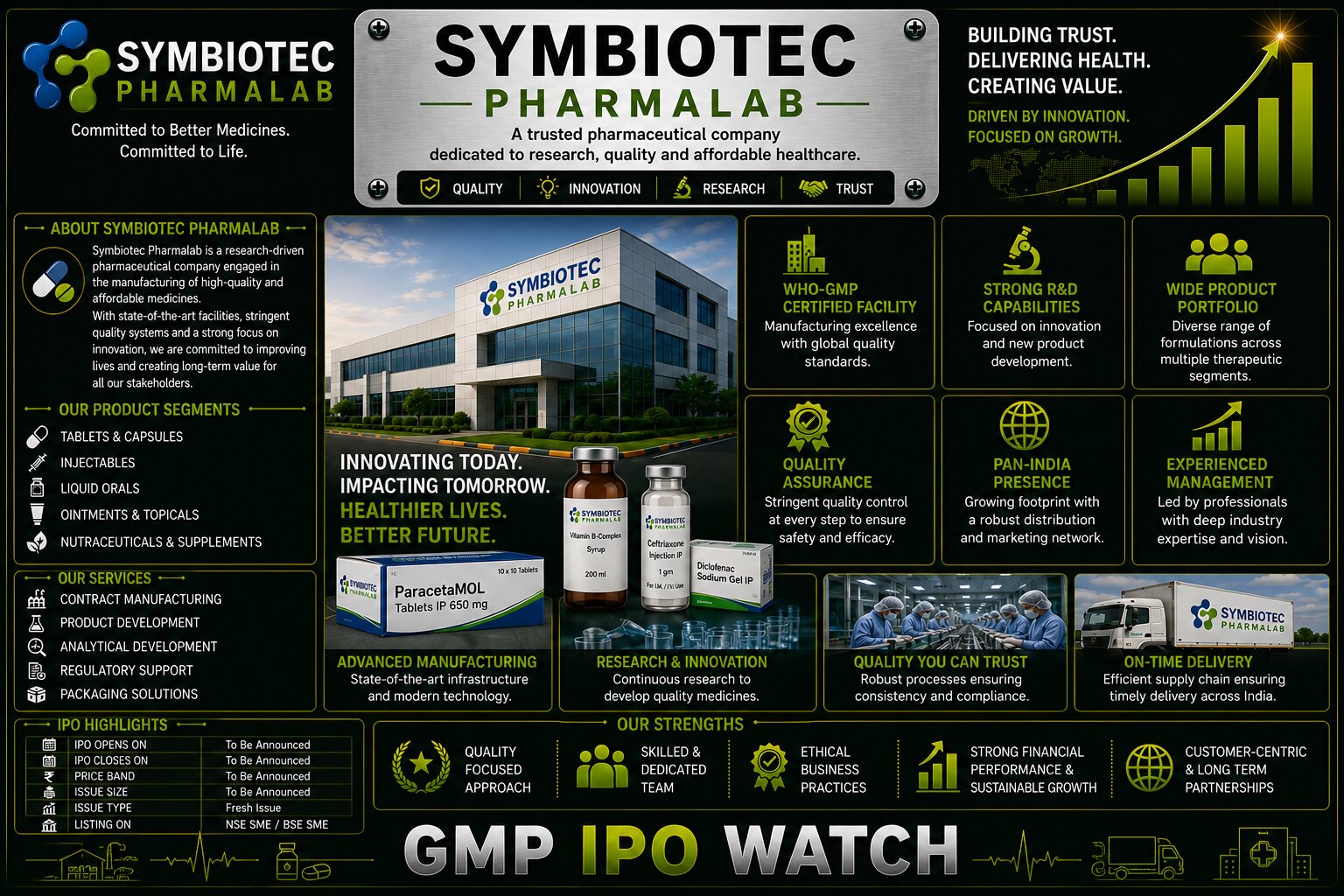
Symbiotec Pharmalab IPO 2026 – Day 3 Update
Symbiotec Pharmalab Limited's mainboard IPO is currently open for subscription after bidding started on August 24, 2026.
The issue closes on August 27, followed by allotment on August 28 and expected listing on BSE and NSE on September 1. The company has fixed a price band of ₹938 to ₹988 per share.
Symbiotec Pharmalab IPO Details
| Particular | Details |
|---|---|
| IPO Type | Mainboard IPO |
| Issue Size | ₹1,757 Crore |
| Fresh Issue | ₹150 Crore |
| Offer for Sale | ₹1,607 Crore |
| Total Shares | ~1.78 Crore |
| Price Band | ₹938 – ₹988 |
| Face Value | ₹2 |
| Lot Size | 15 Shares |
| Minimum Investment | ₹14,820 |
| IPO Open Date | August 24, 2026 |
| IPO Close Date | August 27, 2026 |
| Allotment Date | August 28, 2026 |
| Listing Date | September 1, 2026 |
| Listing | BSE & NSE |
The IPO is heavily weighted toward the Offer for Sale. Approximately ₹1,607 crore, or 91% of the issue, is OFS, while ₹150 crore represents fresh capital for the company.
What Does Symbiotec Pharmalab Do?
Symbiotec Pharmalab operates in the pharmaceutical manufacturing industry and specialises in the development and manufacturing of active pharmaceutical ingredients (APIs), nutritional ingredients and specialty products.
Its business sits behind finished pharmaceutical products rather than primarily selling medicines directly to consumers.
The operating chain can broadly be understood as:
pharmaceutical ingredients → API manufacturing → pharmaceutical customers → finished medicines.
This gives Symbiotec exposure to global pharmaceutical manufacturing demand.
International Markets Drive the Business
Exports are an important part of Symbiotec's operations.
More than two-thirds of its revenue comes from international markets, with Europe alone contributing close to 30% of revenue.
| Market Exposure | Approx. Contribution |
|---|---|
| International Markets | Over 66% |
| Europe | ~30% |
| India & Other Markets | Balance |
This international presence provides access to a much larger pharmaceutical market than India alone.
At the same time, high export exposure creates additional risks involving currency movements, regulatory approvals and changing conditions in overseas markets.
Product Leadership Is an Important Strength
Symbiotec has developed specialised capabilities in certain pharmaceutical ingredients and holds leading positions in some of its products.
Specialised API manufacturing can create meaningful barriers because pharmaceutical customers generally require:
consistent quality + regulatory compliance + manufacturing reliability + documentation + supply continuity.
Once a manufacturer becomes an approved supplier, these requirements can support longer-term customer relationships.
Product Concentration Needs Attention
One of the more important risks in Symbiotec's business is product concentration.
The company's top five products account for approximately 63% of revenue.
| Business Indicator | Position |
|---|---|
| Top 5 Products' Revenue Share | ~63% |
| Overseas Revenue Share | Over 66% |
| Europe Revenue Share | ~30% |
This means changes in demand, pricing or competition for a small group of important products could have a noticeable effect on financial performance.
Future diversification of the product portfolio could therefore reduce business concentration.
IPO Structure Is Dominated by OFS
Unlike several recent IPOs where most of the capital goes directly to the company, Symbiotec's IPO consists primarily of an Offer for Sale.
| IPO Component | Amount | Approx. Share |
|---|---|---|
| Fresh Issue | ₹150 Cr | ~9% |
| Offer for Sale | ₹1,607 Cr | ~91% |
| Total Issue | ₹1,757 Cr | 100% |
This distinction matters.
Money raised through the fresh issue goes to Symbiotec, while the ₹1,607 crore OFS proceeds go to the selling shareholders.
Therefore, investors should not treat the entire ₹1,757 crore IPO as new capital entering the business.
₹112.50 Crore Planned for Debt Repayment
Debt reduction is the principal identified use of the fresh issue proceeds.
Symbiotec plans to deploy approximately ₹112.50 crore toward repayment or prepayment of certain outstanding borrowings.
Use of Fresh Issue Proceeds
| Purpose | Amount |
|---|---|
| Debt Repayment / Prepayment | ₹112.50 Cr |
| General Corporate Purposes | Balance |
| Fresh Issue | ₹150.00 Cr |
This means around three-fourths of the ₹150 crore fresh issue is specifically directed toward reducing borrowings.
The potential benefit is straightforward:
lower debt → lower finance costs → stronger cash flows → improved balance sheet.
Anchor Investors Put in ₹526.20 Crore
Before the public issue opened, Symbiotec Pharmalab raised approximately ₹526.20 crore from anchor investors.
The anchor book included institutional investors such as Citi Group and Singularity.
| Anchor Particular | Details |
|---|---|
| Anchor Amount | ₹526.20 Cr |
| Public Issue Opening | August 24 |
| Total IPO | ₹1,757 Cr |
| Notable Investors | Citi Group, Singularity |
Anchor participation adds institutional visibility to the IPO, although it does not guarantee post-listing performance.
Subscription Reached 1.85x on Day 2
The IPO received a healthy response during its first two days.
By the reported Day 2 update, Symbiotec Pharmalab IPO had been subscribed approximately 1.85 times, against around 1.31 crore shares available for subscription.
| Subscription Indicator | Latest Confirmed Update |
|---|---|
| IPO Stage | Day 3 |
| Day 2 Subscription | 1.85x |
| IPO Closing | August 27 |
| Status | Open |
Since bidding is continuing, the final subscription can be substantially different from the Day 2 figure.
Symbiotec Pharmalab IPO GMP
Grey-market sentiment around the IPO has remained positive, although the premium has moved since opening.
On the first day, reports indicated a GMP suggesting around 41% upside. By the Day 2 update, the indicated premium had moderated to around 34%.
| GMP Indicator | Trend |
|---|---|
| Upper Issue Price | ₹988 |
| Opening-Day Indication | ~41% |
| Latest Day 2 Indication | ~34% |
| GMP Sentiment | Positive |
The change from roughly 41% to 34% also shows why GMP should be treated cautiously.
It is an unofficial market indicator and can change sharply before listing.
Pharmaceutical APIs Can Create Repeat Business
API manufacturing differs from many ordinary manufacturing industries because customers need to maintain strict quality and regulatory standards.
Changing a critical API supplier can require:
quality assessment + documentation + testing + regulatory processes + supply-chain validation.
This can make established pharmaceutical relationships relatively sticky.
For Symbiotec, maintaining regulatory compliance and product quality can therefore be as important as expanding manufacturing volumes.
Export Business Creates a Large Opportunity
More than two-thirds of Symbiotec's revenue comes from outside India.
That gives the company exposure to pharmaceutical demand across multiple international markets.
The opportunity is:
specialised products + regulatory capabilities + global customers → higher export volumes → potential earnings growth.
However, global pharmaceutical customers can also exert significant pricing pressure.
Maintaining margins while remaining competitive will therefore remain important.
Europe Is an Important Market
Europe contributes nearly 30% of company revenue, making it a particularly important geography.
This provides access to a large pharmaceutical market but also creates geographic concentration.
Changes involving European pharmaceutical demand, regulation, customer sourcing strategies or currency movements could therefore affect Symbiotec.
A more geographically diversified export base would reduce dependence on any single region.
Regulatory Compliance Is Critical
Pharmaceutical manufacturing operates under strict regulatory requirements.
API manufacturers need to maintain standards involving:
manufacturing practices + product quality + documentation + testing + plant compliance + customer audits.
Any significant regulatory observation or disruption can potentially affect manufacturing and customer relationships.
For Symbiotec, regulatory track record and successful facility inspections will therefore remain important after listing.
Currency Movements Can Affect Earnings
Because international markets contribute the majority of revenue, foreign-exchange movements can influence financial performance.
A weaker rupee can sometimes benefit export realisations, while an appreciating rupee can have the opposite effect.
However, the actual impact also depends on:
imported raw materials + hedging + customer contracts + currency mix.
Investors should therefore monitor foreign-exchange gains or losses alongside operating margins.
Promoters Will Retain Control After IPO
The promoter group's holding is expected to decline from approximately 36.4% before the IPO to 33.3% after the issue.
| Shareholding | Approx. Stake |
|---|---|
| Promoter Holding Pre-IPO | 36.4% |
| Promoter Holding Post-IPO | 33.3% |
The reduction reflects dilution and shares being offered through the public issue.
IPO Valuation Is an Important Consideration
At the upper price band of ₹988, investors need to compare Symbiotec's valuation with listed pharmaceutical and API manufacturers.
Current analysis has described the company's valuation as relatively attractive compared with certain peers, particularly when considered alongside its market leadership in some products.
However, valuation should be assessed together with concentration risks.
A lower multiple alone does not remove risks arising from:
product concentration + export dependence + regulatory requirements + customer concentration.
Key Strengths of Symbiotec Pharmalab
Symbiotec's established position in specialised pharmaceutical ingredients is one of its main strengths.
The company benefits from international exposure, specialised manufacturing capabilities and leadership positions in certain products. More than two-thirds of its revenue is generated internationally, giving it access to global pharmaceutical demand.
Debt reduction is another potential post-IPO benefit, with ₹112.50 crore of fresh proceeds earmarked for repayment or prepayment of borrowings.
Major Risks
The company's product and geographic concentration deserve attention. Its top five products generate around 63% of revenue, while international markets contribute more than two-thirds and Europe alone contributes roughly 30%.
Other important risks include:
- Pharmaceutical regulatory compliance
- Product concentration
- Customer concentration
- Export-market dependence
- Foreign-exchange movements
- Raw-material price volatility
- Pricing pressure
- Manufacturing disruptions
- Competition from global API manufacturers
- Dependence on successful regulatory inspections
The IPO structure is also heavily OFS-oriented, with only ₹150 crore of the ₹1,757 crore issue going directly to the company.
What Investors Should Track After Listing
| Metric | Why It Matters |
|---|---|
| Revenue Growth | Overall business expansion |
| Export Revenue | International demand |
| Europe Revenue Share | Geographic concentration |
| Top 5 Product Share | Product concentration |
| EBITDA Margin | Operating efficiency |
| PAT Margin | Profitability |
| New Product Launches | Diversification |
| Customer Additions | Revenue diversification |
| Borrowings | IPO debt reduction |
| Finance Cost | Deleveraging benefit |
| Operating Cash Flow | Earnings quality |
| Regulatory Approvals | Business continuity |
For Symbiotec, product diversification, export growth and maintaining pharmaceutical compliance will be particularly important after listing.
Final View on Symbiotec Pharmalab IPO
The Symbiotec Pharmalab IPO is currently open and closes on August 27, 2026. The ₹1,757 crore mainboard IPO carries a price band of ₹938–₹988 and a lot size of 15 shares, with listing scheduled for September 1.
The issue has received healthy early demand, reaching 1.85x subscription by the reported Day 2 update, while the latest reported GMP indicated approximately 34% potential upside.
The IPO structure, however, deserves attention. Of the ₹1,757 crore issue, only ₹150 crore is fresh equity while ₹1,607 crore is OFS. The company plans to use ₹112.50 crore of the fresh proceeds for debt repayment.
Loading comments...