

Shiprocket IPO 2026 – The Next Stage Is About Earning More From Every Merchant
Shiprocket has already proved that thousands of Indian businesses need help managing online commerce.
The next question is harder.
Can Shiprocket turn that scale into sustainable consolidated profitability?
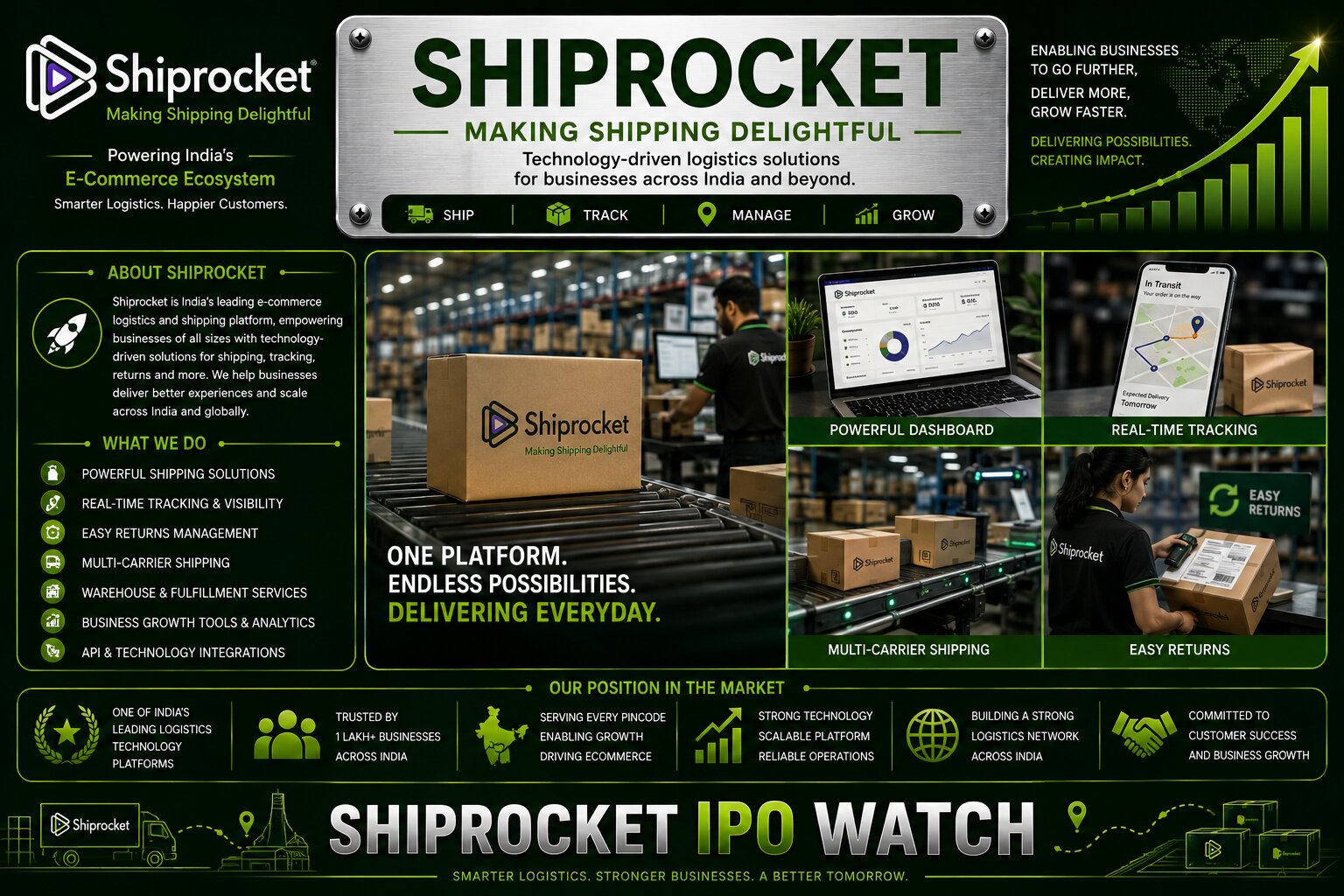
The Gurugram-based company operates an end-to-end e-commerce enablement platform covering shipping, fulfilment, checkout, payments and cross-border commerce. Its platform primarily serves MSMEs, D2C brands and larger retailers that need technology and logistics infrastructure without building everything internally.
The company's ₹1,617.48 crore IPO is currently on its final bidding day. The offer opened on August 12 and closes today, August 14, with shares priced between ₹92 and ₹97. At the upper band, the minimum retail application of 154 shares requires approximately ₹14,938.
But the key long-term investment question is not how many times the IPO gets subscribed.
It is:
Can Shiprocket increase merchant monetisation while bringing its emerging businesses toward profitability?
That is the central investment theme.
Shiprocket IPO Details
| Particular | Details |
|---|---|
| Company | Shiprocket Limited |
| IPO Type | Mainboard Book Built IPO |
| Total Issue Size | ₹1,617.48 Crore |
| Fresh Issue | ₹885.50 Crore |
| Offer for Sale | ₹731.98 Crore |
| Price Band | ₹92 – ₹97 Per Share |
| Face Value | ₹10 Per Share |
| Lot Size | 154 Shares |
| Minimum Retail Investment | ₹14,938 |
| IPO Opening Date | August 12, 2026 |
| IPO Closing Date | August 14, 2026 |
| Expected Allotment | August 17, 2026 |
| Expected Listing | August 19, 2026 |
| Listing | BSE & NSE |
| Registrar | KFin Technologies Limited |
| Lead Managers | Axis Capital, BofA Securities India, JM Financial and Kotak Mahindra Capital |
These are the current final issue terms.
The IPO Is Almost Evenly Split Between Fresh Capital and OFS
The issue contains approximately:
₹885.50 crore fresh issue
and
₹731.98 crore Offer for Sale.
That means roughly 55% of the issue is new capital entering Shiprocket, while the remaining portion provides liquidity to existing shareholders.
Selling shareholders include institutional investors and existing individual shareholders.
For investors, this means the IPO serves two purposes:
growth capital + shareholder monetisation.
What Does Shiprocket Actually Do?
Shiprocket describes itself as a technology-led e-commerce enablement platform.
Its platform covers areas including:
- Shipping
- Logistics
- Fulfilment
- Checkout
- Payments
- Cross-border commerce
- Merchant-facing technology services.
The company does not need to become the courier delivering every parcel itself.
Instead, it acts as a technology layer connecting merchants with commerce and logistics infrastructure.
That can make the model more scalable than building a fully owned national logistics network from scratch.
Shiprocket's Most Important Asset Is Its Merchant Network
A platform company becomes more valuable when customers keep using more of its services.
Suppose a D2C brand first uses Shiprocket only for domestic shipping.
Later it adds:
- Fulfilment
- Checkout
- International shipping
- Payment solutions
Shiprocket's revenue from that merchant increases without requiring the company to acquire an entirely new customer.
This is why revenue per active merchant could eventually become one of the most useful metrics for evaluating the company.
Usage-Based Revenue Can Grow Naturally With Customers
Shiprocket's revenue is primarily based on a usage-driven model, according to current IPO disclosures.
That creates an attractive dynamic.
If an existing merchant grows from:
1,000 monthly orders
to:
10,000 monthly orders,
Shiprocket can generate substantially more revenue even if the number of merchants stays unchanged.
The company's growth therefore depends on both:
adding merchants + helping existing merchants process more commerce.
International Commerce Is Becoming More Important
During FY2026, Shiprocket supported merchants across 146 countries through five international shipping corridors, according to Groww's RHP-based IPO summary.
Cross-border commerce can become a meaningful growth engine because Indian sellers increasingly want access to customers beyond India.
International selling creates complications involving:
- Shipping
- Customs
- Documentation
- Tracking
- Delivery
A platform simplifying these steps can create significant value for smaller brands.
Cross-Border Revenue Can Improve Customer Lifetime Value
Suppose a merchant already uses Shiprocket domestically.
If that merchant starts exporting, Shiprocket can potentially capture additional revenue without acquiring the customer again.
This creates a stronger merchant lifetime value.
The ideal growth model is:
domestic merchant → larger domestic volume → fulfilment → cross-border commerce → higher revenue per merchant.
FY2026 Revenue Reached ₹2,024.14 Crore
Shiprocket reported FY2026 revenue from operations of approximately ₹2,024.14 crore, compared with ₹1,632.01 crore in FY2025 and ₹1,315.98 crore in FY2024.
That means revenue grew roughly 24% year-on-year in FY2026. Moneycontrol also reports the same ₹2,024.1 crore FY2026 revenue figure.
The business has therefore achieved substantial scale.
The problem is that scale has not yet translated into consolidated net profit.
Shiprocket Remains Loss Making
Shiprocket reported a net loss of approximately:
₹79.25 crore in FY2026
compared with:
₹74.45 crore in FY2025
and:
₹595.18 crore in FY2024.
The huge reduction from FY2024 is encouraging.
However, the loss increased slightly from FY2025 to FY2026.
That means investors should avoid describing Shiprocket as already profitable at the consolidated level.
It is not.
EBITDA Is Close to Breakeven
Current RHP-based financial data shows Shiprocket's EBITDA at approximately:
- ₹(495.89) crore in FY2024
- ₹(17.16) crore in FY2025
- ₹(16.56) crore in FY2026.
This represents a dramatic improvement compared with FY2024.
The company is much closer to operating breakeven than it was two years ago.
But the move from a ₹17 crore EBITDA loss to sustainable positive EBITDA has not yet been demonstrated.
Why Revenue Scale Matters Now
At ₹2,024 crore revenue, Shiprocket no longer needs proof that customers want its platform.
The company now needs proof that:
economies of scale can overcome platform investment costs.
A high-growth startup can tolerate losses when revenue is still small.
At Shiprocket's scale, public-market investors will increasingly expect:
- Positive EBITDA
- Positive operating cash flow
- Lower consolidated losses
- Eventually PAT
The valuation will likely become more sensitive to progress on these metrics after listing.
Platform Economics Can Improve Without Matching Revenue Growth With Assets
Shiprocket's technology-led model is one of its major attractions.
A physical logistics operator wanting to double revenue may need substantially more:
- Vehicles
- Warehouses
- Employees
A platform can potentially increase transactions through software and partner networks with lower incremental asset requirements.
That creates the possibility of operating leverage.
However, Shiprocket still invests heavily in:
- Technology
- Marketing
- Merchant acquisition
- New products
So asset-light does not automatically mean expense-light.
Marketing Efficiency Will Matter After the IPO
Shiprocket plans to use fresh capital to support marketing and technology growth across its businesses. Moneycontrol states that about ₹365.6 crore from net fresh proceeds is earmarked for platform growth through marketing initiatives and technology infrastructure/capabilities.
The crucial question is what that spending produces.
Investors should not simply ask:
How much did Shiprocket spend on marketing?
They should ask:
How many profitable, active merchants did that spending create?
Customer Acquisition Cost Needs to Produce Long-Term Value
Imagine Shiprocket spends ₹1,000 to acquire a merchant.
If the merchant generates only ₹500 of gross profit before leaving, the acquisition destroyed value.
If the merchant generates ₹10,000 of gross profit over several years, the economics are excellent.
This is why long-term merchant retention matters more than app downloads or merchant registrations.
Technology Spending Can Expand Monetisation
Investment in technology can support:
- Checkout
- International commerce
- Payments
- Fulfilment
- Merchant analytics
- Platform reliability
Each new product gives Shiprocket another opportunity to earn money from merchants already inside its ecosystem.
That is potentially much more efficient than relying only on shipping volume.
Debt Repayment Is Another Major IPO Objective
Shiprocket plans to use approximately ₹210 crore toward repayment or prepayment of borrowings. As of July 10, 2026, the company had total borrowings of approximately ₹244.5 crore.
This means the planned repayment could remove most of the company's stated borrowings.
That can help improve:
- Finance costs
- Cash flow
- Balance-sheet flexibility
A lower-debt balance sheet is particularly useful while the business is still working toward consolidated profitability.
Lower Interest Cost Can Help the Path to PAT
Shiprocket's next stage does not require only revenue growth.
It also needs fewer costs between revenue and bottom-line profit.
Debt reduction helps remove one of those costs.
The ideal post-IPO progression is:
revenue growth + improving EBITDA + lower finance expense = narrowing net loss and eventually PAT.
Acquisitions Remain Part of the Strategy
The company also plans to retain fresh proceeds for unidentified acquisitions, alongside general corporate purposes.
Shiprocket has historically expanded its platform beyond simple shipping.
Future acquisitions could potentially add:
- Technology
- Merchant tools
- Logistics capabilities
- Cross-border services
But acquisitions also create integration and valuation risk.
Investors should evaluate whether any future deal improves merchant economics rather than simply increasing headline revenue.
Anchor Demand Was Strong
Shiprocket raised approximately ₹727.41 crore from 50 anchor investors on August 11, allotting about 7.5 crore shares at ₹97 each.
Anchor investors included names such as Nomura, Ashoka WhiteOak, Goldman Sachs and Societe Generale. Domestic mutual funds also represented a large portion of the allocation, with 13 mutual funds participating through 31 schemes.
This shows strong institutional interest before public bidding began.
However, anchor demand does not guarantee listing gains or long-term returns.
Mutual Fund Participation Was Significant
Moneycontrol reports that approximately 5 crore anchor shares were allotted to 13 domestic mutual funds through 31 schemes.
Participants included funds managed by:
- SBI Mutual Fund
- HDFC AMC
- Nippon Life India
- Kotak Mahindra AMC
- UTI AMC
- Mirae Asset
- Edelweiss
- PGIM India
- Bandhan Mutual Fund.
Institutional participation is encouraging, but retail investors should still independently assess the company's valuation and profitability path.
Final-Day Subscription Has Accelerated
At 10:40 AM on August 14, Groww reported:
| Category | Subscription |
|---|---|
| QIB | 0.04× |
| NII | 13.68× |
| Retail | 14.96× |
| Employees | 17.96× |
| Overall | 6.56× |
Earlier NSE-linked data published by Moneycontrol showed the IPO already above 4× with retail at 11.31× and NII at 7.91×, confirming rapid final-day bidding.
Because bidding remains open today, the final numbers may be significantly higher.
QIB Demand Is Still the Key Category to Watch
At 10:40 AM, QIB subscription was only around 0.04×.
That appears weak compared with retail and NII demand.
However, institutional investors frequently submit large orders later in the final bidding session.
The final closing QIB number will therefore be much more meaningful than the morning figure.
Retail Demand Is Already Strong
Retail subscription was around 14.96× by 10:40 AM.
This indicates substantial retail interest.
If final demand remains at similar or higher levels, allotment probability in the retail category will be relatively low.
NII Demand Has Also Accelerated
NII subscription reached around 13.68× by 10:40 AM.
NII bidding can be influenced by:
- GMP
- Listing expectations
- Funding availability
Therefore, strong NII demand is a useful sentiment indicator but should not be interpreted as proof of long-term business quality.
Shiprocket IPO GMP Today
Moneycontrol reports the Shiprocket GMP at approximately 37.63% on August 14.
Against the ₹97 upper price band, that suggests an unofficial implied price of around:
₹133–₹134 per share.
This is significantly higher than the issue price.
However, GMP is unofficial, unregulated and does not guarantee the actual listing price or future performance.
GMP Has Strengthened During the IPO
Moneycontrol reported GMP around 35% on August 13, while the latest August 14 figure is approximately 37.6%.
That suggests short-term listing sentiment has strengthened.
But the business fundamentals have not changed overnight.
Investors should avoid confusing market excitement with structural profitability.
The ₹7,057.5 Crore Valuation Requires Growth Execution
At the ₹97 upper band, Shiprocket is seeking a market capitalisation of approximately ₹7,057.5 crore.
Against FY2026 revenue of ₹2,024.1 crore, this implies a market-cap-to-sales ratio of roughly 3.5×.
Because the company is loss making, P/E is not a useful valuation metric today.
Investors are effectively paying for future expectations around:
- Growth
- EBITDA breakeven
- Cash generation
- Merchant monetisation
- Emerging-business profitability
Revenue Growth Alone Will Not Be Enough
Suppose Shiprocket reaches:
₹3,000 crore revenue
but continues reporting losses.
The business becomes larger but not necessarily more valuable economically.
The stronger outcome is:
₹3,000 crore revenue + positive EBITDA + positive operating cash flow + narrowing PAT loss.
After listing, public investors will likely demand this second type of growth.
Competition Remains Intense
Shiprocket operates across several competitive categories.
It competes indirectly or directly with:
- Courier aggregators
- Logistics companies
- Fulfilment providers
- Checkout platforms
- Cross-border commerce providers
- Other merchant software platforms
No single competitor needs to replicate the whole Shiprocket platform to create pressure.
A specialised competitor can attack one high-value part of the ecosystem.
Shiprocket's defence is therefore its breadth and merchant integration.
The Ecosystem Can Become the Real Moat
A merchant using only one Shiprocket service can switch more easily.
A merchant using:
shipping + checkout + fulfilment + cross-border commerce
is more deeply integrated.
This can increase switching costs and merchant retention.
For that reason, one of the most valuable future disclosures would be:
average number of Shiprocket products used per active merchant.
Merchant Revenue Growth Could Be More Important Than Merchant Count
Suppose active merchants increase by only 10%.
But revenue per merchant increases 25%.
That can still produce very attractive growth.
The opposite scenario is less appealing:
merchant count grows rapidly, but each merchant generates little revenue.
This is why Shiprocket's long-term success should be measured through merchant quality and monetisation, not just platform registrations.
Competitive Strengths
Shiprocket enters the IPO with several important strengths.
- FY2026 revenue above ₹2,024 crore.
- Revenue has grown consistently from ₹1,315.98 crore in FY2024.
- The FY2024 EBITDA loss has narrowed dramatically.
- End-to-end commerce capabilities span logistics, checkout, fulfilment and cross-border operations.
- The company supported international merchant activity across 146 countries in FY2026.
- Anchor demand exceeded ₹727 crore.
- ₹210 crore debt repayment can strengthen the balance sheet.
- Final-day retail and NII demand is strong.
Major Risks
Shiprocket Is Still Loss Making
FY2026 PAT was approximately ₹(79.25) crore.
FY2026 Loss Increased Slightly
The FY2025 loss was approximately ₹74.45 crore, so FY2026 did not show year-on-year PAT improvement despite higher revenue.
Emerging Business Investment
Newer platform categories can require continued spending before reaching profitability.
Marketing Efficiency
Large IPO-funded marketing investment needs to produce high-quality merchant growth.
Competition
Shiprocket competes across multiple fast-moving commerce categories.
OFS Component
Approximately ₹731.98 crore of the issue goes to selling shareholders rather than directly to Shiprocket.
Valuation
The company is seeking roughly ₹7,057.5 crore market capitalisation despite remaining loss making.
What Could Drive Shiprocket's Next Growth Phase?
Several areas can support future growth.
Higher merchant volumes: Existing sellers processing more orders.
Cross-selling: More services used by each merchant.
Cross-border commerce: Indian brands expanding globally.
Checkout and payments: Increasing monetisation earlier in the purchase journey.
Fulfilment: Deepening operational relationships with merchants.
Technology investment: Improving platform capabilities.
Debt reduction: Lowering finance costs.
Acquisitions: Adding new commerce capabilities.
What Investors Should Track After Listing
Revenue Per Active Merchant
Is monetisation improving?
Merchant Retention
Are businesses staying with Shiprocket?
EBITDA
When does the company move from approximately ₹16.6 crore negative EBITDA to sustained positive EBITDA?
PAT
Is the ₹79 crore FY2026 loss narrowing?
Operating Cash Flow
Can business scale translate into consistent cash generation?
Marketing Efficiency
Does the ₹365.6 crore platform-growth allocation produce profitable merchants?
Debt
Does the ₹210 crore repayment materially improve finance costs?
Cross-Border Revenue
Does international commerce become a larger contributor?
The Most Important Post-IPO Equation
Shiprocket's ideal next phase looks like:
more active merchants → more transactions per merchant → more products per merchant → higher revenue → positive EBITDA → positive PAT.
The weaker outcome would be:
more merchants → higher marketing spend → higher emerging-business costs → continued consolidated losses.
Both paths can produce revenue growth.
Only the first creates durable shareholder value.
Should Investors Consider Shiprocket IPO?
The positive investment case includes:
- Large ₹2,024 crore revenue base
- Strong e-commerce ecosystem positioning
- End-to-end merchant platform
- Strong anchor participation
- Rapid final-day retail and NII demand
- Positive GMP
- Significant fresh issue for technology and growth
- Large debt-repayment allocation
The caution points include:
- Continued consolidated losses
- Slightly higher FY2026 loss than FY2025
- Competitive market
- Need for significant marketing investment
- Large OFS component
- Valuation based heavily on future profitability
Shiprocket should therefore be evaluated as a high-growth e-commerce infrastructure platform that is approaching operating breakeven but has not yet demonstrated sustained consolidated profitability.
Final View on Shiprocket IPO 2026
The Shiprocket IPO 2026 closes today, August 14, with investor demand strengthening quickly during the final bidding session.
At 10:40 AM, the issue was subscribed approximately 6.56× overall, including 14.96× retail, 13.68× NII, 17.96× employee and 0.04× QIB demand.
The current reported GMP is around 37.6%, indicating strong unofficial listing expectations versus the ₹97 upper band.
The business itself has reached substantial scale.
FY2026 revenue from operations increased to approximately ₹2,024.14 crore, compared with ₹1,632.01 crore in FY2025 and ₹1,315.98 crore in FY2024.
But profitability remains the key unresolved issue.
Shiprocket reported a net loss of about ₹79.25 crore in FY2026, slightly worse than the ₹74.45 crore FY2025 loss, although dramatically better than the ₹595.18 crore loss reported in FY2024. EBITDA has also improved sharply but remained negative at approximately ₹16.56 crore in FY2026.
The IPO provides meaningful fresh capital to accelerate the transition.
Shiprocket plans to deploy approximately ₹365.6 crore toward marketing and technology-related platform growth and ₹210 crore toward debt repayment, while retaining additional capital for acquisitions and general corporate purposes.
The investment thesis can therefore be summarised as:
large merchant ecosystem + rising transaction volumes + broader commerce products + lower debt + improving operating leverage = potential path to profitability.
The biggest risk is that growth continues to require enough marketing and emerging-business spending to keep consolidated earnings negative.
For long-term investors, the most important post-listing numbers will therefore be:
active merchants, revenue per merchant, EBITDA, PAT, operating cash flow, marketing efficiency and cross-border revenue.
Loading comments...